
UNITED STATES
SECURITIES AND EXCHANGE COMMISSION
Washington, D.C. 20549
___________________________________
FORM 10-K
___________________________________
(Mark One)
| ANNUAL REPORT PURSUANT TO SECTION 13 OR 15(d) OF THE SECURITIES EXCHANGE ACT OF 1934 | |||||
For the fiscal year ended December 31 , 2025
OR
| TRANSITION REPORT PURSUANT TO SECTION 13 OR 15(d) OF THE SECURITIES EXCHANGE ACT OF 1934 | |||||
For the transition period from to
Commission file number 001-42365
___________________________________
___________________________________
(Exact name of registrant as specified in its charter)
| (State or other jurisdiction of incorporation or organization) | (I.R.S. Employer Identification No.) | |||||||
| (Address of Principal Executive Offices) | (Zip Code) | |||||||
(617 ) 651-8867
Registrant’s telephone number, including area code
Securities registered pursuant to Section 12(b) of the Act:
| Title of each class | Trading Symbol(s) | Name of each exchange on which registered | ||||||
Securities registered pursuant to section 12(g) of the Act:
None
Indicate by check mark if the registrant is a well-known seasoned issuer, as defined in Rule 405 of the Securities Act.
Yes o No x
Indicate by check mark if the registrant is not required to file reports pursuant to Section 13 or Section 15(d) of the Act.
Yes o No x
Indicate by check mark whether the registrant (1) has filed all reports required to be filed by Section 13 or 15(d) of the Securities Exchange Act of 1934 during the preceding 12 months (or for such shorter period that the registrant was required to file such reports), and (2) has been subject to such filing requirements for the past 90 days.
Indicate by check mark whether the registrant has submitted electronically every Interactive Data File required to be submitted pursuant to Rule 405 of Regulation S-T (§ 232.405 of this chapter) during the preceding 12 months (or for such shorter period that the registrant was required to submit such files).
Indicate by check mark whether the registrant is a large accelerated filer, an accelerated filer, a non-accelerated filer, a smaller reporting company, or an emerging growth company. See the definitions of “large accelerated filer,” “accelerated filer,” “smaller reporting company,” and “emerging growth company” in Rule 12b-2 of the Exchange Act.
| Large accelerated filer | o | Accelerated filer | o | |||||||||||
x | Smaller reporting company | |||||||||||||
| Emerging growth company | ||||||||||||||
If an emerging growth company, indicate by check mark if the registrant has elected not to use the extended transition period for complying with any new or revised financial accounting standards provided pursuant to Section 13(a) of the Exchange Act.
Indicate by check mark whether the registrant has filed a report on and attestation to its management’s assessment of the effectiveness of its internal control over financial reporting under Section 404(b) of the Sarbanes-Oxley Act (15 U.S.C. 7262(b)) by the registered public accounting firm that prepared or issued its audit report.
If securities are registered pursuant to Section 12(b) of the Act, indicate by check mark whether the financial statements of the registrant included in the filing reflect the correction of an error to previously issued financial statements.
Indicate by check mark whether any of those error corrections are restatements that required a recovery analysis of incentive-based compensation received by any of the registrant’s executive officers during the relevant recovery period pursuant to §240.10D-1(b).
o
Indicate by check mark whether the registrant is a shell company (as defined in Rule 12b-2 of the Act).
Yes o No x
As of June 30, 2025, the last business day of the registrant’s most recently completed second fiscal quarter, the aggregate market value of the common stock held by non-affiliates of the registrant was approximately $14.6 million, based on the closing price of the registrant’s common stock on June 30, 2025.
As of March 4, 2026, there were 51,919,321 shares of the registrant’s common stock, par value $0.0001 per share, outstanding.
DOCUMENTS INCORPORATED BY REFERENCE
TABLE OF CONTENTS
| Page | |||||
SPECIAL NOTE REGARDING FORWARD-LOOKING STATEMENTS AND MARKET AND INDUSTRY DATA
This Annual Report on Form 10-K (“Annual Report”) contains forward-looking statements that involve substantial risks and uncertainties because they relate to events and depend on circumstances that may or may not occur in the future. All statements other than statements of historical fact contained in this Annual Report, including statements regarding our strategy, future operations, future financial position, prospects, plans, objectives of management and expected growth, are forward-looking statements. These statements are based on our current beliefs, expectations and assumptions regarding our intentions, beliefs or current expectations concerning, among other things, the future of our business, future plans and strategies, our operational results and other future conditions. Forward-looking statements involve known and unknown risks, uncertainties and other important factors that may cause our actual results, performance or achievements to be materially different from any future results, performance or achievements expressed or implied by the forward-looking statements.
In some cases, you can identify forward-looking statements by terms such as “may,” “will,” “should,” “expect,” “plan,” “anticipate,” “could,” “intend,” “target,” “project,” “estimate,” “believe,” “predict,” “potential” or “continue” or the negative of these terms or other similar expressions intended to identify statements about the future, although not all forward-looking statements contain these identifying words. These forward-looking statements include, without limitation, statements about the following:
•the initiation, timing, progress, results and costs of our research and development (“R&D”) programs and of our current and future preclinical studies and clinical trials of our product candidates, including statements regarding the timing of initiation and completion of studies or trials and related preparatory work, as well as the period during which the results of the trials are expected become available;
•the timing of our planned regulatory submissions, initiation of planned clinical trials and timing of expected clinical results for our current and future product candidates;
•the timing of any submissions of filings for regulatory approval of, and our ability to obtain and maintain regulatory approvals for, any of our product candidates;
•our ability to identify patients with the diseases treated by our product candidates, and to enroll patients in trials;
•our expectations regarding the size of the patient populations, market acceptance and opportunity for and clinical utility of our product candidates, if approved for commercial use;
•our reliance on third party manufacturing partners to comply with significant regulations with respect to manufacturing our products;
•our expectations regarding the scope of any approved indication for any product candidate;
•our ability to successfully commercialize our product candidates, if approved;
•our ability to leverage our RAP Platform to identify and develop future product candidates;
•our estimates of our expenses, ongoing losses, future revenue, capital requirements, and our need for or ability to obtain additional funding before we can expect to generate any revenue from product sales;
•our ability to establish or maintain strategic collaborations or arrangements, including potential business development opportunities and potential licensing partnerships, and our ability to attract collaborators with development, regulatory and commercialization expertise;
•our ability to identify, recruit and retain key personnel;
•our reliance upon intellectual property licensed from third parties and our ability to obtain such licenses on commercially reasonable terms or at all;
•our ability to protect and enforce our intellectual property position for our product candidates, and the scope of such protection;
•our financial performance;
•the sufficiency of our existing cash and cash equivalents to fund our future operating expenses and capital expenditure requirements;
3
•our competitive position and the development of and projections relating to our competitors or our industry;
•our estimates regarding future expenses and needs for additional financing;
•the impact of laws and regulations;
•the effect of changes in international trade policies and general economic, industry, geopolitical and market conditions, such as uncertainties related to military conflict or war, tariffs (including tariffs that have been or may in the future be imposed by the United States or other countries), sanctions, trade protection measures or other trade barriers, inflation and financial institution instability or pandemic or epidemic disease outbreaks, many of which are beyond our control, as well as the value of our common stock and our ability to access capital markets; and
•our expectations regarding the time during which we will be an emerging growth company and smaller reporting company under the Jumpstart Our Business Startups Act of 2012 (the “JOBS Act”).
Although we base these forward-looking statements on assumptions that we believe are reasonable when made, we caution you that forward-looking statements are not guarantees of future performance and that our actual results of operations, financial condition and liquidity, and the development of the industry in which we operate may differ materially from those made in or suggested by the forward-looking statements contained in this Annual Report. In addition, even if our results of operations, financial condition and liquidity, and the development of the industry in which we operate are consistent with the forward-looking statements contained in this Annual Report, those results or developments may not be indicative of results or developments in subsequent periods.
Given these risks and uncertainties, you are cautioned not to place undue reliance on these forward-looking statements. Any forward-looking statement that we make in this Annual Report speaks only as of the date of such statement. Except as required by law, we assume no obligation to update these forward-looking statements publicly, or to update the reasons actual results could differ materially from those anticipated in any forward-looking statements, whether as a result of new information, future events or otherwise. Comparisons of results for current and any prior periods are not intended to express any future trends or indications of future performance, unless specifically expressed as such, and should only be viewed as historical data. You should, therefore, not rely on these forward-looking statements as representing our views as of any date subsequent to the date of this Annual Report.
Unless otherwise indicated, market and industry data contained in this Annual Report, including potential market opportunities, is based on our management’s estimates and research, as well as industry and general publications and research and studies conducted by third parties. Although we believe that the information from these third-party publications, research and studies included in this Annual Report is reliable, and we are responsible for the accuracy of such information, we have not independently verified the accuracy or completeness of this information. Management’s estimates are derived from publicly available information, their knowledge of our industry and their assumptions based on such information and knowledge, which we believe to be reasonable. This data involves a number of assumptions and limitations and the industry in which we operate is subject to a high degree of uncertainty and risk due to a variety of factors, including those described in Part I, Item 1A. “Risk Factors” in this Annual Report. These and other factors could cause our future performance to differ materially from our assumptions and estimates.
4
SUMMARY RISK FACTORS
Our business is subject to a number of risks of which you should be aware before making an investment decision. These risks are discussed more fully in Part I, Item 1A. “Risk Factors” in this Annual Report. These risks include the following:
•We have incurred significant losses since our inception, have no products approved for sale and we expect to incur losses for the foreseeable future;
•We will require substantial additional capital to finance our operations, and a failure to obtain this necessary capital when needed on acceptable terms, or at all, could force us to delay, limit, reduce, or terminate our development programs, commercialization efforts or other operations;
•Raising additional capital may cause dilution to our stockholders, restrict our operations or require us to relinquish rights to our technologies or product candidates;
•We are early in our development efforts. Our product candidates are in varying stages of development. As a result, it will be many years before we commercialize a product candidate, if ever. If we are unable to identify and advance product candidates through preclinical studies and clinical trials, obtain marketing approval and ultimately commercialize them, or experience significant delays in doing so, our business will be materially harmed;
•Our business is highly dependent on our lead product candidate, CMP-002, and we must complete clinical testing before we can seek regulatory approval and begin commercialization of any of our product candidates. If we are unable to obtain regulatory approval for, and successfully commercialize, our current product candidates, our business may be materially harmed and such failure may affect the viability of any future product candidates;
•Drug development is a lengthy and expensive process, and preclinical and clinical testing is uncertain as to the outcome. We may encounter substantial delays in the commencement, enrollment or completion of our clinical trials, or we may fail to demonstrate safety and effectiveness to the satisfaction of applicable regulatory authorities, which could prevent us from advancing or commercializing our product candidates on a timely basis, if at all;
•If any of our current or any future product candidates cause undesirable side effects or have other unexpected adverse properties, such side effects or properties could delay or prevent regulatory approval, limit the commercial potential or result in significant negative consequences following any potential marketing approval;
•We face substantial competition, which may result in others discovering, developing or commercializing products before us or more successfully than we do;
•We may enter into collaborations with third parties for the research, development and commercialization of certain of the product candidates we may develop. If any such collaborations are not successful, we may not be able to capitalize on the market potential of those product candidates;
•Our future success depends on our ability to retain key executives and to attract, retain and motivate qualified personnel;
•We may encounter difficulties in managing our growth and expanding our operations successfully;
•We currently depend on third-party suppliers for the manufacture of our product candidates. The loss of these or future third-party suppliers, or their inability to provide us with sufficient supply, could harm our business;
•Our rights to develop and commercialize our product candidates are subject, in part, to the terms and conditions of licenses granted to us by third parties. If we fail to comply with our obligations under these arrangements or otherwise experience disruptions to our business relationships with our current or any future licensors, we could lose such intellectual property rights that are important to our business;
•Third parties may initiate legal proceedings alleging that we are infringing, misappropriating or otherwise violating their intellectual property rights, the outcome of which would be uncertain and could harm our business;
•If we or our licensors are unable to obtain, maintain, enforce and adequately protect our intellectual property rights with respect to our product candidates and technology, or if the scope of any patent or other intellectual
5
property protection obtained is not sufficiently broad, our competitors could develop and commercialize products and technology similar or identical to ours, and our ability to successfully develop and commercialize our product candidates and technology may be adversely affected. Further, we do not currently own or in-license any issued patents directed to the composition of matter, or methods of use, of CMP-002, our lead product candidate; if we fail to obtain such patents, our competitors may be able to develop, make or market products identical to such product candidate after expiration of any applicable regulatory exclusivities;
•We rely, and intend to continue to rely, on third parties to perform some of our preclinical studies and conduct our clinical trials. If these third parties do not successfully carry out their contractual duties, fail to comply with applicable regulatory requirements, or do not meet expected deadlines, our development programs may be delayed or subject to increased costs or we may be unable to obtain regulatory approval for or commercialize our product candidates;
•An active, liquid, and orderly market for our common stock may not be sustained, or we may in the future fail to satisfy the continued listing requirements of Nasdaq; and
•The trading price of the shares of our common stock could be highly volatile, and purchasers of our common stock could incur substantial losses.
If we are unable to adequately address these and other risks we face, our business, results of operations, financial condition and prospects may be harmed.
NOTE REGARDING TRADEMARKS
“CAMP4,” “RAP Platform,” and our other registered or common law trademarks, trade names or service marks appearing in this Annual Report are the property of CAMP4 Therapeutics Corporation and are registered as trademarks in the United States and other countries. This Annual Report also contains references to trademarks belonging to other entities. Solely for convenience, trademarks and trade names referred to in this Annual Report, including logos, artwork and other visual displays, may appear without the ® or ™ symbols, but such references are not intended to indicate in any way that we will not assert, to the fullest extent under applicable law, our rights or the rights of the applicable licensor to these trademarks and trade names. We do not intend our use or display of other entities’ trade names, trademarks or service marks to imply a relationship with, or endorsement or sponsorship of us by, any other entity.
6
PART I
Item 1. Business
Overview
We are a clinical-stage biopharmaceutical company pioneering the discovery and development of a new class of RNA-targeting therapeutics with the goal of upregulating gene expression and restoring healthy protein levels to treat a broad range of genetic diseases. Our lead product candidate, CMP-002, has the potential to be the first disease-modifying therapy for the treatment of synaptic Ras GTPase activating protein 1 (“SYNGAP1”)-related disorder, or SYNGAP1, a severe developmental and epileptic encephalopathy (“DEE”) characterized by seizures, developmental delays, and cognitive impairments. SYNGAP1 is caused by haploinsufficiency of the SYNGAP1 gene, where mutation of one gene copy results in a reduction in functional SYNGAP protein levels of up to 50%. While we believe that it remains underdiagnosed, we estimate that there are approximately 21,000 individuals living with SYNGAP1 in the United States and the five largest European markets. There are no approved disease-modifying therapies for SYNGAP1.
CMP-002 is a novel, intrathecally delivered antisense oligonucleotide (“ASO”) designed to increase SYGNAP1 gene expression at the transcriptional level, which may increase SYNGAP protein levels in amounts sufficient to yield therapeutic benefit. In preclinical studies, intracerebroventricular injection of CMP-002 restored SYNGAP protein levels to near normal range in haploinsufficient mice carrying a single copy of the human SYNGAP1 gene after a single dose and rescued motor defects and spatial learning defects following two doses. In addition, biweekly intrathecal injections of CMP-002 in cynomolgus monkeys were well tolerated and significantly increased SYNGAP protein levels across multiple brain regions clinically relevant to the disease, with dose-linear increases of CMP-002 in disease-relevant brain regions. We have initiated Good Laboratory Practice (“GLP”) toxicology studies for CMP-002 to support clinical trial applications and, pending successful completion and regulatory clearance, we intend to initiate a global Phase 1/2 clinical trial in individuals with SYNGAP1 as early as the second half of 2026.
Our product development efforts are enabled by our proprietary RAP Platform. We leverage our RAP Platform to identify and characterize regulatory RNAs (“regRNAs”), which play a central role in the regulation of every protein-coding gene by contributing to gene activation and suppression. Our approach is designed to amplify messenger RNA (“mRNA”) expression by harnessing the power of regRNAs that form localized complexes with transcription factors and regulate gene expression. Our RAP Platform allows us to rapidly and systematically identify and characterize the active regulatory elements controlling every expressed gene and tens of thousands of druggable enhancer and promoter regRNA sequences that control protein-coding genes. Once a disease-associated target gene is identified, we apply our RAP Platform to identify the controlling regRNA and rapidly generate novel ASO candidates. These ASOs are designed to bind to the identified regRNA and amplify the expression of the target gene in a specific and controllable way.
Our primary therapeutic focus is on diseases of the central nervous system (“CNS”), where there are numerous rare and prevalent haploinsufficient diseases with no approved treatments for which a modest increase in protein expression has the potential to be clinically meaningful. In addition to our SYNGAP1 program, we are advancing discovery programs in other DEE indications. We also intend to leverage strategic discovery partnerships, including our research, collaboration and license agreement with GlaxoSmithKline, to extend the application of our RAP Platform beyond the CNS and validate our approach to gene upregulation in additional tissues and disease areas.
The Role of RegRNA in Controlling Transcription
The transcription of DNA into mRNA, the molecular template that is then translated into protein, is a complex yet carefully coordinated biological process involving numerous components. Only a small portion of the DNA encodes for proteins. Much of the remaining DNA comprises regions, known as promoters and enhancers, that control gene expression. The approximately 20,000 genes which code for mRNA in the human genome are controlled by hundreds of thousands of these elements and their associated regRNAs. The promoter region of the gene is located immediately before the DNA sequence encoding for an mRNA. Promoters bind transcription factors, coactivators and RNA polymerase leading to transcription initiation. Enhancers bind transcriptional regulatory proteins and interact with promoters to determine the specificity, timing and level at which a particular gene is expressed.
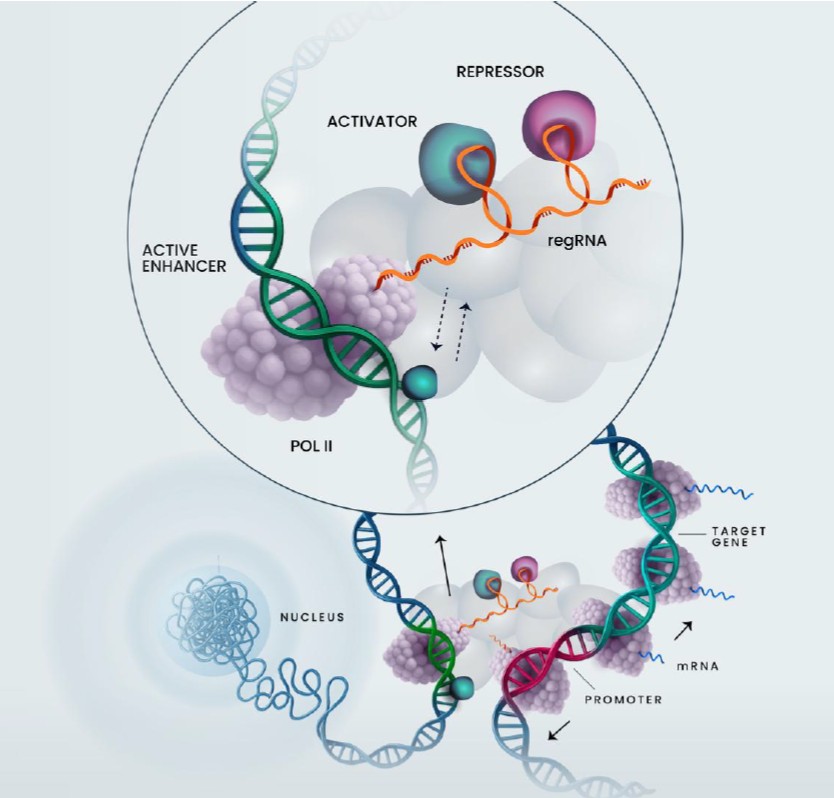
More than a decade ago, it was discovered that all active gene regulatory elements are also transcribed. These non-coding RNA transcripts generated by both enhancer and promoter DNA regions are defined as regRNAs. Recently, it was discovered that regRNAs play a central role in the formation of localized molecular complexes with transcriptional activators and repressors, which function to control mRNA transcription. As shown in the illustration below, promoters and enhancers are brought into close proximity when a gene is being actively transcribed. RegRNAs generated from these
7
regulatory elements remain closely associated with the complex that forms at the enhancer-promoter interface. Thus, regRNAs act in a gene-specific manner, only influencing the expression of the gene near the sites where they arise.
Interactions between enhancer and promoter DNA regions are critical regulators of gene expression
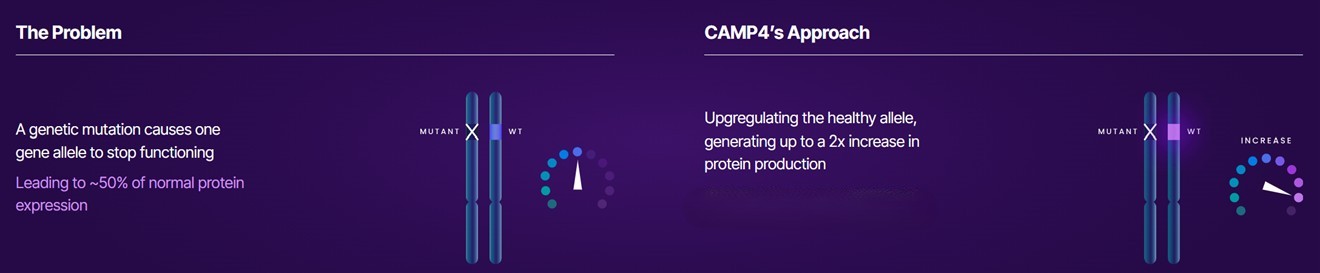
Deficient protein levels characterize over a thousand rare and prevalent human diseases. Haploinsufficient diseases are dominantly inherited conditions in which inadequate gene expression, driven by a mutation in a single allele, or gene copy, results in reductions of protein levels by as much as 50%. Data from our preclinical studies and research reports published by third parties demonstrates that increasing expression of disease-associated genes by modest amounts can restore healthy protein levels and provide therapeutic benefit in these disorders. Our RAP Platform has the potential to identify and characterize virtually every regRNA that regulates a protein-coding gene in the human genome, which we believe enables us to design ASO candidates to address the underlying biology of these diseases. With respect to haploinsufficient diseases, it is anticipated that an increase in functional protein levels, even below those expressed in the wild-type phenotype, would be clinically meaningful. We are leveraging proprietary insights into the regulatory activities of regRNAs generated internally using our proprietary RAP Platform to pioneer the development of novel therapeutics designed to achieve this objective.
Gene expression increases have the potential to reduce or eliminate disease related to haploinsufficiency
Our RAP Platform
Advances in gene modulation and therapeutic regulation of gene expression have expanded the potential to address diseases caused by sub-optimal protein expression. We believe selectively upregulating genes by targeting
8
regRNAs may provide a new way to treat a wide range of rare and prevalent diseases and could represent a new class of medicines. We were founded on the pioneering work in transcription regulation conducted by our co-founders, Richard Young, PhD and Leonard Zon, MD. We have built our proprietary RAP Platform to identify and characterize the regRNAs that control protein-coding genes and develop novel ASO-based therapeutics to modulate regRNA activity to increase the expression of protein-coding genes of interest and thereby address the underlying cause of genetic diseases. Our approach is built on ASOs, a modality to target regRNAs supported by well-established delivery methods and chemistries that provide flexibility to design therapies appropriate for different diseases. Based on our proprietary mapping of regRNAs and screening and optimizing of ASOs, we have established a leadership position in regRNA-targeting therapies. Our goal is to be the preeminent company focused on discovering, developing and delivering regRNA-targeting therapeutics to patients.
Our proprietary RAP Platform is built to map every regRNA for the tunable amplification of gene expression. Only a few regRNAs are described in public genomic databases, as they are often expressed at low levels and their importance was not fully understood. Our RAP Platform utilizes next-generation sequencing technologies and custom sequence analyses to map the active regulatory elements controlling every expressed gene. These data empower our proprietary machine learning algorithm, known as EPIC, to identify the specific control elements that regulate any gene of interest in the most specific manner, including elements that may restrict gene expression to a particular cell type. This enables us to identify the exact sites of regRNA synthesis and ultimately map the complete sequence of every candidate regRNA to target for therapeutic gene control. Further distinguishing the robust capabilities of RAP Platform is our ability to use primary human cell lines, rather than immortalized cultured cells, to preserve the functional integrity of specific cell types.
To date, we have mapped multiple cell types in as little as three months, comprising a number of potentially addressable diseases in the CNS, liver, heart, skeletal muscle and immune system. We have demonstrated that we can identify regRNA-targeting ASOs that increase specific gene expression in those tissues. These data are analyzed with our proprietary machine learning algorithms to select candidate regRNA targets that regulate transcription in a gene-specific manner to increase protein production within a physiological range. Our in-house development and application of this technology has enabled us to identify tens of thousands of regRNA sequences and their key physiological properties resulting in what we believe to be the most comprehensive regRNA dataset available. Moreover, we believe the ability of our RAP Platform to select the most likely regRNAs controlling a given gene from the large number of candidates is a key advantage of our technology, and represents a significant barrier to others seeking to develop this approach.
Our approach is designed to enable the efficient and systematic creation of ASOs to target regRNAs of interest. Building upon the power of this technology, our ASO candidates can be programmed to engage regRNA targets and induce tunable increases in protein expression. As we continue to map regRNAs and conduct ASO screens in more cell types, the data generated will improve the algorithms we use to identify the candidate regRNAs to specifically control gene expression. Thus, we believe the knowledge and learnings from our initial programs will significantly expedite selection of lead candidates and position us to rapidly expand our pipeline.
We combine our proprietary RAP Platform with validated ASO chemistry to develop programmable ASOs that are designed to precisely upregulate gene expression at the transcriptional level. An ASO construct is a single-stranded, chemically modified, nucleic-acid sequence that binds to a target regRNA sequence and modulates its activity. ASOs block or remove key interactions and lead to both increased mRNA and protein expression. Once a target gene is selected, our RAP Platform rapidly identifies the controlling regRNA, and we perform ASO screens to identify regions where ASO binding results in optimal upregulation of that target gene. Further rational design is applied to lead sequences utilizing established approaches to optimize ASOs. Our RAP Platform enables us to design ASO candidates that optimize for specificity by avoiding the potential of binding to similar sequences found elsewhere in the transcriptome which may result in deleterious side effects. As a result, our sequence-specific approach enables us to precisely target regRNA transcripts to increase gene expression.
Our use of validated ASO chemistry to generate potential therapeutic candidates provides us the flexibility to screen using a range of target sequences and to design and synthesize multiple ASO construct variations that integrate a range of chemical modifications and tissue-targeting delivery vehicles intended to optimize therapeutic potency and target specificity.
We design ASO candidates to leverage existing oligonucleotide delivery approaches to enable drug delivery to specific types of tissues throughout the body. Our CNS programs utilize intrathecal delivery of an unconjugated ASO which provides sufficient distribution in the CNS. Our RAP Platform has the potential to address any disease where increasing protein expression can be clinically meaningful, including haploinsufficient diseases or recessive loss-of-function diseases, by returning protein levels to a normal physiological range. Furthermore, given the versatility of our
9
platform, we believe the knowledge and learnings from our initial programs will expedite selection of lead candidates and position us to rapidly expand our pipeline.
Our Programs
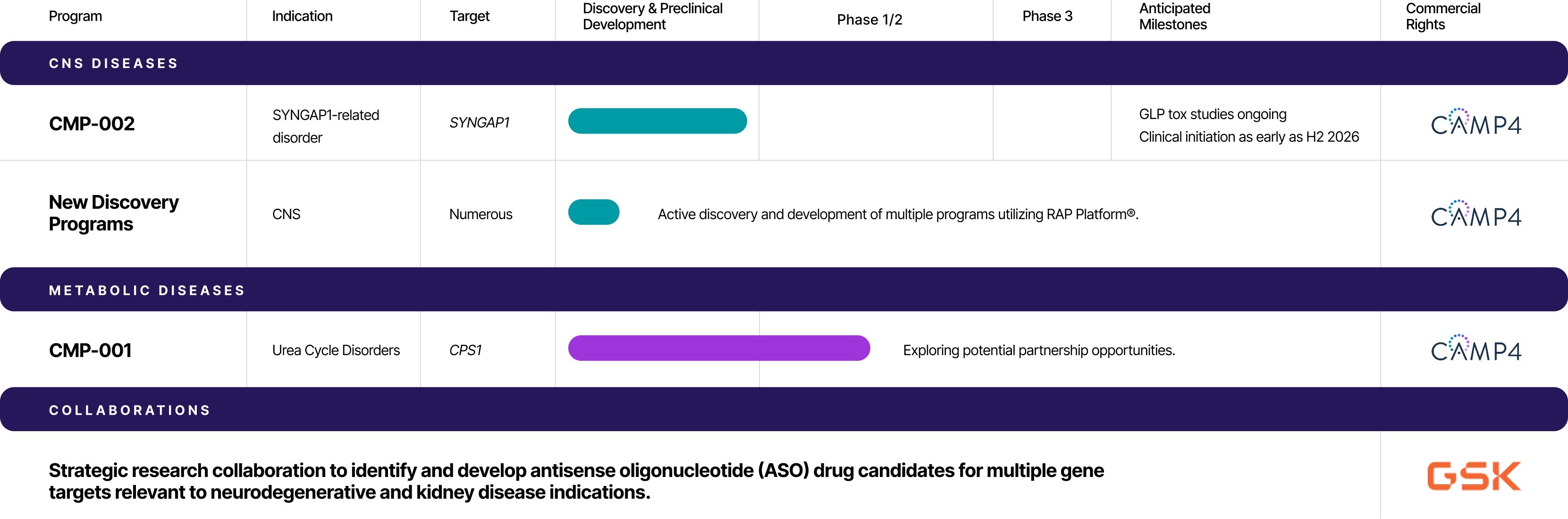
We are leveraging our RAP Platform to enable the discovery and development of potential therapies for a broad spectrum of genetic diseases. Our primary therapeutic focus is on diseases of the CNS, where there are numerous rare and prevalent haploinsufficient diseases with no approved treatments. Our lead product candidate, CMP-002, has the potential to be the first disease-modifying therapy for the treatment of SYNGAP1, a severe DEE caused by haploinsufficiency of the SYNGAP1 gene. We have initiated GLP toxicology studies for CMP-002 to support clinical trial applications and, pending successful completion and regulatory clearance, we intend to initiate a global Phase 1/2 clinical trial in individuals with SYNGAP1 as early as the second half of 2026. We are also advancing discovery programs in other DEE indications. In addition, we intend to leverage strategic discovery partnerships, including our research, collaboration and license agreement with GlaxoSmithKline, to extend the application of our RAP Platform beyond CNS and validate our approach in additional tissues and disease areas.
CMP-002 for SYNGAP1
Our lead product candidate, CMP-002, aims to address the underlying cause of SYNGAP1. CMP-002 utilizes a novel approach that targets the SYNGAP1 gene at the transcriptional level with the goal of restoring SYNGAP function and improving symptoms of SYNGAP1. We are advancing CMP-002 to address the significant unmet need for SYNGAP1 patients by targeting the direct cause of SYNGAP1, haploinsufficiency, which we believe is amenable to treatment by targeting SYNGAP1 regRNAs. Based on compelling data across our preclinical studies, we intend to initiate a global Phase 1/2 clinical trial in individuals with SYNGAP1 as early as the second half of 2026.
SYNGAP1
SYNGAP plays a critical role in the development of cognition and proper synaptic function, enabling synaptic plasticity and axon formation through signal attenuation. SYNGAP1 is a neurodevelopmental condition caused by pathogenic variants in the SYNGAP1 gene leading to a haploinsufficient state that reduces SYNGAP protein levels by as much as 50%. A majority of these pathogenic variants are mutations that result in truncation of the protein or destruction of the RNA by nonsense-mediated decay, ultimately resulting in lower protein levels and haploinsufficiency. SYNGAP1 can manifest with a variety of symptoms that can include developmental delays, movement disorders and features of autism spectrum disorder. Epilepsy is a common feature of SYNGAP1, with seizures usually beginning in early childhood. Nearly all children have some degree of developmental delay and cognitive impairment, though disease symptoms and their severity vary widely. SYNGAP1 is autosomal dominant with clinical disease presentation if either of the two alleles have a mutation. In most cases the pathogenic variant occurs spontaneously and is not inherited. Patient estimates for SYNGAP1 vary significantly, with incidence estimates ranging from one to 40 in 100,000 individuals. While we believe that SYNGAP1 remains underdiagnosed, we estimate that there are approximately 21,000 individuals living with the disorder in the United States and the five largest European markets. SYNGAP1 is reported to represent 0.5% to 1.0% of all intellectual disability cases, making it among the most common causes of intellectual disability in patients with epilepsy, and indicating that the patient population may be significantly larger than incidence estimates suggest.
10
Current Treatments and Their Limitations
There is currently no approved treatment, disease-modifying or otherwise, for SYNGAP1. There is also no definitive treatment protocol, which is dependent on seizure type and severity and other neurological characteristics of the disease. Treatment is often limited to supportive physical, occupational and speech therapy. A combination of anti-seizure medications may be prescribed to treat seizures, though SYNGAP1 has proven difficult to control with available therapeutics. As many as 50% of patients do not adequately respond to medication in which case implantable devices, such as those for vagus nerve stimulation, may offer incremental therapeutic benefit.
Our Solution
CMP-002 is a novel approach that targets the SYNGAP1 gene at the transcriptional level with the goal of restoring SYNGAP function and improving symptoms of SYNGAP1. We are advancing CMP-002 to address the significant unmet need for these patients by targeting the direct cause of SYNGAP1, haploinsufficiency, which we believe is amenable to targeting through regRNAs. As haploinsufficiency characterizes SYNGAP1, upregulation of SYNGAP1 gene expression may enable an increase in protein levels which may yield therapeutic benefit, including potential improvements to memory and incidence of seizures. Research has shown that a small subpopulation of patients with intermediate SYNGAP levels of greater than 50% have milder disease severity than truly haploinsufficient patients, suggesting that even a partial increase in protein expression may improve symptoms of the disease. We have identified specific regRNAs involved in SYNGAP1 transcription and have leveraged our RAP Platform to develop CMP-002, an intrathecally delivered ASO intended to increase SYNGAP1 transcription.
Our Preclinical Studies
We have generated preclinical data to support candidate selection and regulatory submissions for clinical trial initiation, including evaluation of CMP-002 in in vivo models intended to assess target engagement, distribution and pharmacodynamic effect in the CNS.
Dose-dependent increase in SYNGAP protein in the brains of humanized mice
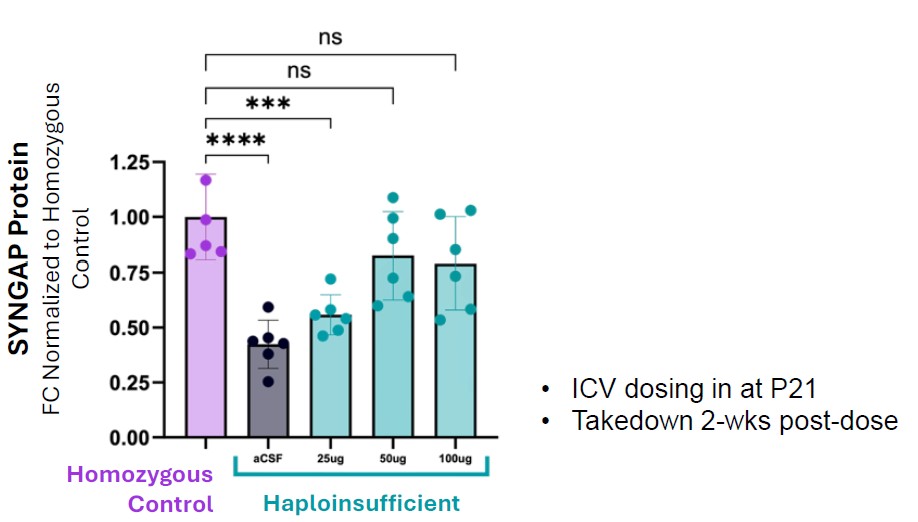
As part of our evaluation of CMP-002 in a humanized SYNGAP1 mouse model, we assessed its ability to increase SYNGAP protein levels following intracerebroventricular injection. The study demonstrated a dose-dependent increase in SYNGAP protein across multiple brain regions, with levels rising up to approximately 1.7-fold compared to control. These findings support the potential of CMP-002 to enhance SYNGAP1 expression.
11
Improved behavioral phenotypes in SYNGAP1 humanized haploinsufficient mice
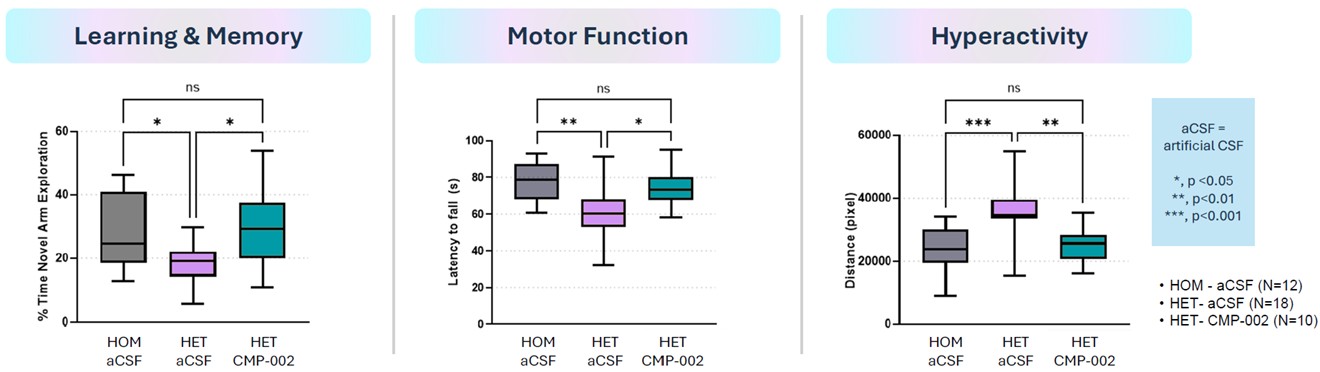
In addition to assessing target engagement, we evaluated disease-relevant behavioral phenotypes in SYNGAP1 haploinsufficient models. Neonatal humanized SYNGAP1 haploinsufficient mice administered two doses of CMP-002 and assessed within approximately three weeks showed improvements across multiple behavioral phenotypes, including learning and memory, motor function, and hyperactivity, compared to vehicle-treated haploinsufficient controls.
Broad brain distribution and increased SYNGAP protein levels in cynomolgus monkeys
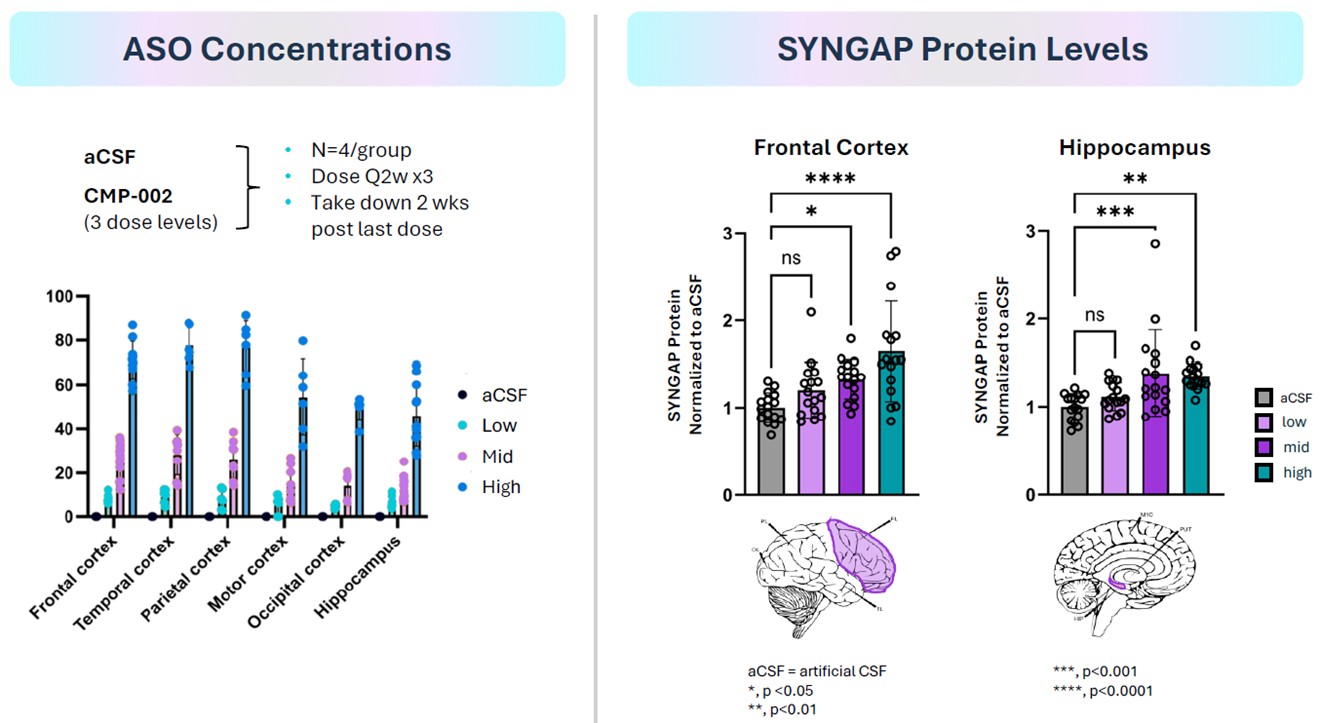
We have evaluated intrathecal administration of CMP-002 in cynomolgus monkeys. In representative studies, animals received intrathecal dosing every two weeks for three doses across three dose levels with an artificial cerebrospinal fluid control group (N=4 per group) and tissue collection occurred approximately two weeks following the last dose. CMP-002 was observed to be generally well tolerated in these studies, demonstrated broad distribution across multiple brain regions, and resulted in increased SYNGAP protein levels in regions that may be clinically relevant to SYNGAP1. We also observed dose-linear increases in CMP-002 concentrations in disease-relevant brain regions, supporting use of these data to inform human translation.
Clinical Readiness and Development Planning
We have focused on clinical readiness activities intended to support efficient initiation and conduct of first-in-human clinical trials in SYNGAP1. These activities include identification of global centers of excellence with experience in SYNGAP1 and related DEEs, engagement with patient advocacy organizations, and evaluation of ongoing and available natural history and real-world data sources that may inform trial planning.
SYNGAP1 shares certain clinical features with other DEEs, including high seizure burden and measurable neurodevelopmental impairments. We intend to evaluate a range of endpoints and measures, which may include seizure-
12
related endpoints as well as neurodevelopmental, behavioral, motor, sleep, communication, and other assessments, for which there are regulatory precedents from development programs for the treatment of other neurodevelopmental disorders.
We have nominated CMP-002 as our development candidate and have initiated GLP toxicology studies intended to enable submission of clinical trial applications. Pending successful completion of GLP toxicology studies and regulatory clearance, we intend to initiate a global Phase 1/2 clinical trial in individuals with SYNGAP1 as early as the second half of 2026. Pending regulatory feedback, design considerations may include multiple dose cohorts, enriched genotype and phenotype populations, pediatric enrollment, and an open-label extension to evaluate longer-term outcomes. We intend to align assessment schedules and selected measures, as appropriate, with those used in available natural history studies to facilitate contextual interpretation.
CMP-001 for Urea-Cycle Disorders
Our pipeline also includes our clinical candidate, CMP-001, for the treatment of the most prevalent urea cycle disorders (“UCDs”), for which we have completed a Phase 1 clinical trial in healthy volunteers. UCDs are a group of severe, inherited metabolic diseases caused by mutations in the genes that encode one or more of the eight enzymes and transporters necessary to convert ammonia into urea. The inability of the body to properly metabolize ammonia leads to the accumulation of toxic levels in circulation, ultimately resulting in severe health outcomes, such as neurologic disability, seizure and death. CMP-001 is designed to improve urea cycle activity by amplifying expression of carbamoyl phosphate synthetase 1 (“CPS1”), an enzyme that catalyzes the first step of the urea cycle, by binding to a CPS1-specific regRNA. Our preclinical studies have demonstrated that modulating the activity of the target regRNA increases expression of the CPS1 gene, resulting in increased CPS1 enzyme levels, which allows for more ammonia to be converted into urea, thereby lowering ammonia levels to normal, healthy ranges. These preclinical studies also demonstrated that CMP-001 can increase the level of, or upregulate, the production of multiple enzymes responsible for converting ammonia into urea, potentially allowing us to address more than 85% of patients with UCDs. We have received approval of a clinical trial application in the Netherlands for the initiation of a Phase 1b expansion clinical trial to enroll female participants who are heterozygous for a mutation of the OTC gene. We estimate that there are approximately 2,000 diagnosed female OTC heterozygotes in the United States who have inherited one copy of a gene with OTC-related changes and experience potentially addressable UCD symptoms.
We have completed the analysis of safety, pharmacokinetic and pharmacodynamic biomarker data from all four cohorts of the single ascending dose (“SAD”) portion of the clinical trial and from the three completed cohorts of the multiple ascending dose (“MAD”) portion of the clinical trial. In total, 86 healthy volunteer participants were observed, including 51 receiving CMP-001. CMP-001 demonstrated a favorable safety profile in both the SAD and MAD portions of the clinical trial, with no serious adverse events or discontinuations due to adverse events. Pharmacokinetic data similarly was observed to be consistent with expectations, demonstrating a dose-dependent increase in exposure (Cmax and AUC) with clear separation between groups and low-to-moderate variability in key pharmacokinetic parameters at all dose levels. There were no conclusive determinations of pharmacodynamic activity or non-activity in this healthy volunteer population, which we believe may have resulted from intrinsic variability in the ureagenesis rates of healthy individuals measured with the investigational 13C-sodium acetate test used in the study. In the second quarter of 2025, we made the strategic decision to pause new investment in our UCD program and to prioritize the development of our SYNGAP1 program. We continue to believe that CMP-001 has the potential to be the first disease-modifying therapy for the most prevalent UCDs and intend to pursue partnership opportunities to support the further development of CMP-001.
Manufacturing Strategy
We do not own or operate, and currently have no plans to establish, any manufacturing facilities. We rely on third- party contract manufacturers for the manufacture of our product candidate for our clinical trials, and, if we receive marketing approval, we will rely on such third parties for commercial manufacture. In addition, we rely on third parties to package, label, store and distribute our product candidates, and we intend to rely on third parties for our commercial products if marketing approval is obtained. We expect this strategy will enable us to maintain a more efficient infrastructure, avoiding dependence on our own manufacturing facility and equipment, while simultaneously enabling us to focus our expertise on the clinical development and future commercialization of our products. Chemistry, Manufacturing and Controls (“CMC”) is a critical element of the drug development process and involves the various procedures used to assess the physical and chemical characteristics of drug products, to ensure their quality and consistency throughout manufacture. CMC increases in complexity as the development process matures.
13
License and Collaboration Agreements
Research, Collaboration and License Agreement with GSK
In December 2025, we entered into a Research, Collaboration and License Agreement (the “GSK Agreement”) with GlaxoSmithKline Intellectual Property (No. 3) Limited (“GSK”). Pursuant to the GSK Agreement, we and GSK have agreed to collaborate on the research and development of ASO therapeutics targeting regRNAs associated with multiple gene targets relevant to neurodegenerative and kidney disease indications (the “Collaboration Targets”). The collaboration combines our proprietary regRNA mapping and ASO discovery platform with GSK’s global development and commercial capabilities.
Under the terms of the GSK Agreement, we have granted GSK an exclusive, worldwide license under certain patents and know-how to research, develop, manufacture, and commercialize certain compounds and products directed to the Collaboration Targets. We have agreed to conduct research activities under agreed research plans to identify, validate, and deliver lead ASO series that achieve certain criteria set forth in the research plan for each Collaboration Target and transfer related data packages and know-how to GSK. After such research activities, GSK will have sole responsibility for development, regulatory activities, manufacturing, and commercialization of licensed compounds and licensed products globally.
GSK has paid us a one-time, non-refundable upfront payment of $17.5 million. In addition, we are eligible to receive up to $440 million in development and commercial milestone payments, subject to achievement of specified criteria, as well as tiered royalties on annual net sales of licensed products ranging from the low- to mid-single digits during a defined royalty term for each licensed product.
The GSK Agreement includes customary provisions regarding governance, diligence, intellectual property ownership, confidentiality, and indemnification. The GSK Agreement may be terminated in its entirety or on a Collaboration Target-by-Collaboration Target basis for convenience by GSK and may also be terminated by either party under certain other circumstances, including material breach, as set forth in the GSK Agreement. The term of the GSK Agreement continues on a country-by-country and product-by-product basis until the expiration of the applicable royalty term, unless terminated earlier in accordance with its terms.
Whitehead Institute Patent License Agreement
In October 2019, we and the Whitehead Institute for Biomedical Research (the “Whitehead Institute”) entered into a patent license agreement (as amended in December 2021 and November 2023, the “Whitehead Agreement”) pursuant to which we received a worldwide, royalty-bearing, sublicensable license under certain patent rights owned or controlled by the Whitehead Institute to develop, make, have made, use, sell, offer to sell, lease and import products, and to perform and have performed licensed processes, in each case, in the fields of human and animal therapeutics and diagnostics. The license granted under the Whitehead Agreement included an exclusive license to certain patent rights generally related to, among other things, methods of modulating gene expression using oligonucleotides, and a co-exclusive license to certain patent rights generally relating to, among other things, methods of modulating gene expression by targeting certain genomic sequences.
Under the Whitehead Agreement, the Whitehead Institute retains the right to practice the licensed patent rights for research, teaching, and other educational purposes, including use in third-party sponsored research, and to grant non-exclusive licenses to other nonprofit and academic institutes solely for non-commercial research, teaching, and other educational purposes. The license granted to us under the Whitehead Agreement is also subject to certain rights held by the U.S. government under applicable law with respect to inventions that arose from federal research funding. In addition, the license is subject to a certain non-exclusive license for internal research purposes only that the Whitehead Institute granted to a certain third party, and to certain preexisting rights held by a certain third party who is a party to a certain sponsored research agreement (“SRA”) with the Whitehead Institute. Under the SRA, the Whitehead Institute covenanted not to sue said third party if certain inventions arising under the SRA, or SRA inventions, are dominated by the licensed patent rights and we are thereby excluded from asserting certain patent rights licensed from the Whitehead Institute that cover the SRA inventions against said third party.
We are obligated to use certain efforts to develop one or more products or licensed processes and commercialize the products or licensed processes in a major market. Furthermore, beginning five years from the effective date and subject to certain terms and conditions, the Whitehead Agreement requires us to negotiate and potentially issue mandatory sublicenses to a third party under the exclusively licensed patent rights to make, have made, use, sell, offer to sell, or import a product or process that is not directly competitive with a licensed product or licensed process then offered for sale or in bona fide research or development by or on behalf of us.
14
Under the terms of the Whitehead Agreement, we paid to the Whitehead Institute an upfront license issuance fees of $0.1 million and de minimis additional fees in connection with each of the December 2021 and November 2023 amendments to the agreement that were recorded as research and development expense in our consolidated statement of operations and comprehensive loss. We are also obligated to make annual license maintenance fees under the agreement, pursuant to which we have paid an aggregate of $0.4 million through December 31, 2025. In addition, we are obligated to pay certain filing, prosecution and maintenance fees with respect to certain patent rights licensed to us under the agreement, pursuant to which we have paid an aggregate of $0.5 million through December 31, 2025. We are obligated to pay potential development milestone payments of up to an aggregate of $1.9 million under the terms of the agreement upon the achievement of certain specified contingent events, pursuant to which we have paid an aggregate of $0.2 million through December 31, 2025. In addition, if we successfully commercialize a product under the Whitehead Agreement, then we will be required to pay the Whitehead Institute tiered royalties at percentage rates ranging from less than one percent to the mid-single digits of net sales or of running royalties of net sales, subject to specified reductions, until either the last-to-expire valid claim of a Whitehead Institute patent covering the product or seven years after the first commercial sale, in each case on a product-by-product and country-by-country basis.
The expected termination of the royalty obligations will depend on factors such as the availability and application of patent term extensions for the licensed patents in the licensed territory. The Whitehead Agreement will remain in effect until voluntarily terminated by the company and may be earlier terminated by the Whitehead Institute if the company fails to pay any amounts due under the agreement or materially breaches the agreement and fails to cure such breach. The last to expire patent, if issued, under the Whitehead Agreement, is expected to expire in 2043.
Competition
The biotechnology and pharmaceutical industries have made substantial investments in recent years into the rapid development of novel treatments for metabolic and CNS-related diseases and disorders.
We face substantial competition from multiple sources, including large and specialty pharmaceutical and biotechnology companies, academic research institutions and governmental agencies and public and private research institutions. Our competitors compete with us on the level of the technologies employed, or on the level of development of product candidates. In addition, many small biotechnology companies have formed collaborations with large, established companies to (i) obtain support for their research, development and commercialization of products or (ii) combine several treatment approaches to develop longer lasting or more efficacious treatments that may potentially directly compete with our current or future product candidates. We anticipate that we will continue to face increasing competition as new therapies and combinations thereof, technologies, and data emerge within the field of antisense oligonucleotide therapeutics and, furthermore, within the treatment of diseases of the CNS, as well as other tissues and disease areas we may seek to address with our product candidates in the future.
In addition to the current standard-of-care treatments to address the diseases we are targeting in therapeutic development programs, numerous commercial and academic preclinical studies and clinical trials are being undertaken by a large number of parties to assess novel technologies and product candidates.
Companies that compete with us directly on the discovery and development of product candidates targeting SYNGAP1 include Stoke Therapeutics, Inc. and Acadia Pharmaceuticals Inc. (which have agreed to co-develop and co-commercialize licensed products for SYNGAP1 globally), Praxis Precision Medicines, Inc., GondolaBio LLC, Tevard Biosciences, Inc., Regel Therapeutics, Inc., and Quiver Bioscience Inc.
If we advance our UCD program through a partner, we would expect CMP-001 to compete with Ravicti, a nitrogen scavenger commercialized by Amgen Inc. Other therapeutics in development are focused on patients with ornithine transcarbamlyse (“OTC”) deficiency only, where CMP-001 would potentially compete with Ultragenyx Pharmaceutical Inc., Arcturus Therapeutics Holdings Inc., and iECURE, Inc. (“iECURE”), among others, assuming they are successful in clinical development. Ultragenyx Pharmaceutical Inc. is developing its potential therapy in OTC patients aged 12 and older, and iECURE is initially targeting neonatal patients only.
Companies engaged in the commercialization and development of antisense oligonucleotides as therapeutics include Alnylam Pharmaceuticals, Inc. and Ionis Pharmaceuticals Inc.
Many of our competitors, either alone or in combination with their respective strategic partners, have significantly greater financial resources and expertise in research and development, manufacturing, the regulatory approval process, and marketing than we do. Mergers and acquisition activity in the pharmaceutical, biopharmaceutical and biotechnology sector is likely to result in greater resource concentration among a smaller number of our competitors. Smaller or early-stage companies may also prove to be significant competitors, particularly through sizeable collaborative arrangements with
15
established companies. These competitors also compete with us in recruiting and retain qualified scientific and management personnel and establishing clinical trial sites and patient registration for clinical trials, as well as in acquiring technologies complementary to, or necessary for, our programs.
Our commercial opportunity could be reduced or eliminated if one or more of our competitors develop and commercialize products that are safer, more effective, better tolerated, or of greater convenience or economic benefit than our proposed product offering. Our competitors also may be in a position to obtain FDA or other regulatory approval for their products more rapidly, resulting in a stronger or dominant market position before we are able to enter the market. The key competitive factors affecting the success of all of our programs are likely to be product safety, efficacy, convenience and treatment cost.
Intellectual Property
We believe that our intellectual property estate is a strategic asset that has the potential to provide us with a competitive advantage. We strive to protect and enhance the proprietary technology, inventions and improvements that we believe are important to our business, including pursuing, maintaining and defending patent rights, whether developed internally or licensed from third parties. We also rely on trade secrets and know-how relating to our proprietary technology and product candidates, continuing technological innovation and in-licensing opportunities to develop, strengthen and maintain our proprietary and intellectual property position. We additionally may rely on data exclusivity, market exclusivity and patent term extensions, when available, and plan to seek and rely on regulatory protection afforded through orphan drug designations. Our commercial success may depend in part on our ability to obtain and maintain patent and other proprietary protection for our technology, inventions, and improvements; to preserve the confidentiality of our trade secrets; to defend and enforce our proprietary rights, including our patents; and to operate without infringing on the valid and enforceable patents and other proprietary rights of third parties.
Our wholly owned and in-licensed patent portfolio includes patent rights covering various aspects of our RAP Platform and current product candidates, and certain legacy programs the company is no longer pursuing. As of December 31, 2025, our patent portfolio consists of 25 patent families, including four owned issued U.S. patents, 14 in-licensed issued U.S. patents, 27 in-licensed foreign issued patents, 23 owned or in-licensed pending U.S. patent applications (including provisional patent applications), 66 owned or in-licensed foreign pending patent applications, and one owned or in-licensed pending Patent Cooperation Treaty application (“PCT application”) that has not entered national phase. Our objective is to continue to expand our patent portfolio to protect our technology, inventions, improvements and current and future product candidates. Examples of the product candidates and technology areas covered by our intellectual property portfolio are described below.
Program-related Intellectual Property
The program-related patent rights in our patent portfolio provide coverage for our programs and product candidates designed to address certain diseases and disorders. The program-related patent applications for our lead programs include those described below. The patents and patent applications described below are wholly owned by us.
SYNGAP1 Program
Our lead product candidate, CMP-002, aims to amplify SYNGAP1 expression. As of December 31, 2025, we owned one pending U.S. non-provisional patent application and 14 pending foreign patent applications in Australia, Brazil, Canada, China, Eurasia, Europe, Israel, India, Japan, South Korea, Mexico, New Zealand, Singapore, and South Africa, and one pending PCT application, each relating to compositions of matter, including ASOs designed to amplify SYNGAP1 expression, and methods of treating SYNGAP1. We expect patents issuing from or claiming priority to these patent applications, if any, to expire between 2043 and 2045, excluding any patent term adjustments or extensions.
Urea Cycle Disorders Program
CMP-001 is designed to amplify expression of the CPS1 gene. As of December 31, 2025, we owned one issued U.S. patent, one pending U.S. non-provisional patent application, and 16 pending foreign patent applications in Australia, Brazil, Canada, China, Eurasia, Europe, Hong Kong, Israel, India, Japan, South Korea, Mexico, New Zealand, Singapore and South Africa, relating to compositions of matter, including ASOs designed to amplify CPS1 expression, and methods of treating UCDs. We expect the issued patent, and patents issuing from or claiming priority to these patent applications, to expire in 2042, excluding any patent term adjustments or extensions.
In addition to our programs listed above, we also have patent applications relating to ASO compositions directed to regRNAs involved in the transcription of additional gene targets and their use for treating additional diseases or
16
disorders that may benefit from upregulation of gene expression. As of December 31, 2025 we owned one pending U.S. non-provisional patent application and ten pending foreign patent applications in Australia, Canada, China, Europe, Hong Kong, Israel, India, Japan and Mexico, relating to compositions and methods for treating UCDs. We expect patents issuing from or claiming priority from these pending patent applications, if any, to expire in 2042, excluding any patent term adjustments or extensions. As of December 31, 2025, we owned one pending U.S. non-provisional patent application and 11 pending foreign patent applications in Australia, Canada, China, Europe, Hong Kong, Israel, India, Japan, South Korea and Mexico, relating to compositions and methods for treating several diseases and disorders including frontotemporal dementia. We expect patents issuing from or claiming priority from these pending patent applications, if any, to expire in 2043, excluding any patent term adjustments or extensions. As of December 31, 2025, we owned one pending U.S. non-provisional patent application relating to compositions and methods for treating cholestatic liver disease. We expect patents issuing from or claiming priority from this patent application, if any, to expire in 2043, excluding any patent term adjustments or extensions.
Platform-related Intellectual Property
In addition to the program-related intellectual property, our intellectual property portfolio includes know-how and patent applications directed to our RAP Platform and other technologies developed internally or in-licensed from the Whitehead Institute. Exemplary platform technologies that are subject to such patent applications include methods of modulating gene expression using oligonucleotides, methods for characterizing enhancer-promoter pairs, and methods for modulating condensate-dependent transcription. These platform technologies, and our intellectual property portfolio related thereto, relate broadly to our existing product candidates and those we may develop in the future.
We continually assess and refine our intellectual property strategy as we develop new product candidates and technologies. To that end, we expect to file additional patent applications in support of current and new product candidates as well as new technologies.
Our ability to stop third parties from making, using, selling, marketing, offering to sell, importing, and commercializing our product candidates and technology is dependent upon the extent to which we have rights under valid and enforceable patents and other intellectual property rights that cover our product candidates and technology. We cannot predict whether or when our owned or licensed pending and future patent applications will result in the issuance of patents, nor can we predict whether any patents that may be granted to us in the future will be commercially useful in protecting our product candidates and technology.
The terms of individual patents depend upon the legal term of the patents in the countries in which they are obtained. In most countries in which we file, including the United States, the patent term is 20 years from the earliest date of filing a non-provisional patent application. In the United States, a patent’s term may be lengthened by patent term adjustment, which compensates a patentee for administrative delays by the U.S. Patent and Trademark Office (“USPTO”) in granting a patent, or may be shortened if a patent is terminally disclaimed over an earlier-filed patent.
In the United States, the term of a patent that covers an FDA-approved drug may be eligible for a patent term extension under the Hatch-Waxman Act as compensation for the loss of patent term during the FDA regulatory review process. The period of extension may be up to five years beyond the expiration of the patent, but cannot extend the remaining term of a patent beyond a total of 14 years from the date of product approval. Only one patent among those eligible for an extension may be extended, and a given patent may only be extended once. Similar provisions are available in Europe and in certain other jurisdictions to extend the term of a patent that covers an approved drug. If our product candidates receive approval, we intend to apply for patent term extensions, if available, to extend the term of patents that cover the approved product candidates. We also intend to seek patent term extensions in any jurisdiction where they are available, however there is no guarantee that the applicable authorities, including the FDA in the United States, will agree with our assessment that such extensions should be granted, and if granted, the length of such extensions.
In addition to patent protection, we also rely on know-how and trade secret protection for our proprietary information to develop and maintain our proprietary and intellectual property position. However, trade secrets can be difficult to protect. Although we take steps to protect our proprietary information, including entering into agreements with our employees, corporate collaborators, external scientific collaborators, contract manufacturers, consultants, advisors, and other third parties, such individuals may breach such agreements and disclose our proprietary information, including our trade secrets, and we may not be able to obtain adequate remedies for such breaches. In addition, third parties may independently develop the same or similar proprietary information or may otherwise gain access to our proprietary information. As a result, we may be unable to meaningfully protect our know-how, trade secrets and proprietary information.
17
Government Regulation in the United States
The FDA and other regulatory authorities at federal, state and local levels, as well as in foreign countries, extensively regulate, among other things, the research, development, testing, manufacture, pricing, reimbursement, sales, quality control, approval, packaging, storage, recordkeeping, labeling, advertising, promotion, distribution, marketing, post-approval monitoring and reporting and import and export of drugs. We, along with our contract manufacturers (“CMOs”), contract research organizations CROs, and third-party vendors, will be required to satisfy these requirements in each of the countries in which we wish to conduct studies or seek approval of our product candidates. The process of obtaining marketing approvals and the subsequent compliance with appropriate federal, state, local, and foreign statutes and regulations require the expenditure of substantial time and financial resources. The regulatory requirements applicable to drug development, approval, and marketing are subject to change, and regulations and administrative guidance often are revised or reinterpreted by the agencies in ways that may have a significant impact on our business. We cannot predict whether legislative changes will be enacted or if regulatory authorities’ guidance or interpretations will change.
In the United States, the FDA regulates drugs under the Federal Food, Drug, and Cosmetic Act (“FDCA”), as amended, and its implementing regulations. Drugs are also subject to other federal, state and local statutes and regulations. FDA clearance of an Investigational New Drug (“IND”) application must be obtained before commencing clinical testing of a new drug in the U.S. FDA approval also must generally be obtained before a drug may be legally marketed in the United States.
Failure to comply with applicable regulatory requirements at any time during the product development, approval, or post-approval processes, could result in delays in the conduct of clinical trials or regulatory review and approval, as well as administrative or judicial sanctions or other legal consequences. These sanctions or consequences could include, among other things, the FDA’s refusal to approve pending applications, issuance of clinical holds for planned or ongoing studies, suspension or revocation of existing product approvals, issuance of warning or untitled letters, adverse publicity, product withdrawals or recalls, marketing restrictions, product seizures, total or partial suspensions of manufacturing or distribution, import detentions or refusals, injunctions, fines, government investigations, civil penalties or criminal prosecution.
U.S. Development Process
The process for seeking approval to market and distribute a new drug in the United States generally involves the following:
•completion of nonclinical laboratory tests and animal studies according to GLP requirements and applicable requirements for the humane use of laboratory animals or other regulations;
•completion of the manufacture, under current Good Manufacturing Practices (“cGMPs”), conditions of the drug substance and drug product that the sponsor intends to use in human clinical trials along with required analytical and stability testing;
•submission to the FDA of an IND application, which must become effective before human clinical trials may begin;
•approval by an institutional review board (“IRB”) reviewing each clinical site before each clinical trial may be initiated;
•performance of adequate and well-controlled human clinical trials according to Good Clinical Practices (“GCPs”), and any additional requirements for the protection of human research subjects and their health information, to establish the safety and efficacy of the drug for its intended use;
•preparation and submission to the FDA of a New Drug Application (“NDA”) requesting marketing approval for one or more proposed indications, including submission of detailed information on the chemistry, manufacture and quality controls of the product in clinical development and proposed labeling;
•satisfactory completion of one or more FDA pre-approval inspections of the manufacturing facility or facilities where the drug will be produced, including those of third parties, to assess compliance with cGMP requirements;
•potential FDA audit of the nonclinical and clinical study sites that generated the data in support of the NDA to assess compliance with GLP and GCP and the integrity of clinical data in support of the NDA;
•payment of user fees under the Prescription Drug User Fee Act (“PDUFA”), unless exempted;
18
•FDA review and approval of the NDA, including consideration of the views of any FDA advisory committee, prior to any commercial marketing or sale of the drug in the United States; and
•compliance with any post-approval requirements, including the potential requirement to implement a Risk Evaluation and Mitigation Strategy (“REMS”), and the potential requirement to conduct post approval studies.
Before testing any drug in humans, the product candidate enters the preclinical testing stage. Nonclinical tests include laboratory evaluations of drug chemistry, formulation and stability, as well as in vitro and animal studies to assess safety and in some cases to establish the rationale for therapeutic use. The conduct of nonclinical studies is subject to federal and state regulation, including GLPs. The clinical study sponsor must submit the results of the nonclinical tests, together with manufacturing information, analytical data, any available clinical data or literature, and a proposed clinical protocol, to the FDA as part of the IND. Some nonclinical testing typically continues after the IND is submitted.
An IND is an exemption from the FDCA that allows an unapproved product to be shipped in interstate commerce for use in an investigational clinical trial and a request for FDA authorization to administer an investigational product to humans. The IND must become effective before clinical trials may begin. The IND automatically becomes effective 30 days after receipt by the FDA, unless before that time the FDA raises concerns or questions about the product or conduct of the proposed clinical trial, including concerns that human research subjects will be exposed to unreasonable health risks. If the FDA raises concerns or questions either during the initial 30-day period, or at any time during the IND review process, it may choose to impose a clinical hold. In such a case, the IND sponsor and the FDA must resolve any outstanding concerns before the clinical trial can begin. As a result, submission of an IND may or may not result in FDA authorization to begin a clinical trial, or to begin a clinical trial on the terms originally specified by the sponsor in the IND. A separate submission to an existing IND must also be made for each successive clinical trial conducted, and the FDA must grant permission, either explicitly or implicitly by not objecting, before each clinical trial can begin.
Clinical trials may involve the administration of the drug product candidate to healthy volunteers or subjects under the supervision of qualified investigators. Clinical trials involving some products for certain diseases, including some rare diseases may begin with testing in patients with the disease. Clinical trials are conducted under protocols detailing, among other things, the objectives of the clinical trial, dosing procedures, subject selection, and exclusion criteria, and the parameters to be used to monitor subject safety, including stopping rules that assure a clinical trial will be stopped if certain adverse events should occur. Each protocol and any amendments to the protocol must be submitted to the FDA as part of the IND. Clinical trials must be conducted and monitored in accordance with the FDA’s regulations comprising the GCP requirements, including the requirement that all research subjects or his or her legal representative provide informed consent. Further, each clinical trial must be reviewed and approved by an independent IRB, at or servicing each institution at which the clinical trial will be conducted. An IRB is charged with protecting the welfare and rights of study participants and considers such items as whether the risks to individuals participating in the clinical trials are minimized and are reasonable in relation to anticipated benefits. The IRB also approves the form and content of the informed consent that must be signed by each clinical trial subject or his or her legal representative and must monitor the clinical trial until completed.
Some clinical trials also include oversight by an independent group of qualified experts organized by the clinical trial sponsor, known as a data safety monitoring board or data monitoring committee. This group may recommend continuation of the trial as planned, changes in trial conduct, or cessation of the trial at designated check points based on certain data from the trial to which only the group has access.
Human clinical trials are typically conducted in three sequential phases that may overlap or be combined:
•Phase 1. The drug is initially introduced into healthy human subjects and tested for safety, including adverse effects, dose tolerance, absorption, metabolism, distribution, excretion and pharmacodynamics. In the case of some products for rare diseases, the initial human testing is often conducted in patients.
•Phase 2. The drug is evaluated in a limited patient population to identify possible adverse effects and safety risks, preliminarily evaluate the efficacy of the product for specific targeted diseases, and determine dosage tolerance, optimal dosage, and dosing schedule. Multiple Phase 2 clinical trials may be conducted by the sponsor to obtain information prior to beginning larger and more costly Phase 3 clinical trials.
•Phase 3. Phase 3 clinical trials typically proceed if the Phase 2 clinical trials demonstrate that a dose range of the product candidate is potentially effective and has an acceptable safety profile. Phase 3 clinical trials are generally undertaken within an expanded patient population to further evaluate dosage, provide substantial evidence of clinical efficacy and further test for safety, in a diverse patient population at multiple, geographically dispersed clinical trial sites. A well-controlled, statistically robust Phase 3 trial may be
19
designed to deliver the data that regulatory authorities will use to decide whether or not to approve, and, if approved, how to appropriately label a product candidate.
In some cases, the FDA may approve an NDA for a product but require the sponsor to conduct additional clinical trials to further assess the product’s safety and effectiveness after approval. Such post-approval trials are typically referred to as Phase 4 clinical trials. These trials are used to gain additional experience from the treatment of patients in the intended therapeutic indication and to document a clinical benefit for products approved under accelerated approval regulations. The failure to exercise due diligence with regard to conducting Phase 4 clinical trials could result in withdrawal of approval for products.
During all phases of clinical development, the FDA requires extensive monitoring and auditing of all clinical activities, clinical data, and clinical trial investigators. Annual progress reports detailing the results of the clinical trials must be submitted to the FDA. Written IND safety reports must be promptly submitted to the FDA and the investigators for serious and unexpected adverse events, any findings from other studies, tests in laboratory animals or in vitro testing that suggest a significant risk for human subjects, or any clinically important increase in the rate of serious suspected adverse reactions over those listed in the protocol or investigator brochure. The sponsor must submit an IND safety report within 15 calendar days after the sponsor determines that the information qualifies for such reporting. The sponsor also must notify the FDA of any unexpected fatal or life-threatening suspected adverse reaction within 7 calendar days after the sponsor’s initial receipt of the information. Phase 1, Phase 2, and Phase 3 clinical trials may not be completed successfully within any specified period, if at all. At any time while clinical trials are ongoing under the IND, the FDA may impose a partial or complete clinical hold. Clinical holds may be imposed when there is concern for patient safety, and may be a result of new data, findings, or developments in clinical, nonclinical, and/or chemistry, manufacturing and controls or where there is non-compliance with regulatory requirements. If the FDA imposes a clinical hold, trials may not recommence without FDA authorization and then only under terms authorized by the FDA. Similarly, an IRB can suspend or terminate approval of a clinical trial at its institution if the clinical trial is not being conducted in accordance with the IRB’s requirements and either the IRB or the data safety monitoring board may suspend a clinical trial at any time on various grounds, including a finding that the research subjects or patients are being exposed to an unacceptable health risk.
During the development of a new drug, sponsors are given opportunities to meet with the FDA at certain points. These points may be prior to submission of an IND, at the end of Phase 2, and before an NDA is submitted. Meetings at other times may be requested. These meetings can provide an opportunity for the sponsor to share information about the data gathered to date, for the FDA to provide advice, and for the sponsor and the FDA to reach agreement on the next phase of development.
Concurrent with clinical trials, companies must finalize a process for manufacturing the drug product in commercial quantities in accordance with cGMP requirements. The manufacturing process must be capable of consistently producing quality batches of the product candidate and manufacturers must develop, among other things, methods for testing the identity, strength, quality and purity of the final drug product. Additionally, appropriate packaging must be selected and tested, and stability studies must be conducted to demonstrate that the product candidate does not undergo unacceptable deterioration over its shelf life.
There are also various laws and regulations regarding laboratory practices, the experimental use of animals, and the use and disposal of hazardous or potentially hazardous substances in connection with the research. In each of these areas, the FDA and other regulatory authorities have broad regulatory and enforcement powers, including the ability to levy fines and civil penalties, suspend or delay issuance of approvals, seize or recall products, and withdraw approvals.
Information about certain clinical trials must be submitted within specific timeframes for public dissemination on the clinicaltrials.gov website. Sponsors or distributors of investigational products for the diagnosis, monitoring, or treatment of one or more serious diseases or conditions must also have a publicly available policy on evaluating and responding to requests for expanded access requests.
A sponsor who wishes to conduct a clinical trial outside of the United States may, but need not, obtain FDA authorization to conduct the clinical trial under an IND. When a foreign clinical trial is conducted under an IND, all FDA IND requirements must be met unless waived. If a foreign clinical trial is not conducted under an IND, FDA will nevertheless accept the results of the study in support of an NDA if the study was conducted in accordance with GCP requirements, and the FDA is able to validate the data through an onsite inspection if deemed necessary. The FDA’s regulations are intended to help ensure the protection of human subjects enrolled in non-IND foreign clinical trials, as well as the quality and integrity of the resulting data. They further help ensure that non-IND foreign trials are conducted in a manner comparable to that required for clinical trials in the United States.
20
U.S. Review and Approval Processes
Assuming successful completion of the required clinical testing, the results of the preclinical studies and clinical trials, together with detailed information relating to the product’s chemistry, manufacture, controls and proposed labeling, among other things, are submitted to the FDA as part of an NDA package requesting approval to market the product for one or more indications. An NDA is a request for approval to market a new drug for one or more specified indications and must contain proof of the drug’s safety and efficacy for the requested indications. The marketing application is required to include both negative and ambiguous results of preclinical studies and clinical trials, as well as positive findings. Data may come from company-sponsored clinical trials intended to test the safety and efficacy of a product’s use or from a number of alternative sources, including studies initiated by investigators. To support marketing approval, the data submitted must be sufficient in quality and quantity to establish the safety and efficacy of the investigational product to the satisfaction of the FDA. FDA must generally approve an NDA before a drug may be marketed in the United States.
The FDA reviews all submitted NDAs before it accepts them for filing and may request additional information rather than accepting the NDA for filing. The FDA must make a decision on accepting an NDA for filing within 60 days of receipt, and such decision could include a refusal to file by the FDA. Once the submission is accepted for filing, the FDA begins an in-depth substantive review of the NDA. The FDA reviews an NDA to determine, among other things, whether the drug is safe and effective for the indications sought and whether the facility in which it is manufactured, processed, packaged or held meets standards designed to assure the product’s continued safety, quality and purity. The FDA likely will reanalyze the clinical trial data, which could result in extensive discussions between the FDA and the applicant during the review process. Under the goals and polices agreed to by the FDA under PDUFA, the FDA targets ten months, from the filing date, in which to complete its initial review of an NDA and respond to the applicant, and six months from the filing date of an NDA for priority review. The FDA does not always meet its PDUFA goal dates for standard or priority NDAs, and the review process is often extended by FDA requests for additional information or clarification. Each NDA must be accompanied by a substantial PDUFA user fee, which FDA adjusts on an annual basis. Fee waivers or reductions are available in certain circumstances, including a waiver of the application fee for the first application filed by a small business. Additionally, no user fees are assessed on NDAs for products designated as orphan drugs, unless the product also includes a non-orphan indication.
The FDA may refer an application for a novel drug or drug that presents difficult questions of safety and efficacy to an advisory committee. An advisory committee is a panel of independent experts, including clinicians and other scientific experts, which reviews, evaluates and provides a recommendation as to whether the application should be approved and under what conditions. The FDA is not bound by the recommendations of an advisory committee, but it considers such recommendations carefully when making decisions.
Before approving an NDA, the FDA typically will inspect the facility or facilities where the product is manufactured. The FDA will not approve an application unless it determines that the manufacturing processes and facilities are in compliance with cGMP requirements and are adequate to assure consistent production of the product within required specifications. Additionally, before approving an NDA, the FDA may inspect one or more clinical trial sites to assure compliance with GCP and other requirements and the integrity of the clinical data submitted to the FDA.
After evaluating the NDA and all related information, including the advisory committee recommendation, if any, and inspection reports regarding the manufacturing facilities and clinical trial sites, the FDA may issue an approval letter, or, in some cases, a complete response letter. A complete response letter generally contains a statement of specific conditions that must be met in order to secure final approval of the NDA and may require additional clinical or preclinical testing in order for the FDA to reconsider the application. The NDA sponsor will have one year to submit to the FDA information that represents a complete response to the deficiencies described in the letter. The FDA will then re-review the application, taking into consideration the response and determine whether the application meets the criteria for approval. If and when those conditions have been met to the FDA’s satisfaction, the FDA will typically issue an approval letter. An approval letter authorizes commercial marketing of the drug with specific prescribing information for specific indications.
Even if the FDA approves a product, it may limit the approved indications for use of the product and require that contraindications, warnings or precautions be included in the product labeling. Additionally, the FDA may require post-approval studies, including Phase 4 clinical trials, to further assess a drug’s efficacy or safety after approval. The agency may also require testing and surveillance programs to monitor the product after commercialization, or impose other conditions, including distribution restrictions or other risk management mechanisms under a REMS. A REMS can include medication guides, physician communication plans, assessment plans, and/or elements to assure safe use, such as restricted distribution methods, patient registries, or other risk-minimization tools, which can materially affect the potential market and profitability of the product. The FDA may prevent or limit further marketing of a product based on the results of post-marketing studies or surveillance programs. After approval, some types of changes to the approved product, such as adding
21
new indications, manufacturing changes, and additional labeling claims, are subject to further testing requirements and FDA review and approval.
Post-approval Requirements
Maintaining substantial compliance with applicable federal, state, and local statutes and regulations requires the expenditure of substantial time and financial resources. Rigorous and extensive FDA regulation of drugs continues after approval, particularly with respect to cGMP. If we obtain regulatory approval for any of our products, we will be required to comply with all post-approval regulatory requirements as well as any specific post-approval requirements that the FDA have imposed as part of the approval process. We will be required to report certain adverse reactions and production problems to the FDA, provide updated safety and efficacy information, and comply with requirements concerning advertising and promotional labeling requirements and record-keeping requirements. Further, if there are any modifications to the drug, including changes in indications, labeling or manufacturing processes or facilities, we may be required to submit and obtain FDA approval of a new NDA or NDA supplement, which may require the generation of additional data or the conduct of additional preclinical studies and clinical trials. Manufacturers and other parties involved in the drug supply chain for prescription drug products must also comply with product tracking and tracing requirements and for notifying the FDA of counterfeit, diverted, stolen and intentionally adulterated products or products that are otherwise unfit for distribution in the United States.
We will rely, and expect to continue to rely, on third parties for the production of clinical and commercial quantities of any products that we may commercialize. Manufacturers of our products are required to comply with applicable requirements in the cGMP regulations, including quality control and quality assurance and maintenance of records and documentation.
Manufacturing facilities are required to register their establishments with the FDA and certain state agencies and are subject to periodic inspections by the FDA and certain state agencies for compliance with ongoing regulatory requirements. Failure to comply with statutory and regulatory requirements may result in the issuance of an FDA Form 483 notice of inspectional observations, untitled letter, warning letter, or suspension of manufacturing or other legal or regulatory action, such as product seizures, injunctions, civil penalties or criminal prosecution. Additionally, defects in manufacturing of commercial products can result in product recalls.
Systems need to be put in place to record and evaluate adverse events reported by healthcare providers and patients and to assess product complaints. Later discovery of previously unknown problems with a product, including adverse events of unanticipated severity or frequency, or with manufacturing processes, or failure to comply with regulatory requirements, may result in revisions to the approved labeling to add new safety information, requirements for post-market studies or clinical trials to assess new safety risks, or imposition of distribution or other restrictions under a REMS. Other potential consequences include, among other things:
•restrictions on the marketing or manufacturing of the product, complete withdrawal of the product from the market or product recalls;
•the issuance of safety alerts, Dear Healthcare Provider letters, press releases or other communications containing warnings or other safety information about the product;
•fines, warning letters or holds on post-approval clinical trials;
•refusal of the FDA to approve applications or supplements to approved applications, or suspension or revocation of product approvals;
•product seizure or detention, or refusal to permit the import or export of products;
•injunctions or the imposition of civil or criminal penalties; and
•consent decrees, corporate integrity agreements, debarment or exclusion from federal healthcare programs; or mandated modification of promotional materials and labeling and issuance of corrective information.
The FDA strictly regulates the marketing, labeling, advertising and promotion of prescription drug products placed on the market. This regulation includes, among other things, standards and regulations for direct-to-consumer advertising, communications regarding unapproved uses, industry-sponsored scientific and educational activities and promotional activities involving the internet and social media. Promotional claims about a drug’s safety or effectiveness are prohibited before the drug is approved. After approval, a drug product generally may not be promoted for uses or patient populations that are not approved by the FDA, as reflected in the product’s prescribing information (known as “off-label” use). In the United States, healthcare professionals are generally permitted to prescribe drugs for such off-label uses because the FDA does not regulate the practice of medicine. However, FDA regulations impose rigorous restrictions on
22
manufacturers’ communications, prohibiting the promotion of off-label uses. Prescription drug promotional materials must be submitted to the FDA in conjunction with their first use.
If a company, including any agent of the company or anyone speaking on behalf of the company, is found to have promoted off-label uses, the company may become subject to adverse public relations and administrative and judicial enforcement by the FDA, the DOJ, or the Office of the Inspector General of the Department of Health and Human Services (“HHS”), as well as state authorities. This could subject a company to a range of penalties that could have a significant commercial impact, including civil and criminal fines and agreements that materially restrict the manner in which a company promotes or distributes drug products. The federal government has levied large civil and criminal fines against companies for alleged improper promotion and has also requested that companies enter into consent decrees or permanent injunctions under which specified promotional conduct is changed or curtailed.
Orphan Drug Designation
Under the Orphan Drug Act, the FDA may grant Orphan Drug Designation (“ODD”) to a drug intended to treat a rare disease or condition, which is generally a disease or condition that affects fewer than 200,000 individuals in the United States, or more than 200,000 individuals in the United States and for which there is no reasonable expectation that the cost of developing and making a drug available in the United States for this type of disease or condition will be recovered from sales of the product. ODD must be requested before submitting a marketing application. After the FDA grants ODD, the identity of the therapeutic agent and its potential orphan use are disclosed publicly by the FDA. ODD does not convey any advantage in or shorten the duration of the regulatory review and approval process.
If a product that has ODD receives the first FDA approval for the disease or condition for which it has such designation, the product is entitled to orphan product exclusivity, which means that the FDA may not approve any other applications to market the same drug for the same indication for seven years, except in limited circumstances, such as not being able to supply the product for patients or showing clinical superiority to the product with orphan exclusivity.
Competitors, however, may receive approval of different products for the indication for which the orphan product has exclusivity or obtain approval for the same product but for a different indication for which the orphan product has exclusivity. Orphan product exclusivity also could block the approval of one of our products for seven years if a competitor obtains approval of the same drug as defined by the FDA or if our product candidate is determined to be contained within the competitor’s product for the same indication or disease. If a drug designated as an orphan product receives marketing approval for an indication broader than what is designated, it may not be entitled to orphan product exclusivity. Further, it is unclear how future litigation, legislation, agency decisions, and administrative actions will impact the scope of the orphan drug exclusivity.
Rare Pediatric Disease Priority Review Voucher Program
Under the Rare Pediatric Disease Priority Review Voucher program, the FDA may award a priority review voucher to the sponsor of an approved marketing application for a drug that is for the prevention or treatment of a rare pediatric disease. The sponsor can use the voucher to obtain priority review for a subsequent human drug or biologic application. The sponsor can also transfer or sell the voucher to another company.
To be eligible for a rare pediatric disease priority review voucher, the NDA must be for a drug that prevents or treats a “rare pediatric disease” defined to mean a serious or life-threatening disease in which the serious or life-threatening manifestations primarily affect individuals aged from birth to 18 years and the disease affects fewer than 200,000 individuals in the United States, or affects 200,000 or more individuals in the United States but for which there is no reasonable expectation that the cost of developing the drug will be recovered from sales of the drug in the United States. Additionally, the NDA must be deemed eligible for priority review, rely on clinical data derived from studies examining a pediatric population and dosages of the drug intended for that population, not seek approval for a different adult indication in the original rare pediatric disease product application and be for a drug that does not include a previously approved active ingredient. A sponsor may request rare pediatric disease designation from the FDA prior to the submission of the NDA; however rare pediatric disease designation does not guarantee that a sponsor will receive a priority review voucher upon approval of the NDA.
The Rare Pediatric Disease Priority Review Voucher program has been subject to periodic statutory sunset provisions and extensions. Under the current statutory sunset provisions, the FDA may only award a rare pediatric disease priority review voucher if the NDA for the product is approved before September 30, 2029. After September 30, 2029, the FDA may not award any rare pediatric disease priority review vouchers, unless the program is further extended.
23
Expedited Review and Approval Programs
The FDA has various programs, including Fast Track designation, priority review, accelerated approval, and breakthrough therapy designation, that are intended to expedite or simplify the process for the development and FDA review of drugs that are intended for the treatment of serious or life-threatening diseases or conditions and demonstrate the potential to address unmet medical needs. The purpose of these programs is to provide important new drugs to patients earlier than under standard FDA review procedures. To be eligible for a Fast Track designation, the FDA must determine, based on the request of a sponsor, that a drug is intended to treat a serious or life-threatening disease or condition and demonstrates the potential to address an unmet medical need. The FDA will determine that a product will fill an unmet medical need if it will provide a therapy where none exists or provide a therapy that may be potentially superior to existing therapy based on efficacy or safety factors. In addition to other benefits, such as the ability to have greater interactions with the FDA, the FDA may initiate review of sections of a Fast Track BLA before the application is complete, a process known as rolling review.
The FDA may give a priority review designation, such as a rare pediatric disease designation, to drugs that treat a serious condition and, if approved, would provide a significant improvement in safety or effectiveness. A priority review means that the goal for the FDA to review an application is six months, rather than the standard review of ten months under current PDUFA guidelines. Most products that are eligible for Fast Track designation may also be considered appropriate to receive a priority review. In addition, drugs studied for their safety and effectiveness in treating serious or life-threatening illnesses and that provide meaningful therapeutic benefit over existing treatments may receive accelerated approval and may be approved on the basis of adequate and well-controlled clinical trials establishing that the drug has an effect on a surrogate endpoint that is reasonably likely to predict clinical benefit, or on a clinical endpoint that can be measured earlier than irreversible morbidity or mortality, that is reasonably likely to predict an effect on irreversible morbidity or mortality or other clinical benefit, taking into account the severity, rarity, or prevalence of the condition and the availability or lack of alternative treatments. As a condition of approval, the FDA may require a sponsor of a drug receiving accelerated approval to perform adequate and well-controlled post-marketing studies to verify and describe the predicted effect on irreversible morbidity or mortality or other clinical endpoint. Under the Food and Drug Omnibus Reform Act of 2022 (“FDORA”), the FDA may require, as appropriate, that such trials be underway prior to approval or within a specific time period after the date of approval for a product granted accelerated approval. Under FDORA, the FDA has increased authority for expedited procedures to withdraw approval of a drug or indication approved under accelerated approval if, for example, the confirmatory trial fails to verify the predicted clinical benefit of the product. In addition, for products being considered for accelerated approval, the FDA generally requires, unless otherwise informed by the agency, that all advertising and promotional materials intended for dissemination or publication within 120 days of marketing approval be submitted to the agency for review during the pre-approval review period.
Moreover, a sponsor can request designation of a product candidate as a “breakthrough therapy.” A breakthrough therapy is defined as a drug that is intended, alone or in combination with one or more other drugs, to treat a serious or life-threatening disease or condition, and preliminary clinical evidence indicates that the drug may demonstrate substantial improvement over existing therapies on one or more clinically significant endpoints, such as substantial treatment effects observed early in clinical development. Drugs designated as breakthrough therapies are also eligible for accelerated approval. The FDA must take certain actions, such as holding timely meetings and providing advice, intended to expedite the development and review of an application for approval of a breakthrough therapy.
Even if a product qualifies for one or more of these programs, the FDA may later decide that the product no longer meets the conditions for qualification or decides that the time period for FDA review or approval will not be shortened. Furthermore, fast-track designation, priority review, accelerated approval, and breakthrough therapy designation do not change the standards for approval and may not ultimately expedite the development or approval process.
Pediatric Information and Pediatric Exclusivity
The Pediatric Research Equity Act (“PREA”) requires a sponsor to conduct pediatric clinical trials for most drugs, for a new active ingredient, new indication, new dosage form, new dosing regimen or new route of administration. Under PREA, as amended, certain NDAs and NDA supplements must contain data that can be used to assess the safety and efficacy of the drug for the claimed indications in all relevant pediatric subpopulations and to support dosing and administration for each pediatric subpopulation for which the product is safe and effective. The FDA may grant deferrals for submission of pediatric data or full or partial waivers. The FDCA requires that a sponsor who is planning to submit a marketing application for a drug that includes a new active ingredient, new indication, new dosage form, new dosing regimen or new route of administration submit an initial Pediatric Study Plan (“PSP”) within 60 days of an end-of-Phase 2 meeting or, if there is no such meeting, as early as practicable before the initiation of the Phase 3 or Phase 2/3 study. The initial PSP must include an outline of the pediatric study or studies that the sponsor plans to conduct, including study
24
objectives and design, age groups, relevant endpoints and statistical approach, or a justification for not including such detailed information, and any deferral or waiver requests. The FDA and the sponsor must reach an agreement on the PSP. A sponsor can submit amendments to an agreed-upon initial PSP at any time if changes to the pediatric plan need to be considered based on data collected from preclinical studies, early phase clinical trials and/or other clinical development programs.
The FDA may, on its own initiative or at the request of the applicant, grant deferrals for submission of some or all pediatric data until after approval of the product for use in adults, or full or partial waivers from the pediatric data requirements. Unless otherwise required by regulation, the pediatric data requirements do not apply to products with orphan designation. The FDA is required to send a PREA non-compliance letter to sponsors who have failed to submit pediatric assessments required under PREA, seek or obtain a deferral or deferral extension, or request approval for a required pediatric formulation. The FDA publicly posts such PREA non-compliance letters as well as the sponsor’s response.
A drug can also obtain pediatric market exclusivity in the U.S. Pediatric exclusivity, if granted, adds six months to existing marketing exclusivity periods and patent terms. This six-month exclusivity, which runs from the end of other exclusivity protection or patent term, may be granted based on the voluntary completion of a pediatric study in accordance with an FDA-issued “Written Request” for such a study.
Marketing Exclusivity
Market exclusivity provisions authorized under the FDCA can delay the submission or the approval of certain marketing applications. The FDCA provides a five-year period of non-patent marketing exclusivity within the United States to the first applicant to obtain approval of an NDA for a new chemical entity. A drug is a new chemical entity if the FDA has not previously approved any other new drug containing the same active moiety, which is the molecule or ion responsible for the action of the drug substance. During the exclusivity period, the FDA may not approve or even accept for review an abbreviated new drug application (“ANDA”), or an NDA submitted under Section 505(b)(2), or 505(b)(2) NDA, submitted by another company for another drug based on the same active moiety, regardless of whether the drug is intended for the same indication as the original innovative drug or for another indication, where the applicant does not own or have a legal right of reference to all of the data required for approval. However, an application may be submitted after four years if it contains a certification of patent invalidity or non-infringement to one of the patents listed with the FDA by the innovator NDA holder.
The FDCA alternatively provides three years of marketing exclusivity for an NDA, or supplement to an existing NDA if new clinical investigations, other than bioavailability studies, that were conducted or sponsored by the applicant are deemed by the FDA to be essential to the approval of the application, for example new indications, dosages or strengths of an existing drug. This three-year exclusivity covers only the modification for which the drug received approval on the basis of the new clinical investigations and does not prohibit the FDA from approving ANDAs or 505(b)(2) NDAs for drugs containing the active agent for the original indication or condition of use. Five-year and three-year exclusivity will not delay the submission or approval of a full NDA. However, an applicant submitting a full NDA would be required to conduct or obtain a right of reference to any preclinical studies and adequate and well-controlled clinical trials necessary to demonstrate safety and effectiveness.
In addition, pediatric exclusivity and orphan drug exclusivity, as described above, may offer a six-month or seven-year period of exclusivity, respectively, except in certain circumstances.
Patent Term Restoration and Extension
Depending upon the timing, duration and specifics of FDA approval of our product candidates, some of a sponsor’s U.S. patents may be eligible for limited patent term extension (“PTE”) under the Hatch-Waxman Amendments. As compensation for patent term lost during product development and the FDA regulatory review process, the Hatch-Waxman Amendments permit a patent restoration term, which is limited to a maximum of five years, or less if the extended patent term would exceed 14 years after the date of the regulatory approval of the product. The patent term restoration period is generally one-half the time between the effective date of an IND and the submission date of an NDA plus the time between the submission date of an NDA, less any time the sponsor did not act with due diligence during the period and the approval of that application less any time the sponsor did not act with due diligence during the period. Only one patent applicable to an approved drug or drug product is eligible for the extension, only those claims covering the approved drug, a method for using it, or a method for manufacturing it may be extended, and the application for the extension must be submitted prior to the expiration of the patent. Moreover, a given patent may only extended once based on a single product. The USPTO, in consultation with the FDA, reviews and approves the application for any patent term extension or
25
restoration. Similar provisions are available in Europe and other foreign jurisdictions to extend the term of a patent that covers an approved drug. In the future, we may intend to apply for restoration of a patent term for one of our currently owned or licensed patents to add patent life beyond its current expiration date, depending on the expected length of the clinical trials and other factors involved in the filing of the relevant NDA. However, we may not receive an extension if we fail to exercise due diligence during the testing phase or regulatory review process, fail to apply within applicable deadlines, fail to apply prior to expiration of relevant patents or otherwise fail to satisfy applicable requirements. Moreover, the length of the extension could be less than we request. There can be no assurance that we will benefit from any PTE or favorable adjustment to the term of any of our patents.
Regulation Outside of the United States
In addition to regulations in the United States, we are subject to a variety of regulations in other jurisdictions governing clinical studies, commercial sales, and distribution of our products. Most countries outside of the United States require that clinical trial applications be submitted to and approved by the local regulatory authority for each clinical study.
Government Regulation in the European Union
In the European Union (“EU”), medicinal products are subject to comprehensive pre- and post-market regulation by both EU and national authorities, ensuring oversight of authorization, safety, efficacy, quality and ongoing monitoring. Recent reforms introduced through the EU Pharma Package bring significant changes, including streamlined authorization procedures, enhanced measures for access and affordability, stricter management of medicine shortages, strengthened post-market surveillance and new requirements addressing environmental and ethical considerations. These initiatives are designed to modernize and harmonize medicines regulation, facilitate patient access to innovative therapies and provide robust oversight of emerging technologies across the EU.
The legislative process for the EU Pharma Package began with the European Commission’s proposal in April 2023, followed by the development of positions by the European Parliament and the Council. This culminated in Trilogue negotiations, with a political agreement reached in December 2025. The agreed text now awaits formal adoption by both the Parliament and Council, after which it will be published in the Official Journal of the EU. The new Directive and Regulation will then enter into force following a transition period of 18 to 36 months, ultimately modernizing EU pharmaceutical law to better support innovation, access and supply. Under the agreed EU Pharma Package, companies launching new medicines will benefit from eight years of data protection and one year of marketing exclusivity, with a possible additional year for innovative products meeting specific criteria. The package empowers EU countries to require adequate supply of protected medicines to meet patient needs and introduces safeguards to prevent misuse for parallel trade. It provides an intellectual property exemption for generic manufacturers to prepare for immediate market entry post-patent expiry and extends this to procurement submissions. In addition, the European Commission proposed in December 2025 the Biotech Act which seeks to strengthen the competitiveness of the biotechnology sector and facilitate the development and timely market entry of biotechnology innovations, while ensuring high standards for the protection of human health.
EU Development and Approval Process
In the European Union an application must be submitted to the national competent authority and an independent ethics committee in each country in which we intend to conduct clinical trials, much like the FDA and IRB, respectively. Under Clinical Trials Regulation (EU) No 536/2014, which replaced the Clinical Trials Directive 2001/20/EC on January 31, 2022, a single application is now made through the Clinical Trials Information System (“CTIS”) for clinical trial authorization in up to 30 EU/EEA countries at the same time and with a single set of documentation.
The assessment of applications for clinical trials is divided into two parts (Part I contains scientific and medicinal product documentation and Part II contains the national and patient-level documentation). Part I is assessed by a coordinated review by the competent authorities of all European Union Member States in which an application for authorization of a clinical trial has been submitted (Member States concerned) of a draft report prepared by a Reference Member State. Part II is assessed separately by each Member State concerned. The role of the relevant ethics committees in the assessment procedure will continue to be governed by the national law of the Member State concerned, however overall related timelines are defined by the Clinical Trials Regulation. The Clinical Trials Regulation also provides for simplified reporting procedures for clinical trial sponsors.
In addition, whether or not we obtain FDA approval for a product, we must obtain approval of a product by the comparable regulatory authorities of countries outside the United States before we can commence marketing of the product in those countries. The approval process and requirements vary from country to country, so the number and type of
26
nonclinical, clinical, and manufacturing studies needed may differ, and the time may be longer or shorter than that required for FDA approval.
To obtain regulatory approval of our medicinal products under the European Union regulatory system, we are required to submit a marketing authorization application (“MAA”) to be assessed in the centralized procedure. The centralized procedure allows applicants to obtain a marketing authorization (“MA”) that is valid throughout the European Union, and the additional Member States of the European Economic Area (Iceland, Liechtenstein and Norway) (“EEA”). It is compulsory for medicinal products manufactured using biotechnological processes, orphan medicinal products, advanced therapy medicinal products (gene-therapy, somatic cell-therapy or tissue-engineered medicines) and human products containing a new active substance which is not authorized in the European Union and which is intended for the treatment of HIV, AIDS, cancer, neurodegenerative disorders, auto-immune and other immune dysfunctions, viral diseases or diabetes. The centralized procedure is optional for any other products containing new active substances not authorized in the European Union or for products which constitute a significant therapeutic, scientific, or technical innovation or for which a centralized authorization is in the interests of patients at European Union level. When a company wishes to place on the market a medicinal product that is eligible for the centralized procedure, it sends an application directly to the EMA, to be assessed by the Committee for Medicinal Products for Human Use (“CHMP”). The CHMP is responsible for conducting the assessment of whether a medicine meets the required quality, safety, and efficacy requirements, and whether the product has a positive risk/benefit profile. The procedure results in a European Commission decision, which is valid in all European Union Member States. The centralized procedure is as follows: full copies of the MAA are sent to a rapporteur and a co-rapporteur designated by the competent EMA scientific committee. They coordinate the EMA’s scientific assessment of the medicinal product and prepare draft reports. Once the draft reports are prepared (other experts might be called upon for this purpose), they are sent to the CHMP, whose comments or objections are communicated to the applicant. The rapporteur is therefore the privileged interlocutor of the applicant and continues to play this role, even after the MA has been granted.
The rapporteur and co-rapporteur then assess the applicant’s replies, submit them for discussion to the CHMP, and taking into account the conclusions of this debate, prepare a final assessment report. Once the evaluation is completed, the CHMP gives a favorable or unfavorable opinion as to whether to grant the authorization. When the opinion is favorable, it shall include the draft summary of product characteristics (“SmPC”), the package leaflet, and the texts proposed for the various packaging materials. The time limit for the evaluation procedure is 210 days (excluding clock stops, when additional written or oral information is to be provided by the applicant in response to questions asked by the CHMP). The EMA then has 15 days to forward its opinion to the European Commission, which will make a binding decision on the grant of an MA within 67 days of the receipt of the CHMP opinion.
There are two other procedures in the European Union for the grant of an MA in multiple European Union Member States. The decentralized procedure provides for approval by one or more other (“Concerned Member States”) of an assessment of an application performed by one Member State, known as the Reference Member State. Under this procedure, an applicant submits an application, or dossier, and related materials including a draft SmPC, and draft labeling and package leaflet, to the Reference Member State and Concerned Member States. The Reference Member State prepares a draft assessment and drafts of the related materials within 120 days after receipt of a valid application. Within 90 days of receiving the Reference Member State’s assessment report, each Concerned Member State must decide whether to approve the assessment report and related materials. If a Member State cannot approve the assessment report and related materials on the grounds of potential serious risk to the public health, the disputed points may eventually be referred to the European Commission, whose decision is binding on all Member States. Where a product has already been authorized for marketing in a European Union Member State, this national MA can be recognized in other Member States through the mutual recognition procedure.
The criteria for designating an “orphan medicinal product” in the European Union are similar in principle to those in the United States. Under Article 3 of Regulation (EC) 141/2000, a medicinal product may be designated as an orphan medicinal product if it is intended for the diagnosis, prevention, or treatment of a life-threatening or chronically debilitating condition that affects no more than five in 10,000 persons in the European Union when the application is made. In addition, orphan designation can be granted if the product is intended for a life threatening, seriously debilitating, or serious and chronic condition in the European Union and, without incentives, it is unlikely that sales of the product in the European Union would be sufficient to justify the necessary investment in its development. Orphan designation is only available if there is no other satisfactory method approved in the European Union of diagnosing, preventing, or treating the applicable orphan condition, or if such a method exists, the proposed orphan medicinal product will be of significant benefit to patients affected by such condition, as defined in Regulation (EC) 847/2000.
Orphan designation provides opportunities for fee reductions, protocol assistance, and access to the centralized procedure. Fee reductions are limited to the first year after an MA, except for small and medium enterprises. In addition, if
27
a product which has an orphan designation subsequently receives a centralized MA for the indication for which it has such designation, the product is entitled to orphan market exclusivity, which means the EMA may not approve any other application to market a similar medicinal product for the same indication for a period of ten years. A “similar medicinal product” is defined as a medicinal product containing a similar active substance or substances as contained in an authorized orphan medicinal product, and which is intended for the same therapeutic indication. The exclusivity period may be reduced to six years if, at the end of the fifth year, it is shown that the designation criteria are no longer met, including where it is shown that the product is sufficiently profitable not to justify maintenance of market exclusivity. Additionally, an MA may be granted to a similar medicinal product for the same indication at any time if:
•the second applicant can establish that its product, although similar to the authorized product, is safer, more effective or otherwise clinically superior;
•the MA holder of the authorized product consents to a second orphan medicinal product application; or
•the MA holder of the authorized product cannot supply enough orphan medicinal product.
A pediatric investigation plan (“PIP”) in the European Union is aimed at ensuring that the necessary data are obtained to support the authorization of a medicine for children, through studies in children. All applications for MAs for new medicines have to include the results of studies as described in an agreed PIP, unless the medicine is exempt because of a deferral or waiver. This requirement also applies when an MA holder wants to add a new indication, pharmaceutical form, or route of administration for a medicine that is already authorized and covered by intellectual property rights. Several rewards and incentives for the development of pediatric medicines for children are available in the European Union. Medicines authorized across the European Union with the results of studies from a PIP included in the product information are eligible for an extension of their supplementary protection certificate (“SPC”) by six months (provided an application for such extension is made at the same time as filing the SPC application for the product, or at any point up to two years before the SPC expires). This is the case even when the studies’ results are negative. For orphan medicinal products, the incentive is an additional two years of market exclusivity. Scientific advice and protocol assistance at the EMA are free of charge for questions relating to the development of pediatric medicines. Medicines developed specifically for children that are already authorized but are not protected by a patent or supplementary protection certificate are eligible for a pediatric-use MA (“PUMA”). If a PUMA is granted, the product will benefit from ten years of market protection as an incentive.
In March 2016, the EMA launched an initiative, the PRIority Medicines (“PRIME”), scheme, to facilitate development of product candidates in indications, often rare, for which few or no therapies currently exist. The PRIME scheme is intended to encourage development of products in areas of unmet medical need and provides accelerated assessment of products representing substantial innovation reviewed under the centralized procedure. Products from small- and medium-sized enterprises may qualify for earlier entry into the PRIME scheme than larger companies on the basis of compelling non-clinical data and tolerability data from initial clinical trials. Many benefits accrue to sponsors of product candidates with PRIME designation, including but not limited to, early and proactive regulatory dialogue with the EMA, frequent discussions on clinical trial designs and other development program elements, and potentially accelerated MAA assessment once a dossier has been submitted. Importantly, once a candidate medicine has been selected for the PRIME scheme, a dedicated contact and rapporteur from the CHMP or from the Committee for Advanced Therapies (“CAT”), are appointed early in the PRIME scheme facilitating increased understanding of the product at EMA’s committee level. An initial meeting with the CHMP/CAT rapporteur initiates these relationships and includes a team of multidisciplinary experts at the EMA to provide guidance on the overall development and regulatory strategies. PRIME eligibility does not change the standards for product approval, and there is no assurance that any such designation or eligibility will result in expedited review or approval.
The aforementioned European Union rules are generally applicable in the EEA. The United Kingdom left the European Union on January 31, 2020, and the United Kingdom and the European Union have concluded a trade and cooperation agreement (“TCA”), which was provisionally applicable since January 1, 2021 and has been formally applicable since May 1, 2021.
The TCA includes specific provisions concerning pharmaceuticals, which include the mutual recognition of GMP, inspections of manufacturing facilities for medicinal products and GMP documents issued, but does not provide for wholesale mutual recognition of United Kingdom and European Union pharmaceutical regulations. At present, Great Britain has implemented European Union legislation on the marketing, promotion and sale of medicinal products through the Human Medicines Regulations 2012 (as amended). Except in respect of the European Union Clinical Trials Regulation, the regulatory regime in Great Britain therefore largely aligns with current European Union medicines regulations, however it is possible that these regimes will diverge more significantly in future now that Great Britain’s regulatory system is independent from the European Union and the TCA does not provide for mutual recognition of United Kingdom and
28
European Union pharmaceutical legislation. However, notwithstanding that there is no wholesale recognition of European Union pharmaceutical legislation under the TCA, under a new framework mentioned below which will be put in place by the Medicines and Healthcare products Regulatory Agency (“MHRA”), the United Kingdom’s medicines regulator, from January 1, 2024, the MHRA has stated that it will take into account decisions on the approval of MAs from the EMA (and certain other regulators) when considering an application for a Great Britain MA.
On February 27, 2023, the United Kingdom government and the European Commission announced a political agreement in principle to replace the Northern Ireland Protocol with a new set of arrangements, known as the “Windsor Framework.” This new framework fundamentally changes the existing system under the Northern Ireland Protocol, including with respect to the regulation of medicinal products in the United Kingdom. In particular, the MHRA will be responsible for approving all medicinal products destined for the United Kingdom market (i.e., Great Britain and Northern Ireland), and the EMA will no longer have any role in approving medicinal products destined for Northern Ireland. A single United Kingdom-wide MA will be granted by the MHRA for all medicinal products to be sold in the United Kingdom, enabling products to be sold in a single pack and under a single authorization throughout the United Kingdom. The Windsor Framework was approved by the European Union-United Kingdom Joint Committee on March 24, 2023, so the United Kingdom government and the European Union will enact legislative measures to bring it into law.
To be used or sold in the United Kingdom, a drug must have a valid MA granted through the national application process. National applications are governed by the Human Medicines Regulations (SI 2012/1916). Applications are made electronically through the MHRA Submissions Portal. The MHRA operates fixed submission and assessment timetables for innovative medicines applications to facilitate consultation with its statutory advisory committee, the Commission on Human Medicines (“CHM”). The MHRA assessment procedure for a MA application involves an initial evaluation, including orphan designation if applicable, and consultation with expert advisory groups as needed. By Day 90, applicants receive a consolidated request for information (“RFI”), which pauses the review clock until a complete response is submitted electronically. Responses are assessed by Day 150, with further RFIs issued for minor issues or a CHM letter for major objections. Each subsequent RFI requires a complete response within three months, and the clock is restarted upon submission. Applicants may make written or oral representations to the CHM if major objections remain. Final compliance checks are conducted once all issues are resolved, and the MHRA issues a grant or refusal letter specifying any conditions and the MA expiry date. The entire assessment process is designed to be completed within 210 calendar days, excluding any procedural clock-stops for additional information or representations.
In addition, the MHRA 150-day accelerated review is a specialized, fast-track national MA procedure designed for innovative medicines, new active substances and biosimilars, aiming for a decision in 150 “clock-on” days rather than the standard 210. It requires high-quality applications, typically involving one round of questions and a 60-day cool-down period for responses.
On August 30, 2023, the MHRA published detailed guidance on its recently announced new International Recognition Procedure (“IRP”) for MAAs. The IRP applies from January 1, 2024 and replaces existing EU decision reliance procedure. to apply for authorizations from seven international regulators (e.g. Health Canada, Swiss Medic, FDA, EMA, among others). The IRP allows the MHRA to take into account the assessment and decision-making of the ‘Reference Regulators” to perform a targeted assessment of IRP applications but retain the authority to reject applications if the evidence provided is considered insufficiently robust. There exist two recognition timetables for new IRP MAAs: IRP Route A (60 days) and IRP Route B (110 days), both starting from validation. Eligibility is determined via an applicant-completed form six weeks before submission. Recognition A applies to applications with Reference Regulator approval within the past two years, with no clock stop, but may revert to Recognition B if major objections arise. IRP Route B covers Reference Regulator approvals within the past ten years (or exceptionally older) and applies if specific criteria, such as conditional approvals, manufacturing changes, or UK-specific requirements, are met. IRP Route B allows for consultation with the CHM and aligns with CHM dates for new active substances. Applications not eligible for either timetable may be submitted as full national applications if MHRA requirements are met. IRP can be used for post-authorization measures including line extensions, variations and renewal application.
There is now no pre-MA orphan designation in Great Britain. Instead, the MHRA reviews applications for orphan designation in parallel to the corresponding MAA. The criteria are essentially the same, but have been tailored for the Great Britain market, i.e., the prevalence of the condition in Great Britain (rather than the European Union) must not be more than five in 10,000. Should an orphan designation be granted, the period or market exclusivity will be set from the date of first approval of the product in Great Britain or the European Union, wherever is earliest.
29
Healthcare Laws and Regulations in the United States
Sales of our product candidates, if approved, or any other future product candidate, will be subject to healthcare regulation and enforcement by the federal government and the states and foreign governments in which we might conduct our business. The healthcare laws and regulations that may affect our ability to operate include the following:
•The federal Anti-Kickback Statute (“AKS”), which makes it illegal for any person or entity to knowingly and willfully, directly or indirectly, solicit, receive, offer, or pay any remuneration that is in exchange for or to induce the referral of business, including the purchase, order, lease of any good, facility, item or service for which payment may be made, in whole or in part, under a federal healthcare program, such as Medicare or Medicaid. The term “remuneration” has been broadly interpreted to include anything of value. Liability may be established without proving actual knowledge of the statute or specific intent to violate it;
•Federal false claims, and false statement laws, including the federal civil False Claims Act (“FCA”), which prohibits, among other things, any person or entity from knowingly presenting, or causing to be presented, for payment to, or approval by, federal programs, including Medicare and Medicaid, claims for items or services, including drugs and biologics, that are false or fraudulent. Manufacturers can be held liable under the FCA even when they do not submit claims directly to government payors if they are deemed to “cause” the submission of false or fraudulent claims; the FCA also permits a private individual acting as whistleblower to bring actions on behalf of the federal government alleging violations of the FCA and to share in any monetary recovery;
•The Civil Monetary Penalties Law, which covers a variety of conduct, often violations under other laws, and includes penalties for violating the AKS violations, causing the submission of false claims, and offering or transfer of remuneration to a Medicare or state healthcare program beneficiary if the person knows or should know it is likely to influence the beneficiary’s selection of a particular provider, practitioner, or supplier of services reimbursable by Medicare or a state healthcare program;
•The Health Insurance Portability and Accountability Act of 1996 (“HIPAA”), as amended by the Health Information Technology for Economic and Clinical Health Act of 2009 and their implementing regulations, imposes criminal and civil liability for knowingly and willfully executing, or attempting to execute, a scheme to defraud any healthcare benefit program, including private third-party payors or making any false, fictitious or fraudulent statement in connection with the delivery of or payment for healthcare benefits, items or services;
•HIPAA also imposes obligations related to the privacy, security, and transmission of individually identifiable health information that apply to many healthcare providers, physicians, and third-party payors with whom we interact;
•Federal consumer protection and unfair competition laws broadly regulate marketplace activities and activities that potentially harm consumers;
•Federal government price reporting laws, which require pharmaceutical manufacturers to report certain calculated product prices to the government or provide certain discounts or rebates to government authorities or private entities, often as a condition of reimbursement under governmental healthcare programs;
•The federal Physician Payments Sunshine Act which requires certain manufacturers of drugs, devices, biologics and medical supplies for which payment is available under Medicare, Medicaid or the Children’s Health Insurance Program, with specific exceptions, to report annually to the Centers for Medicare & Medicaid Services (“CMS”) information related to payments or other transfers of value made to “physicians” (which has the same meaning as under Section 1861(r) of the Social Security Act, which generally includes doctors of medicine, osteopathy, dentists, podiatrists, optometrists and chiropractors who are legally authorized to practice by a state) and teaching hospitals, as well as ownership and investment interests held by physicians and their immediate family members. Beginning in 2022, applicable manufacturers are also required to report such information regarding payments and transfers of value provided during the previous year to physician assistants, nurse practitioners, clinical nurse specialists, anesthesiologist assistants, certified nurse anesthetists and certified nurse-midwives; and
•The Foreign Corrupt Practices Act (“FCPA”), which prohibits U.S. businesses and their representatives from offering to pay, paying, promising to pay or authorizing the payment of money or anything of value to a foreign official in order to influence any act or decision of the foreign official in his or her official capacity or to secure any other improper advantage in order to obtain or retain business. The scope of the FCPA includes interactions with certain healthcare professionals in many countries.
30
Many states have similar laws and regulations, such as anti-kickback and false claims laws, that may be broader in scope and may apply regardless of payor, in addition to items and services reimbursed under Medicaid and other state programs. Additionally, we may be subject to state laws that require pharmaceutical companies to comply with the federal government’s and/or pharmaceutical industry’s voluntary compliance guidelines, state laws that require drug and biologics manufacturers to report information related to payments and other transfers of value to physicians and other healthcare providers or marketing expenditures, as well as state and foreign laws governing the privacy and security of health information, many of which differ from each other in significant ways and often are not preempted by HIPAA. The scope and enforcement of each of these laws is uncertain and subject to rapid change in the current environment of healthcare reform. Additionally, to the extent that our product is sold in a foreign country, we may be subject to similar foreign laws.
Because of the breadth of these laws and the narrowness of the statutory exceptions and safe harbors available, it is possible that some of our business activities could be subject to challenge under one or more of such laws in the future. If our operations are found to be in violation of any of such laws or any other governmental regulations that apply to us, we may be subject to, on a corporate or individual basis, penalties, including civil and criminal penalties, damages, fines, the curtailment or restructuring of our operations, the exclusion from participation in federal and state healthcare programs and even imprisonment, any of which could materially adversely affect our ability to operate our business and our financial results. In addition, the cost of implementing sufficient systems, controls, and processes to ensure compliance with all of the aforementioned laws could be significant. Any action for violation of these laws, even if successfully defended, could cause us to incur significant legal expenses and divert management’s attention from the operation of the company’s business. If any of the physicians or other healthcare providers or entities with whom we expect to do business is found not to be in compliance with applicable laws, that person or entity may be subject to criminal, civil or administrative sanctions, including exclusions from government funded healthcare programs.
It is not always possible to identify and deter employee misconduct, and the precautions we take to detect and prevent inappropriate conduct may not be effective in controlling unknown or unmanaged risks or losses or in protecting us from governmental investigations or other actions or lawsuits stemming from a failure to be in compliance with such laws or regulations. Efforts to ensure that our business arrangements will comply with applicable healthcare laws may involve substantial costs. It is possible that governmental and enforcement authorities will conclude that our business practices may not comply with current or future statutes, regulations or case law interpreting applicable fraud and abuse or other healthcare laws and regulations. If any such actions are instituted against us and we are not successful in defending ourselves or asserting our rights those actions, our business may be impaired.
Pharmaceutical Coverage, Pricing and Reimbursement
Significant uncertainty exists as to the coverage and reimbursement status of any product candidates for which we obtain regulatory approval. In the United States and foreign markets, sales of any products for which we receive regulatory approval for commercial sale will depend, in part, on the extent to which third-party payors provide coverage, and establish adequate reimbursement levels for such drug products. In the United States, third-party payors include federal and state healthcare programs, private managed care organizations, private health insurers and other organizations.
In the United States, no uniform policy of coverage and reimbursement for products exists among third-party payors. One payor’s determination to provide coverage for a drug product does not assure that other payors will also provide coverage for the drug product. Third-party payors are increasingly challenging the price, examining the medical necessity and reviewing the cost-effectiveness of medical drug products and medical services, in addition to questioning their safety and efficacy. As a result, obtaining coverage and reimbursement approval of a product from these payors can be a time-consuming and costly process that could require us to provide each payor supporting scientific, supporting scientific, clinical and cost-effectiveness data for the use of our products on a payor-by-payor basis, with no assurance that coverage and adequate reimbursement will be obtained. We may need to conduct expensive pharmaco-economic studies in order to demonstrate the medical necessity and cost-effectiveness of our products, in addition to the costs required to obtain the FDA approvals. Nonetheless, our product candidates may not be considered medically necessary or cost-effective. In the United States, the principal decisions about reimbursement for new medicines are typically made by CMS. CMS decides whether and to what extent a new medicine will be covered and reimbursed under Medicare and private payors tend to follow CMS to a substantial degree. Such payors may limit coverage to specific drug products on an approved list, also known as a formulary, which might not include all of the FDA-approved drugs for a particular indication.
Further, the process for determining whether a third-party payor will provide coverage for a drug product may be separate from the process for setting the price of a drug product or for establishing the reimbursement rate that such a payor will pay for the drug product. A payor’s decision to provide coverage for a drug product does not imply that an adequate reimbursement rate will be approved. Even if we obtain coverage for a given product, the resulting reimbursement payment rates might not be adequate for us to achieve or sustain profitability or may require co-payments that patients find
31
unacceptably high. There is significant uncertainty related to insurance coverage and reimbursement of newly approved products. It is difficult to predict at this time what third-party payors will decide with respect to the coverage and reimbursement for our product candidates.
Net prices for drugs may be reduced by mandatory discounts or rebates required by government healthcare programs or private payors and impacted by any future relaxation of laws that presently restrict imports of drugs from countries where they may be sold at lower prices than in the United States. In addition, many pharmaceutical manufacturers must calculate and report certain price reporting metrics to the government, such as average sales price and best price. Penalties may apply in some cases when such metrics are not submitted accurately and timely.
The marketability of any product candidates for which we receive regulatory approval for commercial sale may suffer if third-party payors fail to provide adequate coverage and reimbursement. In addition, emphasis on managed care in the United States has increased and could increase the pressure on pharmaceutical pricing. Coverage policies and third-party reimbursement rates may change at any time. Even if favorable coverage and reimbursement status is attained for one or more products for which we receive regulatory approval, less favorable coverage policies and reimbursement rates may be implemented in the future.
Healthcare Reform
The United States and many foreign jurisdictions have enacted or proposed legislative and regulatory changes affecting the healthcare system. The U.S. government, state legislatures and foreign governments also have shown significant interest in implementing cost-containment programs to limit the growth of government-paid healthcare costs, including price controls, restrictions on reimbursement, and requirements for substitution of generic products for branded prescription drugs and biologics. In recent years, Congress has considered reductions in Medicare reimbursement levels for drugs and biologics administered by physicians. CMS, the agency that administers the Medicare and Medicaid programs, also has authority to revise reimbursement rates and to implement coverage restrictions for some drugs and biologics. On October 31, 2025, CMS finalized a Medicare payment rule for calendar year 2026 that includes updated guidance relevant to the methodology by which Medicare average sales prices are calculated, which could impact biotech and pharmaceutical manufacturers. Cost reduction initiatives and changes in coverage implemented through legislation or regulation could decrease utilization of and reimbursement for any approved products. While Medicare regulations apply only to drug benefits for Medicare beneficiaries, private payors often follow Medicare coverage policy and payment limitations in setting their own reimbursement rates. Therefore, any reduction in reimbursement that results from federal legislation or regulation may result in a similar reduction in payments from private payors.
By way of example, the U.S. and state governments continue to propose and pass legislation designed to reduce the cost of healthcare. In March 2010, the U.S. Congress enacted the Patient Protection and Affordable Care Act and the Health Care and Education Reconciliation Act (the “Affordable Care Act”), which, among other things, includes changes to the coverage and payments for products under government healthcare programs. profitability of drug products through increased rebates for drugs reimbursed by Medicaid programs, extension of Medicaid rebates to Medicaid managed care plans, mandatory discounts for certain Medicare Part D beneficiaries and, annual fees based on pharmaceutical companies’ share of sales to federal healthcare programs. Current laws, as well as other healthcare reform measures that may be adopted in the future, may result in more rigorous coverage criteria and in additional downward pressure on the price for any approved products. Since the enactment of the Affordable Care Act, there have been, and continue to be, numerous judicial, administrative, executive, and legislative challenges to certain aspects of the Affordable Care Act, and there could be additional amendments to the Affordable Care Act in the future. It is unclear whether the Affordable Care Act will be overturned, repealed, replaced, or further amended. We cannot predict what affect further changes to the Affordable Care Act would have on our business.
Additionally, there have been several U.S. congressional inquiries and proposed federal and proposed and enacted state legislation designed to, among other things, bring more transparency to drug pricing, review the relationship between pricing and manufacturer patient support programs, reduce the costs of drugs under Medicare and reform government program reimbursement methodologies for drug products. Due to increasing political pressure and governmental budget constraints, we expect these mechanisms to remain robust, potentially even be strengthened, and to have a continued negative influence on the prices we may be able charge for our products, if approved, in the future. For example, the Inflation Reduction Act of 2022 (the “IRA”), signed into law on August 16, 2022, includes several provisions that have impacted and will continue to impact the pharmaceutical industry to varying degrees, including provisions that create a $2,000 out-of-pocket cap for Medicare Part D beneficiaries, impose new manufacturer financial liability on all drugs in Medicare Part D, allow the U.S. government to negotiate Medicare Part B and Part D pricing for certain high-cost drugs and biologics without generic or biosimilar competition, require companies to pay rebates to Medicare for drug prices that
32
increase faster than inflation and delay the rebate rule that would require pass through of pharmacy benefit manager rebates to beneficiaries.
The IRA mandates that eligible Medicare Part B and Part D drugs participate in what the statute calls the Drug Price Negotiation Program (the “Program”). The Program seeks to lower the prices of certain Medicare Part B and Part D drugs without competition via government negotiation. Through the Program, the HHS Secretary must (1) publish a list of selected drugs, (2) enter into agreements with manufacturers of those drugs, (3) negotiate and, where applicable, renegotiate “maximum fair prices,” for selected drugs that will apply to Medicare Parts B and D, and (4) monitor and enforce compliance, including through new civil monetary penalties and excise taxes. Each year, a new cohort of Medicare-covered drugs (“Selected Drugs”) are subject to negotiation. Specifically, the HHS Secretary selected for negotiation 10 Part D drugs for the initial 2026 price applicability year, 15 Part D drugs for 2027, and 15 Part B or Part D drugs for 2028. The HHS Secretary must also select 20 Part B or Part D drugs for 2029 and each subsequent year. These negotiation-eligible drugs must be selected from the 50 Part B drugs and 50 Part D drugs with the highest Medicare program expenditures over the preceding 12-month period. A negotiation-eligible drug means a single source pharmaceutical product that is either (1) an FDA-approved drug for which at least seven years have elapsed since the date of its approval and for which there is no generic on the market, or (2) an FDA-licensed biologic for which at least 11 years have elapsed since licensure and for which there is no biosimilar on the market. On August 29, 2023, the U.S. government released the list of the first 10 Selected Drugs to be subject to the Program. On January 17, 2025, the U.S. government released the list of the next 15 Selected Drugs to be subject to the Program. On January 27, 2026, the U.S. government released the next 15 Selected Drugs subject to the Program, including, for the first time, drugs payable under Medicare Part B, and selected one previously negotiated drug for the Program’s first renegotiations. Following the previously published lists of Selected Drugs and future lists to come, significant uncertainty remains regarding the ultimate impact of the Program on the pharmaceutical and biotech industries. The IRA is broadly impacting regulatory and corporate strategy for biotechnology and pharmaceutical firms of all sizes. Companies have reviewed and are planning to monitor, review and adjust their economic projections for pipeline assets, particularly for drugs with the potential to become Selected Drugs. The IRA continues to face legal challenges from industry stakeholders and advocacy groups, as well as political opposition from certain lawmakers in Congress. These efforts in the courts and Congress may influence the future of the Program, though a full repeal is unlikely. Continued changes to certain provisions and U.S. federal government guidance are possible given ongoing changes to the federal political landscape, potentially altering the Program’s implementation and impact.
The current presidential administration has focused on the healthcare industry, drug and device manufacturing and drug prices generally. A May 12, 2025 Executive Order signed by President Trump directed the HHS Secretary to communicate “most favored nation” (“MFN”) price “targets” to pharmaceutical manufacturers. The same Executive Order also instructed the HSS Secretary to facilitate direct-to-consumer purchasing programs for pharmaceutical manufactures to sell drugs to patients at the MFN price. As of January 9, 2026, 15 of the 17 companies contacted after the Executive Order was issued had reached agreements with the current presidential administration. These actions, along with shifting tariff policies, have impacted and may continue to impact pharmaceutical imports and drug pricing.
At the state level, legislatures have increasingly passed legislation and implemented regulations designed to control pharmaceutical product pricing, including price or patient reimbursement constraints, discounts, restrictions on certain product access, and marketing cost disclosure and transparency measures, and in some cases, designed to encourage importation from other countries and bulk purchasing. States have also expanded drug price transparency and reporting regimes directed at manufacturers and other drug supply chain participants. As of December 31, 2025, approximately half of U.S. states have passed legislation intended to impact pricing or requiring manufacturers to report price increases to states, with eleven of these states also allowing for drug affordability (i.e., price control) review boards. The disclosure requirements vary by state. Many states require multiple types of reporting, including for new drug applications, new drug launches, prior notice of price increases, and quarterly or annual reporting. Further, states may seek approval from the HHS Secretary to establish a Canadian drug importation program (a “Section 804 Importation Program”). Seven U.S. states (Colorado, Florida, Maine, New Hampshire, New Mexico, Texas and Vermont) have enacted laws authorizing the establishment of such a program. However, the HHS Secretary must approve each state importation plan before it can be implemented. As of December 31, 2025, Florida remains the only state with an FDA-authorized Section 804 Importation Program. Drug importation could lower manufacturer revenue or otherwise have a chilling effect on incentives to pursue research and development of new or improved versions of drugs.
We expect that additional federal, state, and foreign healthcare reform measures will be adopted in the future, any of which could limit the amounts that federal and state governments will pay for healthcare products and services, which could result in limited coverage and reimbursement and reduced demand for our products, once approved, or additional pricing pressures. We cannot predict the ultimate content, timing or effect of any healthcare reform legislation or the impact of potential legislation on us. We also cannot predict changes resulting from U.S. federal and state elections and
33
resulting changes in leadership of regulatory bodies, including potential changes that might impact the pharmaceutical and biotech industry.
Employees and Human Capital Resources
As of December 31, 2025, we had 48 employees, all of whom were full-time and 34 of whom were engaged in research and development activities. Nineteen of our employees hold PhD or MD degrees. All laboratory personnel and our administrative team are based in and around Boston, Massachusetts. None of our employees are represented by a labor union or covered under a collective bargaining agreement. We consider our relationship with our employees to be good.
Our human capital resources objectives include, as applicable, identifying, recruiting, retaining, incentivizing and integrating our existing and new employees, advisors and consultants. The principal purposes of our equity and cash incentive plans are to attract, retain and reward personnel through the granting of stock-based and cash-based compensation awards, in order to increase stockholder value and the success of our company by motivating such individuals to perform to the best of their abilities and achieve our objectives.
Corporate Information
We were originally incorporated under the laws of the State of Delaware in 2015 under the name Marauder Therapeutics, Inc. and began operations in 2016. We changed our name to CAMP4 Therapeutics Corporation in March 2018. Our principal executive offices are located at One Kendall Square, Building 1400 West, 3rd Floor, Cambridge, Massachusetts 02139 and our telephone number is (617) 651-8867. Our website address is www.camp4tx.com. The information contained on, or accessible through, our website is not incorporated by reference into this Annual Report. We have included our website in this Annual Report solely as an inactive textual reference.
We will make available on our website, free of charge, our Annual Report on Form 10-K, Quarterly Reports on Form 10-Q, Current Reports on Form 8-K and any amendments to those reports filed or furnished pursuant to Section 13(a) or 15(d) of the Exchange Act as soon as reasonably practicable after we electronically file such material with, or furnish it to, the Securities and Exchange Commission (the “SEC”). The SEC maintains an Internet site (http://www.sec.gov) containing reports, proxy and information statements, and other information regarding issuers that file electronically with the SEC.
34
Item 1A. Risk Factors
A description of the risks and uncertainties associated with our business and industry is set forth below. Before deciding to invest in our common stock, you should consider carefully the risks and uncertainties described below, together with all of the other information in this Annual Report on Form 10-K (“Annual Report”), including in the audited consolidated financial statements and the related notes contained in this Annual Report and in the section titled “Management’s Discussion and Analysis of Financial Condition and Results of Operations.” The risks and uncertainties described below are not the only ones we face. Additional risks and uncertainties that we are unaware of, or that we currently believe are not material, may also become important factors that affect us. If any of the following risks are realized, our business, financial condition, results of operations and prospects could be materially and adversely affected. In that event, the price of our common stock could decline, and you could lose part or all of your investment.
Risks Related to Our Financial Position and Need for Additional Capital
We have incurred significant losses since our inception, have no products approved for sale and we expect to incur losses for the foreseeable future.
We are a clinical-stage biopharmaceutical company in the early stages of development with a limited operating history. Since our inception, we have focused primarily on developing our proprietary RAP Platform, identifying, developing and progressing our product candidates through preclinical and clinical development, organizing and staffing our company, research and development activities, establishing and protecting our intellectual property portfolio, and raising capital. Investment in biopharmaceutical product development is highly speculative because it entails substantial upfront capital expenditures and significant risk that any potential product candidate will fail to demonstrate adequate effect or an acceptable safety profile, gain regulatory approval and become commercially viable. We are still in the early stages of development of our product candidates and our lead product candidate, CMP-002, has not yet entered clinical trials. We have no products licensed for commercial sale and have not generated any revenue to date, and we continue to incur significant research and development and other expenses related to our ongoing operations. As a result, we are not profitable and have incurred losses in each period since our inception. For the years ended December 31, 2025 and 2024, we reported net losses of $80.4 million and $51.8 million, respectively. As of December 31, 2025, we had an accumulated deficit of $292.2 million. We expect to continue to incur significant losses for the foreseeable future, and we expect these losses to increase as we continue the research and development of, and seek regulatory approvals for, our lead product candidate CMP-002 for the treatment of SYNGAP1-related disorder (“SYNGAP1”), along with any other current or future product candidates we may develop.
We anticipate that our expenses will increase substantially if and as we:
•finalize preclinical development for CMP-002 and advance into clinical trials;
•advance current and future product candidates through preclinical studies and clinical trials;
•expand the capabilities of our RAP Platform and seek to identify and develop additional product candidates;
•seek marketing approvals for any product candidates that successfully complete clinical trials;
•obtain, expand, maintain, defend and enforce our intellectual property portfolio;
•hire additional clinical, regulatory and scientific personnel;
•contract with third-party manufacturers for preclinical and clinical supply to support any future product candidates we may develop and for commercial supply with respect to any such product candidates that receive regulatory approval;
•ultimately establish a sales, marketing and distribution infrastructure to commercialize any products for which we may obtain marketing approval; and
•add operational, legal, compliance, financial and management information systems and personnel to support our research, product development and future commercialization efforts.
Even if we obtain regulatory approval for, and are successful in commercializing, one or more of any of our current and any future product candidates, we will continue to incur substantial research and development and other costs to develop and market additional product candidates. We may encounter unforeseen expenses, difficulties, complications, delays and other unknown factors that may adversely affect our business. The size of our future net losses will depend, in part, on the rate of future growth of our expenses and our ability to generate revenue. Our prior losses and expected future losses have had and will continue to have an adverse effect on our stockholders’ equity and working capital.
35
We have never generated revenue from product sales and may never achieve or maintain profitability.
Our product candidates are in varying stages of development. To date, we have not generated any revenue. We expect that it will be several years, if ever, before we have a product candidate ready for commercialization. To become and remain profitable, we must succeed in developing, obtaining the necessary regulatory approvals for, and eventually commercializing a product or products that generate significant revenue. The ability to achieve this success will require us to be effective in a range of challenging activities, including:
•identifying product candidates and completing preclinical and clinical development of any product candidates we may identify;
•obtaining regulatory approval for any of our current or future product candidates;
•manufacturing, marketing and selling any products for which we may obtain regulatory approval;
•achieving market acceptance of any products for which we obtain regulatory approval as a viable treatment option; and
•satisfying any post-marketing requirements.
Many of the factors listed above are beyond our control, and could cause us to experience significant delays or prevent us from obtaining regulatory approvals or commercialize our product candidates. We are in the preliminary stages of many of these activities. We may never succeed in these activities and, even if we do, we may never generate revenues that are significant enough to achieve profitability. Because of the numerous risks and uncertainties associated with product development, we are unable to accurately estimate or know the nature, timing or costs of the efforts that will be necessary to complete the preclinical and clinical development and commercialization of any of our current or future product candidates or when, or if, we will be able to generate revenues or achieve profitability.
If we are successful in obtaining regulatory approval to market one or more of our products, our revenue will be dependent, in part, upon the size of the markets in the territories for which we gain regulatory approval, the accepted price for the product, the ability to obtain coverage and reimbursement, and whether we own the commercial rights for that territory. If the number of our addressable patients is not as significant as we estimate, the indication approved by regulatory authorities is narrower than we expect, or the treatment population is narrowed by competition, physician choice or treatment guidelines, we may not generate significant revenue from sales of such products, even if approved.
Even if we do achieve profitability, we may not be able to sustain or increase profitability on a quarterly or annual basis. Our failure to become and remain profitable could impair our ability to raise capital, maintain our research and development efforts, expand our business or even continue our operations. A decline in the value of our company could also cause our stockholders to lose all or part of their investment.
We will require substantial additional capital to finance our operations, and a failure to obtain this necessary capital when needed on acceptable terms, or at all, could force us to delay, limit, reduce, or terminate our development programs, commercialization efforts or other operations.
Our operations have consumed substantial amounts of cash since inception. We expect our expenses to substantially increase in connection with our ongoing activities, particularly as we conduct our ongoing and planned clinical trials and preclinical studies and potentially seek regulatory approval for our product candidates and any future product candidates we may develop. If we obtain regulatory approval for any of our product candidates, we also expect to incur significant commercialization expenses related to product manufacturing, marketing, sales, and distribution. Because the outcome of any clinical trial or preclinical study is highly uncertain, we cannot reasonably estimate the actual amount of capital necessary to successfully complete the development and commercialization of our product candidates.
As of December 31, 2025, we had cash and cash equivalents of $109.5 million. Based on our current operating plan, we estimate that our cash and cash equivalents as of December 31, 2025 will be sufficient to fund our operating expenses and capital expenditure requirements into 2028. However, we have based this estimate on assumptions that may prove to be wrong, and we could deplete our capital resources sooner than we currently expect. Our operating plans and other demands on our cash resources may change as a result of many factors currently unknown to us, and we do not expect that our existing cash and cash equivalents will be sufficient to complete development of any of our product candidates, or any future product candidates we may identify, and we will require substantial capital in order to advance our product candidates through clinical trials, regulatory approval and commercialization. Accordingly, we will need to obtain substantial additional funding in connection with our continuing operations. Our ability to raise additional funds may be adversely impacted by global economic conditions, disruptions to, and volatility in, the credit and financial markets in the United States and worldwide, and diminished liquidity and credit availability. If the equity and credit markets
36
deteriorate, it may make any necessary debt or equity financing more difficult, more costly, and more dilutive. We cannot be certain that additional funding will be available on acceptable terms, or at all. If we are unable to raise capital when needed or on attractive terms, we could be forced to delay, reduce, or eliminate our research and development programs or any future commercialization efforts, or even cease operations. We expect to finance our cash needs through public or private equity or debt financings or other capital sources, including potential collaborations, licenses, and other similar arrangements. In addition, we may seek additional capital due to favorable market conditions or strategic considerations even if we believe we have sufficient funds for our current or future operating plans. Attempting to secure additional financing may divert our management from our day-to-day activities, which may adversely affect our ability to develop our product candidates.
Our future capital requirements will depend on many factors, including, but not limited to:
•the initiation, type, number, scope, progress, expansions, results, costs and timing of preclinical studies and clinical trials of CMP-002 and any future product candidates we may choose to pursue, including the costs of modification to clinical development plans based on feedback that we may receive from regulatory authorities and any third-party products used as combination agents in our clinical trials;
•the costs and timing of manufacturing for our product candidates, including commercial manufacturing at sufficient scale, if any product candidate is approved;
•the costs, timing and outcome of regulatory meetings and reviews of our product candidates or any future product candidates, including requirements of regulatory authorities in any additional jurisdictions in which we may seek approval and any future product candidates;
•the costs of obtaining, maintaining, enforcing and protecting our patents and other intellectual property and proprietary rights;
•the costs associated with hiring additional personnel and consultants as our clinical and preclinical activities increase;
•the timing and payment of milestone, royalty or other payments we must make or may receive pursuant to our existing and potential future license or collaboration agreements with third parties;
•the costs and timing of establishing or securing sales and marketing capabilities if our product candidates or any product candidate is approved;
•our ability to achieve sufficient market acceptance, coverage, and adequate reimbursement from third-party payors and adequate market share and revenue for any approved products;
•patients’ ability and willingness to pay out-of-pocket for any approved products in the absence of coverage and/or adequate reimbursement from third-party payors;
•the terms and timing of establishing and maintaining collaborations, licenses, and other similar arrangements; and
•costs associated with any products or technologies that we may in-license or acquire.
Conducting clinical trials and preclinical studies and discovering potential product candidates using our RAP Platform is an expensive and uncertain process, and we may never generate the necessary data or results required to obtain regulatory approval and commercialize our product candidates. In addition, our product candidates, if approved, may not achieve commercial success. Our commercial revenue, if any, will initially be derived from sales of products that we do not expect to be commercially available for many years, if at all.
Raising additional capital may cause dilution to our stockholders, restrict our operations or require us to relinquish rights to our technologies or product candidates.
Until such time, if ever, as we can generate substantial product revenues, we expect to finance our cash needs through a combination of equity offerings, debt financings, collaborations, strategic alliances and/or licensing arrangements. To the extent that we raise additional capital through the sale of equity or convertible debt securities, our stockholders’ ownership interests will be diluted, and the terms of these securities may include liquidation or other preferences that adversely affect the rights of common stockholders. Any debt financing or preferred equity financing, if available, may involve agreements that include covenants limiting or restricting our ability to take specific actions, such as incurring additional debt, selling or licensing our assets, making capital expenditures, declaring dividends or encumbering our assets to secure future indebtedness.
37
If we raise additional funds through collaborations, strategic alliances or licensing arrangements with third parties, we may have to relinquish valuable rights to our technologies, future revenue streams, research programs or product candidates or grant licenses on terms that may not be favorable to us. If we are unable to raise additional funds through equity or debt financings or other arrangements when needed or on terms acceptable to us, we may be required to delay, limit, reduce or eliminate some or all of our research and development programs, pipeline expansion or future commercialization efforts or grant rights to develop and market product candidates that we would otherwise prefer to develop and market ourselves.
Risks Related to the Research and Development of Our Product Candidates
We are early in our development efforts. Our product candidates are in varying stages of development. As a result, it will be many years before we commercialize a product candidate, if ever. If we are unable to identify and advance product candidates through preclinical studies and clinical trials, obtain marketing approval and ultimately commercialize them, or experience significant delays in doing so, our business will be materially harmed.
We are early in our development efforts and our lead product candidate has not yet entered clinical trials. We have focused our efforts to date on developing our RAP Platform, identifying our programs and commencing the preclinical and clinical development of our product candidates. Our ability to generate product revenue, which we do not expect will occur for many years, if ever, will depend heavily on the successful development and eventual commercialization of our product candidates, which may never occur. We currently generate no revenue from sales of any product, and we may never be able to develop or commercialize a marketable product.
Pending successful completion of Good Laboratory Practices (“GLP”) toxicology studies and regulatory clearance, we intend to initiate a global Phase 1/2 clinical trial of CMP-002 in individuals with SYNGAP1 as early as the second half of 2026. In each jurisdiction, clinical trials are subject to applicable regulatory requirements and must be reviewed and authorized by the applicable regulatory authorities and reviewed and approved by the applicable ethics committees or institutional review boards prior to initiation and as amended during the course of the trial. Commencing clinical trials in the United States is subject to acceptance by the U.S. Food and Drug Administration (the “FDA”) of an investigational new drug (“IND”) application and finalizing the trial design based on discussions with the FDA and other regulatory authorities. Commencing clinical trials outside the United States similarly requires the submission and authorization of comparable clinical trial applications or notifications, and compliance with local requirements relating to, among other things, trial conduct, informed consent, safety reporting, importation and handling of investigational product, and data integrity. In the event that the FDA or any comparable foreign regulatory authority or ethics committee requires us to complete additional preclinical studies or we are required to satisfy other requests prior to commencing clinical trials, the start of our planned Phase 1/2 CMP-002 clinical trial and any future clinical trials may be delayed. Even after we receive and incorporate guidance from applicable regulatory authorities, such authorities could disagree that we have satisfied their requirements to commence any clinical trial or continue or change their position on the acceptability of our trial design or the clinical endpoints selected, which may require us to complete additional preclinical studies or clinical trials or impose stricter approval conditions than we currently expect, which could delay the start or completion of such clinical trials or require more capital resources than we currently anticipate to start or complete such clinical trials.
Commercialization of any of our current or future product candidates will require preclinical and clinical development; regulatory and marketing approval issued by regulators in any jurisdiction where we seek to commercialize such product candidates, such as the FDA and the European Commission (the “EC”) following a favorable assessment performed by the European Medicines Agency (the “EMA”); manufacturing supply, capacity and expertise; a commercial organization; and significant marketing efforts. The success of any of our current or future product candidates will depend on many factors, including the following:
•timely and successful completion of preclinical studies;
•acceptance of INDs or comparable foreign applications that allow commencement of clinical trials or future clinical trials for any product candidates we may develop;
•successful enrollment and completion of clinical trials, including under the FDA’s current Good Clinical Practices (“GCPs”), current GLPs, and any additional regulatory requirements from foreign regulatory authorities;
•positive results from our clinical trials that support a finding of safety and effectiveness and an acceptable risk-benefit profile in the intended populations;
•receipt of marketing approvals from applicable regulatory authorities;
38
•establishment of arrangements through our own facilities or with third-party manufacturers for clinical supply and, where applicable, commercial manufacturing capabilities;
•establishment, maintenance, defense and enforcement of patent, trademark, trade secret and other intellectual property protection or regulatory exclusivity for any product candidates we may develop;
•commercial launch of any product candidates we may develop, if approved, whether alone or in collaboration with others;
•obtaining and maintaining third-party coverage and adequate reimbursement;
•effectively competing against other therapies;
•acceptance of the benefits and use of our product candidates we may develop, including method of administration, if and when approved, by patients the medical community and third-party payors; and
•maintaining a continued acceptable safety profile of our products following regulatory approval.
If we do not succeed in one or more of these factors in a timely manner or at all, we could experience significant delays or an inability to successfully commercialize any product candidates we may develop, which would materially harm our business. If we are unable to advance our product candidates into and through clinical development, obtain regulatory approval and ultimately commercialize our product candidates, or experience significant delays in doing so, our business will be materially harmed.
Our business is highly dependent on our lead product candidate, CMP-002, and we must complete clinical testing before we can seek regulatory approval and begin commercialization of any of our product candidates. If we are unable to obtain regulatory approval for, and successfully commercialize, our current product candidates, our business may be materially harmed, and such failure may affect the viability of any future product candidates.
There is no guarantee that any of our product candidates will proceed in preclinical or clinical development or achieve regulatory approval. The process for obtaining marketing approval for any product candidate is very long and risky and there will be significant challenges for us to address in order to obtain marketing approval as planned, if at all.
There is no guarantee that we will be able to advance CMP-002, our lead development candidate, into clinical trials, or that the results obtained in any future clinical trials we may conduct will be sufficient to obtain regulatory approval for any current or future product candidates. In addition, because our product candidates will be based on our RAP Platform and antisense oligonucleotide (“ASO”) technology, if any of our product candidates encounter safety or efficacy problems, developmental delays, regulatory issues, or other problems, our development plans and business related to our other future product candidates could be significantly harmed. A failure of one of our product candidates may affect the ability to obtain regulatory approval to continue or conduct clinical programs for our other or future product candidates.
Our approach to the discovery and development of product candidates based on our RAP Platform is unproven, and we may not be successful in our efforts to develop and commercialize our product candidates and to identify and discover additional potential product candidates.
The success of our business depends upon our ability to identify, develop and commercialize products based on our proprietary RAP Platform. All of our product candidates are still in varying stages of development. Our research programs may fail to identify additional product candidates for clinical development for a number of reasons. Our RAP Platform may be unsuccessful in identifying additional potential product candidates and our potential product candidates may be shown to have harmful side effects. In addition, our product candidates may be successful in upregulating the expression of their target genes and may nonetheless fail to show promising signals of therapeutic effect in such experiments or studies or they may have other characteristics that may make the product candidates impractical to manufacture, unmarketable or unlikely to receive marketing approval. Further, because all of our product candidates and programs are based on our RAP Platform, adverse developments with respect to one of our product candidates and programs may have a significant adverse impact on the actual or perceived likelihood of success and value of our other product candidates and programs.
In addition, we have not successfully developed any product candidates, and our ability to identify and develop additional product candidates may never materialize. The process by which we identify and develop product candidates may fail to yield additional product candidates for clinical development for a number of reasons, including those discussed in these risk factors. In addition:
•we may not be able to assemble sufficient resources to acquire or discover product candidates;
•competitors may develop alternatives that render our product candidates obsolete or less attractive;
39
•product candidates we develop may nevertheless be covered by third parties’ patents or other intellectual property rights;
•product candidates may, on further study, be shown to have harmful side effects, toxicities or other characteristics that indicate that they are unlikely to be products that will receive marketing approval and achieve market acceptance;
•product candidates may not achieve the optimal levels of gene upregulation or, notwithstanding such upregulation, may not be effective in achieving a meaningful clinical result in their targeted diseases or disorders;
•the market for a product candidate may change so that the continued development of that product candidate is no longer reasonable;
•a product candidate may not be capable of being produced in commercial quantities at an acceptable cost, or at all; or
•the regulatory pathway for a product candidate may be too complex and difficult to navigate successfully or economically.
If we are unable to identify and discover suitable product candidates for clinical development, this would adversely impact our business strategy and our financial position and share price and could potentially cause us to cease operations.
Drug development is a lengthy and expensive process, and preclinical and clinical testing is uncertain as to the outcome. We may encounter substantial delays in the commencement, enrollment or completion of our clinical trials, or we may fail to demonstrate safety and effectiveness to the satisfaction of applicable regulatory authorities, which could prevent us from advancing or commercializing our product candidates on a timely basis, if at all.
The risk of failure in developing therapeutic product candidates is high. This elevated risk exists even when preclinical studies in animal models demonstrate positive data. It is impossible to predict when or if any product candidate would prove effective or safe in humans or will receive regulatory approval. Before obtaining marketing approval from regulatory authorities for the sale of any product candidate, we must complete preclinical development, obtain regulatory authorization to commence clinical trials, and then conduct extensive clinical trials to demonstrate the safety and efficacy of product candidates in humans.
Clinical trials may fail to demonstrate that our product candidates are safe for humans and effective for indicated uses, and earlier results, both preclinical and clinical, may not be indicative of future clinical trial results. Even if the clinical trials are successful, changes in marketing approval policies during the development period, changes in or the enactment or promulgation of additional statutes, regulations or guidance, varying interpretations of clinical data or changes in regulatory review for each submitted product application may cause delays in the approval or rejection of an application.
Before we can commence clinical trials for a product candidate, we must complete extensive preclinical testing and studies that support clearance of our regulatory filings, including IND applications to the FDA in the United States and other similar regulatory filings in other jurisdictions. We cannot be certain if the outcome of our preclinical studies and clinical trials will ultimately support further development of our product candidates or future programs or whether the FDA or comparable foreign regulatory authorities will accept our proposed clinical programs or whether the outcome of our preclinical testing and studies will ultimately support the further development of our product candidates. Conducting preclinical testing is a lengthy, time-consuming and expensive process. The length of time may vary substantially according to the type, complexity and novelty of the program, and often can be several years or more per program. As a result, we cannot be sure that we will be able to submit INDs and other similar regulatory filings for our preclinical programs on the timelines we expect, if at all, and we cannot be sure that submission of such regulatory filings will result in the FDA or comparable foreign regulatory authorities allowing clinical trials to begin.
Clinical testing is expensive, is difficult to design and implement, can take many years to complete and is uncertain as to outcome. We cannot guarantee that any clinical trials will be conducted as planned or completed on schedule, or at all. A failure of one or more clinical trials can occur at any stage of testing, which may result from a multitude of factors, including, but not limited to, flaws in trial design, dose selection issues, patient enrollment criteria, operational challenges, site implementation challenges, biostatistical plans, and failure to demonstrate favorable safety or efficacy traits.
40
Other events that may prevent successful or timely completion of clinical development include:
•delays in reaching a consensus with regulatory authorities on trial design;
•delays in reaching agreement on acceptable terms with prospective clinical research organizations (“CROs”) and clinical trial sites;
•delays in opening clinical trial sites or obtaining required approval from institutional review boards (“IRBs”) or independent ethics committees, or the equivalent review groups for sites outside the United States, at each clinical trial site;
•imposition of a clinical hold by regulatory authorities as a result of a serious adverse event or manufacturing concerns or after an inspection of our clinical trial operations or trial sites;
•negative or inconclusive results observed in clinical trials, including failure to demonstrate statistical significance, which could lead us, or cause regulators to require us, to conduct additional clinical trials or abandon product development programs;
•failure by us, any CROs we engage or any other third parties to adhere to clinical trial requirements;
•failure to perform in accordance with the FDA’s GCPs, Good Manufacturing Practices (“GMP”) regulations or those of other regulatory authorities;
•failure by physicians to adhere to delivery protocols, leading to protocol deviations and variable results;
•inappropriate storage or failure of storage facilities or storage equipment of preclinical or clinical trial samples;
•delays in the testing, validation, manufacturing and delivery of our product candidates to the clinical sites, including delays by third parties with whom we have contracted to perform certain of those functions;
•failure of our third-party contractors to comply with regulatory requirements or to meet their contractual obligations to us in a timely manner, or at all;
•inability to recruit patients to participate in a clinical trial, including as a result of competition with other pharmaceutical and biotechnology companies and the patient population size for our product candidates;
•delays in having patients complete participation in a clinical trial or return for post-treatment follow-up;
•clinical trial sites or patients dropping out of a trial;
•selection of clinical endpoints that require prolonged periods of clinical observation or analysis of the resulting data, or clinical endpoints that have broad variability or inconsistency, resulting in negative or indeterminable results;
•occurrence of serious adverse events associated with a product candidate in development by another company, which are viewed to outweigh its potential benefits, and which may negatively impact the perception of our current or future product candidates due to a similarity in technology or approach;
•changes in regulatory requirements and guidance that require amending or submitting new clinical protocols;
•changes in the legal or regulatory regimes domestically or internationally related to patient rights and privacy;
•lack of adequate funding to continue the clinical trial; or
•lack of diminished revenue potential of the programs due to competition.
Clinical trials must be conducted in accordance with the legal requirements, regulations or guidelines of the FDA and other applicable regulatory authorities, and are subject to oversight by these governmental agencies and IRBs or ethics committees at the medical institutions where the clinical trials are conducted. We could encounter delays if a clinical trial is suspended or terminated by us, by the data safety monitoring board for such trial or by the FDA or any other regulatory authority, or if the IRBs of the institutions in which such trials are being conducted suspend or terminate the participation of their clinical investigators and sites subject to their review. Such authorities may suspend or terminate a clinical trial due to a number of factors, including failure to conduct the clinical trial in accordance with regulatory requirements or our clinical protocols, inspection of the clinical trial operations or trial site by the FDA or other regulatory authorities resulting in the imposition of a clinical hold, unforeseen safety issues or adverse side effects, failure to demonstrate a benefit from using a product candidate, changes in governmental regulations or administrative actions or lack of adequate funding to continue the clinical trial.
41
Moreover, principal investigators for our clinical trials may also serve as our scientific advisors or consultants to us from time to time and receive compensation in connection with such services. Under certain circumstances, we may be required to report some of these relationships to the FDA or comparable foreign regulatory authorities. The FDA or comparable foreign regulatory authority may conclude that a financial relationship between us and a principal investigator has created a conflict of interest or otherwise affected interpretation of the trial. The FDA or comparable foreign regulatory authority may therefore question the integrity of the data generated at the applicable clinical trial site and the utility of the clinical trial itself may be jeopardized. This could result in a delay in approval, or rejection, of our marketing applications by the FDA or comparable foreign regulatory authority, as the case may be, and may ultimately lead to the denial of marketing approval of our product candidates.
Any inability to successfully complete preclinical studies and clinical trials could result in additional costs to us or preclude or impair our ability to generate revenues from product sales, regulatory and commercialization milestones and royalties. In addition, if we make manufacturing or formulation changes to our product candidates, we may need to conduct additional studies to bridge our modified product candidates to earlier versions. Clinical trial delays also could shorten any periods during which we may have the exclusive right to commercialize our product candidates or allow our competitors to bring products to market before we do, which could impair our ability to successfully commercialize our product candidates and may harm our business, financial condition, results of operations and prospects.
Further, conducting clinical trials in foreign countries, such as our planned Phase 1/2 clinical trial of CMP-002 for the treatment of SYNGAP1, presents additional risks that may delay completion of our clinical trials. These risks include the failure of enrolled patients in foreign countries to adhere to clinical protocol as a result of differences in healthcare services or cultural customs, managing additional administrative burdens associated with foreign regulatory schemes, as well as political and economic risks relevant to such foreign countries.
Additionally, if the results of clinical trials are inconclusive or if there are safety concerns or serious adverse events associated with our product candidates, we may:
•be delayed in obtaining marketing approval for product candidates, if at all;
•obtain approval for indications or patient populations that are not as broad as intended or desired;
•obtain approval with labeling that includes significant use or distribution restrictions or safety warnings;
•be subject to changes in the way our product candidates are administered;
•be required to perform additional clinical trials to support approval or be subject to additional post-marketing testing requirements;
•have regulatory authorities withdraw, or suspend, their approval of the product or impose restrictions on its distribution in the form of a Risk Evaluation and Mitigation Strategy (“REMS”);
•be subject to the addition of labeling statements, such as warnings or contraindications;
•be subject to litigation; or
•experience damage to our reputation.
Any of these events could prevent us from achieving or maintaining regulatory approval or market acceptance of our product candidates or could substantially increase commercialization costs and expenses, which in turn could delay or prevent us from generating significant revenue from the sale of our product candidates, if approved.
Interim, topline, and preliminary data from our clinical trials and preclinical studies that we announce or publish from time to time may change as more patient data become available and are subject to audit and verification procedures that could result in material changes in the final data.
From time to time, we may publicly disclose interim, topline, or preliminary data from our clinical trials and preclinical studies, which is based on a preliminary analysis of then-available data, and the results and related findings and conclusions are subject to change following quality assurance, audit, and/or a more comprehensive review of the data related to the particular study or trial. We also make assumptions, estimations, calculations, and conclusions as part of our analyses of data, and we may not have received or had the opportunity to fully and carefully evaluate all data. As a result, the interim, topline, or preliminary results that we report may differ from future results of the same studies or trials, or different conclusions or considerations may qualify such results once additional data have been received and fully evaluated. Topline and preliminary data also remain subject to audit and verification procedures that may result, in the final
42
data being materially different from the topline or preliminary data we previously published. As a result, topline and preliminary data should be viewed with caution until the final data are available. Interim data from clinical trials that we may complete are further subject to the risk that one or more of the clinical outcomes may materially change as patient enrollment continues and more patient data become available. Adverse differences between interim, topline, or preliminary data and final data could significantly harm our business prospects.
In addition, others, including regulatory authorities, may not accept or agree with our assumptions, estimates, calculations, conclusions, or analyses or may interpret or weigh the importance of data differently, which could impact the value of the particular program, the approvability or commercialization of particular product candidate and our company in general. Moreover, the information we choose to publicly disclose regarding a particular study or clinical trial is based on what is typically extensive information, and you or others may not agree with what we determine is material or otherwise appropriate information to include in our disclosure, and any information we determine not to disclose may ultimately be deemed significant with respect to future decisions, conclusions, views, activities or otherwise regarding a particular product candidate or our business. If the interim, topline, or preliminary data that we report differ from actual results, or if others, including regulatory authorities, disagree with the conclusions reached, our ability to obtain approval for, and commercialize our product candidates may be harmed, which could harm our business, operating results, prospects, or financial condition.
The outcome of preclinical studies and earlier-stage clinical trials may not be predictive of future results or the success of later preclinical studies and clinical trials.
We are in the early stages of development of our programs and plan to initiate a global Phase 1/2 clinical trial of our lead product candidate, CMP-002, in individuals with SYNGAP1, but we have not yet received regulatory clearance to commence clinical activities for CMP-002. As a result, our belief in the potential success of CMP-002 is based on early research and preclinical studies. However, the results of preclinical studies may not be predictive of the results of later preclinical studies or clinical trials, and the results of any early-stage clinical trials may not be predictive of the results of later clinical trials. In addition, initial success in clinical trials may not be indicative of results obtained when such trials are completed. Moreover, preclinical and clinical data are often susceptible to varying interpretations and analyses, and many companies that have believed their product candidates performed satisfactorily in preclinical studies and clinical trials have nonetheless failed to obtain marketing approval of their product candidates. Our clinical trials may not ultimately be successful or support further clinical development of our product candidates.
Our choices with respect to the design and implementation of our clinical trials will be a significant factor in our ability to successfully and timely complete clinical development with respect to our product candidates. Pending successful completion of GLP toxicology studies and regulatory clearance, we intend to initiate a global Phase 1/2 clinical trial of CMP-002 in individuals with SYNGAP1. The design of this planned trial, including the selection of dose levels, dosing regimen, patient population and inclusion criteria, trial duration, and the clinical endpoints we evaluate, will involve significant judgment and will be subject to feedback from regulatory authorities, clinical and scientific experts, and ethics committees. Individuals with SYNGAP1 may present with varying baseline disease characteristics and developmental trajectories, which could increase variability in trial outcomes, complicate enrollment and stratification, and render interpretation of trial results difficult, particularly in small patient populations. In addition, while there are precedent clinical endpoints and assessments used in connection with the development of therapies for other disorders of the CNS that share certain clinical characteristics with SYNGAP1, there are limited established and routinely used clinical endpoints for assessing treatment benefit in SYNGAP1 specifically, and we may therefore rely in part on exploratory or emerging measures, including neurophysiological assessments, and clinical or caregiver-reported outcomes, to evaluate potential pharmacodynamic activity and early signals of clinical effect. Such measures may be variable, may not be validated or may not be broadly accepted by regulators as clinically meaningful endpoints, and may be influenced by factors unrelated to CMP-002, including differences in background therapies, inter-site variability, and placebo or expectancy effects. As a result, even if CMP-002 demonstrates activity with respect to one or more exploratory measures, there is no guarantee that any observed changes will correlate with clinically meaningful improvements, or that such data will be predictive of positive results with respect to the clinical endpoints that we expect to use in our later-stage clinical trials. Accordingly, early data from our planned Phase 1/2 clinical trial of CMP-002, including any exploratory findings, should not be interpreted as conclusive evidence of the efficacy of CMP-002.
There is a high failure rate for product candidates proceeding through clinical trials. A number of companies in the pharmaceutical and biotechnology industries have suffered significant setbacks in clinical development even after achieving encouraging results in earlier studies. Any such setbacks in our clinical development could materially harm our business and results of operations.
43
Additionally, some or all of our planned clinical trials may utilize an “open-label” trial design. An “open-label” clinical trial is one where both the patient and investigator know whether the patient is receiving the investigational product candidate or either an existing approved drug or placebo. Most typically, open-label clinical trials test only the investigational product candidate and sometimes may do so at different dose levels. Open-label clinical trials are subject to various limitations that may exaggerate any therapeutic effect as patients in open-label clinical trials are aware when they are receiving treatment. Open-label clinical trials may be subject to a “patient bias” where patients perceive their symptoms to have improved merely due to their awareness of receiving an experimental treatment. In addition, open-label clinical trials may be subject to an “investigator bias” where those assessing and reviewing the physiological outcomes of the clinical trials are aware of which patients have received treatment and may interpret the information of the treated group more favorably given this knowledge. The results from an open-label trial may not be predictive of future clinical trial results with any of our product candidates when studied in a controlled environment with a placebo or active control.
Additionally, some of our planned clinical trials may utilize a “placebo” and/or blinded clinical trial design. A placebo controlled clinical trial is one where both the participant and the investigator may and/or should not know whether the participants have received the product candidate or placebo. In studies utilizing placebo and/or blinded control, there exists the phenomenon of “placebo response” where participants assigned to the placebo may experience a benefit given their participation in the study. This placebo response in the control group at times may limit or prevent the detection of a numerical and/or a statistical difference between the treatment group and the placebo group.
Certain of the disorders we seek to treat, including SYNGAP1, have low prevalence and it may be difficult to identify and enroll patients with these disorders. If we experience delays or difficulties in the enrollment and/or maintenance of patients in clinical trials, our receipt of necessary regulatory approvals could be delayed or prevented.
Identifying and qualifying patients to participate in clinical trials of any of our current or future product candidates is critical to our success. Patient enrollment, a significant factor in the timing of clinical trials, is affected by many factors, including the size and nature of the patient population and competition for patients with other trials. Genetic diseases generally, and especially the rare diseases for which some of our current and any future product candidates are targeted, have low incidence and prevalence. Further, the pediatric population is an important patient population for CMP-002 and our addressable patient population estimates include pediatric populations. However, it may be more challenging to conduct studies in this population, and to locate and enroll pediatric patients. Additionally, pediatric and adolescent patients with SYNGAP1 frequently present with developmental delays, intellectual disabilities, and behavioral problems, and it may be challenging to ensure that they adhere to clinical trial protocols. We may not be able to identify, recruit and enroll a sufficient number of patients, or those with required or desired characteristics, to complete our clinical trials in a timely manner. Patient enrollment and trial completion is affected by factors including:
•size of the patient population, in particular for rare diseases, including the diseases on which we are currently focused, and the process for identifying patients and screening patients;
•design of the trial protocol;
•eligibility and exclusion criteria;
•perceived risks and benefits of the product candidate under study;
•availability of competing therapies and clinical trials;
•severity of the disease or disorder under investigation;
•proximity and availability of clinical trial sites for prospective patients;
•ability to obtain and maintain patient consent;
•risk that enrolled patients will drop out before completion of the trial;
•patient referral practices of physicians; and
•ability to monitor patients adequately during and after treatment.
Our inability to enroll a sufficient number of patients for clinical trials would result in significant delays and could require us to abandon one or more clinical trials altogether. Enrollment delays in these clinical trials may result in increased development costs for our product candidates, which would cause the value of our company to decline and limit our ability to obtain additional financing. Furthermore, we rely on and expect to continue to rely on CROs and clinical trial sites to ensure the proper and timely conduct of our clinical trials and we will have limited influence over their performance.
44
Furthermore, certain of our planned clinical trials may utilize a “placebo” and/or blinded clinical trial design, which may in some situations cause additional enrollment difficulty. In clinical trials of patients, patients may decline to enroll out of concern of being assigned into the placebo group. This concern may be higher in rare diseases and may increase if other treatments become available to patients during the clinical trial or clinical development.
Even if we are able to enroll a sufficient number of patients for our clinical trials, we may have difficulty maintaining patients in our clinical trials. For example, patients who end up receiving placebo may perceive that they are not receiving the product candidate being tested, and they may decide to withdraw from our clinical trials to pursue other alternative therapies rather than continue the trial with the perception that they are receiving placebo. If we have difficulty enrolling or maintaining a sufficient number of patients to conduct our clinical trials, we may need to delay, limit or terminate clinical trials, any of which would harm our business, financial condition, results of operations and prospects.
If any of our current or any future product candidates cause undesirable side effects or have other unexpected adverse properties, such side effects or properties could delay or prevent regulatory approval, limit the commercial potential or result in significant negative consequences following any potential marketing approval.
It is impossible to predict when or if any of our current or future product candidates will prove safe in humans. There can be no assurance that our product candidates will not cause undesirable side effects.
Although other ASOs have received regulatory approval, no regulatory authorities to date have approved ASOs that are directed towards the type of RNA (regulatory RNAs) that our product candidates target. As a result, there is uncertainty as to the safety profile of any of our current or future product candidates compared to currently approved ASOs.
If any product candidates we develop are associated with serious adverse events, undesirable side effects or unexpected characteristics, we may need to abandon their development or limit development to certain uses or subpopulations in which the serious adverse events, undesirable side effects or other characteristics are less prevalent, less severe or more acceptable from a risk-benefit perspective, any of which would have a material adverse effect on our business, financial condition, results of operations and prospects. Many product candidates that initially showed promise in early-stage testing have later been found to cause side effects that prevented further clinical development of the product candidates.
If in the future we are unable to demonstrate that such side effects were caused by factors other than our product candidates, the FDA or other regulatory authorities could order us to cease further development of, or deny approval of, any product candidates for any or all targeted indications. Even if we are able to demonstrate that any future serious adverse events are not product-related and regulatory authorities do not order us to cease further development of our product candidates, such occurrences could affect patient recruitment or the ability of enrolled patients to complete the trial. Moreover, if we elect, or are required, to delay, suspend or terminate any clinical trial of any product candidate, the commercial prospects of such product candidates may be harmed and our ability to generate product revenues from any of these product candidates may be delayed or eliminated. Any of these occurrences may harm our ability to develop other product candidates, and may harm our business, financial condition and prospects significantly.
We may expend our limited resources to pursue a particular program, product candidate or indication and fail to capitalize on programs, product candidates or indications that may be more profitable or for which there is a greater likelihood of success.
Because we have limited financial and managerial resources, we focus on research programs and product candidates that we identify for specific indications that we believe can be addressed by our technology among many potential options. As a result, we may forego or delay pursuit of opportunities with other product candidates or for other indications that later prove to have greater commercial potential, or we may choose to focus our efforts and resources on a potential product candidate that ultimately proves to be unsuccessful. For example, we have announced our intention, pending successful completion of GLP toxicology studies and regulatory clearance, to initiate a global Phase 1/2 clinical trial in individuals with SYNGAP1 as early as the second half of 2026 and to pursue partnership opportunities to support the further development of CMP-001 for individuals with urea cycle disorders. Our resource allocation decisions may cause us to fail to capitalize on viable commercial products or profitable market opportunities. Our spending on current and future research and development programs and product candidates for specific indications may not yield any commercially viable products. If we do not accurately evaluate the commercial potential or target market for a particular product candidate, we may relinquish valuable rights to that product candidate through collaboration, licensing or other royalty arrangements in cases in which it would have been more advantageous for us to retain sole development and
45
commercialization rights to such product candidate. Any such event could have a material adverse effect on our business, financial condition, results of operations and prospects.
We intend to conduct certain of our clinical trials globally. However, the FDA and other foreign equivalents may not accept data from such trials, in which case our development plans will be delayed, which could materially harm our business.
We intend to conduct certain of our clinical trials globally. The acceptance by the FDA or other regulatory authorities of study data from clinical trials conducted outside their jurisdiction may be subject to certain conditions or may not be accepted at all. In cases where data from foreign clinical trials are intended to serve as the sole basis for marketing approval in the United States, the FDA will generally not approve the application on the basis of foreign data alone unless (i) the data are applicable to the U.S. population and U.S. medical practice; (ii) the trials were performed by clinical investigators of recognized competence and pursuant to GCP regulations; and (iii) the data may be considered valid without the need for an on-site inspection by the FDA, or if the FDA considers such inspection to be necessary, the FDA is able to validate the data through an on-site inspection or other appropriate means.
In addition, even where the foreign study data are not intended to serve as the sole basis for approval, the FDA will not accept the data as support for an application for marketing approval unless the clinical trial is well-designed and well-conducted in accordance with GCP requirements and the FDA is able to validate the data from the trial through an onsite inspection if deemed necessary. Many foreign regulatory authorities have similar approval requirements. In addition, such foreign trials would be subject to the applicable local laws of the foreign jurisdictions where the trials are conducted. There can be no assurance that the FDA or any comparable foreign regulatory authority will accept data from trials conducted outside of the United States or the applicable jurisdiction. If the FDA or any comparable foreign regulatory authority does not accept such data, it would result in the need for additional trials, which could be costly and time-consuming, and which may result in current or any future product candidates that we may develop not receiving approval for commercialization in the applicable jurisdiction.
Conducting clinical trials outside the United States also exposes us to additional risks, including risks associated with additional foreign regulatory requirements; foreign exchange fluctuations; compliance with foreign manufacturing, customs, shipment and storage requirements; cultural differences in medical practice and clinical research; diminished protection of intellectual property in some countries; and interruptions or delays in our trials resulting from geopolitical events, such as war or terrorism.
Changes in the methods of manufacturing or formulation of our product candidates may result in additional costs or delay.
As our product candidates progress through clinical trials to regulatory approval and commercialization, it is common that various aspects of the development program, such as manufacturing methods and formulation, may be altered along the way in an effort to optimize safety, efficacy, yield, and manufacturing batch size, minimize costs, and achieve consistent quality and results. There can be no assurance that any future manufacturing or formulation changes will achieve their intended objectives. These changes and any future changes we may make to our product candidates may also cause such candidates to perform differently and affect the results of future clinical trials conducted with the altered materials. Such changes or related unfavorable clinical trial results could delay initiation or completion of additional clinical trials, require the conduct of bridging studies or clinical trials or the repetition of one or more studies or clinical trials, increase development costs, delay or prevent potential regulatory approval, and jeopardize our ability to commercialize our product candidates, if approved, and generate revenue.
If the market opportunities for any product candidates we develop are smaller than we believe they are, our revenue may be adversely affected, and our business may suffer. Because the target patient populations of certain of our programs are small, and the addressable patient population even smaller, we must be able to successfully identify patients and capture a significant market share to achieve profitability and growth.
Certain of our research and product development initiatives are focused on treatments for rare diseases. Given the small number of patients who have certain of the diseases that we are currently targeting, including SYNGAP1, it is critical to our ability to grow and become profitable that we continue to successfully identify patients with these rare diseases. Our projections of both the number of people who have these diseases, as well as the subset of people with these diseases who have the potential to benefit from treatment with any product candidates we may develop, are based on our beliefs and estimates. These estimates have been derived from a variety of sources, including the scientific literature, surveys of clinics, patient foundations or market research that we conducted, and may prove to be incorrect or contain errors. New studies may change the estimated incidence or prevalence of these diseases. The number of patients may turn out to be
46
lower than expected. The effort to identify patients with diseases we seek to treat is in early stages, and we cannot accurately predict the number of patients for whom treatment might be possible. Additionally, the potentially addressable patient population for each of our product candidates may be limited or may not be amenable to treatment with our product candidates, and new patients may become increasingly difficult to identify or gain access to, which would adversely affect our results of operations and our business. Further, even if we obtain significant market share for our product candidates, because the potential target populations are very small, we may never achieve profitability despite obtaining such significant market share.
Changes in U.S. federal policy priorities and agency operations under the current U.S. presidential administration may adversely affect our business.
The U.S. federal government may adopt, and in some cases has adopted or proposed, policy changes and operational measures that could affect the standards, timing, and predictability of regulatory review and oversight applicable to our product candidates. For example, we are aware of recent turnover in leadership at the FDA, and public reporting has indicated that the FDA has experienced significant staffing attrition and has faced or may face continued hiring constraints and budgetary pressure, including proposed reductions in FDA budget authority. In addition, the HHS and the FDA have announced a deregulatory initiative intended to identify and eliminate certain existing regulations, and such initiatives may extend beyond formal rulemaking to include guidance documents and other policy directives. These and other actions or initiatives could result in changes in the FDA’s interpretation or application of existing legal and regulatory requirements, reduced opportunities for informal engagement with the FDA, slower or less predictable review timelines, changes in inspection and oversight activity, and/or increased uncertainty regarding the data and evidence the FDA may require to support clinical development, marketing approval, labeling and promotion. If these or other federal policy or operational changes constrain the FDA’s ability to engage in routine oversight and product review activities, alter applicable regulatory expectations, or increase the time, cost or uncertainty associated with our development and approval pathways, our clinical development programs, regulatory submissions and commercialization efforts could be delayed or adversely affected.
Risks Related to Regulatory Approval and Commercialization
Even if we complete the necessary preclinical studies and clinical trials, the marketing approval process is expensive, time-consuming and uncertain and may prevent us from obtaining approvals for the commercialization of any product candidates we may develop. If we are not able to obtain, or if there are delays in obtaining, required regulatory approvals, we will not be able to commercialize, or will be delayed in commercializing, product candidates we may develop, and our ability to generate revenue will be materially impaired.
Any product candidates we may develop and the activities associated with their development and commercialization, including their design, testing, manufacture, safety, efficacy, potential confirmatory studies, recordkeeping, labeling, storage, approval, advertising, promotion, sale and distribution, are subject to comprehensive regulation by the FDA and other regulatory authorities in the United States and by comparable authorities in other countries, including the EC and the NCAs in the European Union, and by the Medicines and Healthcare products Regulatory Agency (the “MHRA”) in the United Kingdom. Failure to obtain marketing approval for a product candidate we may develop will prevent us from commercializing the product candidate in a given jurisdiction. We have not received approval to market any product candidates from regulatory authorities in any jurisdiction. We have no experience as a company in filing and supporting the applications necessary to gain marketing approvals and expect to utilize or rely on third-party experts, CROs, and other competent groups and/or individuals to assist us in this process. Securing regulatory approval requires the submission of extensive preclinical and clinical data and supporting information to the various regulatory authorities for each therapeutic indication to establish the product candidate’s safety and efficacy. Securing regulatory approval also requires the submission of information about the product manufacturing process to, and inspection of manufacturing facilities by, the relevant regulatory authority. Any product candidates we may develop may not be effective, may be only moderately effective or may prove to have undesirable or unintended side effects, toxicities, or other characteristics that may preclude our obtaining marketing approval or prevent or limit commercial use.
The process of obtaining marketing approvals, both in the United States and abroad, is expensive, may take many years if additional clinical trials are required, if approval is obtained at all, and can vary substantially based upon a variety of factors, including the type, complexity and novelty of the product candidates involved. Of the large number of product candidates in development, only a small percentage successfully complete the FDA or foreign regulatory approval processes and are commercialized. Even if any product candidates we may develop demonstrate safety and efficacy in clinical trials, the regulatory agencies may not complete their review processes in a timely manner, or we may not be able to obtain regulatory approval. Additional delays may result if an FDA Advisory Committee or other regulatory authority recommends non-approval or restrictions on approval. Changes in marketing approval policies during the development
47
period, changes in or the enactment of additional statutes or regulations, or changes in regulatory review for each submitted product application, may cause delays in the approval or rejection of an application. The FDA and comparable authorities in other countries have substantial discretion in the approval process and may refuse to accept any application or may decide that our data is insufficient for approval and require additional preclinical, clinical or other studies. In addition, varying interpretations of the data obtained from preclinical and clinical testing could delay, limit or prevent marketing approval of a product candidate. If we experience delays in obtaining approval or if we fail to obtain approval of any product candidates we may develop, the commercial prospects for those product candidates may be harmed, and our ability to generate revenues will be materially impaired.
Further, under the Pediatric Research Equity Act (the “PREA”), a new drug application (an “NDA”) or supplement to an NDA for certain drugs must contain data to assess the safety and effectiveness of the drug in all relevant pediatric subpopulations and to support dosing and administration for each pediatric subpopulation for which the product is safe and effective, unless the sponsor receives a deferral or waiver from the FDA. A deferral may be granted for several reasons, including a finding that the product or therapeutic candidate is ready for approval for use in adults before pediatric trials are complete or that additional safety or effectiveness data needs to be collected before the pediatric trials begin. The applicable legislation in the EU also requires sponsors to either conduct clinical trials in a pediatric population in accordance with a Pediatric Investigation Plan approved by the Pediatric Committee of the EMA, or to obtain a waiver or deferral from the conduct of these studies by the Pediatric Committee of the EMA. For any of our product candidates for which we seek regulatory approval in the United States or the EU, we cannot guarantee that we will be able to obtain a waiver or alternatively complete any required studies and other requirements in a timely manner, or at all, which could result in associated reputational harm and subject us to enforcement action.
Even if we eventually complete clinical testing and receive approval of an NDA or foreign marketing application for any product candidates, the FDA or the applicable foreign regulatory agency may grant approval or other marketing authorization contingent on the performance of costly additional clinical trials, including post-market clinical trials. The FDA or the applicable foreign regulatory agency also may approve or authorize for marketing a product candidate for a more limited indication or patient population that we originally request, and the FDA or applicable foreign regulatory agency may not approve or authorize the labeling that we believe is necessary or desirable for the successful commercialization of a product candidate. Any of these restrictions or commitments could render an approved product not commercially viable, which would materially adversely impact our business and prospects.
We may attempt to seek approval from the FDA or comparable foreign regulatory authorities, where applicable, under the accelerated approval pathways. We may fail to obtain approval under such accelerated approval pathways. Moreover, these pathways may not lead to a faster development, regulatory review or approval process and do not increase the likelihood that our product candidates will receive marketing approval.
We may in the future seek accelerated approval, where applicable, under the FDA’s accelerated approval pathway. A product candidate may be eligible for accelerated approval if it treats a serious or life-threatening condition, generally provides a meaningful advantage over available therapies, and demonstrates an effect on a surrogate endpoint that is reasonably likely to predict clinical benefit or on a clinical endpoint that can be measured earlier than irreversible morbidity or mortality (an “IMM”) that is reasonably likely to predict an effect on IMM or other clinical benefit. As a condition of accelerated approval, the FDA likely would require that we perform adequate and well-controlled post-marketing clinical trials to confirm the product’s clinical benefit. These confirmatory trials must be completed with due diligence. Under the Food and Drug Omnibus Reform Act of 2022 (“FDORA”), the FDA is permitted to require, as appropriate, that a post-approval confirmatory study or studies be underway prior to approval or within a specified time period after the date of accelerated approval was granted. FDORA also requires sponsors to send updates to the FDA every 180 days on the status of such studies, including progress toward enrollment targets, and the FDA must promptly post this information publicly. FDORA also gives the FDA increased authority to withdraw approval of a drug granted accelerated approval on an expedited basis if the sponsor fails to conduct such studies in a timely manner, send the necessary updates to the FDA, or if such post-approval studies fail to verify the drug’s predicted clinical benefit. Under FDORA, the FDA is empowered to take action, such as issuing fines, against companies that fail to conduct with due diligence any post-approval confirmatory study or submit timely reports to the agency on their progress. Even if we seek to utilize the accelerated approval pathway, we may not be able to obtain accelerated approval and, even if we do, we may not experience a faster development, regulatory review or approval process for that product. In addition, receiving accelerated approval does not ensure that the product’s accelerated approval will eventually be converted to a full approval.
In the EU, under the centralized procedure, the EMA’s Committee for Medicinal Products for Human Use may perform an accelerated assessment of a marketing authorization application. Applicants requesting an accelerated assessment procedure must justify that the product candidate is expected to be of major public health interest, particularly from the point of view of therapeutic innovation. Prior to seeking accelerated approval for any of our product candidates,
48
we intend to seek feedback from the FDA or similar foreign regulatory authorities and will otherwise evaluate our ability to seek and receive accelerated approval. There can be no assurance that after our evaluation of the feedback and other factors we will decide to pursue or submit an NDA or similar application for accelerated approval or any other form of expedited development or review. Similarly, there can be no assurance that after subsequent FDA or similar foreign regulatory authorities’ feedback we will continue to pursue or apply for accelerated approval or any other form of expedited development or review, even if we initially decide to do so. Furthermore, if we decide to submit an application for accelerated approval or other expedited development or review for our product candidates, there can be no assurance that such submission or application will be accepted or that any expedited development or review will be granted on a timely basis, or at all. The FDA or other comparable foreign regulatory authorities could also require us to conduct further studies prior to considering our application or granting approval of any type. A failure to obtain accelerated approval or any other form of expedited development or review for our product candidate would result in a longer time period to commercialization of such product candidate, if any, could increase the cost of development of such product candidate, and could harm our competitive position in the marketplace.
We may seek one or more designations or expedited programs for one or more of our product candidates, but we might not receive such designations or be allowed to proceed on expedited program pathways, and even if we do and proceed on such expedited program pathways in the future, such designations or expedited programs may not lead to a faster development or regulatory review or approval process, and each designation does not increase the likelihood that any of our product candidates will receive marketing approval in the United States.
We may seek fast track designation for certain of our product candidates. If a drug is intended for the treatment of a serious or life-threatening condition and nonclinical or clinical data for the drug demonstrates the potential to address an unmet medical need for such a condition, the drug sponsor may apply for fast track designation. The FDA has broad discretion whether or not to grant this designation, so even if we believe a particular product candidate is eligible for this designation, we cannot assure you that the FDA would decide to grant it for any of our other product candidates. Even with fast-track designation, we may not experience a faster development process, review or approval compared to conventional FDA procedures. The FDA may withdraw fast track designation if it believes that the designation is no longer supported by data from our clinical development program. Fast track designation alone does not guarantee qualification for the FDA’s priority review procedures.
We may seek a breakthrough therapy designation for some of our product candidates. A breakthrough therapy is defined as a drug that is intended, alone or in combination with one or more other drugs, to treat a serious or life-threatening disease or condition, and preliminary clinical evidence indicates that the drug may demonstrate substantial improvement over existing therapies on one or more clinically significant endpoints, such as substantial treatment effects observed early in clinical development. For product candidates that have been designated as breakthrough therapies, interaction and communication between the FDA and the sponsor of the trial can help to identify the most efficient path for clinical development while minimizing the number of patients placed in ineffective control regimens. Product candidates designated as breakthrough therapies by the FDA may also be eligible for priority review and accelerated approval. Designation as a breakthrough therapy is within the discretion of the FDA. Accordingly, even if we believe one of our product candidates meets the criteria for designation as a breakthrough therapy, the FDA may disagree and instead determine not to make such designation. In any event, the receipt of a breakthrough therapy designation for a product candidate may not result in a faster development process, review or approval compared to therapies considered for approval under conventional FDA procedures and does not assure ultimate approval by the FDA. In addition, even if one or more of our product candidates qualify as breakthrough therapies, the FDA may later decide that such product candidates no longer meet the conditions for qualification or decide that the time period for FDA review or approval will not be shortened.
If the FDA determines that a product candidate offers a treatment for a serious condition and, if approved, the product would provide a significant improvement in safety or effectiveness, the FDA may designate the product candidate for priority review. A priority review designation means that the goal for the FDA to review an application is six months, rather than the standard review period of ten months. We may request priority review for our product candidates. The FDA has broad discretion with respect to whether or not to grant priority review status to a product candidate, so even if we believe a particular product candidate is eligible for such designation or status, the FDA may decide not to grant it. Moreover, a priority review designation does not necessarily result in an expedited regulatory review or approval process or necessarily confer any advantage with respect to approval compared to conventional FDA procedures. Receiving priority review from the FDA does not guarantee approval within the six-month review cycle or at all.
We have received orphan drug designation for CMP-001 for the treatment of UCDs, and we may pursue orphan drug designation for certain of our other product candidates. We may not be able to obtain or maintain the
49
benefits of orphan drug designation, including potential orphan drug exclusivity, and even if we do, that exclusivity may not prevent regulatory authorities from approving other competing products.
The FDA granted orphan drug designation to CMP-001 for the treatment of UCDs in September 2024; however, we may not be able to obtain or maintain the benefits of such designation, including potential orphan drug exclusivity. Additionally, we may seek orphan drug designation for certain of our other product candidates in the future; however, we may never receive such designations. Under the Orphan Drug Act, the FDA may designate a product candidate as an orphan drug if it is a drug intended to treat a rare disease or condition, defined as a patient population of fewer than 200,000 in the United States, or a patient population greater than 200,000 in the United States where there is no reasonable expectation that the cost of developing the drug will be recovered from sales in the United States Orphan drug designation must be requested before submitting an NDA. A similar regulatory scheme governs orphan products in the EU and the United Kingdom based on, among others, prevalence of the disease or condition of less than 5 in 10,000.
Orphan drug designation entitles a party to financial incentives such as opportunities for grant funding towards clinical trial costs, tax advantages and application fee waivers. After the FDA grants orphan drug designation, the generic identity of the product candidate and its potential orphan use are disclosed publicly by the FDA. In addition, if a product candidate with an orphan drug designation subsequently receives the first marketing approval for the indication for which it has such designation, the product is entitled to a period of marketing exclusivity, which precludes the FDA from approving another marketing application for the same product for the same therapeutic indication for seven years.
Even if we obtain orphan drug exclusivity for a product, that exclusivity may not effectively protect the product from competition because different products can be approved for the same condition. In addition, even after an orphan drug is approved, the FDA can subsequently approve the same product for the same condition if the FDA concludes that the later product is clinically superior in that it is shown to be safer, more effective or makes a major contribution to patient care. Orphan drug exclusivity may also be lost if the FDA determines that the request for designation was materially defective or if the manufacturer is unable to assure sufficient quantity of the product to meet the needs of the patients with the rare disease or condition. Further, even if we obtain orphan drug designation, we may not be the first to obtain marketing approval for any particular orphan indication due to the uncertainties associated with developing pharmaceutical products.
Finally, it is unclear how future litigation, legislation, agency decisions, or administrative actions may impact the scope of the orphan drug exclusivity. We do not know if, when, or how the FDA may change the orphan drug regulations and policies in the future, and it is uncertain how any changes might affect our business. Depending on what changes the FDA may make to its orphan drug regulations and policies, our business could be adversely impacted.
We have received rare pediatric disease designation from the FDA for CMP-001 for the treatment of UCDs, and we may pursue rare pediatric disease designation for certain of our other product candidates; however, there is no guarantee that a marketing application for such product candidates, if approved, will qualify for a rare pediatric disease priority review voucher.
Under the Rare Pediatric Disease Priority Review Voucher (“PRV”) program, a sponsor of an NDA that receives approval for a drug for a “rare pediatric disease” may qualify for a rare pediatric disease PRV that can be redeemed to obtain priority review for a subsequent application. Although the PRV program was reauthorized in February 2026, the FDA’s authority to award rare pediatric disease PRVs is time-limited and is currently scheduled to terminate after September 30, 2029. While we have obtained rare pediatric disease designation for CMP-001 for the treatment of UCDs and may pursue this designation for other product candidates, if approval of such a product candidate is not obtained by September 30, 2029, we will not be eligible for a rare pediatric disease PRV unless Congress further reauthorizes the program beyond the current sunset date. Additionally, designation of a drug for a rare pediatric disease does not guarantee that an NDA for such product candidate will meet the criteria for a “rare pediatric disease priority product application” or be eligible for a rare pediatric disease PRV at the time the application is approved. The FDA may determine that a marketing application does not meet the eligibility criteria for a rare pediatric disease PRV for a number of reasons, including:
•the rare pediatric disease that received such designation no longer meets the definition of a “rare pediatric disease”;
•the marketing application contains an active ingredient (including any ester or salt of the active ingredient) that has been previously approved in a marketing application;
•the marketing application is not deemed eligible for priority review;
50
•the marketing application does not rely on clinical data derived from studies examining a pediatric population and dosages of the product intended for that population (that is, if the marketing application does not contain sufficient clinical data to allow for adequate labeling for use by the full range of affected pediatric patients); or
•the marketing application is approved for a different adult indication than the rare pediatric disease for which our product candidates are designated.
Rare pediatric disease designation does not lead to faster development or regulatory review of the product or increase the likelihood that will receive marketing approval.
Obtaining and maintaining marketing approval or commercialization of our product candidates in the United States does not mean that we will be successful in obtaining marketing approval of our product candidates in other jurisdictions. Failure to obtain marketing approval in foreign jurisdictions would prevent any product candidates we may develop from being marketed in such jurisdictions, which, in turn, would materially impair our ability to generate revenue.
In order to market and sell any product candidates we may develop in the European Union and many other foreign jurisdictions, we or our collaborators must obtain separate marketing approvals and comply with numerous and varying regulatory requirements. The approval procedure varies among countries and can involve additional testing. The time required to obtain approval may differ substantially from that required to obtain FDA approval. The regulatory approval process outside the United States generally includes all of the risks associated with obtaining FDA approval. In addition, in many countries outside the United States, it is required that the product candidate be approved for reimbursement before the product can be approved for sale in that country. We or these third parties may not obtain approvals from regulatory authorities outside the United States on a timely basis, if at all. Approval by the FDA does not ensure approval by regulatory authorities in other countries or jurisdictions, and approval by one regulatory authority outside the United States does not ensure approval by regulatory authorities in other countries or jurisdictions or by the FDA. We may not be able to file for marketing approvals and may not receive necessary approvals to commercialize our product candidates in any jurisdiction, which would materially impair our ability to generate revenue.
In addition, foreign regulatory authorities may change their approval policies and new regulations may be enacted. For instance, the EU pharmaceutical legislation is currently undergoing a complete revision, in the context of the Pharmaceutical Strategy for Europe initiative, launched by the European Commission in November 2020. The European Commission’s proposals for revision of several fundamental legislative instruments related to medicinal products, which may reduce the duration of regulatory data and marketing protection or exclusivity and revise the eligibility for expedited pathways in addition to other changes, was published on April 26, 2023. On December 11, 2025, the EU Parliament and the Council, representing all EU Member States, reached agreement on a new directive and regulation that will significantly update EU pharmaceutical laws. The agreed text maintains eight years of regulatory data exclusivity for new active substances, with up to 11 years of market protection available through additional incentives such as addressing unmet medical needs, significant new indications, comparative clinical trials in the EU or early marketing authorization applications. For orphan medicinal products, the standard market exclusivity is nine years, while breakthrough orphan products entering therapeutic areas with no existing treatment will receive 11 years of exclusivity. To enhance patient access, Member States may require marketing authorization holders to supply medicines within three years of a request, with failure to do so resulting in a two-year reduction in exclusivity in that Member State.
Any delay in obtaining, or an inability to obtain, any marketing approvals would prevent us from commercializing any product candidates in the United Kingdom and/or the European Union and restrict our ability to generate revenue and achieve and sustain profitability. If any of these outcomes occur, we may be forced to restrict or delay efforts to seek regulatory approval in the United Kingdom and/or the European Union for any product candidates we may develop, which could significantly and materially harm our business.
Even if we obtain regulatory approval for any of our product candidates, we will still face extensive and ongoing regulatory requirements and obligations, which may result in significant additional expense.
Any product candidate for which we obtain marketing approval, along with the manufacturing processes, post-approval clinical data, labeling, packaging, distribution, adverse event reporting, storage, recordkeeping, export, import, and advertising and promotional activities for such product, among other things, will be subject to extensive and ongoing requirements of and review by the FDA and other regulatory authorities. These requirements include submissions of safety and other post-marketing information and reports, establishment registration and drug listing requirements, continued compliance with GMP requirements relating to manufacturing, quality control, quality assurance and corresponding
51
maintenance of records and documents, requirements regarding the distribution of samples to physicians and recordkeeping and GCP requirements for any clinical trials that we conduct post-approval.
Even if marketing approval of a product candidate is granted, the approval may be subject to limitations on the indicated uses for which the product candidate may be marketed or to the conditions of approval, including a requirement to implement a REMS. If a product candidate receives marketing approval, the accompanying label may limit the approved indicated use of the product, which could limit sales of the product. The FDA may also require costly post-marketing studies or clinical trials and surveillance to monitor the safety or efficacy of a product. The FDA closely regulates the post-approval marketing and promotion of drugs to ensure drugs are marketed only for the approved indications and in accordance with the provisions of the approved labeling. The FDA imposes stringent restrictions on manufacturers’ communications regarding off-label use, and if we market our products for uses beyond their approved indications, we may be subject to enforcement action for off-label marketing. Violations of the FDCA, relating to the promotion of prescription drugs, may lead to FDA enforcement actions and investigations alleging violations of federal and state healthcare fraud and abuse laws, as well as state consumer protection laws.
If we fail to comply with applicable regulatory requirements following approval of any product candidates we may develop, a regulatory agency may:
•issue a warning letter asserting that we are in violation of the law;
•seek an injunction or impose civil or criminal penalties or monetary fines;
•suspend or withdraw regulatory approval;
•suspend any ongoing clinical trials;
•refuse to approve a pending NDA or supplements to an NDA submitted by us;
•seize product; or
•refuse to allow us to enter into supply contracts, including government contracts.
Any government investigation of alleged violations of law could require us to expend significant time and resources in response and could generate negative publicity. The occurrence of any event or penalty described above may inhibit our ability to commercialize any product candidates we may develop and generate revenues.
In addition, later discovery of previously unknown problems with our products, manufacturers or manufacturing processes, or failure to comply with regulatory requirements, may yield various results, including:
•restrictions on such products, manufacturers or manufacturing processes;
•restrictions on the labeling or marketing of a product;
•restrictions on the distribution or use of a product;
•requirements to conduct post-marketing clinical trials;
•receipt of warning or untitled letters;
•withdrawal of the products from the market;
•refusal to approve pending applications or supplements to approved applications that we submit;
•recall of products;
•fines, restitution or disgorgement of profits or revenue;
•suspension or withdrawal of marketing approvals;
•suspension of any ongoing clinical trials;
•refusal to permit the import or export of our products;
•product seizure; and
•injunctions or the imposition of civil or criminal penalties.
Any government investigation of alleged violations of law could require us to expend significant time and resources in response and could generate negative publicity. The occurrence of any event or penalty described above may
52
inhibit our ability to commercialize any product candidates we develop and adversely affect our business, financial condition, results of operations and prospects.
The U.S. Supreme Court’s June 2024 decision in Loper Bright Enterprises v. Raimondo overturned the longstanding Chevron doctrine, under which courts were required to give deference to regulatory agencies’ reasonable interpretations of ambiguous federal statutes. The Loper decision could result in additional legal challenges to regulations and guidance issued by federal agencies, including the FDA, on which we rely. Any such legal challenges, if successful, could have a material impact on our business. Additionally, the Loper decision may result in increased regulatory uncertainty, inconsistent judicial interpretations, and other impacts to the agency rulemaking process, any of which could adversely impact our business and operations. We cannot predict the likelihood, nature or extent of government regulation that may arise from future legislation or administrative action or as a result of legal challenges, either in the United States or abroad. If we are slow or unable to adapt to changes in existing requirements or the adoption of new requirements or policies, or if we are not able to maintain regulatory compliance, our business could be materially harmed.
Even if any product candidate that we may develop receives marketing approval, it may fail to achieve the degree of market acceptance by physicians, patients, third-party payors and others in the medical community necessary for commercial success.
If any product candidate we may develop receives marketing approval, it may nonetheless fail to gain sufficient market acceptance by physicians, patients, third-party payors and others in the medical community. Sales of medical products depend in part on the willingness of physicians to prescribe the treatment, which is likely to be based on a determination by these physicians that the products are safe, therapeutically effective and cost-effective. In addition, the inclusion or exclusion of products from treatment guidelines established by various physician groups and the viewpoints of influential physicians can affect the willingness of other physicians to prescribe the treatment. We cannot predict whether physicians, physicians’ organizations, hospitals, other healthcare providers, government agencies or private insurers will determine that our product is safe, therapeutically effective and cost-effective as compared with competing treatments. Efforts to educate the medical community and third-party payors on the benefits of any product candidates we may develop may require significant resources and may not be successful. If any product candidates we may develop do not achieve an adequate level of acceptance, we may not generate significant product revenues and we may not become profitable. The degree of market acceptance of any product candidates we may develop, if approved for commercial sale, will depend on a number of factors, including:
•the efficacy and safety of such product candidates as demonstrated in clinical trials;
•the potential advantages and limitations compared to alternative treatments;
•the effectiveness of sales and marketing efforts;
•the cost of treatment in relation to alternative treatments;
•the clinical indications for which the product is approved;
•the convenience and ease of administration compared to alternative treatments;
•the willingness of the target patient population to try new therapies and of physicians to prescribe these therapies;
•the strength of marketing and distribution support;
•the timing of market introduction of competitive products;
•the availability of third-party coverage and adequate reimbursement;
•the prevalence and severity of any side effects; and
•any restrictions on the use of our products, if approved, together with other medications.
The pricing, insurance coverage and reimbursement status of newly approved products is uncertain. Failure to obtain or maintain adequate coverage and reimbursement for our product candidates, if approved, could limit our ability to market those products and decrease our ability to generate product revenue.
Certain of the target indications in our pipeline are indications with small patient populations. For product candidates that are designed to treat smaller patient populations to be commercially viable, the reimbursement for such product candidates must be higher, on a relative basis, to account for the lack of volume. Accordingly, we will need to implement a coverage and reimbursement strategy for any approved product candidate that accounts for the smaller potential market size. If we are unable to establish or sustain coverage and adequate reimbursement for any approved
53
product candidates from third-party payors, the adoption of those product candidates and sales revenue will be adversely affected, which, in turn, could adversely affect the ability to market or sell those product candidates, if approved.
We expect that coverage and reimbursement by third-party payors will be essential for most patients to be able to afford these treatments. Accordingly, any future sales of our product candidates, if approved, will depend substantially, both domestically and internationally, on the extent to which the costs of such product candidates will be paid by health maintenance, managed care, pharmacy benefit and similar healthcare management organizations, or will be reimbursed by government authorities, private health coverage insurers and other third-party payors. Even if coverage is provided, the approved reimbursement amount may not be high enough to allow us to establish or maintain pricing sufficient to realize a sufficient return on our investment.
There is significant uncertainty related to the insurance coverage and reimbursement of newly approved products. In the United States, the principal decisions about reimbursement by government authorities for new products are typically made by the Centers for Medicare & Medicaid Services (“CMS”), since CMS decides whether and to what extent a new product will be covered and reimbursed under Medicare. Private payors tend to follow CMS to a substantial degree. However, one payer’s determination to provide coverage for a product does not assure that other payors will also provide coverage for the drug product. Further, a payer’s decision to provide coverage for a drug product does not imply that an adequate reimbursement rate will be approved. Reimbursement agencies in the European Union may be more conservative than CMS.
Outside the United States, international operations are generally subject to extensive governmental price controls and other market regulations, and we believe the increasing emphasis on cost-containment initiatives in Europe, Canada and other countries has and will continue to put pressure on the pricing and usage of therapeutics such as any product candidates we may develop. In many countries, particularly the countries of the European Union, the prices of medical products are subject to varying price control mechanisms as part of national health systems. In these countries, pricing negotiations with governmental authorities can take considerable time after the receipt of marketing approval for a product. As a result, we might obtain marketing approval for a product in a particular country, but then be subject to price regulations that delay or might even prevent our commercial launch of the product, possibly for lengthy periods of time. To obtain reimbursement or pricing approval in some countries, we may be required to conduct a clinical trial that compares the cost-effectiveness of our product candidate to other available therapies. In general, the prices of products under such systems are substantially lower than in the United States. Other countries allow companies to fix their own prices for products but monitor and control company profits. Additional foreign price controls or other changes in pricing regulation could restrict the amount that we are able to charge for product candidates. Accordingly, in markets outside the United States, the reimbursement for any product candidates we may develop may be reduced compared with the United States and may be insufficient to generate commercially reasonable revenues and profits.
Moreover, increasing efforts by governmental and third-party payors, in the United States and internationally, to cap or reduce healthcare costs may cause such organizations to limit both coverage and level of reimbursement for new products approved and, as a result, they may not cover or provide adequate payment for any product candidates we may develop. We expect to experience pricing pressures in connection with the sale of any product candidates we may develop due to the trend toward managed healthcare, the increasing influence of certain third-party payors, such as health maintenance organizations, and additional legislative changes. The downward pressure on healthcare costs in general, particularly prescription drugs and surgical procedures and other treatments, has become very intense. As a result, increasingly high barriers are being erected to the entry of new products into the healthcare market. There have been instances in which third-party payors have refused to reimburse treatments for patients for whom the treatment is indicated in the FDA-approved product label. Even if we are successful in obtaining FDA approvals to commercialize our product candidates, we cannot guarantee that we will be able to secure reimbursement for all patients for whom treatment with our product candidates is indicated.
In addition to CMS and private payors, professional organizations, such as the American Medical Association, can influence decisions about reimbursement for new products by determining standards for care. In addition, many private payors contract with commercial vendors who sell software that provide guidelines that attempt to limit utilization of, and therefore reimbursement for, certain products deemed to provide limited benefit to existing alternatives. Such organizations may set guidelines that limit reimbursement or utilization of our product candidates. Even if favorable coverage and reimbursement status is attained for one or more product candidates for which we or our collaborators receive regulatory approval, less favorable coverage policies and reimbursement rates may be implemented in the future.
54
If we are unable to establish sales, marketing and distribution capabilities or enter into sales, marketing and distribution agreements with third parties, we may not be successful in commercializing any product candidates we may develop if and when they are approved.
We do not have a sales or marketing infrastructure and have no experience in the sale, marketing or distribution of pharmaceutical products. To achieve commercial success for any product for which we have obtained marketing approval, we will need to establish a sales, marketing and distribution organization, either ourselves or through collaborations or other arrangements with third parties.
In the future, we may build a sales and marketing infrastructure to market some of the product candidates we may develop if and when they are approved. There are risks involved with establishing our own sales, marketing and distribution capabilities. For example, recruiting and training a sales force is expensive and time-consuming and could delay any product launch. If the commercial launch of a product candidate for which we recruit a sales force and establish marketing capabilities is delayed or does not occur for any reason, we would have prematurely or unnecessarily incurred these commercialization expenses. These efforts may be costly, and our investment would be lost if we cannot retain or reposition our sales and marketing personnel.
Factors that may inhibit our efforts to commercialize our products on our own include:
•our inability to recruit, train and retain adequate numbers of effective sales, marketing, coverage or reimbursement, customer service, medical affairs and other support personnel;
•the inability of sales personnel to educate adequate numbers of physicians on the benefits of such product candidates;
•the inability of reimbursement professionals to negotiate arrangements for formulary access, reimbursement and other acceptance by payors;
•the inability to price our products at a sufficient price point to ensure an adequate and attractive level of profitability;
•restricted or closed distribution channels that make it difficult to distribute our products to segments of the patient population;
•the lack of complementary products to be offered by sales personnel, which may put us at a competitive disadvantage relative to companies with more extensive product lines; and
•unforeseen costs and expenses associated with creating an independent sales and marketing organization.
If we are unable to establish our own sales, marketing and distribution capabilities and we enter into arrangements with third parties to perform these services, our product revenues and our profitability, if any, are likely to be lower than if we were to market, sell and distribute any products that we develop ourselves. In addition, we may not be successful in entering into arrangements with third parties to sell, market and distribute any product candidates we may develop or may be unable to do so on terms that are acceptable to us. We likely will have little control over such third parties, and any of them may fail to devote the necessary resources and attention to sell and market our products effectively. If we do not establish sales, marketing and distribution capabilities successfully, either on our own or in collaboration with third parties, we will not be successful in commercializing any product candidates we may develop.
Our relationships with healthcare providers, physicians, patients and third-party payors may be subject to various anti-kickback, fraud and abuse, other healthcare laws and regulations, which could increase compliance costs, and our failure to comply with these laws and regulations could harm our reputation, subject us to significant fines and liability, or otherwise adversely affect our business.
Our business operations and current and future arrangements with investigators, healthcare professionals, consultants, third-party payors, patient organizations, and customers may expose us to broadly applicable fraud and abuse and other healthcare laws and regulations. These laws may constrain the business or financial arrangements and relationships through which we conduct our operations, including how we research, market, sell, and distribute any products for which we obtain regulatory approval. Such laws include:
•the federal Anti-Kickback Statute (“AKS”), which prohibits, among other things, persons or entities from knowingly and willfully soliciting, offering, receiving, or providing any remuneration (including any kickback, bribe, or certain rebates), directly or indirectly, overtly or covertly, in cash or in kind, in return for, either the referral of an individual or the purchase, lease, or order, or arranging for or recommending the purchase, lease, or order of any good, facility, item, or service, for which payment may be made, in whole or
55
in part, under a federal healthcare program such as Medicare and Medicaid. A person or entity does not need to have actual knowledge of the federal AKS or specific intent to violate it in order to have committed a violation;
•the federal false claims laws, including the civil False Claims Act (“FCA”), and civil monetary penalties laws, which prohibit, among other things, individuals or entities from knowingly presenting, or causing to be presented, to the federal government, claims for payment or approval that are false or fraudulent, knowingly making, using or causing to be made or used, a false record or statement material to a false or fraudulent claim, or from knowingly making or causing to be made a false statement to avoid, decrease or conceal an obligation to pay money to the federal government. In addition, the government may assert that a claim including items or services resulting from a violation of the federal AKS constitutes a false or fraudulent claim for purposes of the civil FCA. Manufacturers can be held liable under the FCA even when they do not submit claims directly to government payors if they are deemed to “cause” the submission of false or fraudulent claims; the FCA also permits a private individual acting as whistleblower to bring actions on behalf of the federal government alleging violations of the FCA and to share in any monetary recovery;
•the Civil Monetary Penalties Law, which covers a variety of conduct, often violations under other laws, and includes penalties for violating the AKS violations, causing the submission of false claims, and offering or transfer of remuneration to a Medicare or state healthcare program beneficiary if the person knows or should know it is likely to influence the beneficiary’s selection of a particular provider, practitioner, or supplier of services reimbursable by Medicare or a state healthcare program;
•the federal Health Insurance Portability and Accountability Act of 1996 (“HIPAA”), as amended by the Health Information Technology for Economic and Clinical Health Act of 2009 and their implementing regulations, which imposes criminal and civil liability for, among other things, knowingly and willfully executing, or attempting to execute, a scheme to defraud any healthcare benefit program, or knowingly and willfully falsifying, concealing, or covering up a material fact or making any materially false statement, in connection with the delivery of, or payment for, healthcare benefits, items, or services. Similar to the federal AKS, a person or entity does not need to have actual knowledge of the statute or specific intent to violate it in order to have committed a violation. HIPAA also imposes obligations related to the privacy, security, and transmission of individually identifiable health information that apply to many healthcare providers, physicians, and third-party payors with whom we interact;
•federal consumer protection and unfair competition laws broadly regulate marketplace activities and activities that potentially harm consumers;
•federal government price reporting laws, which require pharmaceutical manufacturers to report certain calculated product prices to the government or provide certain discounts or rebates to government authorities or private entities, often as a condition of reimbursement under governmental healthcare programs;
•the federal Physician Payments Sunshine Act, which requires certain manufacturers of drugs, devices, biologics, and medical supplies for which payment is available under Medicare, Medicaid, or the Children’s Health Insurance Program (with certain exceptions) to report annually to CMS, information related to payments and other “transfers of value” made to “physicians” (which has the same meaning as under Section 1861(r) of the Social Security Act, which generally includes doctors of medicine, osteopathy, dentists, podiatrists, optometrists and chiropractors who are legally authorized to practice by a state), certain non-physician practitioners (physician assistants, nurse practitioners, clinical nurse specialists, certified nurse anesthetists, anesthesiology assistants, and certified nurse-midwives), and teaching hospitals and other healthcare providers, as well as ownership and investment interests held by such healthcare professionals and their immediate family members; and
•analogous state and foreign laws and regulations, such as state anti-kickback and false claims laws, which may apply to sales or marketing arrangements and claims involving healthcare items or services reimbursed by non-governmental third-party payors, including private insurers; some state laws require biopharmaceutical companies to comply with the biopharmaceutical industry’s voluntary compliance guidelines and the relevant compliance guidance promulgated by the federal government and may require drug manufacturers to report information related to payments and other transfers of value to physicians and other healthcare providers or marketing expenditures; some state laws that require biopharmaceutical companies to report information on the pricing of certain drug products; and some state and local laws that require the registration of pharmaceutical sales representatives.
56
Healthcare providers, physicians and third-party payors in the United States and elsewhere play a primary role in the recommendation and prescription of pharmaceutical products. Arrangements with third-party payors and customers can expose pharmaceutical manufacturers to broadly applicable fraud and abuse and other healthcare laws and regulations, which may constrain the business or financial arrangements and relationships through which such companies sell, market and distribute pharmaceutical products. In particular, the promotion, sales and marketing of healthcare items and services, as well as a wide range of pricing, discounting, marketing and promotion, structuring and commissions, certain customer incentive programs and other business arrangements, are subject to extensive laws designed to prevent fraud, kickbacks, self-dealing and other abusive practices. These laws and regulations may restrict or prohibit a wide range of pricing, discounting, marketing and promotion, structuring and commissions, support programs and other business arrangements generally. Activities subject to these laws also involve the improper use of information obtained in the course of patient recruitment for clinical trials.
Efforts to ensure that our current and future business arrangements with third parties will comply with applicable healthcare laws and regulations will involve substantial ongoing costs. It is possible that governmental authorities will conclude that our business practices, including certain consulting agreements and advisor agreements we have entered into with physicians who are paid, in part, in the form of stock or stock options, may not comply with current or future statutes, regulations or case law involving applicable fraud and abuse or other healthcare laws and regulations. Due to the breadth of these laws, the narrowness of statutory exceptions and regulatory safe harbors available, and the range of interpretations to which they are subject, it is possible that some of our current or future practices might be challenged under one or more of these laws. If our operations are found to be in violation of any of these laws or any other governmental regulations that may apply to us, we may be subject to significant penalties, including civil, criminal, and administrative penalties, damages, fines, disgorgement, imprisonment, exclusion from participation in government-funded healthcare programs, such as Medicare and Medicaid, integrity oversight and reporting obligations, contractual damages, reputational harm, diminished profits and future earnings, and the curtailment or restructuring of our operations. Defending against any such actions can be costly and time-consuming and may require significant financial and personnel resources. Therefore, even if we are successful in defending against any such actions that may be brought against us, our business may be impaired. Further, if any of the physicians or other healthcare providers or entities with whom we expect to do business are found be non-compliant with applicable laws or regulations, they may be subject to significant criminal, civil, or administrative sanctions, including exclusions from government-funded healthcare programs.
Current and future healthcare reform legislation or regulation may increase the difficulty and cost for us to obtain coverage for and commercialize our product candidates and may adversely affect the prices we may set.
In the United States and some foreign jurisdictions, there have been, and we expect there will continue to be, a number of legislative and regulatory changes to the healthcare system, including cost-containment measures that may reduce or limit coverage and reimbursement for newly approved drugs and biologics and affect our ability to profitably sell any product candidates for which we obtain regulatory approval. In particular, there have been and continue to be a number of initiatives at the U.S. federal and state levels that seek to reduce healthcare costs and improve the quality of healthcare.
For example, the Affordable Care Act contains provisions will become more salient to our business if any of our product candidates are approved. The Affordable Care Act includes, among other things, changes to the coverage and payments for products under government healthcare programs, profitability of drug products through increased rebates for drugs reimbursed by Medicaid programs, extension of Medicaid rebates to Medicaid managed care plans, mandatory discounts for certain Medicare Part D beneficiaries. and annual fees based on pharmaceutical companies’ share of sales to federal healthcare programs. We may face uncertainties because of efforts to repeal, substantially modify or invalidate some or all of the provisions of the Affordable Care Act. There is no assurance that the Affordable Care Act, as currently enacted or as amended in the future, will not adversely affect our business and financial results, and we cannot predict how future federal or state legislative or administrative changes relating to healthcare reform will affect our business.
In addition, other legislative changes have been proposed and adopted since the Affordable Care Act was enacted. For example, beginning April 1, 2013, Medicare payments to providers were reduced under the sequestration required by the Budget Control Act of 2011, which will remain in effect through 2032, unless additional Congressional action is taken. Additionally, on January 2, 2013, the American Taxpayer Relief Act of 2012 was signed into law, which, among other things, further reduced Medicare payments to several providers, including hospitals, imaging centers, and cancer treatment centers, and increased the statute of limitations period for the government to recover overpayments to providers from three to five years. On March 11, 2021, the American Rescue Plan Act of 2021 was signed into law, which eliminated the statutory cap on Medicaid drug rebates, effective January 1, 2024, and has allowed Medicaid to collect more from manufacturers for drugs with higher prices. The rebate was previously capped at 100% of a drug’s average manufacturer price. Additionally, the Inflation Reduction Act of 2022 includes several provisions such as drug pricing controls and Medicare redesign that are likely to continue impacting our business to varying degrees, but we cannot predict the exact
57
nature of its future effects on our business and the healthcare industry in general. Additionally, the U.S. 2025 reconciliation bill, or the “One Big Beautiful Bill Act,” which was signed into law on July 4, 2025, contains language that heavily impacts the Affordable Care Act’s Medicaid expansion and includes over $800 billion in Medicaid cuts. See “Healthcare Laws and Regulation in the United States-Healthcare Reform” section for a more detailed discussion.
Further, there has been heightened governmental scrutiny in the United States of pharmaceutical pricing practices in light of the rising cost of prescription drugs. Such scrutiny has resulted in several recent congressional inquiries and proposed and enacted federal and state legislation designed to, among other things, bring more transparency to product pricing, review the relationship between pricing and manufacturer patient assistance programs, and reform government program reimbursement methodologies for products. On December 19, 2025, the current presidential administration announced nine new agreements had been reached with major pharmaceutical companies to offer MFN pricing on new innovative medicines and discounts off the list price when selling direct-to-consumer, bringing the total to 15 out of 17 companies contacted following the Executive Order of May 12, 2025. There is also significant economic pressure on state budgets that may result in states increasingly seeking to achieve budget savings through mechanisms that limit coverage or payment for drugs or that would allow for importation of pharmaceutical products from lower cost jurisdictions outside the United States. State Medicaid programs are increasingly requesting manufacturers to pay supplemental rebates and requiring prior authorization by the state program for use of any drug for which supplemental rebates are not being paid. Government efforts to reduce Medicaid expenses may lead to increased use of managed care organizations by Medicaid programs. This may result in managed care organizations influencing prescription decisions for a larger segment of the population and a corresponding limitation on prices and reimbursement for our products, if approved.
These healthcare reforms, as well as other healthcare reform measures that may be adopted in the future, may result in additional reductions in Medicare and other healthcare funding, more rigorous coverage criteria, new payment methodologies and additional downward pressure on the price that we receive for any approved product and/or the level of reimbursement physicians receive for administering any approved product we might bring to market. Reductions in reimbursement levels may negatively impact the prices we receive or the frequency with which our potential products are prescribed or administered. Any reduction in reimbursement from Medicare or other government programs may result in a similar reduction in payments from private payors.
We are subject to privacy laws, regulations, and contractual obligations related to data privacy and security and changes in such laws, regulations, and contractual obligations and failure to comply with such requirements could subject us to significant fines and penalties, which may have a material adverse effect on our business, financial condition, results of operations or prospects.
We are subject to data protection laws, regulations, and contractual obligations that apply to the collection, transmission, storage and use of personal information, which among other things, impose certain requirements relating to the privacy, security and transmission of personal information, including comprehensive regulatory systems in the United States, European Union and United Kingdom. The legislative and regulatory landscape for privacy and data protection continues to evolve in jurisdictions worldwide, and there has been an increasing focus on privacy and data protection issues with the potential to affect our business. A growing number of other U.S. states have passed comprehensive data protection legislation, and the global regulatory environment pertaining to information security and privacy is increasingly demanding, with new and changing requirements, such as the European Union’s General Data Protection Regulation, The Personal Information Protection Law of the People’s Republic of China and Brazil’s Lei Geral de Protecao de Dados. Complying with these laws and regulations may be more costly or take longer than we anticipate, and any failure to comply with any of these laws and regulations could result in enforcement action against us, including fines, claims for damages by affected individuals, damage to our reputation and loss of goodwill, any of which could have a material adverse effect on our business, financial condition, results of operations or prospects.
There are numerous U.S. federal and state laws and regulations related to the privacy and security of personal information. In particular, regulations promulgated pursuant to HIPAA establish privacy and security standards that limit the use and disclosure of individually identifiable health information, or protected health information, and impose requirements regarding the privacy and security of individually identifiable health information, including mandatory contractual terms, for covered entities, or certain healthcare providers, health plans, and healthcare clearinghouses, and their business associates that provide services to the covered entity that involve individually identifiable health information and their subcontractors that use, disclose, or otherwise process individually identifiable health information. While pharmaceutical and biotechnology companies are typically not directly regulated by HIPAA, our business may be indirectly impacted by HIPAA in our interactions with providers, payors, and others that have HIPAA compliance obligations. If we are unable to properly protect the privacy and security of protected health information, we could be found to have violated these privacy and security laws and/or breached certain contracts. Further, if we fail to comply with applicable privacy laws, including applicable HIPAA privacy and security standards, we could face significant civil and
58
criminal penalties. HHS enforcement activity can result in financial liability and reputational harm, and responses to such enforcement activity can consume significant internal resources. In some states, such as California and Washington, state privacy laws are even more protective than HIPAA. In addition, state attorneys general are authorized to bring civil actions seeking either injunctions or damages in response to violations that threaten the privacy of state residents. We cannot be sure how these regulations will be interpreted, enforced or applied to our operations.
In addition to the risks associated with enforcement activities and potential contractual liabilities, our ongoing efforts to comply with evolving laws and regulations at the federal and state level may be costly and require ongoing modifications to our policies, procedures and systems. States are increasingly regulating the privacy and security of personal information, requiring attention to frequently changing regulatory requirements. A growing number of other U.S. states have enacted comprehensive data privacy laws that have taken effect or will come into effect at various times over the next few years. Similar laws have been passed or are being considered in several other states, as well as at the federal and local levels. All of these evolving compliance and operational requirements impose significant costs that are likely to increase over time, may require us to modify our data processing practices and policies, divert resources from other initiatives and projects and could restrict the way services involving data are offered, all of which may adversely affect our results of operations. We will need to evaluate and update our privacy program to seek to comply with applicable privacy and data security laws, which may impose substantial penalties for violations, impose significant costs for investigations and compliance, and carry significant potential liability for our business, and we expect to incur additional expense in our effort to comply.
We are also potentially subject to privacy enforcement from the Federal Trade Commission (the “FTC”). The FTC has been particularly focused on health and genetic data through its recent enforcement actions and is expanding the types of privacy violations that it interprets to be “unfair” under Section 5 of the Federal Trade Commission Act, as well as the types of activities it views to trigger the Health Breach Notification Rule, which the FTC also has the authority to enforce. We will need to account for the FTC’s evolving rules and guidance for proper privacy and data security practices in order to mitigate our risk for a potential enforcement action, which may be costly. If we are subject to a potential FTC enforcement action, we may be subject to a settlement order that requires us to adhere to very specific privacy and data security practices, which may impact our business. We may also be required to pay fines as part of a settlement, depending on the nature of the alleged violations. If we violate any consent order that we reach with the FTC, we may be subject to additional fines and compliance requirements.
Outside of the U.S., data protection laws, including the E.U. General Data Protection Regulation (the “GDPR”), which also forms part of the law of England and Wales, Scotland and Northern Ireland by virtue of section 3 of the European Union (Withdrawal) Act 2018 and as amended by the Data Protection, Privacy and Electronic Communications (Amendments etc.) (EU Exit) Regulations 2019 (SI 2019/419) (“UK GDPR”), also apply to some of our operations. The GDPR and UK GDPR increase our obligations with respect to the processing of personal information in relation to clinical trials conducted in the member states of the EEA and the United Kingdom, including by expanding the definition of personal information to include coded (pseudonymized) data and requiring changes to informed consent practices and more detailed notices for clinical trial subjects and investigators. In addition, the GDPR and the UK GDPR increase the scrutiny that clinical trial sites located in the EEA and UK should apply to transfers of personal information from such sites to countries that are considered to lack an adequate level of data protection. The GDPR and UK GDPR impose substantial fines for breaches of data protection requirements, which can be up to four percent of global revenue or 20 million Euros (£17.5 million in the U.K.), whichever is greater, and they also confer a private right of action on data subjects for breaches of data protection requirements. Compliance with these laws is a rigorous and time-intensive process that requires review and updates that may increase our cost of doing business, and despite those efforts, there is a risk that we may be subject to fines and penalties, litigation and reputational harm in connection with our European and UK activities. In addition, as we conduct clinical trials in Australia and may in the future conduct clinical trials or seek to commercialize our products outside of the United States, we will also be subject to a variety of foreign data protection laws and regulations. For our clinical trials in Australia, to the extent that the sites for our trials include certain university, company or government agencies, we may be subject to restrictions and data protection obligations under the Privacy Act 1988 (Cth). We may, otherwise, be subject to additional data protection laws in Australia and in the other foreign jurisdictions in which we conduct our trials, which have similar restrictions on our ability to collect, analyze and transfer medical records and other patient data. These laws may impact our business. Other governmental authorities around the world are considering and, in some cases, have enacted, similar privacy and data security laws. Our failure to comply with these privacy laws and regulations or significant changes in the laws and regulations restricting our ability to obtain required patient information could significantly impact our business and our future business plans.
59
Laws and regulations governing any international operations we may have in the future may preclude us from developing, manufacturing and selling certain product candidates outside of the United States and require us to develop and implement costly compliance programs.
We are subject to numerous laws and regulations in each jurisdiction outside the United States in which we operate. The creation, implementation and maintenance of international business practices compliance programs is costly and such programs are difficult to enforce, particularly where reliance on third parties is required.
The Foreign Corrupt Practices Act (the “FCPA”) prohibits any U.S. individual or business from paying, offering, or authorizing the provision of money or anything of value, directly or indirectly through parties, to any foreign official, official of a public international organization, or political party official or candidate for the purpose of influencing any act or decision of the foreign entity in order to assist the individual or business in obtaining or retaining business. The FCPA also obligates companies whose securities are listed in the United States to comply with certain accounting provisions requiring the company to maintain books and records that accurately and fairly reflect all transactions of the corporation, including international subsidiaries, and to devise and maintain an adequate system of internal accounting controls for international operations. The anti-bribery provisions of the FCPA are enforced primarily by the Department of Justice. The SEC is involved with enforcement of the books and records provisions of the FCPA.
Compliance with the FCPA and other anti-corruption laws potentially applicable to our business is expensive and difficult, particularly in countries in which corruption is a recognized problem. In addition, compliance with the FCPA and other anti-corruption laws presents particular challenges in the pharmaceutical industry, because, in many countries, hospitals are operated by the government, and doctors and other hospital employees are considered foreign officials.
Various U.S. export and sanctions laws, regulations and executive orders also restrict the use and dissemination outside of the United States, or the sharing with certain non-U.S. nationals, of certain products and technical data relating to those products. Furthermore, such export and sanctions laws include restrictions or prohibitions on the sale or supply of certain products and services to U.S. embargoed countries or sanctioned countries, governments, persons and entities. Our expansion outside of the United States has required, and will continue to require, us to dedicate additional resources to comply with these laws, and these laws may preclude us from developing, manufacturing or selling certain drugs and drug candidates outside of the United States, which could limit our growth potential and increase our development costs. The failure to comply with laws governing international business practices may result in substantial penalties, including suspension or debarment from government contracting. Violation of the FCPA and export and sanctions laws can result in significant civil and criminal penalties, imprisonment, the loss of export or import privileges, debarment, breach of contract and fraud litigation, reputational harm, and other consequences. Indictment alone under the FCPA can lead to suspension of the right to do business with the U.S. government until the pending claims are resolved. Conviction of a violation of the FCPA can result in long-term disqualification as a government contractor. The termination of a government contract or relationship as a result of our failure to satisfy any of our obligations under laws governing international business practices would have a negative impact on our operations and harm our reputation and ability to procure government contracts. The SEC also may suspend or bar issuers from trading securities on U.S. exchanges for violations of the FCPA’s accounting provisions.
Inadequate funding for the FDA, the Securities and Exchange Commission (the “SEC”), and other government agencies, including from government shut downs, or other disruptions to these agencies’ operations, could hinder their ability to hire and retain key leadership and other personnel, prevent new products and services from being developed or commercialized in a timely manner or otherwise prevent those agencies from performing normal business functions on which the operation of our business may rely, which could negatively impact our business.
The ability of the FDA and comparable foreign regulatory authorities to review and approve or certify new products, to provide feedback on clinical trials and development programs, to meet with sponsors and to otherwise review regulatory submissions can be affected by a variety of factors, including government budget and funding levels, the ability to hire and retain key personnel and accept the payment of user fees and statutory, regulatory and policy changes. Average review times at the FDA have fluctuated in recent years as a result. Disruptions at the FDA, other agencies and authorities may also slow the time necessary for new product candidates to be reviewed and/or approved, which would adversely affect our business. In addition, government funding of the FDA, SEC and other government agencies on which our operations may rely, including those that fund research and development activities, is subject to the political process, which is inherently fluid and unpredictable.
The current presidential administration has made and is expected to continue to make significant changes in the leadership of the FDA, HHS and other U.S. federal regulatory agencies, as well as changes to U.S. federal government policy, that have led to, in some cases, legal challenges and uncertainty around the funding, functioning and policy
60
priorities of the U.S. federal regulatory agencies, including the FDA. We are unable to predict the extent to which the presidential administration may impose or seek to impose leadership or policy changes at the FDA or changes to rules and policies impacting our business and operations, including potential changes that might impact funding for drug research and development, reimbursement for drugs and their administration, drug mandates and recommendations, and public perception of the pharmaceutical and biotech industry. Additionally, public reporting has indicated that the FDA has experienced significant staffing attrition and has faced or may continue to face hiring constraints and budgetary pressures, the full impact of which is unclear at this time. Such disruptions could significantly impact the ability of the FDA or other regulatory authorities to timely review and process our regulatory submissions, which could have a material adverse effect on our business.
Any funding, personnel, policy or other disruptions at the FDA or other agencies may also slow the time necessary for new product candidates to be reviewed and/or approved by necessary government agencies, including foreign regulatory authorities, which would adversely affect our business. For example, over the last several years the U.S. government has shut down several times and certain regulatory agencies, such as the FDA and the SEC, have had to furlough critical employees and stop critical activities. If a prolonged government shutdown occurs, it could significantly impact the ability of the FDA to timely review and process our regulatory submissions, which could have a material adverse effect on our business. Further, future government shutdowns could impact our ability to access the public markets and obtain necessary capital in order to properly capitalize and continue our operations.
Risks Related to Reliance on Third Parties
We rely, and intend to continue to rely, on third parties to perform some of our preclinical studies and conduct our clinical trials. If these third parties do not successfully carry out their contractual duties, fail to comply with applicable regulatory requirements, or do not meet expected deadlines, our development programs may be delayed or subject to increased costs or we may be unable to obtain regulatory approval for or commercialize our product candidates.
We are dependent on third parties to perform some of our preclinical studies and to conduct our ongoing and planned clinical trials. Specifically, we rely on, and intend to continue to rely on, medical institutions, clinical investigators, CROs, consultants and other third parties to perform some of our preclinical studies and conduct our clinical trials and the subsequent collection and analysis of data. These third parties play a significant role in the conduct and timing of our research, preclinical studies and clinical trials. While we have and will have agreements governing the committed activities of these third parties, we have limited influence over their actual performance. Nevertheless, we are responsible for ensuring that each of our clinical trials is conducted in accordance with the applicable protocol and legal, regulatory, and scientific standards and requirements, and our reliance on third parties does not relieve us of our regulatory responsibilities. In addition, we and these third parties are required to comply with GLP requirements for certain preclinical studies, as well as GCP requirements, which are regulations and guidelines enforced by the FDA and comparable foreign regulatory authorities for clinical trials of all of our product candidates. Regulatory authorities enforce these GCP requirements through periodic inspections of trial sponsors, principal investigators, and trial sites. If we or any of these third parties fail to comply with applicable GLP or GCP or other requirements, the clinical data generated in our preclinical studies or clinical trials may be deemed unreliable, and the FDA or comparable foreign regulatory authorities may require us to perform additional preclinical studies or clinical trials before approving our marketing applications, if ever. Further, our clinical trials must be conducted with product produced in accordance with current GMP regulations. Failure to comply with these regulations may require us to repeat clinical trials, which would delay the regulatory approval process.
There is no guarantee that any such CROs, clinical investigators or other third parties on which we rely will devote adequate time and resources to our development activities or perform as contractually required. If any of these third parties fail to meet expected deadlines, adhere to our clinical protocols, or meet regulatory requirements, or otherwise perform in a substandard manner or terminate their engagements with us, the timelines for our development programs may be extended, delayed or subject to increased costs, or our clinical trials may be extended, delayed, or terminated. In addition, many of these third parties may also have relationships with other entities, including our competitors, for whom they may also be conducting clinical trials or other development activities that could harm our competitive position. If these third parties do not successfully carry out their contractual duties or obligations or meet expected deadlines, if they need to be replaced or if the quality or accuracy of the preclinical or clinical data they obtain is compromised due to the failure to adhere to our protocols or regulatory requirements or for other reasons, our development timelines, including clinical development timelines, may be extended, delayed or terminated and we may not be able to complete development of, obtain regulatory approval of or successfully commercialize our product candidates. As a result, our financial results and the commercial prospects for our product candidates would be harmed, our costs could increase and our ability to generate revenue could be delayed or precluded entirely.
61
If any of our relationships with these third parties terminate, we may not be able to enter into arrangements with alternative third parties on commercially reasonable terms, in a timely manner or at all. Switching or adding additional CROs, clinical investigators, and other third parties involves additional cost and requires our management’s time and focus. In addition, there is a natural transition period when a new CRO or other third party commences work. As a result, delays occur, which can materially impact our ability to meet our desired clinical development timelines. Though we endeavor to carefully manage our relationships with our CROs, clinical investigators and other third parties, there can be no assurance that we will not encounter challenges or delays in the future or that these delays or challenges will not have a material adverse impact on our business, financial condition, and prospects.
We currently depend on third-party suppliers for the manufacture of our product candidates. The loss of these or future third-party suppliers, or their inability to provide us with sufficient supply, could harm our business.
We do not own or operate manufacturing facilities and have no current plans to develop our own clinical or commercial-scale manufacturing capabilities. We rely on third-party suppliers for the manufacture of our product candidates. We expect to continue to depend on third-party suppliers for the manufacture of any product candidates that we evaluate in preclinical studies and clinical trials, as well as for commercial manufacture if those product candidates receive marketing approval. The facilities used by third-party manufacturers to manufacture our product candidates must be approved by the FDA and any comparable foreign regulatory authority pursuant to inspections that will be conducted after we submit an NDA to the FDA or any comparable filing to a foreign regulatory authority. We have limited control over the manufacturing process of, and are completely dependent on, third-party manufacturers or Contract Manufacturing Organizations (“CMOs”) for compliance with GMP requirements for manufacture of products. If these third-party manufacturers cannot successfully manufacture material that conforms to our specifications and the strict regulatory requirements of the FDA or any comparable foreign regulatory authority, they will not be able to secure and/or maintain regulatory approval for their manufacturing facilities.
In addition, we have limited control over the ability of third-party manufacturers to maintain adequate quality control, quality assurance and qualified personnel. If the FDA or any comparable foreign regulatory authority does not approve these facilities for the manufacture of any product candidates we may develop or if it withdraws any such approval in the future, we may need to find alternative manufacturing facilities, which would significantly impact our ability to develop, obtain regulatory approval for or market any product candidates we may develop, if approved. Our failure or the failure of our third-party manufacturers to comply with applicable regulations could result in sanctions being imposed on us, including clinical holds, fines, injunctions, civil penalties, delays in approval or other delays, suspension or withdrawal of approvals, seizures or recalls of product candidates or products, operating restrictions and criminal prosecutions, any of which could significantly and adversely affect supplies of our product candidates.
In addition, certain of the raw materials for our product candidates are currently provided by a Chinese company, Hongene Biotech, and we expect to rely on this supplier for the foreseeable future on an as-needed basis. Recently enacted U.S. legislation and executive actions may significantly limit our ability to source from or engage with Chinese suppliers, potentially disrupting our supply chain. In December 2025, the BIOSECURE Act was enacted as part of the National Defense Authorization Act for fiscal year 2026. The BIOSECURE Act prohibits U.S. federal agencies from procuring biotechnology equipment or services from entities designated as biotechnology companies of concern (“BCCs”) and from contracting with entities that use such equipment or services in performing federal contracts. BCCs include entities listed on the Department of Defense’s Section 1260H list of “Chinese military-affiliated companies” and additional entities to be designated through an interagency process led by the Office of Management and Budget (“OMB”). OMB has not yet identified any BCCs.
The law does not immediately ban private-sector dealings, but it creates significant compliance obligations for companies with federal contracts and signals heightened scrutiny of Chinese biotech firms.
If any of our current or future suppliers, or their affiliates, are designated as a BCC or placed on other U.S. restricted party lists, our ability to purchase services or products from these suppliers could be severely restricted or prohibited. Additional executive actions, export controls, or sanctions could further limit our options. Such restrictions may result in supply chain disruptions, increased costs, delays in development, and adverse effects on our business operations. Although the BIOSECURE Act provides transitional provisions for federal contracts until January 1, 2032, these do not apply to private commercial arrangements, and future designations of BCCs could require us to identify alternative suppliers on short notice.
In addition to the BIOSECURE Act, any additional executive action, legislative action or potential sanctions applicable to our current and any future suppliers could materially impact our relationship with such suppliers. U.S. executive agencies have the ability to designate entities and individuals on various governmental prohibited and restricted parties lists.
62
Depending on the designation, potential consequences can range from a comprehensive prohibition on all transactions or dealings with designated parties, or a limited prohibition on certain types of activities, such as exports and financing activities, with designated parties. If any current or future supplier is designated on any U.S. government prohibited party lists, such designation could impact and potentially restrict our engagement with such suppliers. Such disruption could have adverse effects on the development of our product candidates and our business operations.
Any failure by a third-party manufacturer to execute on our manufacturing requirements on commercially reasonable terms and in compliance with GMP could adversely affect our business in a number of ways, including:
•an inability to initiate preclinical studies or clinical trials of product candidates;
•delays in submitting regulatory applications, or receiving marketing approvals, for product candidates;
•subjecting third-party manufacturing facilities or our manufacturing facilities to additional inspections by regulatory authorities;
•requirements to cease development or to recall batches of product candidates; and
•in the event of approval to market and commercialize any product, an inability to meet commercial demands for the product.
We are party to manufacturing agreements with a number of third-party manufacturers. We may be unable to maintain these agreements or establish any additional agreements with third-party manufacturers or to do so on acceptable terms. Even if we are able to maintain or establish agreements with third-party manufacturers, reliance on third-party manufacturers entails additional risks, including:
•failure of third-party manufacturers to comply with regulatory requirements and maintain quality assurance;
•breach of the manufacturing agreement by the third party;
•failure to manufacture according to our specifications;
•failure to manufacture according to our schedule or at all;
•misappropriation of our proprietary information, including our trade secrets and know-how; and
•termination or nonrenewal of the agreement by the third party at a time that is costly or inconvenient for us.
We may compete with third parties for access to manufacturing facilities. There are a limited number of manufacturers that operate under GMP regulations and that might be capable of manufacturing for us.
We do not currently have arrangements in place for redundant supply or a second source for all required raw materials. If our existing or future third-party manufacturers cannot perform as agreed, we may be required to replace such manufacturers and we may be unable to replace them on a timely basis or at all. Additionally, if supply from one approved manufacturer is interrupted, there could be a significant disruption in supply. The regulatory agencies may also require additional studies or trials if a new manufacturer is relied upon for commercial production. Switching manufacturers may involve substantial costs and is likely to result in a delay in our desired clinical and commercial timelines.
These factors could cause the delay of clinical trials, regulatory submissions, required approvals or commercialization of our product candidates, cause us to incur higher costs and prevent us from commercializing our products successfully. Furthermore, if our suppliers fail to meet contractual requirements, and we are unable to secure one or more replacement suppliers capable of production at a substantially equivalent cost, our clinical trials may be delayed or we could lose potential revenue.
Our current and anticipated future dependence upon third parties for the manufacture of any product candidates we develop may adversely affect our development programs and our ability to commercialize any products that receive marketing approval on a timely and competitive basis.
Our reliance on third parties requires us to share our trade secrets, which increases the possibility that a competitor or other third party will discover our trade secrets or that our trade secrets will be misappropriated or disclosed.
Because we currently rely on certain third parties to manufacture all or part of our preclinical and clinical drug supply and to perform quality testing, and because we collaborate with various third parties for the advancement of our platform and pipeline, we must, at times, share our proprietary technology and confidential information, including trade secrets, with them. We seek to protect our proprietary technology, in part, by entering into confidentiality agreements and,
63
if applicable, material transfer agreements, collaborative research agreements, consulting agreements and other similar agreements with our collaborators, advisors, employees, consultants, and other third parties prior to beginning research or disclosing any proprietary information. These agreements typically limit the rights of the third parties to use or disclose our confidential information. Despite the contractual provisions employed when working with third parties, the need to share trade secrets and other confidential information increases the risk that such trade secrets become known by our competitors or other third parties, are inadvertently incorporated into the technology of others or are disclosed or used in violation of these agreements. Despite our efforts to protect our trade secrets, our competitors may discover our trade secrets, either through breach of these agreements, independent development or publication of information including our trade secrets by third parties. Given that our proprietary position is based, in part, on our know-how and trade secrets, a competitor’s or other third party’s discovery of our proprietary technology and confidential information or other unauthorized use or disclosure would impair our competitive position and may harm our business, financial condition, results of operations and prospects.
We may enter into collaborations with third parties for the research, development and commercialization of certain of the product candidates we may develop. If any such collaborations are not successful, we may not be able to capitalize on the market potential of those product candidates.
We may seek third-party collaborators for the research, development and commercialization of certain of the product candidates we may develop. For example, in December 2025, we entered into a Research, Collaboration and License Agreement with GlaxoSmithKline Intellectual Property (No. 3) Limited (“GSK”), pursuant to which we and GSK have agreed to collaborate on the research and development of ASO therapeutics targeting regulatory RNAs associated with multiple gene targets relevant to neurodegenerative and kidney disease indications (the “Collaboration Targets”). Under the terms of this agreement, we granted GSK an exclusive, worldwide license under certain patents and know-how to research, develop, manufacture and commercialize certain compounds and products directed to the Collaboration Targets. We have agreed to conduct research activities under agreed research plans to identify, validate and deliver lead ASO series that achieve certain criteria set forth in the research plan for each Collaboration Target and to transfer related data packages and know-how to GSK. After such research activities, GSK will have sole responsibility for development, regulatory activities, manufacturing and commercialization of licensed compounds and licensed products globally. Under the agreement with GSK, and pursuant to any additional arrangements we may enter into in the future with any third parties, we will have limited control over the amount and timing of resources that our collaborators dedicate to the development or commercialization of any product candidates we may seek to develop with them. Our ability to generate revenues from these arrangements will depend on our collaborators’ abilities to successfully perform the functions assigned to them in these arrangements. For example, our ability to receive certain development and commercial milestone payments and royalties from GSK will depend in significant part on GSK’s success and diligence in advancing any licensed compounds and licensed products through development, regulatory approval and commercialization. We cannot predict the success of any collaboration that we enter into.
Collaborations involving our research programs or any product candidates we may develop pose numerous risks to us, including the following:
•collaborators would have significant discretion in determining the efforts and resources that they will apply to these collaborations;
•collaborators may not pursue development and commercialization of any product candidates we may develop or may elect not to continue or renew development or commercialization programs based on clinical trial results, changes in the collaborator’s strategic focus or available funding or external factors such as an acquisition that diverts resources or creates competing priorities;
•collaborators may delay programs, preclinical studies or clinical trials, provide insufficient funding for programs, preclinical studies or clinical trials, stop a preclinical study or clinical trial or abandon a product candidate, repeat or conduct new clinical trials or require a new formulation of a product candidate for clinical testing;
•collaborators could independently develop, or develop with third parties, products that compete directly or indirectly with any product candidates we may develop if the collaborators believe that competitive products are more likely to be successfully developed or can be commercialized under terms that are more economically attractive than ours;
•collaborators may be acquired by a third party having competitive products or different priorities, causing the emphasis on our product development or commercialization program under such collaboration to be delayed, diminished or terminated;
64
•collaborators with marketing and distribution rights to one or more products may not commit sufficient resources to the marketing and distribution of such product or products;
•collaborators may not properly obtain, maintain, enforce or defend our intellectual property or proprietary rights or may use our proprietary information in such a way as to invite litigation that could jeopardize or invalidate our proprietary information or expose us to potential litigation;
•disputes may arise between the collaborators and us that result in the delay or termination of the research, development, or commercialization of any product candidates we may develop or that result in costly litigation or arbitration that diverts management attention and resources;
•we may lose certain valuable rights under certain circumstances, including if we undergo a change of control;
•collaborations may be terminated and, if terminated, may result in a need for additional capital to pursue further development or commercialization of the applicable product candidates we may develop; and
•collaboration agreements may not lead to development or commercialization of product candidates in the most efficient manner or at all.
If any current or future collaborations do not result in the successful development and commercialization of product candidates, or if any such collaborator terminates its agreement with us, we may not receive any future research funding or milestone or royalty payments under the collaboration. If we do not receive the funding we expect under these agreements, our development of product candidates could be delayed, and we may need additional resources to develop product candidates. In addition, if a current or future collaborator terminates its agreement with us, we may find it more difficult to find a suitable replacement collaborator or attract new collaborators, and our development programs may be delayed or the perception of us in the business and financial communities could be adversely affected. All of the risks relating to product development described in this “Risk Factors” section apply to the activities of our collaborators.
These relationships, or those like them, may require us to incur non-recurring and other charges, increase our near- and long-term expenditures, issue securities that dilute our existing stockholders, or disrupt our management and business. If we license rights to any product candidates we or our collaborators may develop, we may not be able to realize the benefit of such transactions if we are unable to successfully integrate them with our existing operations and company culture.
If we are not able to establish collaborations on commercially reasonable terms, we may have to alter our development and commercialization plans.
Our research programs and product candidates and the potential commercialization of any product candidates we may develop will require substantial additional cash to fund expenses. For some of the product candidates we may develop, we plan to seek collaborations with pharmaceutical and biotechnology companies for the development and potential commercialization of those product candidates.
We face significant competition in seeking high-quality collaborators, and the negotiation process is time-consuming and complex. Whether we reach a definitive agreement for such a collaboration will depend, among other things, upon our assessment of the collaborator’s resources and expertise, the terms and conditions of the proposed collaboration, and the proposed collaborator’s evaluation of a number of factors. Those factors may include the design or results of preclinical studies and clinical trials, the likelihood of approval by the FDA or similar regulatory authorities outside the United States, the potential market for the subject product candidate, the costs and complexities of manufacturing and delivering such product candidate to patients, the potential of competing products, the existence of uncertainty with respect to our ownership of technology, which can exist if there is a challenge to such ownership without regard to the merits of the challenge, and industry and market conditions generally. The collaborator may also consider alternative product candidates or technologies for similar indications that may be available to collaborate on and whether such a collaboration could be more attractive than one with our company.
Collaborations are complex and time-consuming to negotiate and document. We may not be able to negotiate future collaborations on a timely basis, on acceptable terms, or at all. If we are unable to do so, we may have to curtail the development of the product candidate for which we are seeking to collaborate, reduce or delay its development program or one or more of our other development programs, delay its potential commercialization, reduce the scope of any sales or marketing activities, or increase our own expenditures on the development of the product candidate.
65
We are dependent on third-party vendors to provide certain licenses, products and services and our business and operations, including clinical trials, could be disrupted by any problems with our significant third-party vendors.
We engage a number of third-party suppliers and service providers to supply critical goods and services, such as contract research services, contract manufacturing services and IT services. Disruptions to the business, financial stability or operations of these suppliers and service providers, including due to strikes, labor disputes or other disruptions to the workforce or to their willingness and ability to produce or deliver such goods or provide such services in a manner that satisfies the requirements put forth by the authorities, or in a manner that satisfies our own requirements, could affect our ability to develop and market our product candidates on a timely basis. If these suppliers and service providers were unable or unwilling to continue to provide their goods or services in the manner expected, or at all, we could encounter difficulty finding alternative suppliers. Even if we are able to secure appropriate alternative suppliers in a timely manner, costs for such goods or services could increase significantly. Any of these events could adversely affect our results of operations and our business.
If we or third parties, including our CROs or contract manufacturers, use hazardous and biological materials in a manner that causes injury or violates applicable law, we may be liable for damages.
Our research and development activities may involve the controlled use of potentially hazardous substances, including chemical and biological materials, by us or third parties such as our CROs and contract manufacturers.
We and such third parties are subject to federal, state and local laws and regulations in the United States governing the use, manufacture, storage, handling and disposal of medical and hazardous materials. Although we believe that our and such third parties’ procedures for using, handling, storing and disposing of these materials comply with legally prescribed standards, we cannot completely eliminate the risk of contamination or injury resulting from medical or hazardous materials. As a result of any such contamination or injury, we may incur liability or local, city, state or federal authorities may curtail the use of these materials and interrupt our business operations. In the event of an accident, we could be held liable for damages or penalized with fines, and the liability could exceed our resources. Compliance with applicable environmental laws and regulations is expensive, and current or future environmental regulations may impair our research, development and production efforts, which could harm our business, prospects, financial condition or results of operations.
Risks Related to Our Intellectual Property
Our rights to develop and commercialize our product candidates are subject, in part, to the terms and conditions of licenses granted to us by third parties. If we fail to comply with our obligations under these arrangements or otherwise experience disruptions to our business relationships with our current or any future licensors, we could lose such intellectual property rights that are important to our business.
We are and expect to continue to be reliant upon third-party licensors for certain patent and other intellectual property rights that are important or necessary to the development of our technology and product candidates. For example, we rely on a license from the Whitehead Institute for Biomedical Research. Our current agreement with the Whitehead Institute for Biomedical Research imposes, and we expect that any future license agreements will also impose, specified diligence, milestone payment, royalty, commercialization, development and other obligations on us and require us to meet development timelines, or to exercise diligent or commercially reasonable efforts to develop and commercialize licensed products, in order to maintain the licenses. See “Business collaboration and license agreements-Whitehead Institute patent license agreement.”
Furthermore, our licensors have, or may in the future have, the right to terminate a license if we materially breach the agreement and fail to cure such breach within a specified period or in the event we undergo certain bankruptcy events. In spite of our best efforts, our current or any future licensors might conclude that we have materially breached our license agreements and might therefore terminate the license agreements. If our license agreements are terminated, we may lose our rights to develop and commercialize our product candidates and technology, lose patent protection, experience significant delays in the development and commercialization of our product candidates and technology, and incur liability for damages. If these in-licenses are terminated, or if the underlying intellectual property fails to provide the intended exclusivity, our competitors or other third parties could have the freedom to seek regulatory approval of, and to market, products and technologies identical or competitive to ours and we may be required to cease our development and commercialization of certain of our product candidates and technology. In addition, we may seek to obtain additional licenses from our licensors and, in connection with obtaining such licenses, we may agree to amend our existing licenses in a manner that may be more favorable to the licensors, including by agreeing to terms that could enable third parties, including our competitors, to receive licenses to a portion of the intellectual property that is subject to our existing licenses
66
and to compete with any product candidates we may develop and our technology. Any of the foregoing could have a material adverse effect on our competitive position, business, financial condition, results of operations and prospects.
Disputes may arise regarding intellectual property subject to a licensing agreement, including:
•the scope of rights granted under the license agreement and other interpretation-related issues;
•our or our licensors’ ability to obtain, maintain and defend intellectual property and to enforce intellectual property rights against third parties;
•the extent to which our technology, product candidates and processes infringe, misappropriate or otherwise violate the intellectual property of the licensor that is not subject to the license agreement;
•the sublicensing of patent and other intellectual property rights under our license agreements;
•our diligence, development, regulatory, commercialization, financial or other obligations under the license agreement and what activities satisfy those diligence obligations;
•the inventorship and ownership of inventions and know-how resulting from the joint creation or use of intellectual property by our current or future licensors and us and our partners; and
•the priority of invention of patented technology.
In addition, future license agreements are likely to be complex, and certain provisions in such agreements may be susceptible to multiple interpretations. The resolution of any contract interpretation disagreement that may arise could narrow what we believe to be the scope of our rights to the relevant intellectual property or technology, or increase what we believe to be our diligence, development, regulatory, commercialization, financial or other obligations under the relevant agreement. In addition, if disputes over intellectual property that we have licensed or any other dispute related to our license agreements prevent or impair our ability to maintain our current license agreements on commercially acceptable terms, we may be unable to successfully develop and commercialize the affected product candidates and technology. Any of the foregoing could have a material adverse effect on our business, financial condition, results of operations and prospects.
License agreements we may enter into in the future may be non-exclusive. Accordingly, third parties may also obtain non-exclusive licenses from such licensors with respect to the intellectual property licensed to us under such license agreements. For example, our license agreement with the Whitehead Institute for Biomedical Research grants certain co-exclusive rights to a third-party to certain patent rights generally relating to, among other things, methods of modulating gene expression by targeting certain genomic sequences. Accordingly, these license agreements may not provide us with exclusive rights to use such licensed patent and other intellectual property rights, or may not provide us with exclusive rights to use such patent and other intellectual property rights in all relevant fields of use and in all territories in which we may wish to develop or commercialize our technology and any product candidates we may develop in the future.
Moreover, some of our in-licensed patent and other intellectual property rights may in the future be subject to third party interests such as co-ownership. If we are unable to obtain an exclusive license to such third-party co-owners’ interest, in such patent and other intellectual property rights, such third-party co-owners may be able to license their rights to other third parties, including our competitors, and our competitors could market competing products and technology. We or our licensors may need the cooperation of any such co-owners of our licensed patent and other intellectual property rights in order to enforce them against third parties, and such cooperation may not be provided to us or our licensors.
Additionally, we may not have complete control over the preparation, filing, prosecution, maintenance, enforcement and defense of patents and patent applications that we license from third parties. It is possible that our licensors’ filing, prosecution and maintenance of the licensed patents and patent applications, enforcement of patents against infringers or defense of such patents against challenges of validity or claims of enforceability may be less vigorous than if we had conducted them ourselves, and accordingly, we cannot be certain that these patents and patent applications will be prepared, filed, prosecuted, maintained, enforced and defended in a manner consistent with the best interests of our business. If our licensors fail to file, prosecute, maintain, enforce and defend such patents and patent applications, or lose rights to those patents or patent applications, the rights we have licensed may be reduced or eliminated, our right to develop and commercialize any of our technology and any product candidates we may develop that are the subject of such licensed rights could be adversely affected and we may not be able to prevent competitors or other third parties from making, using and selling competing products.
Furthermore, our owned and in-licensed patent rights may be subject to a reservation of rights by one or more third parties. When new technologies are developed with government funding, in order to secure ownership of patent rights related to the technologies, the recipient of such funding is required to comply with certain government regulations,
67
including timely disclosing the inventions claimed in such patent rights to the U.S. government and timely electing title to such inventions. A failure to meet these obligations may lead to a loss of rights or the unenforceability of relevant patents or patent applications. In addition, the U.S. government may have certain rights in such patent rights, including a non-exclusive license authorizing the U.S. government to use the invention or to have others use the invention on its behalf. If the U.S. government decides to exercise these rights, it is not required to engage us as its contractor in connection with doing so. The U.S. government’s rights may also permit it to disclose the funded inventions and technology, which may include our confidential information, to third parties and to exercise march-in rights to use or allow third parties to use the technology that was developed using U.S. government funding. The U.S. government may exercise its march-in rights if it determines that action is necessary because we or our licensors failed to achieve practical application of the U.S. government-funded technology, because action is necessary to alleviate health or safety needs, to meet requirements of federal regulations, or to give preference to industry in the United States. In addition, our rights in such U.S. government-funded inventions may be subject to certain requirements to manufacture any product candidates we may develop embodying such inventions in the United States. Any of the foregoing could harm our business, financial condition, results of operations and prospects significantly.
If we or our licensors are unable to obtain, maintain, enforce and adequately protect our intellectual property rights with respect to our product candidates and technology, or if the scope of any patent or other intellectual property protection obtained is not sufficiently broad, our competitors could develop and commercialize products and technology similar or identical to ours, and our ability to successfully develop and commercialize our product candidates and technology may be adversely affected.
Our success depends in large part on our and our licensors’ ability to obtain, maintain, enforce and adequately protect our intellectual property rights through patents, trade secrets, and trademarks in the United States and other jurisdictions with respect to our product candidates and our technology, as well as our ability to operate our business without infringing, misappropriating or otherwise violating the intellectual property rights of others.
Given the early stage of development of our product candidates and technology, our patent portfolio with respect to certain aspects of our product candidates and technology is similarly at a very early stage. For example, we do not currently own or in-license any issued patents directed to the composition of matter, or methods of use, of CMP-002, our lead product candidate. We have filed and intend to continue filing patent applications directed to the compositions of matter, and methods of use, of our current and future product candidates. Composition of matter patents for pharmaceutical product candidates often provide a strong form of intellectual property protection for those types of products, as such patents provide protection without regard to their method of use. However, we cannot be certain that any claims in our patent applications directed to the composition of matter of our product candidates will be considered patentable by the United States Patent and Trademark Office (the “USPTO”) or by patent offices in foreign countries, or that, if issued, the claims in any such patents, if challenged, will be adjudicated to be not invalid and enforceable by courts and administrative bodies in the United States or foreign countries. Further, if issued, any composition of matter patents covering our product candidates may expire at such a date that competitors may not be prevented from developing, making and marketing a product identical to our product candidates after expiration of any applicable regulatory exclusivities. Method of use patents protect the use of a product for the specified method or indication. This type of patent does not prevent a competitor from making and marketing a product identical to our product candidate for an indication that is outside the scope of the patented methods of use. Moreover, even if competitors do not actively promote their product for indications covered by our patents, clinicians may prescribe these competitor products “off-label” for uses that are covered by our method of use patents. Although off-label prescriptions may infringe or contribute to the infringement of method of use patents, the practice is common and such infringement is difficult to prevent or prosecute. To establish our proprietary position, we own and have in-licensed certain intellectual property rights, and we and our licensors have filed and may file provisional and non-provisional patent applications in the United States or abroad relating to our product candidates and certain technologies that are important to our business. We may in the future also license or purchase intellectual property rights from others. Our ability to stop third parties from making, using, selling, marketing, offering to sell, importing and commercializing our product candidates and technology is dependent upon the extent to which we have rights under valid and enforceable patents and other intellectual property rights that cover our product candidates and technology. We cannot predict whether or when our owned or licensed pending and future patent applications will result in the issuance of patents that provide us with any competitive advantage. If we or our licensors are unable to obtain, maintain, defend and enforce patents and other intellectual property rights with respect to our product candidates and technology, our business, financial condition, results of operations and prospects could be materially harmed.
The patent prosecution process is expensive, time-consuming and complex, and we and our licensors may not be able to file, prosecute, maintain, defend, enforce or license all necessary or desirable patent applications and patents at a reasonable cost or in a timely manner. In addition, we may not pursue or obtain patent protection in all relevant markets.
68
U.S. provisional patent applications are not eligible to become issued patents until, among other things, we or our licensors file a non-provisional patent application within 12 months of the filing of one or more of our related provisional patent applications. Any failure to file a non-provisional patent application within this timeline could cause us or our licensors to lose our priority date with respect to the provisional patent application and any patent protection on the inventions disclosed in the provisional patent applications. We and our licensors may not be able to obtain, maintain or defend patents and patent applications due to the subject matter claimed in such patents and patent applications being in the public domain. It is also possible that we will fail to identify patentable aspects of our research and development output before it is too late to obtain patent protection. Although we enter into non-disclosure and confidentiality agreements with parties who have access to confidential or patentable aspects of our research and development output, such as our employees, corporate collaborators, external scientific collaborators, contract research organizations, contract manufacturers, consultants, advisors and other third parties, any of these parties may breach these agreements and disclose such output before a patent application is filed, thereby potentially jeopardizing our ability to seek patent protection.
The patent position of biotechnology and pharmaceutical companies generally is highly uncertain, involves complex legal and factual questions and has, in recent years, been the subject of much litigation. As a result, the issuance, scope, validity, enforceability and commercial value of patent rights are highly uncertain. Our owned and licensed pending and future patent applications may not result in patents being issued which protect our technology, our product candidates, or which effectively prevent others from commercializing competitive technologies and products or otherwise provide any competitive advantage. In fact, our owned or licensed patent applications may not issue as patents at all, and even if such patent applications do issue as patents, they may not issue in a form, or with a scope of claims, that will provide us with any meaningful protection, prevent others from competing with us, or otherwise provide us with any competitive advantage. In addition, the scope of the invention claimed in a patent application can be significantly reduced before a patent is issued, and the scope of claims of an issued patent can be reinterpreted after issuance. Any patents that eventually issue may be challenged, narrowed or invalidated by third parties. Moreover, changes in either the patent laws or interpretation of the patent laws in the United States and other jurisdictions may diminish the value of our patent rights or narrow the scope of our patent protection. Consequently, we do not know whether any of our product candidates will be protectable or remain protected by valid and enforceable patent rights. Furthermore, our competitors or other third parties may be able to circumvent our owned or licensed patents by developing similar or alternative technologies or products in a non-infringing manner.
Third parties have developed technologies that may be related or competitive to our own technologies and product candidates and may have filed or may file patent applications, or may have obtained issued patents, claiming inventions that may overlap or conflict with those claimed in our owned or licensed patent applications or issued patents. We may not be aware of all third-party intellectual property rights potentially relating to our current and future product candidates and technology. Publications of discoveries in the scientific literature often lag the actual discoveries, and patent applications in the United States and other jurisdictions are typically not published until 18 months after filing or, in some cases, not at all. Therefore, we cannot know for certain whether the inventors of our owned or licensed patents and patent applications were the first to make the inventions claimed in any owned or licensed patents or pending patent applications, or that we were the first to file for patent protection of such inventions. If a third party can establish that we or our licensors were not the first to make or the first to file for patent protection of such inventions, our owned or licensed patent applications may not issue as patents and even if issued, may be challenged and invalidated or ruled unenforceable.
Furthermore, patents have a limited lifespan. In the United States, the expiration of a patent is generally 20 years from the earliest date of filing of the first non-provisional patent application to which the patent claims priority. Patent term adjustments and extensions may be available; however, the overall term of a patent, and the protection it affords, is limited. Given the amount of time required for the development, testing and regulatory review of new product candidates, patents protecting such product candidates might expire before or shortly after such product candidates are commercialized. As a result, our owned and licensed patent portfolio and other intellectual property rights may not provide us with sufficient rights to exclude others from commercializing products similar or identical to ours. Any of the foregoing could have a material adverse effect on our competitive position, business, financial condition, results of operations and prospects.
Third parties may initiate legal proceedings alleging that we are infringing, misappropriating or otherwise violating their intellectual property rights, the outcome of which would be uncertain and could harm our business.
Our commercial success depends upon our ability and the ability of our collaborators to develop, manufacture, commercialize, market and sell our product candidates and use our proprietary technology without infringing, misappropriating or otherwise violating the intellectual property rights of third parties. The biotechnology and pharmaceutical industries are characterized by extensive and complex litigation regarding patents and other intellectual property rights. We may become party to, or be threatened with, adversarial proceedings or litigation in which third parties may assert infringement, misappropriation or other violation claims against us, alleging that our product candidates,
69
compositions, technology, or methods are covered by their patents. Given the vast number of patents and other intellectual property in our field of technology, we cannot be certain or guarantee that we do not infringe, misappropriate or otherwise violate patents or other intellectual property. Other companies and institutions have filed, and continue to file, patent applications that may be related to our product candidates, compositions, technology and methods. Some of these patent applications have already been allowed or issued and others may issue in the future. Since this area is competitive and of strong interest to pharmaceutical and biotechnology companies, there will likely be additional patent applications filed and additional patents granted in the future, as well as additional research and development programs expected in the future. Numerous U.S. and foreign issued patents and pending patent applications, which are owned by third parties, exist in the fields in which we are developing our product candidates and technology. As the biotechnology and pharmaceutical industries expand and more patents are issued, the risk increases that we may be subject to claims of infringement of the patent rights of third parties. If a patent holder believes the manufacture, use, sale or importation of any product candidates we may develop or our technology infringes its patent, the patent holder may sue us even if we have licensed other patent rights for our product candidates or technology.
We are aware of certain U.S. and foreign issued patents and pending patent applications that claim subject matter that relates to certain of our product candidates and technology. Although we believe that their claims are invalid and/or not infringed, such third parties may assert these patents against us in litigation. The outcome of any such litigation is uncertain and, even if we prevail, the costs of such litigation could have a material adverse effect on our financial position, distract key personnel from the continued development of our business, and adversely affect our ability to enter or maintain commercial relationships with collaborators, clients, customers or other third parties. If we are unsuccessful in such litigation, we could be prevented from commercializing products or could be required to take licenses from such third parties, which may not be available on commercially reasonable terms, if at all.
It is also possible that we have failed to identify relevant third-party issued patents or patent applications. Because patent applications can take many years to issue, may be confidential for 18 months or more after filing and can be revised before issuance, there may be applications now pending which may later result in issued patents that may be infringed by the manufacture, use, sale or importation of our product candidates, compositions, or our technology and we may not be aware of such patents. Furthermore, applications filed before November 29, 2000 and certain applications filed after that date that will not be filed outside the United States may remain confidential until a patent issues. Moreover, it is difficult for industry participants, including us, to identify all third-party patent rights that may be relevant to our product candidates and our technology because patent searching is imperfect due to differences in terminology among patents, incomplete databases and the difficulty in assessing the meaning of patent claims. We may fail to identify relevant patents or patent applications or may identify pending patent applications of potential interest but incorrectly predict the likelihood that such patent applications may issue with claims of relevance to our technology. In addition, we may incorrectly conclude that a third-party patent is invalid, unenforceable or not infringed by our activities. Additionally, pending patent applications that have been published can, subject to certain limitations, be later amended in a manner that could cover our technology product candidates, compositions, or methods.
Third parties may assert infringement claims against us based on existing patents or patents that may be granted in the future, regardless of the merit of the claim. There is a risk that third parties may choose to engage in litigation with us to enforce or to otherwise assert their patent rights against us. Even if we believe such claims are without merit, a court of competent jurisdiction could hold that these third-party patents are not invalid, enforceable and infringed, which could adversely affect our ability to commercialize our product candidates or technology covered by the asserted third-party patents. In order to successfully challenge the validity of any such U.S. patent in federal court, we would need to overcome a presumption of validity. As this burden is a high one requiring us to present clear and convincing evidence as to the invalidity of any such U.S. patent claim, there is no assurance that a court of competent jurisdiction would invalidate the claims of any such U.S. patent. If we are found to infringe a third party’s valid and enforceable intellectual property rights, we could be required to obtain a license from such third party to continue developing, manufacturing and marketing our product candidates and technology. However, we may not be able to obtain any required license on commercially reasonable terms or at all. Even if we were able to obtain a license, it could be non-exclusive, thereby giving our competitors and other third parties access to the same technologies licensed to us, and it could require us to make substantial licensing and royalty payments. We could be forced, including by court order, to cease developing, manufacturing and commercializing the infringing technology or product candidates. In addition, we could be found liable for monetary damages, including treble damages and attorneys’ fees, if we are found to have willfully infringed a patent or other intellectual property right. A finding of infringement could prevent us from manufacturing and commercializing our product candidates or force us to cease some of our business operations, which could harm our business. In addition, we may be forced to redesign our product candidates or technology, seek new regulatory approvals, and indemnify third parties pursuant to contractual agreements. Claims that we have misappropriated the confidential information or trade
70
secrets of third parties could have a similar negative impact on our business, financial condition, results of operations and prospects.
We may be involved in lawsuits to protect or enforce our patents or other intellectual property or the intellectual property of our licensors, which could be expensive, time-consuming, and unsuccessful.
Competitors may infringe our patents or other intellectual property rights, or the intellectual property rights of our licensors. To counter infringement or unauthorized use, we may be required to file infringement claims, which can be expensive and time-consuming and divert the time and attention of our management and scientific personnel. Our and our licensors’ pending patent applications cannot be enforced against third parties practicing the technology claimed in such applications unless and until a patent issues from such applications. In addition, in an infringement proceeding or a declaratory judgment action, a court may decide that one or more of our or our licensors’ patents is not valid or is unenforceable, or may refuse to stop the other party from using the technology at issue on the grounds that our patents do not cover the technology in question. An adverse result in any litigation or defense proceeding could put one or more of our or our licensors’ patents at risk of being invalidated, held unenforceable, or interpreted narrowly and could put our or our licensors’ patent applications at risk of not issuing. Defense of these claims, regardless of their merit, would involve substantial litigation expense and would be a substantial diversion of employee resources from our business.
Even if we establish infringement, the court may decide not to grant an injunction against further infringing activity and instead award only monetary damages, which may or may not be an adequate remedy. Furthermore, because of the substantial amount of discovery required in connection with intellectual property litigation, there is a risk that some of our confidential information could be compromised by disclosure during litigation. In addition, there could be public announcements of the results of hearings, motions or other interim proceedings or developments. If securities analysts or investors perceive these results to be negative, it could have a substantial adverse effect on the price of our common stock. Moreover, there can be no assurance that we will have sufficient financial or other resources to file and pursue such infringement claims, which typically last for years before they are concluded. Even if we ultimately prevail in such claims, the monetary cost of such litigation and the diversion of the attention of our management and scientific personnel could outweigh any benefit we receive as a result of any proceedings. Any of the foregoing may have a material adverse effect on our business, financial condition, results of operations and prospects.
We may not be able to protect our intellectual property rights throughout the world.
Filing, prosecuting, maintaining, enforcing and defending patents and other intellectual property rights relating to our technology and product candidates in all jurisdictions throughout the world would be prohibitively expensive, and accordingly, our intellectual property rights in some jurisdictions outside the United States could be less extensive than those in the United States. In some cases, we or our licensors may not be able to obtain patent or other intellectual property protection for certain technology and product candidates outside the United States. In addition, the laws of some foreign jurisdictions do not protect intellectual property rights to the same extent as federal and state laws in the United States. Consequently, we and our licensors may not be able to obtain issued patents or other intellectual property rights covering our product candidates and our technology in all jurisdictions outside the United States and, as a result, we may not be able to prevent third parties from practicing our and our licensors’ inventions in all countries outside the United States, or from selling or importing products made using our inventions in and into the United States or other jurisdictions. Third parties may use our technologies in jurisdictions where we and our licensors have not pursued and obtained patent or other intellectual property protection to develop their own products and, further, may export otherwise infringing, misappropriating or violating products to territories where we have patent or other intellectual property protection, but enforcement is not as strong as that in the United States. These products may compete with our product candidates and our technology and our or our licensors’ patents or other intellectual property rights may not be effective or sufficient to prevent them from competing.
Additionally, many companies have encountered significant problems in protecting and defending intellectual property rights in foreign jurisdictions. The legal systems of certain jurisdictions, particularly certain developing countries, do not favor the enforcement of patents, trade secrets and other intellectual property protection, particularly those relating to biotechnology and pharmaceutical products, which could make it difficult for us to stop the infringement, misappropriation or other violation of our or our licensor’s patent and other intellectual property rights or marketing of competing products in violation of our intellectual property rights generally. Proceedings to enforce our or our licensors’ patent and other intellectual property rights in foreign jurisdictions could result in substantial costs and divert our efforts and attention from other aspects of our business, could put our or our licensor’s patent and other intellectual property rights at risk of being invalidated, held unenforceable, or interpreted narrowly, and could put our or our licensor’s patent applications at risk of not issuing, and could provoke third parties to assert claims against us. We or our licensors may not prevail in any lawsuits that we or our licensors initiate and the damages or other remedies awarded, if any, may not be
71
commercially meaningful. Accordingly, our efforts to enforce our intellectual property rights around the world may be inadequate to obtain a significant commercial advantage from the intellectual property that we develop or license.
As another example, the complexity and uncertainty of European patent laws have also increased in recent years. In Europe, a new unitary patent system went into effect on June 1, 2023, which significantly impacts European patents, including those granted before the introduction of such system. Under the unitary patent system, European applications have the option, upon grant of a patent, of becoming a Unitary Patent which will be subject to the jurisdiction of the Unitary Patent Court (the “UPC”). Existing European patents and published applications may be opted out of the jurisdiction of the UPC at any time before the end of a transitional period (at least seven years from the UPC Agreement which went into effect on June 1, 2023), unless an action has already been brought before the UPC in which case an opt-out request cannot be filed. As the UPC is a new court system, there is no precedent for the court, increasing the uncertainty of any litigation. Patents granted before the implementation of the UPC will have the option of opting out of the jurisdiction of the UPC and remaining as national patents in the UPC countries. Patents that remain under the jurisdiction of the UPC will be potentially vulnerable to a single UPC-based revocation challenge that, if successful, could invalidate the patent in all countries who are signatories to the UPC. We cannot predict with certainty the long-term effects of any potential changes.
Many jurisdictions have compulsory licensing laws under which a patent owner may be compelled to grant licenses to third parties. In addition, many jurisdictions limit the enforceability of patents against government agencies or government contractors. In these jurisdictions, the patent owner may have limited remedies, which could materially diminish the value of such patents. If we or any of our licensors are forced to grant a license to third parties with respect to any patents relevant to our business, our competitive position may be impaired, and our business, financial condition, results of operations and prospects may be adversely affected.
Obtaining and maintaining our patent protection depends on compliance with various procedural, document submission, fee payment and other requirements imposed by governmental patent agencies, and our patent protection could be reduced or eliminated for non-compliance with these requirements.
Periodic maintenance fees, renewal fees, annuity fees and various other government fees on patents and/or patent applications will be due to be paid to the USPTO and foreign government patent agencies over the lifetime of our owned or licensed patent rights. We rely on our outside counsel and other professionals or our licensing partners to pay these fees due to the USPTO and foreign government patent agencies. The USPTO and foreign government patent agencies also require compliance with several procedural, documentary and other similar provisions during the patent application process. We rely on our outside counsel and other professionals to help us comply and we are also dependent on our licensing partners to take the necessary action to comply with these requirements with respect to our licensed intellectual property. In many cases, an inadvertent lapse can be cured by payment of a late fee or by other means in accordance with the applicable rules. There are situations, however, in which non-compliance can result in abandonment, loss of priority or lapse of the patent or patent application, resulting in partial or complete loss of patent rights in the relevant jurisdiction. In such an event, potential competitors might be able to enter the market and this circumstance could have a material adverse effect on our competitive position, business, financial condition, results of operations and prospects.
Changes in patent law in the United States and in foreign jurisdictions could diminish the value of patents in general, thereby impairing our ability to protect our product candidates and our technology.
As is the case with other biotechnology and pharmaceutical companies, our success is heavily dependent on intellectual property, particularly patents. Obtaining, defending and enforcing patents in the biotechnology and pharmaceutical industry involves both technological and legal complexity, and is therefore costly, time-consuming and inherently uncertain. Changes in either the patent laws or their interpretation in the United States and in foreign jurisdictions, including patent reform legislation such as the Leahy-Smith America Invents Act (the “Leahy-Smith Act”), signed into law on September 16, 2011, could increase these uncertainties and costs. The Leahy-Smith Act includes a number of significant changes to U.S. patent law. These changes include provisions that affect the way patent applications are prosecuted, redefine prior art, provide more efficient and cost-effective avenues for competitors to challenge the validity of patents, and enable third-party submission of prior art to the USPTO during patent prosecution and additional procedures to attack the validity of a patent at USPTO-administered post-grant proceedings, including post-grant review, inter partes review, and derivation proceedings. In addition, the Leahy-Smith Act transformed the U.S. patent system into a “first-to-file” system. The first-to-file provisions, however, became effective on March 16, 2013. As such, the Leahy-Smith Act and its implementation could increase the uncertainties and costs surrounding the prosecution of our owned and in-licensed patent applications and the enforcement or defense of our owned and in-licensed issued patents and issued patents we may own or in-license in the future, all of which could have a material adverse effect on our business, financial condition, results of operations and prospects.
72
Moreover, recent U.S. Supreme Court rulings have narrowed the scope of patent protection available in certain circumstances and weakened the rights of patent owners in certain situations. In addition to increasing uncertainty with regard to our or our licensors’ ability to obtain patents in the future, this combination of events has created uncertainty with respect to the validity and enforceability of patents once obtained. Depending on future actions by the U.S. Congress, the federal courts and the USPTO, the laws and regulations governing patents could change in unpredictable ways that could have a material adverse effect on our patent rights and our ability to protect, defend and enforce our patent rights in the future.
Any patents covering our product candidates or our technology could be found invalid or unenforceable if challenged in court or before administrative bodies in the United States or abroad.
The issuance of a patent is not conclusive as to its inventorship, scope, validity or enforceability. Our owned and licensed patent rights, including any patent of our owned or in-licensed patent applications that may issue in the future, may be subject to priority, validity, inventorship and enforceability disputes. If we or our licensors are unsuccessful in any of these proceedings, such patent rights may be narrowed, invalidated or held unenforceable, we may be required to obtain licenses from third parties, which may not be available on commercially reasonable terms or at all, or we may be required to cease the development, manufacture and commercialization of one or more of our product candidates. Any of the foregoing could have a material adverse effect on our business, financial condition, results of operations and prospects.
If we or one of our licensors initiate legal proceedings against a third party to enforce a patent covering our product candidates or our technology, the defendant could counterclaim that the patent is invalid and/or unenforceable. In patent litigation in the United States, defendant counterclaims alleging invalidity and/or unenforceability are commonplace, and there are numerous grounds upon which a third party can assert invalidity or enforceability of a patent. Grounds for a validity challenge could be an alleged failure to meet any of several statutory requirements, including lack of novelty, obviousness, lack of written description or non-enablement. Grounds for an unenforceability assertion could be an allegation that someone connected with prosecution of the patent withheld information material to patentability from the USPTO, or made a misleading statement, during prosecution. Third parties also may raise similar claims before administrative bodies in the United States or abroad, even outside the context of litigation. Such mechanisms include re-examination, interference proceedings, derivation proceedings, post grant review, inter partes review and equivalent proceedings in foreign jurisdictions, such as opposition, invalidation and revocation proceedings. Such proceedings could result in the revocation or cancellation of or amendment to our or our licensors’ patents in such a way that they no longer cover our product candidates or our technology or prevent third parties from competing with our product candidates or our technology. The outcome following legal assertions of invalidity and unenforceability is unpredictable. With respect to the validity question, for example, we cannot be certain that there is no invalidating prior art, of which we, our licensing partners, or the patent examiners were unaware during prosecution. If a third party were to prevail on a legal assertion of invalidity or unenforceability, we could lose at least part, and perhaps all, of any patent protection we may eventually obtain relating to our product candidates or technology. Such a loss of patent protection could have a material adverse effect on our business, financial condition, results of operations and prospects.
If we do not obtain patent term extension and data exclusivity for our product candidates, our business may be materially harmed.
Depending upon the timing, duration and specifics of any FDA marketing approval of our current or future product candidates that we may receive, one or more of our owned or in-licensed U.S. patents that we may obtain in the future may be eligible for limited patent term extension under the Drug Price Competition and Patent Restoration Act (the “Hatch-Waxman Amendments”). The Hatch-Waxman Amendments permit a patent extension term of up to five years as compensation for patent term lost during the FDA regulatory review process. A patent term extension cannot extend the remaining term of a patent beyond a total of 14 years from the date of product approval, only one patent may be extended and only those claims covering the approved product, a method for using it, or a method for manufacturing it may be extended. The application for the extension must be submitted prior to the expiration of the patent for which extension is sought. A patent that covers multiple products for which approval is sought can only be extended in connection with one of the approvals. However, we may not be granted an extension because of, for example, failing to exercise due diligence during the testing phase or regulatory review process, failing to apply within applicable deadlines, failing to apply prior to expiration of relevant patents or otherwise failing to satisfy applicable requirements. Moreover, the applicable time period or the scope of patent protection afforded could be less than we request. In addition, to the extent we wish to pursue patent term extension based on a patent that we in-license from a third party, we would need the cooperation of that third party. If we are unable to obtain patent term extension or the term of any such extension is less than we request, our competitors may obtain approval of competing products following our patent expiration, and our revenue could be reduced. Any of the foregoing could have a material adverse effect on our business, financial condition, results of operations and prospects.
73
We may be subject to claims challenging the inventorship or ownership of our patent and other intellectual property rights.
We or our licensors may be subject to claims that former employees, collaborators or other third parties have an interest in our owned or in-licensed patent rights, trade secrets or other intellectual property as an inventor or co-inventor. For example, we or our licensors may have inventorship disputes arise from conflicting obligations of employees, consultants or others who are involved in developing our product candidates or our technology. Litigation may be necessary to defend against these and other claims challenging inventorship or our or our licensors’ ownership of our owned or in-licensed patent rights, trade secrets or other intellectual property. If we or our licensors fail in defending any such claims, in addition to paying monetary damages, we may lose valuable intellectual property rights, such as exclusive ownership of or right to use intellectual property that is important to our product candidates or our technology. Even if we are successful in defending against such claims, litigation could result in substantial costs and be a distraction to management and other employees. Any of the foregoing could have a material adverse effect on our business, financial condition, results of operations and prospects.
If we are unable to protect the confidentiality of our trade secrets, our business and competitive position would be harmed.
In addition to seeking patents for some of our product candidates, we also rely on trade secrets, including unpatented know-how, technology and other proprietary information, to maintain our competitive position. We seek to protect these trade secrets, in part, by entering into non-disclosure and confidentiality agreements with parties who have access to them, such as our employees, corporate collaborators, external scientific collaborators, contract manufacturers, consultants, advisors, and other third parties. We also enter into confidentiality and invention or patent assignment agreements with our employees and consultants. Despite these efforts, any of these parties may breach the agreements and disclose our proprietary information, including our trade secrets, and we may not be able to obtain adequate remedies for such breaches. Enforcing a claim that a party illegally disclosed or misappropriated a trade secret is difficult, expensive, and time consuming, and the outcome is unpredictable. If we are unable to prevent unauthorized material disclosure of our intellectual property to third parties, we may not be able to establish or maintain a competitive advantage, which could materially adversely affect our business, operating results and financial condition. If we choose to go to court to stop a third party from using any of our trade secrets, we may incur substantial costs. These lawsuits may consume our time and other resources even if we are successful. In addition, some courts inside and outside the United States are less willing or unwilling to protect trade secrets. As a result, we may encounter significant problems in protecting and defending our intellectual property both in the United States and abroad. If any of our trade secrets were to be lawfully obtained or independently developed by a competitor, we would have no right to prevent them from using that technology or information to compete with us. If any of our trade secrets were to be disclosed to or independently developed by a competitor, our competitive position would be harmed.
We may not be successful in obtaining necessary rights to product candidates we may develop through acquisitions and in-licenses.
We currently have rights to certain intellectual property through licenses from third parties. Because our product candidates and technology may require the use of additional intellectual property rights held by third parties, the growth of our business likely will depend, in part, on our ability to acquire, in-license or use these intellectual property rights. We may be unable to acquire or in-license any intellectual property rights related to compositions, methods of use, processes or other technology from third parties that we identify as necessary to our business operations on commercially reasonable terms, if at all. We may need to cease use of the compositions, methods of use, processes or other technology covered by such intellectual property rights, and may need to seek to develop alternative approaches that do not infringe on such intellectual property rights which may entail significant costs and development delays, even if we are able to develop such alternatives, which may not be feasible. Even if we are able to acquire or in-license any such necessary intellectual property, it could be on non-exclusive terms, thereby giving our competitors and other third parties access to the same intellectual property licensed to us, and the applicable licensors could require us to make substantial licensing and royalty payments. The licensing or acquisition of third-party intellectual property rights is a competitive area, and several more established companies may pursue strategies to license or acquire third-party intellectual property rights that we may consider attractive or necessary. These established companies may have a competitive advantage over us due to their size, capital resources and greater clinical development and commercialization capabilities. In addition, companies that perceive us to be a competitor may be unwilling to assign or license rights to us. We also may be unable to license or acquire third-party intellectual property rights on terms that would allow us to make an appropriate return on our investment.
We sometimes collaborate with non-profit and academic institutions to accelerate our preclinical research or development under written agreements with these institutions. In certain cases, these institutions may provide us with an
74
option to negotiate a license to any of the institution’s rights in technology resulting from the collaboration. Regardless of such option, we may be unable to negotiate a license within the specified timeframe or under terms that are acceptable to us. If we are unable to do so, the institution may offer the intellectual property rights to third parties, potentially blocking our ability to pursue our research programs and develop and commercialize our product candidates.
If we are unable to successfully obtain rights to required third-party intellectual property rights or maintain the existing intellectual property rights we have licensed, we may be required to expend significant time and resources to redesign our product candidates, the methods for manufacturing them, or to develop or license replacement technology, all of which may not be feasible on a technical or commercial basis. If we are unable to do so, we may be unable to develop or commercialize the affected product candidates or technology, which could have a material adverse effect on our business, financial condition, results of operations and prospects.
We may be subject to claims asserting that our employees, consultants, independent contractors or advisors have wrongfully used or disclosed alleged trade secrets of their former employers or other third parties or claims asserting ownership of what we regard as our own intellectual property.
We have received, and will continue to receive, confidential and proprietary information from third parties. In addition, many of our employees, consultants, independent contractors or advisors are currently, or were previously, employed at universities or other biotechnology or pharmaceutical companies, including our competitors or potential competitors. Although we try to ensure that our employees, consultants, independent contractors and advisors do not use the proprietary information or know-how of others in their work for us, we may be subject to claims that these individuals or we have deliberately, inadvertently or otherwise used or disclosed intellectual property, including trade secrets or other proprietary information, of any such individual’s current or former employers, competitors or other third parties, or to claims that we have improperly used or obtained such trade secrets or other proprietary information. We may be subject to claims that we or our employees, consultants, independent contractors or advisors have inadvertently or otherwise used or disclosed confidential information of third parties. Litigation may be necessary to defend against these claims. If we fail in defending any such claims, in addition to paying monetary damages, we may lose valuable intellectual property rights or be required to obtain licenses to such intellectual property rights, which may not be available on commercially reasonable terms or at all. An inability to incorporate such intellectual property rights would harm our business and may prevent us from successfully commercializing any product candidates or technology we may develop or at all. In addition, we may lose personnel as a result of such claims and any such litigation or the threat thereof may adversely affect our ability to hire employees or contract with consultants, independent contractors or advisors. A loss of key personnel or their work product could hamper or prevent our ability to commercialize any product candidates and our technology, which would have a material adverse effect on our business, results of operations, financial condition and prospects. Even if we are successful in defending against such claims, litigation could result in substantial costs and be a distraction to our scientific and management personnel.
In addition, while it is our policy to require our employees and consultants who may be involved in the conception or development of intellectual property to execute agreements assigning such intellectual property to us, we may be unsuccessful in executing such an agreement with each party who, in fact, conceives or develops intellectual property that we regard as our own. Moreover, even when we obtain agreements assigning intellectual property to us, the assignment of intellectual property rights may not be self-executing or the assignment agreements may be breached, and we may be forced to bring claims against third parties, or defend claims that they may bring against us, to determine the ownership of what we regard as our intellectual property. Furthermore, individuals executing agreements with us may have pre-existing or competing obligations to a third party, such as an academic institution, and thus an agreement with us may be ineffective in perfecting ownership of inventions developed by that individual. Disputes about the ownership of intellectual property that we own may have a material adverse effect on our business, financial condition, results of operations and prospects.
If our trademarks and trade names are not adequately protected, then we may not be able to build name recognition in our markets of interest and our business may be adversely affected.
Our trademarks or trade names may be challenged, infringed, circumvented or declared generic or determined to be infringing on other marks. We rely on both registration and common law protection for our trademarks. During trademark registration proceedings, we may receive rejections. Although we would be given an opportunity to respond to those rejections, we may be unable to overcome such rejections. In addition, in the USPTO and in comparable agencies in many foreign jurisdictions, third parties are given an opportunity to oppose pending trademark applications and to seek to cancel registered trademarks. Opposition or cancellation proceedings may be filed against our trademarks, and our trademarks may not survive such proceedings. As a means to enforce our trademark rights and prevent infringement, we may be required to file trademark claims against third parties or initiate trademark opposition proceedings. This can be expensive and time-consuming, particularly for a company of our size. We may not be able to protect our rights to these
75
trademarks and trade names, which we need to build name recognition among potential partners, clients or customers in our markets of interest. At times, third parties may adopt trade names or trademarks similar to ours, thereby impeding our ability to build brand identity and possibly leading to market confusion. In addition, there could be potential trade name or trademark infringement claims brought by owners of other registered trademarks or trademarks that incorporate variations of our registered or unregistered trademarks or trade names. Over the long term, if we are unable to establish name recognition based on our trademarks and trade names, then we may not be able to compete effectively and our business may be adversely affected. Our efforts to enforce or protect our proprietary rights related to trademarks, trade secrets, domain names, copyrights or other intellectual property may be ineffective and could result in substantial costs and diversion of resources. Any of the foregoing could have a material adverse effect on our business, financial condition, results of operations or prospects.
Intellectual property rights do not necessarily address all potential threats.
The degree of future protection afforded by our intellectual property rights is uncertain because intellectual property rights have limitations and may not adequately protect our business or permit us to maintain our competitive advantage. For example:
•others may be able to make products that are similar to our product candidates or that utilize similar technology but that are not covered by the intellectual property rights, including the claims of the patents, that we own or license currently or in the future;
•we, or our current or future license partners or collaborators, might not have been the first to make the inventions covered by the issued patent or pending patent application that we own or license currently or in the future;
•we, or our current or future license partners or collaborators, might not have been the first to file patent applications covering certain of our or their inventions;
•others may independently develop similar or alternative technologies or duplicate any of our technologies without infringing, misappropriating or otherwise violating our owned or licensed intellectual property rights;
•it is possible that our current or future owned or licensed pending patent applications will not lead to issued patents;
•issued patents that we hold rights to may be held invalid or unenforceable, including as a result of legal challenges by third parties;
•third parties might conduct research and development activities in jurisdictions where we do not have patent or other intellectual property rights and then use the information learned from such activities to develop competitive products for sale in our major commercial markets;
•we may not develop additional proprietary technologies that are patentable;
•the patents or other intellectual property rights of others may have an adverse effect on our business; and
•we may choose not to file a patent for certain trade secrets or know-how, and a third party may subsequently file a patent covering such intellectual property.
Should any of these events occur, they could significantly harm our business, financial condition, results of operations and prospects.
Intellectual property discovered through government funded programs may be subject to federal regulations such as “march-in” rights, certain reporting requirements and a preference for U.S.-based companies. Compliance with such regulations may limit our exclusive rights and limit our ability to contract with non-U.S. manufacturers.
We have in-licensed certain patents and patent applications that were generated through the use of U.S. government funding or grants, and we may acquire or license in the future intellectual property rights that have been generated through the use of U.S. government funding or grants. Pursuant to the Bayh-Dole Act of 1980, the U.S. government has certain rights in inventions developed with government funding. These U.S. government rights include a non-exclusive, non-transferable, irrevocable worldwide license to use inventions for any governmental purpose. In addition, the U.S. government has the right, under certain limited circumstances, to require us to grant exclusive, partially exclusive, or non-exclusive licenses to any of these inventions to a third party if it determines that: (1) adequate steps have not been taken to commercialize the invention; (2) government action is necessary to meet public health or safety needs; or (3) government action is necessary to meet requirements for public use under federal regulations (also referred to as
76
“march-in” rights). If the U.S. government exercised its march-in rights in our current or future intellectual property rights generated through the use of U.S. government funding or grants, we could be forced to license or sublicense intellectual property developed by us or that we license on terms unfavorable to us, and there can be no assurance that we would receive compensation from the U.S. government for the exercise of such rights. The U.S. government also has the right to take title to these inventions if the grant recipient fails to disclose the invention to the government or fails to file an application to register the intellectual property within specified time limits. Intellectual property generated under a government funded program is also subject to certain reporting requirements, compliance with which may require us to expend substantial resources. In addition, the U.S. government requires that any products embodying any of these inventions or produced through the use of any of these inventions be manufactured substantially in the United States. This preference for U.S. industry may be waived by the federal agency that provided the funding if the owner or assignee of the intellectual property can show that reasonable but unsuccessful efforts have been made to grant licenses on similar terms to potential licensees that would be likely to manufacture substantially in the United States or that under the circumstances domestic manufacture is not commercially feasible. This preference for U.S. industry may limit our ability to contract with non-U.S. product manufacturers for products covered by such intellectual property. Any failure by us to comply with federal regulations regarding intellectual property rights that were developed through the use of U.S. government funding could have a material adverse effect on our business, financial condition, results of operations and prospects.
Risks Related to Our Business Operations and Industry
Our operating results may fluctuate significantly, which makes our future operating results difficult to predict and could cause our operating results to fall below expectations or any guidance we may provide.
Our quarterly and annual operating results may fluctuate significantly, which makes it difficult for us to predict our future operating results. These fluctuations may occur due to a variety of factors, many of which are outside of our control, including, but not limited to:
•the timing and cost of, and level of investment in, research, development, regulatory approval, and commercialization activities relating to our product candidates, which may change from time to time, including the need to conduct unanticipated clinical trials or trials that are larger or more complex than anticipated;
•our ability to enroll patients in clinical trials and the timing of enrollment;
•the timing and success or failure of preclinical studies or clinical trials for our product candidates or competing products, or any other change in the competitive landscape of our industry, including consolidation among our competitors or partners;
•coverage and reimbursement policies with respect to our product candidates, if approved, and potential future drugs that compete with our product candidates;
•the cost of manufacturing our product candidates, which may vary depending on the quantity of production and the terms of our agreements with third-party manufacturers;
•expenditures that we may incur to acquire, develop, or commercialize additional product candidates and technologies;
•the level of demand for any approved product candidates, which may vary significantly and be difficult to predict;
•our ability to establish and maintain collaborations, licensing, or other arrangements;
•potential unforeseen business disruptions that increase our costs or expenses;
•future accounting pronouncements or changes in our accounting policies; and
•the timing and amount of any milestone, royalty, or other payments payable by us or due to us under any collaboration, licensing, or other similar agreement.
The cumulative effects of these factors could result in large fluctuations and unpredictability in our quarterly and annual operating results. As a result, comparing our operating results on a period-to-period basis may not be meaningful. Investors should not rely on our past results as an indication of our future performance.
This variability and unpredictability could also result in our failing to meet the expectations of industry or financial analysts or investors for any period. If our revenue or operating results fall below the expectations of analysts or investors or below any forecasts we may provide to the market, or if the forecasts we provide to the market are below the
77
expectations of analysts or investors, the price of our common stock could decline substantially. Such a stock price decline could occur even when we have met any previously publicly stated revenue or earnings guidance we may provide.
We face substantial competition, which may result in others discovering, developing or commercializing products before us or more successfully than we do.
The development and commercialization of new drug products is highly competitive. We may face competition with respect to any product candidates that we may develop from major pharmaceutical companies, specialty pharmaceutical companies and biotechnology companies worldwide. There are a number of large pharmaceutical and biotechnology companies that currently market and sell products or are pursuing the development of products for the treatment of some of the disorders for which we are conducting research and development programs. Potential competitors also include academic institutions, government agencies and other public and private research organizations that conduct research, seek patent protection and establish collaborative arrangements for research, development, manufacturing and commercialization.
Our commercial opportunity could be reduced or eliminated if our competitors develop and commercialize products that are safer, more effective, have fewer or less severe side effects, are more convenient or are less expensive than our product candidates or that would render any product candidates that we may develop obsolete or non-competitive. Our competitors also may obtain FDA or other regulatory approval for their products more rapidly than we may obtain approval for ours, which could result in our competitors establishing a strong market position before we are able to enter the market. Additionally, technologies developed by our competitors may render our product candidates uneconomical or obsolete, and we may not be successful in marketing any product candidates we may develop against competitors.
We expect to face competition from existing products and product candidates in development for each of our programs and product candidates. In addition to the current standard-of-care treatments to address the diseases we are targeting in therapeutic development programs, numerous commercial and academic preclinical studies and clinical trials are being undertaken by a large number of parties to assess novel technologies and product candidates.
Companies that compete with us directly on the discovery and development of product candidates targeting SYNGAP1 include Stoke Therapeutics, Inc. and Acadia Pharmaceuticals Inc. (which have agreed to co-develop and co-commercialize licensed products for SYNGAP1 globally), Praxis Precision Medicines, Inc., GondolaBio LLC, Tevard Biosciences, Inc., Regel Therapeutics, Inc., and Quiver Bioscience Inc.
If we advance our UCD program through a partner, we would expect CMP-001 to compete with Ravicti, a nitrogen scavenger commercialized by Amgen Inc. Other therapeutics in development are focused on patients with OTC deficiency only, where CMP-001 would potentially compete with Ultragenyx Pharmaceutical Inc., Arcturus Therapeutics Holdings Inc., and iECURE, Inc. (“iECURE”), among others, assuming they are successful in clinical development. Ultragenyx Pharmaceutical Inc. is developing its potential therapy in OTC patients aged 12 and older, and iECURE is initially targeting neonatal patients only.
Companies engaged in the commercialization and development of antisense oligonucleotides as therapeutics include Alnylam Pharmaceuticals, Inc. and Ionis Pharmaceuticals Inc.
Many of the companies against which we compete or against which we may compete in the future have significantly greater financial resources and expertise in research and development, manufacturing, preclinical testing, conducting clinical trials, obtaining regulatory approvals and marketing approved products than we do. Accordingly, our competitors may be more successful than us in research and development, manufacturing, preclinical testing, conducting clinical trials, obtaining regulatory and marketing approvals, and achieving widespread market acceptance, rendering our product candidates obsolete or non-competitive.
Additionally, mergers and acquisitions in the pharmaceutical and biotechnology industries may result in even more resources being concentrated among a smaller number of our competitors. Smaller and other early-stage companies may also prove to be significant competitors, particularly through collaborative arrangements with large and established companies. These third parties compete with us in recruiting and retaining qualified scientific and management personnel, establishing clinical trial sites and patient registration for clinical trials, as well as in acquiring technologies complementary to, or necessary for, our programs.
If we successfully obtain approval for any product candidate, we will face competition based on many different factors, including the safety and effectiveness of our products and the ease with which our products can be administered, the timing and scope of regulatory approvals for these products, the availability and cost of manufacturing, marketing and sales capabilities, price, reimbursement coverage and patent position. Competing products could present superior treatment
78
alternatives, including by being more effective, safer, more convenient, less expensive or marketed and sold more effectively than any products we may develop. Competitive products or technological approaches may make any products we develop, or our RAP Platform, obsolete or noncompetitive before we recover the expense of developing and commercializing our product candidates. If we are unable to compete effectively, our opportunity to generate revenue from the sale of our products we may develop, if approved, could be adversely affected.
Our international activities subject us to various risks, and our failure to manage these risks could adversely affect our results of operations.
We face significant operational risks as a result of doing business internationally, such as:
•fluctuations in foreign currency exchange rates;
•differing payor reimbursement regimes, governmental payors or patient self-pay systems and price controls;
•potentially adverse and/or unexpected tax consequences, including penalties due to the challenge by tax authorities on our tax position;
•potential changes to the accounting standards, which may influence our financial situation and results;
•compliance with tax, employment, immigration and labor laws should we have any employees living or traveling abroad;
•becoming subject to the different, complex and changing laws, regulations and court systems of multiple jurisdictions and compliance with a wide variety of foreign laws, treaties;
•reduced protection of, or significant difficulties in enforcing, intellectual property rights, or increased risk of intellectual property disputes, in certain countries;
•difficulties in attracting and retaining qualified consultants, contractors, and personnel;
•restrictions imposed by any applicable local labor practices and laws on our business and operations, including unilateral cancellation or modification of contracts;
•rapid changes in global government, economic and political policies and conditions, political or civil unrest or instability, terrorism or epidemics and other similar outbreaks or events, and potential failure in confidence of our suppliers or customers due to such changes or events;
•geopolitical tensions that affect our activities, operations and/or operations of our contractors, consultants, collaborators, vendors or partners; and
•tariffs, trade protection measures, import or export licensing requirements, trade embargoes and other trade barriers.
We conduct certain research and development operations through our wholly-owned Australian subsidiary. If we lose our ability to operate in Australia, or if our subsidiary is unable to receive the research and development incentive payment allowed by Australian regulations, our business and results of operations could suffer.
In September 2023, we formed a wholly-owned Australian subsidiary, CAMP4 Therapeutics Pty Ltd, to conduct various clinical activities for our product candidates in Australia. Due to the geographical distance and lack of employees currently in Australia, as well as our lack of experience operating in Australia, we may not be able to efficiently or successfully monitor our clinical activities in Australia, including conducting clinical trials. Furthermore, we have no assurance that the results of any clinical trials that we conduct for our product candidate in Australia will be accepted by the FDA or comparable foreign regulatory authorities for development and commercialization approvals.
In addition, current Australian tax regulations provide for a refundable research and development incentive plan of up to 18.5% of qualified expenditures. If our subsidiary loses its ability to operate in Australia, or if we are ineligible or unable to receive the research and development incentive payment, or the Australian government significantly reduces or eliminates the incentive program, our business and results of operation may be adversely affected.
Our future success depends on our ability to retain key executives and to attract, retain and motivate qualified personnel.
We are highly dependent on the research and development, clinical, financial, operational and other business expertise of our executive officers, as well as the other principal members of our management, scientific and clinical teams. Although we have entered into employment offer letters with each of our executive officers, our executive officers may
79
terminate their employment with us at any time. We do not maintain “key person” insurance for any of our executives or other employees. Recruiting and retaining qualified scientific, clinical, manufacturing, accounting, legal and sales and marketing personnel will also be critical to our success.
The loss of the services of our executive officers or other key employees could impede the achievement of our research, development and commercialization objectives and seriously harm our ability to successfully implement our business strategy. Furthermore, replacing executive officers and key employees may be difficult and may take an extended period of time because of the limited number of individuals in our industry with the breadth of skills and experience required to successfully develop, gain regulatory approval of and commercialize products. Competition to hire from this limited pool is intense, and we may be unable to hire, train, retain or motivate these key personnel on acceptable terms given the competition among numerous pharmaceutical and biotechnology companies for similar personnel. We also experience competition for the hiring of scientific and clinical personnel from universities and research institutions. In addition, we rely on consultants and advisors, including scientific and clinical advisors, to assist us in formulating our research and development and commercialization strategy. Our consultants and advisors may be employed by employers other than us and may have commitments under consulting or advisory contracts with other entities that may limit their availability to us. Our success as a public company also depends on maintaining internal controls and the accuracy and timeliness of our financial reporting. If we are unable to continue to attract and retain high quality personnel, our ability to pursue our growth strategy will be limited.
We may encounter difficulties in managing our growth and expanding our operations successfully.
As of December 31, 2025, we had 48 full-time employees. As we continue development and pursue the potential commercialization of our product candidates, we will need to expand our financial, development, regulatory, manufacturing, information technology, marketing, and sales capabilities or contract with third parties to provide these capabilities for us. As our operations expand, we expect that we will need to manage additional relationships with various strategic partners, suppliers, and other third parties, and we may not be successful in doing so. Our future financial performance and our ability to develop and commercialize our product candidates and to compete effectively will depend, in part, on our ability to manage any future growth effectively.
We may engage in strategic transactions that could impact our liquidity, increase our expenses, and present significant distractions to our management.
From time to time, we may consider strategic transactions, such as acquisitions of companies, asset purchases, and out-licensing or in-licensing of intellectual property, products, or technologies. Additional potential transactions that we may consider in the future include a variety of business arrangements, including spin-offs, strategic partnerships, joint ventures, restructurings, divestitures, business combinations, and investments. Any future transactions could increase our near and long-term expenditures, result in potentially dilutive issuances of our equity securities, including our common stock, or the incurrence of debt, contingent liabilities, amortization expenses or acquired in-process research and development expenses, any of which could affect our financial condition, liquidity, and results of operations. Future acquisitions may also require us to obtain additional financing, which may not be available on favorable terms or at all. These transactions may never be successful and may require significant time and attention of our management. In addition, the integration of any business that we may acquire in the future may disrupt our existing business and may be a complex, risky, and costly endeavor for which we may never realize the full benefits. Furthermore, we may experience losses related to investments in other companies, including as a result of failure to realize expected benefits or the materialization of unexpected liabilities or risks, which could have a material negative effect on our results of operations and financial condition. Accordingly, although there can be no assurance that we will undertake or successfully complete any additional transactions of the nature described above, any additional transactions that we do complete could have a material adverse effect on our business, results of operations, financial condition, and prospects.
Clinical trial and product liability lawsuits against us could divert our resources, could cause us to incur substantial liabilities and could limit commercialization of our product candidates.
We will face an inherent risk of clinical trial and product liability exposure related to the testing of our product candidates in clinical trials, and we will face an even greater risk if we commercially sell any products that we may develop. While we currently have no product candidates that have been approved for commercial sale, the use of product candidates by us in clinical trials, and the sale of any approved products in the future, may expose us to liability claims. These claims might be made by patients that use the product, healthcare providers, pharmaceutical companies or others
80
selling such products. If we cannot successfully defend ourselves against claims that our product candidates or products caused injuries, we will incur substantial liabilities. Regardless of merit or eventual outcome, liability claims may result in:
•decreased demand for any product candidates we may develop;
•injury to our reputation and significant negative media attention;
•withdrawal of clinical trial participants and inability to continue clinical trials;
•initiation of investigations by regulators;
•significant costs to defend any related litigation;
•product recalls, withdrawals or labeling, marketing or promotional restrictions;
•substantial monetary awards to trial participants or patients;
•loss of revenue;
•exhaustion of any available insurance and our capital resources;
•declined in our stock price;
•reduced resources of our management to pursue our business strategy; and
•the inability to commercialize any product candidates we may develop.
Although we maintain clinical trial liability insurance coverage, such insurance may not be adequate to cover all liabilities that we may incur. The cost of any product liability litigation or other proceeding, even if resolved in our favor, could be substantial. We may need to increase our insurance coverage as we expand our clinical trials or if we commence commercialization of any product candidates that receive marketing approval. Insurance coverage is increasingly expensive. We may not be able to maintain insurance coverage at a reasonable cost or in an amount adequate to satisfy any liability that may arise. If a successful clinical trial or product liability claim or series of claims is brought against us for uninsured liabilities or in excess of insured liabilities, our assets may not be sufficient to cover such claims and our business operations could be impaired.
Our insurance policies are expensive and protect us from only some business risks, which will leave us exposed to significant uninsured liabilities.
We do not carry insurance for all categories of risk that our business may encounter. Some of the policies we currently maintain include property, general liability, employee benefits liability, workers’ compensation, clinical trial liability, cyber liability, fiduciary liability, and directors’ and officers’ insurance. We do not know, however, if we will be able to maintain insurance with adequate levels of coverage. No assurance can be given that an insurance carrier will not seek to cancel or deny coverage after a claim has occurred. Any significant uninsured liability may require us to pay substantial amounts, which would adversely affect our financial position and results of operations.
Our internal network and information technology systems, or those of our vendors, collaborators, consultants, service providers and other contractors may suffer failure, security breach, loss of data, or other disruptions or compromise, which could result in a material disruption of our product development programs, compromise sensitive information, prevent us from accessing critical information, trigger contractual and legal obligations, or otherwise disrupt our business and materially impact our operations, potentially exposing us to liability, reputational harm, or other adverse effects on our business and financial results.
We are increasingly dependent upon information technology systems, infrastructure and data, some of which is managed by third parties, to operate our business. In the ordinary course of business, we collect, store and transmit large amounts of confidential information (including, but not limited to, intellectual property, proprietary business information and personal information). The secure processing, maintenance, and transmission of this information, including maintaining the availability, security, confidentiality, privacy and integrity of such confidential information, is critical to our operations and business. We have also outsourced elements of our operations to third parties, and as a result a number of third-party vendors, collaborators, consultants, service providers and other contractors (including our contract research organizations, CMOs and CROs) may or could have access to our confidential information, including our research and development efforts.
Despite the implementation of security measures, given the size and complexity of our internal information technology systems and those of any current or future vendors, collaborators, consultants, service providers and other contractors, and the increasing amounts of confidential information we maintain, such information technology systems are
81
vulnerable to breakdown or other damage or interruption due to service interruptions, system malfunctions, natural disasters, terrorism, war and telecommunication and electrical failures, as well as security breaches from inadvertent or intentional actions by rogue employees, vendors, collaborators, consultants, service providers, other contractors and/or other third parties, or from cyber-attacks by criminal hackers, hacktivists, nation-state or state-sponsored actors or other malicious third parties (including the deployment of harmful malware, ransomware, computer viruses, denial-of-service attacks, social engineering, “phishing” scams, network security breaches and other means to affect the service reliability and threaten the confidentiality, integrity and availability of information), which may compromise our system infrastructure, or that of our vendors, collaborators, consultants, service providers and other contractors, or lead to data compromise or loss. In addition to such risks, the adoption of new technologies may also increase our exposure to cybersecurity breaches or failures. The risk of a security breach or disruption, particularly through cyber-attacks or cyber intrusion, including by computer hackers, foreign governments and cyber terrorists, has generally increased as the number, intensity, and sophistication of attempted attacks and intrusions from around the world have increased. We may not be able to anticipate all types of security threats, and we may not be able to implement preventive measures that are effective against all such security threats. The techniques used by cyber criminals change frequently, may not be recognized until launched, and can originate from a wide variety of sources, including outside groups such as external service providers, organized crime affiliates, terrorist organizations or hostile foreign governments or agencies.
Although we seek to protect our information technology systems our efforts may not be successful. If such an event were to occur, it could result in a significant delay or disruption of our development programs and our business operations, whether due to a temporary or permanent loss of our data, trade secrets or other proprietary or confidential information or other disruptions, and we could incur liability and reputational damage. For example, the loss of clinical trial data could result in delays in our regulatory approval efforts and significantly increase our costs to recover or reproduce the data. If we were to experience disruptions or security breaches of our information technology systems, the costs associated with the investigation, remediation and potential notification of the breach to counterparties, data subjects, regulators or others could be material. In addition, our remediation efforts may not be successful. Moreover, if the information technology systems of our vendors, collaborators, consultants, service providers and other contractors become subject to disruptions or security breaches, we may have insufficient recourse against such third parties and we may have to expend significant resources to mitigate the impact of such an event, and to develop and implement protections to prevent future events of this nature from occurring. If we do not allocate and effectively manage the resources necessary to build and sustain the proper technology and cybersecurity infrastructure, we could suffer significant business disruption, including transaction errors, supply chain or manufacturing interruptions, processing inefficiencies, data loss or the loss of or damage to intellectual property or other proprietary information. With the evolving nature of cybersecurity threats, the scope and impact of any information security incident cannot be predicted. In addition, the global regulatory environment pertaining to information security and privacy is increasingly demanding, with new and changing requirements, such as the European Union’s General Data Protection Regulation, The Personal Information Protection Law of the People’s Republic of China, and Brazil’s Lei Geral de Protecao de Dados. Complying with these laws and regulations may be more costly or take longer than we anticipate, and any failure to comply could result in fines or penalties.
To the extent that any disruption or security breach were to result in a loss of, or damage to, our or our vendors’, collaborators’, consultants’, service providers’ or other contractors’ data or applications, or inappropriate disclosure of confidential or proprietary information, we could incur liability including litigation exposure, penalties and fines, we could become the subject of regulatory action or investigation, our competitive position and reputation could be harmed and the further development and commercialization of our product candidates could be delayed. As a result of such an event, we may be in breach of our contractual obligations. Furthermore, any such event that leads to unauthorized access, use, or disclosure of personal information, including personal information regarding our employees or current or future clinical trial participants, could harm our reputation, compel us to comply with federal and/or state breach notification laws and foreign law equivalents, subject us to mandatory corrective action, and otherwise subject us to liability under laws and regulations that protect the privacy and security of personal information, which could result in significant legal and financial exposure and reputational damage. Any of the above could have a material adverse effect on our business, financial condition, results of operations or prospects.
The financial exposure from the events referenced above could either not be insured against or not be fully covered through any insurance that we maintain and could have a material adverse effect on our business, financial condition, results of operations or prospects. In addition, we cannot be sure that our existing insurance coverage will continue to be available on acceptable terms or that our insurers will not deny coverage as to any future claim. There can be no assurance that the limitations of liability in our contracts would be enforceable or adequate or would otherwise protect us from liabilities or damages as a result of the events referenced above.
82
Our operations or those of the third parties upon whom we depend might be affected by the occurrence of a natural disaster, pandemic or other catastrophic event.
We depend on our employees, consultants, vendors, service providers, and other contractors (including CMOs and CROs), as well as regulatory agencies and other third parties, for the continued operation of our business. Despite any precautions we take for natural disasters or other catastrophic events, these events, including terrorist attack, pandemics, hurricanes, fire, floods and ice and snowstorms, could result in significant disruptions to our research and development, preclinical studies, clinical trials, and, ultimately, commercialization of our products. Long-term disruptions in infrastructure caused by events, such as natural disasters, the outbreak of war, the escalation of hostilities and acts of terrorism or other “acts of God,” particularly involving those places in which we maintain office space or at our manufacturing or clinical trial sites, could adversely affect our businesses. Although we carry business interruption insurance policies and typically have provisions in our contracts that protect us in certain events, our coverage might not respond or be adequate to compensate us for all losses that may occur. Any natural disaster or catastrophic event affecting us, our consultants, vendors, service providers, and other contractors, regulatory agencies or other parties with which we are engaged could have a significant negative impact on our operations and financial performance.
Our business could be affected by litigation, government investigations, and enforcement actions.
We currently operate in a number of jurisdictions in a highly regulated industry, and we could be subject to litigation, government investigation, and enforcement actions on a variety of matters in the United States or foreign jurisdictions, including, without limitation, intellectual property, regulatory, product liability, environmental, whistleblower, false claims, privacy, anti-kickback, anti-bribery, securities, commercial, employment, and other claims and legal proceedings that may arise from conducting our business. Any determination that our operations or activities are not in compliance with existing laws or regulations could result in the imposition of fines, civil and criminal penalties, equitable remedies, including disgorgement, injunctive relief, and/or other sanctions against us, and remediation of any such findings could have an adverse effect on our business operations.
Legal proceedings, government investigations, and enforcement actions can be expensive and time-consuming. An adverse outcome resulting from any such proceedings, investigations or enforcement actions could result in significant damages awards, fines, penalties, exclusion from the federal healthcare programs, healthcare debarment, injunctive relief, product recalls, reputational damage, and modifications of our business practices, which could have a material adverse effect on our business and results of operations. Even if such a proceeding, investigation, or enforcement action is ultimately decided in our favor, the investigation and defense thereof could require substantial financial and management resources.
Our employees, consultants, collaborators, vendors, service providers and other contractors may engage in misconduct or other improper activities, including non-compliance with regulatory standards and requirements and insider trading.
We are exposed to the risk of employee and third-party fraud or other misconduct or failure to comply with applicable regulatory requirements. Any past, current or future misconduct or non-compliance by our prior, existing or future employees, consultants, vendors, service providers and other contractors with any industry or regulatory standards or requirements may result in a material adverse effect on our operations or harm our reputation. Misconduct by these parties could include intentional failures to comply with FDA regulations and/or those of comparable applicable regulatory authorities, provide accurate information to such regulatory authorities, comply with manufacturing standards, comply with healthcare fraud and abuse laws and regulations in the United States and abroad, report financial information or data accurately, or disclose unauthorized activities to us. In particular, sales, marketing and other business arrangements in the healthcare industry are subject to extensive laws and regulations intended to prevent fraud, misconduct, kickbacks, self-dealing and other abusive practices. These laws and regulations may restrict or prohibit a wide range of business activities, including, but not limited to, research, manufacturing, distribution, pricing, discounting, marketing and promotion, sales commission, support programs and other business arrangements. Misconduct by these parties could also involve the improper use of individually identifiable information or information obtained in the course of clinical trials or interactions with the FDA or other regulatory authorities, which could result in regulatory sanctions and cause serious harm to our reputation. We have adopted a code of conduct applicable to all of our employees, but it is not always possible to identify and deter employee or third-party misconduct, and the precautions we take to detect and prevent this activity may not be effective in controlling unknown or unmanaged risks or losses or in protecting us from government investigations or other actions or lawsuits stemming from a failure to comply with these laws or regulations. If any such actions are instituted against us, those actions could have a significant impact on our business, including the imposition of significant civil, criminal and administrative penalties, damages, monetary fines, disgorgement of profits, imprisonment, possible exclusion from participation in Medicare, Medicaid and other federal healthcare programs, or other government-supported healthcare
83
in other jurisdictions, contractual damages, reputational harm, diminished profits and future earnings, additional reporting or oversight obligations if we become subject to a corporate integrity agreement or other agreement to resolve allegations of non-compliance with the law and curtailment or restructuring of our operations, any of which could adversely affect our ability to operate. and we are not successful in defending ourselves or asserting our rights, those actions could have a significant impact on our business, financial condition, results of operations and prospects, including the imposition of significant civil, criminal and administrative penalties, damages, monetary fines, disgorgement of profits, imprisonment, possible exclusion from participation in Medicare, Medicaid and other federal healthcare programs, or other government-supported healthcare in other jurisdictions, contractual damages, reputational harm, diminished profits and future earnings, additional reporting or oversight obligations if we become subject to a corporate integrity agreement or other agreement to resolve allegations of non-compliance with the law and curtailment or restructuring of our operations, or other sanctions, any of which could adversely affect our ability to operate.
Our ability to utilize our net operating loss carryforwards and certain other tax attributes may be subject to limitations.
We have a history of cumulative losses and anticipate that we will continue to incur significant losses in the foreseeable future; thus, we do not know whether or when we will generate taxable income necessary to utilize our net operating losses (“NOLs”) or research and development tax credit carryforwards. As of December 31, 2025, we had federal NOL carryforwards of $117.1 million and state NOL carryforwards of $139.2 million.
In general, under Sections 382 and 383 of the U.S. Internal Revenue Code of 1986, as amended, and corresponding provisions of state law, a corporation that undergoes an “ownership change,” generally defined as a greater than 50 percentage point change (by value) in its equity ownership by certain stockholders over a three-year period, is subject to limitations on its ability to utilize its pre-change NOLs and pre-change research and development tax credit carryforwards to offset post-change taxable income. We have not yet conducted a study to determine if any such changes have occurred that could limit our ability to use the NOL and tax credit carryforwards. As a result, if, and to the extent that, we earn net taxable income, our ability to use our NOL carryforwards and research and development tax credit carryforwards to offset such taxable income may be subject to limitations.
There is also a risk that due to regulatory changes, such as suspensions on the use of NOLs, or other unforeseen reasons, our existing NOLs could expire or otherwise become unavailable to offset future income tax liabilities. Tax legislation enacted in 2017, informally titled the Tax Cuts and Jobs Act, as amended by the Coronavirus Aid, Relief, and Economic Security Act, includes changes to U.S. federal tax rates and the rules governing NOL carryforwards that may significantly impact our ability to utilize our NOLs to offset taxable income in the future. In addition, state NOLs generated in one state cannot be used to offset income generated in another state. For these reasons, even if we attain profitability, we may be unable to use a material portion of our NOLs and other tax attributes.
Exchange rate fluctuations may affect our results of operations and financial conditions.
Fluctuations in exchange rates, particularly between the U.S. dollar and the Australian dollar, may adversely affect us. Although we are incorporated in Delaware in the United States, we currently conduct clinical development in Australia. As a result, our business and the price of our common stock may be affected by fluctuations in foreign exchange rates, which may have a significant impact on our results of operations and cash flows from period to period. Currently, we do not have any exchange rate hedging arrangements in place.
International trade policies, including tariffs, sanctions and trade barriers, may adversely affect our business, financial condition, results of operations and growth prospects.
We rely on third-party suppliers located in, and conduct clinical trials in, countries outside the United States. There is inherent risk, based on the complex relationships among the United States and the countries in which we conduct our business, that political, diplomatic and national security factors can lead to global trade restrictions and changes in trade policies and export regulations that may adversely affect our business and operations. The U.S. government has announced tariffs affecting a wide range of products and jurisdictions and has indicated an intention to continue developing new trade policies, including with respect to the pharmaceutical industry. In response, certain foreign governments have announced or implemented retaliatory tariffs and other protectionist measures. Challenges to the tariffs implemented by the U.S. government are being litigated in the federal court system, which has further increased uncertainty regarding the scope and durability of existing and proposed future tariff measures, as well as the ultimate effect of tariffs on economic conditions. These developments have contributed to the creation of a dynamic and unpredictable trade landscape, which is adversely impacting, and may continue to adversely impact, our business.
84
We do not own or operate and currently have no plans to establish any manufacturing facilities. We currently rely, and expect to continue to rely, on third parties for the manufacture of our product candidates for clinical testing, as well as for the manufacture of any products that we may commercialize, if approved. Current or future tariffs are likely to result in increased research and development expenses, including with respect to increased costs associated with active pharmaceutical ingredients, raw materials, laboratory equipment and research materials and components. In addition, such tariffs could increase our supply chain complexity, disrupt our existing supply chain and cause delays in our development timelines. Increased development costs and extended development timelines could place us at a competitive disadvantage compared to companies operating in regions with more favorable trade relationships and could reduce investor confidence, negatively impacting our ability to secure additional financing on favorable terms or at all. In addition, if we succeed in commercializing any drug products, tariffs and trade restrictions could hinder our ability to establish cost-effective production capabilities, negatively impacting our growth prospects.
Trade disputes, tariffs, restrictions and other political tensions between the United States and other countries may also exacerbate unfavorable macroeconomic conditions including inflationary pressures, foreign exchange volatility, financial market instability and economic recessions or downturns. The ultimate impact of current or future tariffs and trade restrictions remains uncertain and could materially and adversely affect our business, financial condition, and prospects. While we actively monitor these risks, any prolonged economic downturn, escalation in trade tensions, or deterioration in international perception of U.S.-based companies could materially and adversely affect our business, results of operations and financial condition. In addition, trade developments have and may continue to heighten the risks related to other risk factors described in this Annual Report.
Risks Related to Ownership of Our Common Stock
An active, liquid, and orderly market for our common stock may not be sustained, or we may in the future fail to satisfy the continued listing requirements of Nasdaq.
Our common stock began trading on the Nasdaq Global Market (“Nasdaq”) on October 11, 2024. Given the limited trading history of our common stock, we can provide no assurance that an active trading market will be sustained. If an active market for our common stock is not sustained, it may be difficult for you to sell your shares at the time you wish to sell them or at a price that you consider reasonable. An inactive market may also impair our ability to raise capital by selling shares and may impair our ability to acquire other businesses or technologies using our shares as consideration, which, in turn, could materially adversely affect our business.
If we fail to satisfy the continued listing requirements of Nasdaq, such as the corporate governance requirements or the minimum closing bid price requirement, Nasdaq may take steps to delist our common stock. Such a delisting would likely have a negative effect on the price of our common stock and would impair your ability to sell or purchase our common stock when you wish to do so. In the event of a delisting, we can provide no assurance that any action taken by us to restore compliance with listing requirements would allow our common stock to become listed again, stabilize the market price or improve the liquidity of our common stock, prevent our common stock from dropping below the Nasdaq minimum bid price requirement, or prevent future non-compliance with the listing requirements of Nasdaq.
The trading price of the shares of our common stock could be highly volatile, and purchasers of our common stock could incur substantial losses.
Since shares of our common stock were sold in our initial public offering (the “IPO”) in October 2024, the price per share of our common stock has fluctuated substantially. The stock market in general and the market for stock of biopharmaceutical companies in particular have experienced extreme volatility that has often been unrelated to the operating performance of individual companies. As a result of this volatility, investors may not be able to sell their common stock at or above the price at which they initially purchased the common stock. The market price for our common stock may be influenced by those factors discussed in this “Risk Factors” section and many others, including:
•results of our clinical trials and preclinical studies, and the results of trials of our competitors or those of other companies in our market sector;
•our ability to enroll patients in our current and any future clinical trials;
•our ability to obtain and maintain regulatory approval of our product candidates or additional indications thereof, or limitations to specific label indications or patient populations for its use, or changes or delays in the regulatory review process;
•regulatory or legal developments in the United States and foreign countries;
•changes in the structure of healthcare payment systems;
85
•the success or failure of our efforts to develop, acquire, or license additional product candidates;
•innovations, clinical trial results, product approvals and other developments regarding our competitors;
•announcements by us or our competitors of significant acquisitions, strategic partnerships, joint ventures, or capital commitments;
•manufacturing, supply, or distribution delays or shortages;
•any changes to our relationship with any manufacturers, suppliers, collaborators, or other strategic partners;
•achievement of expected product sales and profitability;
•variations in our financial results or development timelines or those of companies that are perceived to be similar to us, including variations from expectations of securities analysts or investors;
•market conditions in the biopharmaceutical sector and issuance of securities analysts’ reports or recommendations;
•trading volume of our common stock;
•an inability to obtain additional funding;
•sales of our stock by us, our insiders, or our stockholders, as well as the anticipation of lock-up releases or expiration of market stand-off or lock-up agreements;
•general economic, industry, geopolitical, and market conditions, such as military conflict or war, inflation and financial institution instability, or pandemic or epidemic disease outbreaks, many of which are beyond our control;
•additions or departures of senior management, directors, or key personnel;
•intellectual property, product liability, or other litigation against us or our inability to enforce our intellectual property;
•changes in our capital structure, such as future issuances of securities and the incurrence of additional debt; and
•changes in accounting standards, policies, guidelines, interpretations, or principles.
In addition, in the past, stockholders have initiated class action lawsuits against biopharmaceutical companies following periods of volatility in the market prices of these companies’ stock. Such litigation, if instituted against us, could cause us to incur substantial costs, divert our management’s attention and resources and damage our reputation, which could have a material adverse effect on our business, financial condition and results of operations and prospects.
Our executive officers, directors, and principal stockholders, if they choose to act together, have the ability to significantly influence all matters submitted to stockholders for approval.
Our executive officers, directors and greater than 5% stockholders, in the aggregate, own a substantial majority of our outstanding common stock. As a result, such persons, if they choose to act together, have the ability to significantly influence all matters submitted to our board of directors or stockholders for approval, including the appointment of our management, the election and removal of directors and approval of any significant transaction, as well as our management and business affairs. This concentration of ownership may have the effect of delaying, deferring, or preventing a change in control, impeding a merger, consolidation, takeover or other business combination involving us, or discouraging a potential acquiror from making a tender offer or otherwise attempting to obtain control of our business, even if such a transaction would benefit other stockholders.
We do not currently intend to pay dividends on our common stock, so any returns on your investment will be limited to the value of our common stock.
We have never declared or paid any cash dividend on our common stock. We currently anticipate that we will retain future earnings for the development, operation, and expansion of our business and do not anticipate declaring or paying any cash dividends for the foreseeable future. In addition, any future debt agreements may preclude us from paying dividends. Any return to stockholders will therefore be limited to the appreciation of their stock. There is no guarantee that shares of our common stock will appreciate in value or even maintain the price at which stockholders have purchased their shares.
86
We are an “emerging growth company” and a “smaller reporting company,” and the reduced disclosure requirements applicable to emerging growth companies and smaller reporting companies may make our common stock less attractive to investors.
We are an “emerging growth company,” or an EGC, as defined in the Jumpstart Our Business Startups Act of 2012 (the “JOBS Act”). We are also a “smaller reporting company,” as defined in Rule 12b-2 under the Securities Exchange Act of 1934 (the “Exchange Act”). We may remain an EGC until December 31, 2029, although if the market value of our common stock that is held by non-affiliates exceeds $700.0 million as of any June 30 before that time or if we have annual gross revenues of $1.235 billion or more in any fiscal year, we would cease to be an EGC as of December 31 of the applicable year. We would also cease to be an EGC if we issue more than $1.0 billion of non-convertible debt over a three-year period. For so long as we remain an EGC, we are permitted and intend to rely on exemptions from certain disclosure requirements that are applicable to other public companies that are not EGCs. These exemptions include:
•not being required to comply with the auditor attestation requirements in the assessment of our internal control over financial reporting;
•not being required to comply with any requirement that may be adopted by the Public Company Accounting Oversight Board regarding mandatory audit firm rotation or a supplement to the auditor’s report providing additional information about the audit and the financial statements;
•reduced disclosure obligations regarding executive compensation; and
•exemptions from the requirements of holding a nonbinding advisory vote on executive compensation and stockholder approval of any golden parachute payments not previously approved.
Even after we no longer qualify as an EGC, we may continue to qualify as a smaller reporting company, which would allow us to take advantage of many of the same exemptions from disclosure requirements, including reduced disclosure obligations regarding executive compensation in our periodic reports and proxy statements. In addition, if we are a smaller reporting company with less than $100.0 million in annual revenue, we would not be required to comply with the auditor attestation requirements of Section 404 of the Sarbanes-Oxley Act of 2002 (“Section 404”). We would cease to be a smaller reporting company if the market value of our common stock that is held by non-affiliates exceeds $250.0 million and we had annual revenues in excess of $100.0 million or if the market value of our common stock that is held by non-affiliates exceeds $700.0 million, each as determined on an annual basis.
We cannot predict whether investors will find our common stock less attractive if we rely on these exemptions. If some investors find our common stock less attractive as a result, there may be a less active trading market for our common stock and our stock price may be more volatile.
In addition, the JOBS Act permits an EGC to take advantage of an extended transition period to comply with new or revised accounting standards applicable to public companies until those standards would otherwise apply to private companies. We have elected to take advantage of such extended transition period, which means that when a standard is issued or revised and it has different application dates for public or private companies, we will adopt the new or revised standard at the time private companies adopt the new or revised standard and will do so until such time that we either irrevocably elect to “opt out” of such extended transition period or no longer qualify as an EGC. We may choose to early adopt any new or revised accounting standards whenever such early adoption is permitted for private companies.
Provisions in our corporate charter documents and under Delaware law may have anti-takeover effects that could discourage an acquisition of our company by others, even if an acquisition would be beneficial to our stockholders, and may prevent attempts by our stockholders to replace or remove our current management.
Our amended and restated certificate of incorporation (“Restated Charter”), our amended and restated bylaws (“Restated Bylaws”) and Delaware law contain provisions that may have the effect of discouraging, delaying or preventing a change in control of our company or changes in our management that stockholders may consider favorable, including transactions in which you might otherwise receive a premium for your shares. These include provisions that:
•authorize “blank check” preferred stock, which could be issued by our board of directors without stockholder approval and may contain voting, liquidation, dividend and other rights superior to our common stock;
•create a classified board of directors whose members serve staggered three-year terms;
•specify that special meetings of our stockholders can be called only by our board of directors;
•prohibit stockholder action by written consent;
87
•establish an advance notice procedure for stockholder approvals to be brought before an annual meeting of our stockholders, including proposed nominations of persons for election to our board of directors;
•provide that vacancies on our board of directors may be filled only by a majority of directors then in office, even though less than a quorum;
•provide that our directors may be removed only for cause;
•specify that no stockholder is permitted to cumulate votes at any election of directors;
•expressly authorize our board of directors to modify, alter or repeal our amended and restated bylaws; and
•require supermajority votes of the holders of our common stock to amend specified provisions of our Restated Charter and Restated Bylaws.
These provisions, alone or together, could delay or prevent hostile takeovers and changes in control or changes in our management. These provisions could also limit the price that investors might be willing to pay in the future for shares of our common stock, thereby depressing the market price of our common stock.
In addition, because we are incorporated in the State of Delaware, we are governed by the provisions of Section 203 of the General Corporation Law of the State of Delaware (the “DGCL”), which prohibits a person who owns in excess of 15% of our outstanding voting stock from merging or combining with us for a period of three years after the date of the transaction in which the person acquired in excess of 15% of our outstanding voting stock, unless the merger or combination is approved in a prescribed manner.
Any provision of our Restated Charter, Restated Bylaws or Delaware law that has the effect of delaying or deterring a change in control could limit the opportunity for our stockholders to receive a premium for their shares of our common stock, and could also affect the price that some investors are willing to pay for our common stock.
Our Restated Charter designates specific courts as the sole and exclusive forum for certain claims or causes of action that may be brought by our stockholders, which could discourage lawsuits against us and our directors and officers.
Our Restated Charter provides that, subject to limited exceptions, the Court of Chancery of the State of Delaware (or, if, and only if, the Court of Chancery of the State of Delaware dismisses a Covered Claim (as defined below) for lack of subject matter jurisdiction, any other state or federal court in the State of Delaware that does have subject matter jurisdiction) is, to the fullest extent permitted by applicable law, the sole and exclusive forum for the following types of claims, including: (i) any derivative claim brought in our right, (ii) any claim asserting a breach of a fiduciary duty to us or the our stockholders owed by any of our current or former directors, officers or other employees or stockholders, (iii) any claim against us arising pursuant to any provision of the DGCL, our Restated Charter or Restated Bylaws, (iv) any claim to interpret, apply, enforce or determine the validity of our Restated Charter or Restated Bylaws, (v) any claim against us governed by the internal affairs doctrine, and (vi) any other claim, not subject to exclusive federal jurisdiction and not asserting a cause of action arising under the Securities Act, brought in any action asserting one or more of the claims specified in clauses (a)(i) through (v) herein above (each, a “Covered Claim”). This provision does not apply to claims brought to enforce a duty or liability created by the Exchange Act.
Our Restated Charter further provides that the federal district courts of the United States of America are the exclusive forum for resolving any complaint asserting a cause of action arising under the Securities Act. In addition, our Restated Charter provides that any person or entity purchasing or otherwise acquiring any interest in the shares of capital stock of the Company will be deemed to have notice of and consented to these choice-of-forum provisions and waived any argument relating to the inconvenience of the forums in connection with any Covered Claim.
The choice of forum provisions contained in our Restated Charter may limit a stockholder’s ability to bring a claim in a judicial forum that it finds favorable for disputes with us or any of our directors, officers, other employees or stockholders, which may discourage lawsuits with respect to such claims, although our stockholders will not be deemed to have waived our compliance with federal securities laws and the rules and regulations thereunder. While the Delaware courts have determined that such choice of forum provisions are facially valid, it is possible that a court of law in another jurisdiction could rule that the choice of forum provisions contained in our Restated Charter are inapplicable or unenforceable if they are challenged in a proceeding or otherwise, which could cause us to incur additional costs associated with resolving such action in other jurisdictions. The choice of forum provisions may also impose additional litigation costs on stockholders who assert that the provisions are not enforceable or invalid.
88
General Risk Factors
We incur significant costs as a result of operating as a public company, and our management is required to devote substantial time to new compliance initiatives.
As a public company, we incur significant legal, accounting, and other expenses that we did not incur prior to our IPO. We are subject to the reporting requirements of the Exchange Act, which require, among other things, that we file with the SEC annual, quarterly, and current reports with respect to our business and financial condition. In addition, Sarbanes-Oxley, as well as rules subsequently adopted by the SEC and Nasdaq to implement provisions of Sarbanes-Oxley, impose significant requirements on public companies, including requiring establishment and maintenance of effective disclosure and financial controls and certain corporate governance practices. Further, pursuant to the Dodd-Frank Wall Street Reform and Consumer Protection Act of 2010, the SEC has adopted additional rules and regulations in these areas, such as mandatory “say on pay” voting requirements that will apply to us when we cease to be an emerging growth company. Stockholder activism, the current political environment and the current high level of government intervention and regulatory reform may lead to substantial new regulations and disclosure obligations, which may lead to additional compliance costs and impact the manner in which we operate our business in ways we cannot currently anticipate.
We expect that, as a result of the rules and regulations applicable to public companies, we will incur substantial legal and financial compliance costs. These costs will decrease our net income or increase our net loss, and may require us to reduce expenditures in other areas of our business. For example, we expect these rules and regulations to make it more difficult and more expensive for us to obtain director and officer liability insurance, and we may be required to incur substantial costs to maintain the same or similar coverage. We cannot predict or estimate the amount or timing of costs we may incur to comply with these requirements. The impact of these requirements could also make it more difficult for us to attract and retain qualified persons to serve on our board of directors, our board committees, or as executive officers. If these requirements divert the attention of our management and personnel from other business concerns, they could have a material adverse effect on our business, financial condition, and results of operations.
We are subject to United States and certain foreign export and import controls, sanctions, embargoes, anti-corruption laws, and anti-money laundering laws and regulations. We could face criminal liability and other serious consequences for violations, which could harm our business.
We are subject to export control and import laws and regulations, including the U.S. Export Administration Regulations, U.S. Customs regulations, and various economic and trade sanctions regulations administered by the U.S. Treasury Department’s Office of Foreign Assets Controls and anti-corruption and anti-money laundering laws and regulations, including the U.S. Foreign Corrupt Practices Act of 1977, as amended, the U.S. domestic bribery statute contained in 18 U.S.C. § 201, the U.S. Travel Act, the USA PATRIOT Act and other state and national anti-bribery and anti-money laundering laws in the countries in which we conduct activities. Anti-corruption laws are interpreted broadly and prohibit companies and their employees, agents, CROs, contractors and other collaborators and partners from authorizing, promising, offering, providing, soliciting, or receiving, directly or indirectly, improper payments or anything else of value to recipients in the public or private sector. We may engage third parties for clinical trials outside of the United States, to sell our products abroad if we enter a commercialization phase, and/or to obtain necessary permits, licenses, patent registrations and other regulatory approvals. We have direct or indirect interactions with officials and employees of government agencies or government-affiliated hospitals, universities, and other organizations. We can be held liable for the corrupt or other illegal activities of our employees, agents, CROs, contractors, and other collaborators and partners, even if we do not explicitly authorize or have actual knowledge of such activities, and any training or compliance programs or other initiatives we undertake to prevent such activities may not be effective.
Any violations of the laws and regulations described above may result in substantial civil and criminal fines and penalties, imprisonment, the loss of export or import privileges, debarment, tax reassessments, breach of contract and fraud litigation, reputational harm, and other consequences.
Furthermore, U.S. export control laws and economic sanctions prohibit the provision of certain products and services to countries, governments, and persons targeted by U.S. sanctions. U.S. sanctions that have been or may be imposed as a result of military conflicts in other countries may impact our ability to continue activities at future clinical trial sites within regions covered by such sanctions. If we fail to comply with export and import regulations and such economic sanctions, penalties could be imposed, including fines and/or denial of certain export privileges. These export and import controls and economic sanctions could also adversely affect our supply chain.
89
Unstable market and economic conditions and adverse developments with respect to financial institutions and associated liquidity risk may have serious adverse consequences on our business, financial condition, and stock price.
From time to time, the global credit and financial markets have experienced extreme volatility and disruptions, including severely diminished liquidity and credit availability, declines in consumer confidence, declines in economic growth, increases in unemployment rates, and uncertainty about economic stability. The financial markets and the global economy may also be adversely affected by the current or anticipated impact of military conflict or other geopolitical events.
Sanctions imposed by the United States and other countries in response to such conflicts may also adversely impact the financial markets and the global economy, and any economic countermeasures by the affected countries or others could exacerbate market and economic instability. In addition, in 2023 the closures of financial institutions and their placement into receivership with the FDIC created bank-specific and broader financial institution liquidity risk and concerns. Future adverse developments with respect to specific financial institutions or the broader financial services industry may lead to market-wide liquidity shortages, impair the ability of companies to access near-term working capital needs, and create additional market and economic uncertainty. There can be no assurance that future credit and financial market instability and a deterioration in confidence in economic conditions will not occur. Our general business strategy may be adversely affected by any such economic downturn, liquidity shortages, volatile business environment or continued unpredictable and unstable market conditions. If the equity and credit markets deteriorate, or if adverse developments are experienced by financial institutions, it may cause short-term liquidity risk and may make any necessary debt or equity financing more difficult, more costly, more onerous with respect to financial and operating covenants and more dilutive. Failure to secure any necessary financing in a timely manner and on favorable terms could have a material adverse effect on our growth strategy, financial performance and stock price and could require us to delay or abandon clinical development plans. In addition, there is a risk that one or more of our current service providers, financial institutions, manufacturers, and other partners may be adversely affected by the foregoing risks, which could directly affect our ability to attain our operating goals on schedule and on budget.
Inflation could adversely affect our business and results of operations.
In recent years, the U.S. economy has experienced a material level of inflation. The impact of geopolitical developments may continue to increase uncertainty in the outlook of near-term and long-term economic activity, including whether inflation will continue and how long, and at what rate. Increases in inflation raise our costs for labor, materials and services and other costs required to grow and operate our business, and failure to secure these on reasonable terms may adversely impact our financial condition. Additionally, increases in inflation, along with the uncertainties surrounding geopolitical developments and global supply chain disruptions, have caused, and may in the future cause, global economic uncertainty and uncertainty about the interest rate environment, which may make it more difficult, costly or dilutive for us to secure additional financing. A failure to adequately respond to these risks could have a material adverse impact on our financial condition, results of operations or cash flows.
Changes in tax law may materially adversely affect our financial condition, results of operations and cash flows, or adversely impact the value of an investment in our common stock.
New income, sales, use or other tax laws, statutes, rules, regulations, or ordinances could be enacted at any time, or interpreted, changed, modified, or applied adversely to us, any of which could adversely affect our business operations and financial performance.
Our disclosure controls and procedures may not prevent or detect all errors or acts of fraud.
We are subject to certain reporting requirements of the Exchange Act. Our disclosure controls and procedures are designed to reasonably assure that information required to be disclosed by us in reports we file or submit under the Exchange Act is accumulated and communicated to management, recorded, processed, summarized and reported within the time periods specified in the rules and forms of the SEC. We believe that any disclosure controls and procedures or internal controls and procedures, no matter how well conceived and operated, can provide only reasonable, not absolute, assurance that the objectives of the control system are met. These inherent limitations include the realities that judgments in decision-making can be faulty, and that breakdowns can occur because of simple error or mistake. Additionally, controls can be circumvented by the individual acts of some persons, by collusion of two or more people or by an unauthorized override of the controls. Accordingly, because of the inherent limitations in our control system, misstatements or insufficient disclosures due to error or fraud may occur and not be detected.
90
If securities or industry analysts do not publish research or reports or publish unfavorable research or reports about our business, our stock price and trading volume could decline.
The trading market for our common stock is dependent in part on the research and reports that securities or industry analysts publish about us, our business, our market, or our competitors. A limited number of securities and industry analysts publish research on our company. If one or more of the analysts who covers us downgrades our stock, or if we fail to meet the expectations of one or more of these analysts, our stock price would likely decline. If one or more of these analysts ceases to cover us or fails to regularly publish reports on us, interest in our stock could decrease, which could cause our stock price or trading volume to decline.
If we fail to maintain proper and effective internal control over financial reporting, our ability to produce accurate and timely financial statements could be impaired, investors may lose confidence in our financial reporting, and the trading price of our common stock may decline.
We previously were not required to independently comply with Section 404(a) of the Sarbanes-Oxley Act. Section 404(a) of the Sarbanes-Oxley Act requires annual management assessments of the effectiveness of our internal control over financial reporting, starting with the second annual report that we file with the SEC. We were required to meet these standards in the course of preparing our financial statements as of and for the year ended December 31, 2025, and our management is required to report on the effectiveness of our internal control over financial reporting for such year and annually thereafter. Additionally, when we lose our status as an EGC and do not otherwise qualify as a “smaller reporting company,” our independent registered public accounting firm will be required to attest to the effectiveness of our internal control over financial reporting. The rules governing the standards that must be met for our management to assess our internal control over financial reporting are complex and require significant documentation, testing and possible remediation. To comply with the requirements of being a reporting company under the Exchange Act, we may need to upgrade our information technology systems; implement additional financial and management controls, reporting systems and procedures; and hire additional accounting and finance staff. If we or, if required, our auditors are unable to conclude that our internal control over financial reporting is effective, investors may lose confidence in our financial reporting and the trading price of our common stock may decline.
We cannot assure investors that there will not be material weaknesses or significant deficiencies in our internal control over financial reporting in the future. Any failure to maintain internal control over financial reporting could severely inhibit our ability to accurately report our financial condition, results of operations or cash flows. If we are unable to conclude that our internal control over financial reporting is effective, or if our independent registered public accounting firm determines we have a material weakness or significant deficiency in our internal control over financial reporting once that firm begins its Section 404 reviews, investors may lose confidence in the accuracy and completeness of our financial reports, the market price of our common stock could decline, and we could be subject to sanctions or investigations by Nasdaq, the SEC, or other regulatory authorities. Failure to remedy any material weakness in our internal control over financial reporting, or to implement or maintain other effective control systems required of public companies, could also restrict our future access to the capital markets.
We may subject to securities class action litigation.
Historically, securities class action litigation has often been brought against a company following a decline in the market price of its securities. This risk is especially relevant for us because biotechnology and pharmaceutical companies have experienced significant stock price volatility in recent years. If we were to be sued, it could result in substantial costs and a diversion of management’s attention and resources, which could harm our business.
Item 1B. Unresolved Staff Comments
None.
Item 1C. Cybersecurity
91
The Audit Committee of the board of directors is responsible for reviewing and assessing the integrity of our information technology systems, processes and data, and meets with management on at least an annual basis to review and assess our cyber and technology-related risks, including network security, information security, and data privacy and protection, our technologies, policies, processes, and practices for assessing, monitoring, managing and mitigation those risks, and the steps management has taken to identify, assess, monitor, manage and mitigate those risks, among other matters.
Our Chief Business Operations Officer oversees our company-wide cybersecurity strategy, policy, standards, and processes across relevant departments. The Chief Business Operations Officer has over 15 years of experience overseeing key operational activities in the life sciences industry and works closely with our experienced information technology consulting firm, which helps to assess and prepare us and our employees to maintain awareness of cybersecurity risks, including email, web, and data security. Our outside information technology consultants have extensive experience designing, implementing, and running information technology and cybersecurity programs and processes using the National Institute of Standards and Technology Framework.
To deter and detect cyber threats, we provide all employees with a data protection, cybersecurity and incident response and prevention training and compliance program, which covers timely and relevant topics, including social engineering, phishing, password protection, confidential data protection, asset use and mobile security, and educates employees on the importance of reporting all incidents immediately. To mitigate cybersecurity risks and bolster our employee-based cybersecurity programs, we monitor all user traffic and restrict access by country. In addition, access to web sites is filtered and monitored, and credentials for systems and services require multi-factor authentication whenever possible.
Item 2. Properties
We currently lease approximately 30,000 square feet of office and laboratory space in Cambridge, Massachusetts, and approximately 5,300 square feet of office and laboratory space in Boulder, Colorado. In December 2025, we amended our Cambridge lease and expect to vacate the Cambridge facility during 2026. We have entered into a new lease for approximately 44,000 square feet of office and laboratory space in Watertown, Massachusetts, which is expected to commence in 2026. We believe our facilities will be adequate for the foreseeable future and that suitable additional or substitute space will be available as and when needed.
Item 3. Legal Proceedings
From time to time, we may be subject to legal proceedings. We are not currently a party to or aware of any proceedings that we believe will have, individually or in the aggregate, a material adverse effect on our business, financial condition or results of operations. Regardless of outcome, litigation can have an adverse impact on us because of defense and settlement costs, diversion of management resources, and other factors.
Item 4. Mine Safety Disclosures
Not applicable.
92
PART II
Item 5. Market for Registrant’s Common Equity, Related Stockholder Matters and Issuer Purchases of Equity Securities
Market Information
Our common stock has been publicly traded on the Nasdaq Global Market under the symbol “CAMP” since October 11, 2024. Prior to that time, there was no public market for our common stock.
Holders
As of March 4, 2026, there were 42 holders of record of our common stock. This number does not include beneficial owners whose shares are held by nominees in street name.
Dividends
We have never declared or paid, and do not anticipate declaring or paying, in the foreseeable future, any cash dividends on our capital stock. We currently intend to retain all available funds and any future earnings, if any, to support our operations and finance the growth and development of our business. Any future determination related to our dividend policy will be made at the discretion of our board of directors and will depend upon, among other factors, our results of operations, financial condition, capital requirements, contractual restrictions, business prospects and other factors our board of directors may deem relevant. Our ability to pay cash dividends on our capital stock in the future may also be limited by the terms of any preferred securities we may issue or agreements governing any indebtedness we may incur.
Sales of Unregistered Securities
On November 12, 2025, we granted a stock option to a new employee to purchase a total of 80,000 shares of our common stock at an exercise price of $4.39 per share and on December 11, 2025, we granted stock options to four new employees to purchase a total of 92,000 shares of our common stock at an exercise price of $6.01 per share. These options were inducement grants made outside of our 2024 Equity Incentive Plan in accordance with Nasdaq Listing Rule 5635(c)(4) and Section 4(a)(2) of the Securities Act of 1933, as amended (the “Securities Act”). The options have a ten-year term and vest over four years, with 25% of the shares underlying the option award vesting on the one-year anniversary of the applicable employee’s new hire date and the remaining 75% of the shares underlying the award vesting monthly thereafter for three years. Vesting of each option is subject to the employee’s continued service with our company through the applicable vesting date. We intend to file a registration statement on Form S-8 to register the shares of common stock underlying these options prior to the time at which these options become exercisable.
Other than as stated above or otherwise described in a Quarterly Report on Form 10-Q or Current Report on Form 8-K, we did not issue or sell any shares of our common stock, shares of our preferred stock or warrants to purchase shares of our stock, or restricted stock awards, during the period covered by this Annual Report on Form 10-K that were not registered under the Securities Act.
Use of Proceeds from Public Offering of Common Stock
On October 10, 2024, our Registration Statement on Form S-1, as amended (File No. 333-282241), was declared effective in connection with our IPO, pursuant to which we sold an aggregate of 6,820,000 shares of our common stock at a price to the public of $11.00 per share. The underwriters of our IPO were J.P. Morgan Securities LLC, Leerink Partners LLC, Piper Sandler & Co. and William Blair & Company, L.L.C.
Our IPO closed on October 15, 2024. In connection with the IPO, we granted the underwriters a 30-day option to purchase an additional 1,023,000 shares of common stock. On November 1, 2024, pursuant to the partial exercise by the underwriters of such option, we issued an additional 643,762 shares of common stock. We received aggregate gross proceeds of $82.1 million in connection with the IPO and subsequent exercise of the underwriters’ option and aggregate net proceeds of $76.4 million after deducting underwriting discounts and commissions payable by us. In connection with our IPO, no payments were made by us to directors, officers or persons owning ten percent or more of our ordinary shares or to their associates or to our affiliates. There has been no material change in the planned use of proceeds from our IPO as
93
described in our prospectus filed pursuant to Rule 424(b)(4) under the Securities Act with the SEC on October 11, 2024. We are holding the balance of the net proceeds in cash and cash equivalents.
Issuer Purchases of Equity Securities
None.
Item 6. Reserved
Item 7. Management’s Discussion and Analysis of Financial Condition and Results of Operations
The following discussion and analysis of our financial condition and results of operations should be read in conjunction with the audited financial statements and related notes thereto included elsewhere in this Annual Report on Form 10-K (“Annual Report"). This discussion and analysis and other parts of this Annual Report contain forward-looking statements. Our actual results and the timing of selected events could differ materially from those described in or implied by these forward-looking statements. Factors that could cause or contribute to such differences include, but are not limited to, those discussed in the sections of this Annual Report titled “Special Note Regarding Forward-Looking Statements and Market and Industry Data” and “Risk Factors,” under Part I, Item 1A.
We are a clinical-stage biopharmaceutical company pioneering the discovery and development of a new class of RNA-targeting therapeutics with the goal of upregulating gene expression and restoring healthy protein levels to treat a broad range of genetic diseases. Our lead product candidate, CMP-002, has the potential to be the first disease-modifying therapy for the treatment of synaptic Ras GTPase activating protein 1 (“SYNGAP1”)-related disorder, or SYNGAP1, a severe developmental and epileptic encephalopathy (“DEE”) characterized by seizures, developmental delays, and cognitive impairments. SYNGAP1 is caused by haploinsufficiency of the SYNGAP1 gene, where mutation of one functional gene copy results in a reduction in SYNGAP protein levels of up to 50%. While we believe that it remains underdiagnosed, we estimate that there are approximately 21,000 individuals living with SYNGAP1 in the United States and the five largest European markets. There are no approved disease-modifying therapies for SYNGAP1.
CMP-002 is a novel, intrathecally delivered antisense oligonucleotide (“ASO”) designed to target the SYNGAP1 gene at the transcriptional level to increase gene expression, which may increase SYNGAP protein levels in amounts sufficient to yield therapeutic benefit. In preclinical studies, intracerebroventricular injection of CMP-002 restored SYNGAP protein levels to near normal range in haploinsufficient mice carrying a single copy of the human SYNGAP1 gene after a single dose and rescued motor defects and spatial learning defects following two doses. In addition, biweekly intrathecal injections of CMP-002 in cynomolgus monkeys were well tolerated and significantly increased SYNGAP protein levels across multiple brain regions clinically relevant to the disease, with dose-linear increases of CMP-002 in disease-relevant brain regions. We have initiated Good Laboratory Practice (“GLP”) toxicology studies for CMP-002 to support clinical trial applications and, pending successful completion and regulatory clearance, we intend to initiate a global Phase 1/2 clinical trial in individuals with SYNGAP1 as early as the second half of 2026.
Our product development efforts are enabled by our proprietary RAP Platform. We leverage our RAP Platform to identify and characterize regulatory RNAs (“regRNAs”), which play a central role in the regulation of every protein-coding gene by contributing to gene activation and suppression. Our approach is designed to amplify messenger RNA (“mRNA”) expression by harnessing the power of regRNAs that form localized complexes with transcription factors and regulate gene expression. Our RAP Platform allows us to rapidly and systematically identify and characterize the active regulatory elements controlling every expressed gene and tens of thousands of druggable enhancer and promoter regRNA sequences that control protein-coding genes. Once a disease-associated target gene is identified, we apply our RAP Platform to identify the controlling regRNA and rapidly generate novel ASO candidates. These ASOs are designed to bind to the identified regRNA and amplify the expression of the target gene in a specific and controllable way.
Our primary therapeutic focus is on diseases of the central nervous system (“CNS”), where there are numerous rare and prevalent haploinsufficient diseases with no approved treatments for which a modest increase in protein expression has the potential to be clinically meaningful. In addition to our SYNGAP1 program, we are advancing discovery programs in other DEE indications. We also intend to leverage strategic discovery partnerships, including our research, collaboration, and license agreement with GlaxoSmithKline, to extend the application of our RAP Platform beyond the CNS and validate our approach to gene upregulation in additional tissues and disease areas.
Since our inception in 2015, we have focused substantially all of our resources primarily on developing our RAP Platform, identifying, developing and progressing our product candidates through preclinical and clinical development, organizing and staffing our company, conducting research and development (“R&D”) activities, establishing and protecting
94
our intellectual property portfolio, and raising capital. To date, we have primarily funded our operations with proceeds from the sale of convertible preferred stock and common stock, including pursuant to an underwritten offering completed in December 2025, a private placement of our common stock and pre-funded warrants, the initial closing of which occurred in September 2025 (the “September 2025 private placement”), and our initial public offering (“IPO”), which closed on October 15, 2024, as well as through revenues from our license and collaboration agreements. Through December 31, 2025, we have received net proceeds of $28.1 million from our December 2025 underwritten offering, $46.7 million from the September 2025 private placement, $72.4 million from our IPO and $188.3 million from the sale of our convertible preferred stock prior to our IPO. In addition, through December 31, 2025, we have recognized $21.5 million in research collaboration and license revenue through our development and license agreements. Our ability to generate any product revenue and, in particular, our ability to generate product revenue sufficient to achieve profitability, will depend on the successful development and eventual commercialization of product candidates.
We have incurred significant operating losses and negative cash flows from operations since our inception. Our net losses were $80.4 million and $51.8 million for the years ended December 31, 2025 and 2024, respectively. As of December 31, 2025, we had an accumulated deficit of $292.2 million. Substantially all our net losses have resulted from costs incurred in connection with our R&D programs and, to a lesser extent, from general and administrative (“G&A”) costs associated with our operations. Our net losses may fluctuate significantly from quarter-to-quarter and year-to-year, depending on the timing of our clinical trials and preclinical studies, our other R&D activities and capital expenditures, and the timing and amount of any milestone or royalty payments due under our existing or future license or collaboration agreements. In addition, we incur additional costs associated with operating as a public company, including significant legal, audit, accounting, regulatory and tax-related services associated with maintaining compliance with exchange listing and requirements of the Securities and Exchange Commission (“SEC”), director and officer liability insurance costs, investor and public relations costs, and other expenses that we did not incur as a private company. If we obtain regulatory approval for our product candidates, we expect to incur significant expenses related to developing our commercialization capability to support product sales, marketing and distribution.
We anticipate that our expenses will increase substantially if and as we:
•finalize preclinical development for CMP-002 and advance into clinical trials;
•advance current and future product candidates through preclinical studies and clinical trials;
•expand the capabilities of our RAP Platform and seek to identify and develop additional product candidates;
•seek marketing approvals for any product candidates that successfully complete clinical trials;
•obtain, expand, maintain, defend and enforce our intellectual property portfolio;
•hire additional clinical, regulatory and scientific personnel;
•contract with third-party manufacturers for preclinical and clinical supply to support any future product candidates we may develop and for commercial supply with respect to any such product candidates that receive regulatory approval;
•ultimately establish a sales, marketing and distribution infrastructure to commercialize any products for which we may obtain marketing approval; and
•add operational, legal, compliance, financial and management information systems and personnel to support our research, product development and future commercialization efforts.
Because of the numerous risks and uncertainties associated with the development of therapeutics, we are unable to accurately predict the timing or amount of increased expenses and when, or if, we will be able to achieve or maintain profitability. Even if we are able to generate product sales, we may not become profitable. If we fail to become profitable or are unable to sustain profitability on a continuing basis, then we may be unable to continue our operations as planned and may be forced to reduce or terminate our operations.
We do not have any products approved for sale and have not generated any revenue from product sales. We will not generate revenue from product sales unless and until we successfully complete clinical development and obtain regulatory approval for our current or any future product candidates, which we expect will take a number of years or may never occur. As a result, we will need substantial additional funding to support our continuing operations and pursue our growth strategy. Until such time as we can generate significant revenue from product sales, if ever, we expect to finance our operations through equity offerings, debt financings, or other capital sources, including current and potential future collaborations, license agreements, and other similar arrangements. However, we may be unable to raise additional funds or enter into such other agreements or arrangements when needed on favorable terms, or at all. If we fail to raise capital or
95
enter into such agreements or arrangements as, and when needed, we may delay, limit, reduce or terminate our product development or future commercialization efforts or grant rights to develop and market product candidates that we would otherwise develop and market ourselves, or even cease operations.
As of December 31, 2025, we had cash and cash equivalents of $109.5 million. Based on our current operating plan, we estimate that our cash and cash equivalents as of December 31, 2025 will be sufficient to fund our operating expenses and capital expenditure requirements into 2028. However, we have based this estimate on assumptions that may prove to be wrong, and we could deplete our capital resources sooner than we currently expect. See the sections titled “—Liquidity and Capital Resources” and “Risk Factors—Risks Related to our Financial Position and Need for Additional Capital” included elsewhere in this Annual Report.
We do not own or operate and currently have no plans to establish any manufacturing facilities. We rely, and expect to continue to rely, on third parties for clinical supply as well as commercial supply if we obtain marketing approval. In addition, we rely on third parties to package, label, store, and distribute our clinical supply and we intend to rely on third parties to conduct the same activities for our commercial products if we obtain regulatory approval. We believe that this strategy allows us to maintain a more efficient infrastructure by eliminating the need for us to invest in our own manufacturing facilities, equipment, and personnel while also enabling us to focus our expertise and resources on the development of product candidates and continued enhancement of our RAP Platform.
Collaboration and License Agreements
Below is a summary of the key terms and financial statement impact of certain of our license and collaboration agreements. For a more detailed description of these agreements, see the section titled “Business—License and Collaboration Agreements” included elsewhere in this Annual Report.
In-License Agreements
Children’s Medical Center Corporation
In April 2018, we entered into a development and license agreement (the “CMCC Agreement”) with Children’s Medical Center Corporation (“CMCC”). The CMCC Agreement allows us to use CMCC’s proprietary intellectual property to conduct research, development and commercialization of products utilizing CMCC’s proprietary intellectual property in return for specified payments. The proprietary intellectual property licensed pursuant to this agreement is related to certain legacy programs we are not pursuing, which were subsequently sublicensed to Fulcrum Therapeutics, Inc. (“Fulcrum”), as described below. As part of the CMCC Agreement, we issued a total of 15,123 shares of common stock to CMCC and its affiliates based on the fair value of the common stock on the date of issuance.
We are obligated to pay potential development milestone payments under the terms of the CMCC Agreement of up to $7.7 million for the first licensed target, $3.9 million for the second licensed target and $1.9 million for the third licensed target upon the achievement of certain specified contingent events. If commercial sales of a licensed product commence, we will pay CMCC royalties at percentage rates ranging in the low- to mid-single digits on net sales of licensed products in countries where such product is protected by patent rights. We incurred de minimis royalties owed to CMCC for each of the years ended December 31, 2025 and 2024 under the CMCC Agreement and recorded the amounts in R&D expense in the consolidated statement of operations and comprehensive loss. Further, under the terms of the CMCC Agreement, we are required to pay 10% of any upfront payment received under a sublicensing agreement entered into prior to the initiation of the first investigational new drug study. As such, we recorded de minimis amounts for each of the years ended December 31, 2025 and 2024, which is presented in R&D expenses in the consolidated statements of operations and comprehensive loss. We reevaluate the likelihood of achieving future milestones at the end of each reporting period. As of December 31, 2025, we determined that the likelihood of achieving future milestones was not probable.
Whitehead Institute for Biomedical Research
In October 2019, we entered into a patent license agreement (as subsequently amended, the “Whitehead Agreement”) with the Whitehead Institute for Biomedical Research (“Whitehead”). Under the Whitehead Agreement, we were granted a worldwide, royalty-bearing, sublicensable license under certain patent rights owned or controlled by Whitehead. Upon entering into the Whitehead Agreement, we paid an initial $0.1 million license issuance fee, and paid de minimis additional fees in connection with subsequent amendments to the Whitehead Agreement. We are obligated to pay annual license maintenance fees for the term of the Whitehead Agreement. In addition, we are obligated to pay certain filing, prosecution and maintenance fees with respect to certain patent rights licensed.
96
We are also obligated to pay potential development milestone payments to Whitehead of up to $1.9 million upon the achievement of certain specified contingent events. In addition, if we successfully commercialize a product under the Whitehead Agreement, we are obligated to pay tiered royalties at percentage rates ranging from less than one percent to the mid-single digits of net sales or of running royalties of net sales, subject to specified reductions, until either the last-to-expire valid claim of a Whitehead patent covering the product or seven years after the first commercial sale, in each case on a product-by-product and country-by-country basis. We incurred fees of $0.2 million and $0.3 million under the Whitehead Agreement during the year ended December 31, 2025 and 2024, respectfully. The fees are recorded in our R&D expense in our consolidated statements of operations and comprehensive loss.
Out-License Agreement
Fulcrum Therapeutics, Inc.
In July 2023, we entered into a license agreement (the “Fulcrum Agreement”) with Fulcrum. Under the Fulcrum Agreement, we granted an exclusive license related to our intellectual property (“IP”) and granted a non-exclusive sublicense for IP obtained through the CMCC Agreement. In exchange for the license rights, Fulcrum paid us a $0.4 million upfront payment. In the event that Fulcrum achieves certain development and commercial milestones, Fulcrum will be obligated to pay us one-time milestone payments ranging from $0.6 million to $20.0 million, depending on the product developed and milestone achieved. In addition, under the Fulcrum Agreement there are potential de minimis minimum annual royalty payments as well as sales-based royalties of up to the low-double digits upon commercialization.
During the year ended December 31, 2025, we recorded $0.6 million in license revenue in our consolidated statements of operations and comprehensive loss as a result of the receipt of a milestone payment pursuant to the Fulcrum Agreement and none in the year ended December 31, 2024.
Collaborative Arrangement
Eli Lilly and Company
In July 2023, we executed a Material Transfer Agreement (as amended, the “MTA”), with Eli Lilly and Company (“Eli Lilly”). As part of the MTA, we and Eli Lilly agreed to perform R&D activities to generate up to three ASOs in accordance with a prescribed work plan. As of December 31, 2025, we had completed all of the R&D activities allocated to us under the work plan and the MTA had expired in accordance with its terms. We and Eli Lilly jointly oversaw the R&D activities under the MTA. In addition, both parties were exposed to significant risks and potential rewards under the MTA. During the years ended December 31, 2025 and 2024, we recorded $0.1 million and $0.5 million, respectively, as a reduction in R&D expense in the consolidated statement of operations and comprehensive loss as a result of the earned R&D reimbursement from Eli Lilly. Additionally, we had a de minimis unbilled receivable recorded within prepaid expenses and other current assets on our consolidated balance sheet as of December 31, 2024.
Research and Collaboration Agreements
GlaxoSmithKline Intellectual Property (No. 3) Limited (“GSK”)
In December 2025, we entered into a Research, Collaboration and License Agreement (the “GSK Agreement”) with GlaxoSmithKline Intellectual Property (No. 3) Limited (“GSK”), pursuant to which we and GSK have agreed to collaborate on the research and development of ASO therapeutics targeting regRNAs associated with multiple gene targets relevant to neurodegenerative and kidney disease indications (the “Collaboration Targets”). Under the terms of the GSK Agreement, GSK paid us a one-time, nonrefundable upfront payment of $17.5 million. In addition, we are eligible to receive up to $440.0 million in development and commercial milestone payments, subject to achievement of specified criteria, as well as tiered royalties on annual net sales of licensed products ranging from the low- to mid-single digits during a defined royalty term for each licensed product. The GSK Agreement may be terminated in its entirety or on a Collaboration Target-by-Collaboration Target basis (as defined in the GSK Agreement) for convenience by GSK and may also be terminated by either us or GSK under certain other circumstances, including material breach, as set forth in the GSK Agreement. The term of the GSK Agreement continues on a country-by-country and product-by-product basis until the expiration of the applicable royalty term, unless terminated earlier in accordance with its terms. There was no collaboration revenue recognized under the GSK Agreement during the year ended December 31, 2025.
97
BioMarin Pharmaceutical, Inc.
In September 2024, we entered into a Collaboration and License Agreement (the “BioMarin Agreement”) with BioMarin Pharmaceutical Inc. (“BioMarin”), pursuant to which we and BioMarin agreed to collaborate with respect to the research and discovery of regulatory RNA-targeting ASOs using our proprietary RAP Platform to modulate the expression of two undisclosed genetic targets under two distinct programs. Under the terms of the BioMarin Agreement, BioMarin paid us an upfront, nonrefundable payment of $1.0 million, and reimbursed us for certain research activities. In November 2025, BioMarin provided notice of its election to terminate the BioMarin Agreement, which termination became effective in February 2026. During the years ended December 31, 2025 and 2024, we recognized $2.9 million and $0.7 million, respectively, in collaboration revenue under the BioMarin Agreement.
Components of Our Results of Operations
Revenue
For the years ended December 31, 2025 and 2024, we recognized $3.5 million and $0.7 million, respectively, in research and collaboration revenue through our collaboration and license agreements. We have not generated any revenue from the sale of products, and do not expect to generate any revenue from the sale of products in the foreseeable future, if at all. If our or our collaborators’ development efforts for product candidates or any future product candidates are successful and result in regulatory approval, we may generate revenue in the future from product sales, payments from existing or potential future collaboration or license agreements with third parties, or any combination thereof.
Operating Expenses
Our operating expenses consist of R&D expenses, G&A expenses, and impairment of right-of-use asset.
Research and Development Expenses
Our R&D expenses consist primarily of external and internal costs incurred in performing clinical and preclinical development activities as follows:
•external costs incurred under agreements with contract research organizations (“CROs”), contract manufacturing organizations (“CMOs”), consultants and other third parties to conduct and support our clinical trials and preclinical studies;
•internal costs, including R&D personnel-related expenses such as salaries and stock-based compensation and benefits, as well as allocated facilities costs and depreciation; and
•costs associated with our licensing activities.
We expense R&D costs as incurred. Certain third-party costs for R&D activities are recognized based on an evaluation of the progress to completion of specific tasks using information and data provided to us by our management and scientific personnel, vendors and third-party service providers. Non-refundable advance payments for goods and services that will be used over time for R&D are deferred and capitalized as R&D prepaid expenses on our consolidated balance sheets. The capitalized amounts are recognized as an expense as the goods are delivered or as the related services are performed. Since our inception, substantially all our external costs have been related to the development of product candidates. We use internal resources for platform development, early pipeline discovery, preclinical development, management of clinical development activities, technical operations and oversight of manufacturing partners. We do not track our R&D expenses on a program-by-program basis. Our third-party R&D expenses consist primarily of fees paid to outside consultants, CROs, CMOs and academic research laboratories in connection with our preclinical development, process development, manufacturing and clinical development activities. Our other R&D costs are internal costs primarily associated with our discovery efforts, laboratory supplies, and facilities, including depreciation, that are allocated across multiple programs.
Although R&D activities are central to our business model, the successful development of any future product candidates is highly uncertain. There are numerous factors associated with the successful development of any product, including future trial design and various regulatory requirements, many of which cannot be determined with accuracy at this time based on our stage of development. In addition, future regulatory factors beyond our control may impact our clinical development programs. Product candidates in later stages of clinical development generally have higher development costs than those in earlier stages of clinical development, primarily due to the increased size and longer duration of later-stage clinical trials. As a result, we expect our R&D expenses will increase substantially in connection with our ongoing and planned clinical and preclinical development activities in the near term and in the future. At this time,
98
we cannot accurately estimate or know the nature, timing and costs of the efforts that will be necessary to complete the preclinical and clinical development of our current product candidates and any future product candidates. Our future R&D expenses may vary significantly based on a wide variety of factors such as:
•the number and scope, rate of progress, expense and results of our clinical trials and preclinical studies and any future product candidates we may choose to pursue, including any modifications to clinical development plans based on feedback that we may receive from regulatory authorities;
•per subject trial costs;
•the number of trials required for approval;
•the number of sites included in the trials;
•the countries in which the trials are conducted;
•the length of time required to enroll eligible subjects;
•the number of subjects that participate in the trials;
•the number of doses that subjects receive;
•the drop-out or discontinuation rates of subjects;
•the potential additional safety monitoring requested by regulatory agencies;
•the duration of subjects participation in the trials and follow-up;
•the cost and timing of manufacturing clinical supply;
•the extent of changes in government regulation and regulatory guidance;
•the timing, receipt, and terms of any approvals from applicable regulatory authorities; and
•the extent to which we establish additional collaboration, license, or other arrangements.
A change in the outcome of any of these variables with respect to the development of our product candidates or any future product candidates could significantly change the costs and timing associated with the development of that product candidate.
General and Administrative Expenses
G&A expenses consist primarily of personnel-related expenses such as salaries and stock-based compensation and benefits for our personnel in executive, legal, finance and accounting, human resources and other administrative functions. G&A expenses also include legal fees relating to patent and corporate matters and professional fees paid for accounting, audit, consulting and tax services, as well as facilities-related costs not otherwise included in R&D expenses and other costs such as insurance costs and travel expenses.
We anticipate our G&A expenses will increase substantially in the future as we expand our operations, including increasing our headcount to support our continued R&D activities and continue to advance the development of our product candidates. We also anticipate we will incur increased accounting, audit, legal, regulatory, compliance, director and officer insurance, and investor and public relations expenses associated with operating as a public company.
Impairment of right-of-use asset
Impairment of right-of-use asset expenses is due to the impairment of our Boulder, Colorado lease's right-of-use asset. Upon vacating our Boulder location on August 29, 2025 and pursuing sublease opportunities, it was determined that the market rate for similar space is less than the base rent we are paying under the current lease. The Boulder, Colorado lease is set to expire on September 30, 2028.
Other (expense) Income, Net
Other (expense) income, net consists of the change in fair value of our derivative tranche liability associated with the conditional second tranche of our September 2025 private placement, interest income earned on our invested cash and cash equivalent balances, as well as other insignificant amounts.
99
Results of Operations
Comparison of the Years Ended December 31, 2025 and 2024
The following table summarizes our results of operations for the years ended December 31, 2025 and 2024 (in thousands):
| 2025 | 2024 | Change ($) | |||||||||||||||
| Revenue | |||||||||||||||||
| Research and collaboration revenue | $ | 3,498 | $ | 652 | $ | 2,846 | |||||||||||
| Operating expenses | |||||||||||||||||
| Research and development | 38,202 | 38,817 | (615) | ||||||||||||||
| General and administrative | 17,357 | 14,923 | 2,434 | ||||||||||||||
| Impairment of right-of-use asset | 494 | — | 494 | ||||||||||||||
| Total operating expenses | 56,053 | 53,740 | 2,313 | ||||||||||||||
| Loss from operations | (52,555) | (53,088) | 533 | ||||||||||||||
| Other (expense) income, net: | |||||||||||||||||
| Interest income | 2,174 | 1,330 | 844 | ||||||||||||||
| Change in fair value of derivative tranche liability | (29,830) | — | (29,830) | ||||||||||||||
| Other expense | (192) | (33) | (159) | ||||||||||||||
| Total other (expense) income, net | (27,848) | 1,297 | (29,145) | ||||||||||||||
| Net loss | $ | (80,403) | $ | (51,791) | $ | (28,612) | |||||||||||
Research and Collaboration Revenue
Research and collaboration revenue was $3.5 million for the year ended December 31, 2025, compared to $0.7 million for the year ended December 31, 2024. The increase of $2.8 million was due to a $2.2 million increase in revenue recognized under the BioMarin Agreement driven by increased performance activities and related costs incurred during 2025 and $0.6 million of revenue recognized under the Fulcrum Agreement as a result of the receipt of a milestone payment in the year ended December 31, 2025.
Research and Development Expenses
The following table summarizes our R&D expenses for the years ended December 31, 2025 and 2024 (in thousands):
| 2025 | 2024 | Change ($) | |||||||||||||||
| Clinical and preclinical expenses | $ | 17,322 | $ | 18,049 | $ | (727) | |||||||||||
| Personnel-related expenses | 12,155 | 11,934 | 221 | ||||||||||||||
| Facilities-related and overhead expense | 5,624 | 6,026 | (402) | ||||||||||||||
| Professional and consulting fees | 2,220 | 2,107 | 113 | ||||||||||||||
| Other expenses | 881 | 701 | 180 | ||||||||||||||
| Total R&D expenses | $ | 38,202 | $ | 38,817 | $ | (615) | |||||||||||
R&D expenses were $38.2 million for the year ended December 31, 2025, compared to $38.8 million for the year ended December 31, 2024. The decrease of $0.6 million was primarily due to a $0.7 million decrease in clinical and preclinical expenses as we made the strategic decision to pause further investment in CMP-001. Additionally, a decrease of $0.4 million in facility-related and overhead expense due to a gain recognized in connection with the modification of our non-cancellable operating lease for office and lab space in Cambridge, Massachusetts (the “Cambridge Lease”), of which $0.2 million was included in R&D expense. These decreases were partially offset by increases in other expenses related to non-royalty sublicense fees of $0.1 million. We also incurred an increase of $0.2 million in personnel-related expenses due to lower offsetting personnel reimbursements under one of our collaboration agreements as well as severance and related costs resulting from separation agreements with certain former employees and an increase of $0.1 million in professional and consulting fees due to increased utilization of external support for clinical operations.
100
General and Administrative Expenses
The following table summarizes our G&A expenses for the years ended December 31, 2025 and 2024 (in thousands):
| 2025 | 2024 | Change ($) | |||||||||||||||
| Personnel-related expenses | $ | 8,351 | $ | 8,365 | $ | (14) | |||||||||||
| Professional and consulting fees | 5,440 | 3,876 | 1,564 | ||||||||||||||
| Facilities-related and overhead expense | 2,110 | 1,600 | 510 | ||||||||||||||
| Other expenses | 1,456 | 1,082 | 374 | ||||||||||||||
| Total G&A expenses | $ | 17,357 | $ | 14,923 | $ | 2,434 | |||||||||||
G&A expenses were $17.4 million for the year ended December 31, 2025, compared to $14.9 million for the year ended December 31, 2024. The increase of $2.4 million was primarily due to a $1.6 million increase in professional-related expenses, including $1.0 million of issuance costs and legal fees from our September 2025 private placement that were recognized in G&A expenses as a result of their allocation to the derivative tranche liability. The increase in facilities-related and overhead expense was driven by increased insurance premiums. In addition, there was an increase of $0.4 million in other expenses primarily due to an increase in state franchise taxes. Personnel-related expenses remained generally consistent year-over-year.
Impairment of Right-of-Use Asset
During the year ended December 31, 2025, upon vacating our Boulder, Colorado location and pursuing sublease opportunities, it was determined that the market rate for similar space is less than the base rent we are paying under our current lease. As a result, we impaired the related ROU asset and recognized an impairment charge of $0.5 million during the year ended December 31, 2025.
Other (Expense) Income, Net
Other (expense) income, net was an expense of $27.8 million for the year ended December 31, 2025, compared to income of $1.3 million for the year ended December 31, 2024. The change of $29.1 million was primarily due to a $29.8 million expense for the non-cash change in fair value of our derivative tranche liability associated with the conditional second tranche of our September 2025 private placement. This was partially offset by a $0.8 million increase in interest income due to higher average invested cash equivalent balances during the year ended December 31, 2025 and an increase in other expenses of $0.2 million primarily due to losses incurred related to the disposal of assets.
Liquidity and Capital Resources
Sources of Liquidity
Since our inception, we have not generated any revenue from product sales and have incurred significant operating losses and negative cash flows from operations. We expect to incur significant expenses and operating losses in the foreseeable future as we advance the development of product candidates. Through December 31, 2025, we have primarily funded our operations with proceeds from the sale of our equity securities and revenues from our license and collaboration agreements. During the year ended December 31, 2025, we received aggregate gross proceeds of $80.1 million from the sale of shares of our equity securities. In addition, for the year ended December 31, 2025, we recognized $3.5 million in research and collaboration revenue through our collaboration and license agreements.
In November 2025, we filed a shelf registration statement on Form S-3 (the “Shelf Registration Statement”). Pursuant to the Shelf Registration Statement, we may offer and sell securities having an aggregate public offering price of up to $300.0 million.
In connection with the filing of the Shelf Registration Statement, we also entered into a sales agreement (the “Sales Agreement”) with Leerink Partners LLC, as sales agent, pursuant to which we may issue and sell shares of our common stock for a maximum aggregate offering price of up to $100.0 million, which is included in the $300.0 million of securities that may be offered pursuant to the Shelf Registration Statement. Pursuant to the Sales Agreement, we will pay the sales agent a commission rate of up to 3.0% of the gross proceeds from the sale of any shares of our common stock. We are not obligated to make any sales of shares of our common stock under the Sales Agreement. During the year ended December 31, 2025, we did not issue any shares of our common stock under the Sales Agreement.
101
As of December 31, 2025, we had cash and cash equivalents of $109.5 million. Based on our current operating plan, we estimate that our cash and cash equivalents as of December 31, 2025 will be sufficient to fund our operating expenses and capital expenditure requirements into 2028. However, we have based this estimate on assumptions that may prove to be wrong, and we could deplete our capital resources sooner than we currently expect. Our future viability is dependent on our ability to generate cash from our operating activities or to raise additional capital to finance our operations. There is no assurance that we will succeed in obtaining sufficient funding on terms acceptable to us to fund continuing operations, if at all.
Future Funding Requirements
We expect our expenses to increase substantially in connection with our ongoing activities, particularly as we continue our development of, seek regulatory approval for, and potentially commercialize our product candidates and seek to discover and develop additional product candidates, conduct our ongoing and planned clinical trials and preclinical studies, continue our R&D activities, hire additional personnel, expand and protect our intellectual property, and incur additional costs associated with being a public company.
The timing and amount of our future funding requirements will depend on many factors, including:
•the initiation, type, number, scope, progress, expansions, results, costs and timing of preclinical studies and clinical trials of our product candidates and any future product candidates we may choose to pursue, including the costs of modification to clinical development plans based on feedback that we may receive from regulatory authorities and any third-party products used as combination agents in our clinical trials;
•the costs and timing of manufacturing for our product candidates, including commercial manufacturing at sufficient scale, if any product candidate is approved;
•the costs, timing and outcome of regulatory meetings and reviews of our product candidates or any future product candidates, including requirements of regulatory authorities in any additional jurisdictions in which we may seek approval and any future product candidates;
•the costs of obtaining, maintaining, enforcing and protecting our patents and other intellectual property and proprietary rights;
•our efforts to enhance operational systems and hire additional personnel to satisfy our obligations as a public company, including enhanced internal control over financial reporting;
•the costs associated with hiring additional personnel and consultants as our clinical and preclinical activities increase and as we operate as a public company;
•the timing and payment of milestone, royalty or other payments we must make or may receive pursuant to our existing and potential future license or collaboration agreements with third parties;
•the costs and timing of establishing or securing sales and marketing capabilities if our product candidates or any future product candidate is approved;
•our ability to achieve sufficient market acceptance, coverage, and adequate reimbursement from third-party payors and adequate market share and revenue for any approved products;
•patients’ ability and willingness to pay out-of-pocket for any approved products in the absence of coverage and/or adequate reimbursement from third-party payors;
•the terms and timing of establishing and maintaining collaborations, licenses and other similar arrangements; and
•costs associated with any products or technologies that we may in-license or acquire.
Our operating plans and other demands for our cash resources may change because of many factors currently unknown to us, and we may need to seek additional funds sooner than planned.
We have no other committed sources of capital. Until such time, if ever, we can generate substantial product revenues, we expect to finance our operations through the sale of equity securities, debt financings, working capital lines of credit, strategic alliances and/or license arrangements, grant funding, interest income earned on invested cash balances or a combination of two or more of these sources. However, we may be unable to raise additional funds or enter into such other arrangements when needed, on favorable terms or at all. To the extent we raise additional capital through the sale of equity or convertible debt securities, investors’ ownership interest will be diluted, and the terms of these securities may include liquidation or other preferences that adversely affect the rights of a common stockholder. Debt financing and preferred
102
equity financing, if available, may involve agreements that include covenants limiting or restricting our ability to take specific actions, such as incurring additional debt, engaging in acquisition, merger or collaboration transactions, selling or licensing our assets, making capital expenditures, redeeming our stock, making certain investments or declaring dividends. If we raise additional funds through collaborations or license agreements with third parties, we may have to relinquish valuable rights to our technologies, future revenue streams, research programs or product candidates, or grant licenses on terms that may not be favorable to us. If we are unable to raise additional funds through equity or debt financings when needed, we may be required to delay, limit, reduce or terminate our product development or future commercialization efforts or grant rights to develop and market product candidates that we would otherwise prefer to develop and market ourselves, or even cease operations.
Material Cash Requirements for Known Contractual and Other Obligations
Leases
In October 2019, we entered into the Cambridge Lease, which was originally scheduled to expire on June 30, 2027.
In January 2023, we entered into a non-cancellable operating lease for office and lab space in Boulder, Colorado (the “Boulder Lease”), which expires on September 30, 2028.
In December 2025, we (i) entered into a non-cancellable operating lease for office and lab space in Watertown, Massachusetts (the “Watertown Lease”), which is targeted to commence 180 days after execution of the Watertown Lease and expires on June 30, 2030, and (ii) amended the Cambridge Lease to accelerate the termination date to the date that is thirty days after the commencement date of the Watertown Lease.
See Note 7 to our consolidated financial statements for additional details related to our noncancellable operating leases.
Restricted Cash
In connection with our operating leases, we are required to maintain security deposits, which were issued in the form of letters of credit with a bank. See Note 2 to our consolidated financial statements for additional details related to our restricted cash.
Research and Development Expenses
We are continuing to invest in the development of CMP-002 and have entered into contractual obligations with CROs relating to the performance of services for our planned Phase 1/2 clinical trial. Each contract shall continue until the completion of the clinical trial or until terminated in accordance with its terms. Our clinical trial costs are dependent on, among other things, the scope, timing, and duration of our preclinical and clinical development activities. We also incur R&D costs related to the enhancement of our existing and future product candidates.
Other Capital Requirements and Additional Royalty Obligations
We enter into agreements in the normal course of business with various vendors, which are generally cancellable with a contractually defined notice period. Payments due upon cancellation typically consist of payments for services provided or expenses incurred, as well as non-cancellable obligations of service providers, up to the date of cancellation.
The timing of payment or receipt of royalty payments is uncertain as the royalties are contingent upon future activities, including the successful discovery, development, regulatory approval and commercialization of product candidates.
103
Cash Flows
The following table provides information regarding our cash flows for the years ended December 31, 2025 and 2024 (in thousands):
| 2025 | 2024 | ||||||||||
| Net cash used in operating activities | $ | (29,553) | $ | (45,562) | |||||||
| Net cash used in investing activities | (243) | (441) | |||||||||
| Net cash provided by financing activities | 75,890 | 71,662 | |||||||||
| Net increase in cash, cash equivalents and restricted cash | $ | 46,094 | $ | 25,659 | |||||||
Operating Activities
During the year ended December 31, 2025, operating activities used $29.6 million of cash, primarily resulting from our net loss of $80.4 million, partially offset by net cash used in changes in our operating assets and liabilities of $13.0 million and non-cash charges of $37.8 million, including stock-based compensation expense, loss from the change in fair value of our derivative tranche liability, gain on lease modification, non-cash operating lease expense, and depreciation and amortization.
During the year ended December 31, 2024, operating activities used $45.6 million of cash, primarily resulting from our net loss of $51.8 million and net cash used in changes in our operating assets and liabilities of $1.3 million, partially offset by non-cash charges of $7.6 million, including stock-based compensation expense, non-cash operating lease expense, and depreciation and amortization.
In each of the years ended December 31, 2025 and 2024, cash used in operations was primarily related to clinical and preclinical efforts, compensation and benefits for our employees, consulting and other professional fees, and rent for our Cambridge and Boulder leases.
Investing Activities
During the years ended December 31, 2025 and 2024, net cash used in investing activities was $0.2 million and $0.4 million, respectively, due to purchases of property and equipment.
Financing Activities
During the year ended December 31, 2025, net cash provided by financing activities was $75.9 million, consisting primarily of proceeds of $76.0 million from our September 2025 private placement and the December 2025 underwritten offering, net of issuance costs. These proceeds were partially offset by financing liability and finance lease principal payments totaling $0.2 million.
During the year ended December 31, 2024, net cash provided by financing activities was $71.7 million, consisting primarily of net proceeds of $72.4 million from our IPO, net of underwriting discounts and commissions and offering costs. These proceeds were partially offset by financing liability and finance lease principal payments totaling $0.8 million.
Critical Accounting Policies and Significant Judgments and Estimates
Our management’s discussion and analysis of our financial condition and results of operations are based on our consolidated financial statements, which have been prepared in accordance with U.S. generally accepted accounting principles (“U.S. GAAP”). The preparation of our consolidated financial statements and related disclosures requires us to make estimates and judgments that affect the reported amounts of assets, liabilities, expenses, and the disclosure of our contingent liabilities. We base our estimates on historical experience, known trends and events and various other factors that we believe are reasonable under the circumstances, the results of which form the basis for making judgments about the carrying values of assets and liabilities that are not readily apparent from other sources. We evaluate our estimates and assumptions on an ongoing basis. Our actual results may differ from these estimates under different assumptions or conditions.
While our significant accounting policies are described in more detail in Note 2 to our consolidated financial statements included elsewhere in this Annual Report, we believe the following accounting policies are those most critical to the judgments and estimates used in the preparation of our consolidated financial statements.
104
Research and Development Expenses and Related Prepaid and Accrued Expenses
As part of the process of preparing our consolidated financial statements, we are required to estimate our R&D expenses as of each balance sheet date. This process involves reviewing open contracts and purchase orders, communicating with our personnel to identify services that have been performed on our behalf, and estimating the level of service performed and the associated cost incurred for the service when we have not yet been invoiced or otherwise notified of the actual cost. We make estimates of our R&D expenses as of each balance sheet date based on facts and circumstances known to us at that time. The significant estimates in our R&D expenses include the costs incurred for services performed by our vendors in connection with services for which we have not yet been invoiced. We base our R&D expenses on our estimates of the services received and efforts expended pursuant to quotes and contracts with vendors that conduct R&D on our behalf. The financial terms of these agreements are subject to negotiation, vary from contract to contract, and may result in uneven payment flows.
There may be instances in which payments made to our vendors will exceed the level of services provided and result in a prepayment of the R&D expense. In accruing service fees, we estimate the time period over which services will be performed and the level of effort to be expended in each period. If the actual timing of the performance of services or the level of effort varies from our estimate, we adjust the accrual or prepaid expense accordingly. Advance payments for goods and services that will be used in future R&D activities are expensed when the activity has been performed or when the goods have been received rather than when the payment is made.
Although we do not expect our estimates to be materially different from the amounts actually incurred, if our estimates of the status and timing of services performed differ from the actual status and timing of services performed, it could result in us reporting amounts that are too high or too low in any period. To date, there have been no material differences between our estimates of such expenses and the amounts actually incurred.
Stock-Based Compensation
We periodically grant equity-based awards in the form of stock options and restricted stock awards to employees, directors and non-employees and record stock-based compensation expenses based on their estimated fair value at the grant date. We estimate the fair value of stock options using the Black-Scholes option-pricing model as of the grant date. Stock-based compensation expenses are recognized on the accompanying consolidated statement of operations and comprehensive loss on a straight-line basis over the requisite service period, which is typically the vesting period. Determining the appropriate fair value model and related input assumptions requires judgment.
The inputs to the Black-Scholes option-pricing model, excluding fair value of common stock discussed further below, include the following:
•the risk-free interest rate used is based on the published U.S. Department of Treasury interest rates in effect at the time of stock option grant for zero coupon U.S. Treasury notes with maturities approximating each grant’s expected term;
•the dividend yield is zero as we have not paid dividends and do not anticipate paying a cash dividend in the foreseeable future;
•the expected term for options granted is calculated using the simplified method and represents the average time that options are expected to be outstanding based on the mid-point between the vesting date and the end of the contractual term of the award; and
•expected volatility is derived from the historical volatilities of a select group of representative public companies, for a look-back period commensurate with the expected term of the stock options, as we lack sufficient trading history of common stock.
See Note 11 to our consolidated financial statements for weighted-average assumptions used to estimate the fair value of the stock options granted during the years ended December 31, 2025 and 2024.
The intrinsic value of all outstanding options as of December 31, 2025 was $3.3 million, of which approximately $1.3 million was related to vested options and $2.0 million was related to unvested options.
Valuation of Derivative Tranche Liability
In connection with the September 2025 private placement, we undertook a commitment to issue, and investors incurred an obligation to purchase, securities in a second, future closing at a fixed price, if specified conditions are met. The obligation to issue additional securities at a future date was determined to be a freestanding derivative instrument and
105
is accounted for as a liability. The derivative tranche liability was accounted for at fair value at the issuance date and fair value is remeasured at the end of each reporting period until the shares are issued or the obligation expires. Changes in the fair value of the derivative tranche liability are recognized in the consolidated statement of operations.
The fair value of the derivative tranche liability was determined using a probability weighted model, which considered as inputs the probability of achieving tranche closing conditions, the estimated fair value of our common stock and a discount rate. We recognized a $29.8 million loss for the year ended December 31, 2025, related to the non-cash change in fair value of the derivative tranche liability.
Recently Issued Accounting Standards
A description of recently issued accounting standards that may potentially impact our financial position, cash flows, and results of operations is included in Note 2 to our consolidated financial statements.
Emerging Growth Company and Smaller Reporting Company Status
We are an emerging growth company, as defined in the Jumpstart Our Business Startups Act of 2012 (the “JOBS Act”), and we may remain an emerging growth company until December 31, 2029 or until such earlier time that we are no longer an emerging growth company. For so long as we remain an emerging growth company, we are permitted and intend to rely on certain exemptions from various public company reporting requirements, including not being required to have our internal control over financial reporting audited by our independent registered public accounting firm pursuant to Section 404 of the Sarbanes-Oxley Act, reduced disclosure obligations regarding executive compensation in our periodic reports and proxy statements, exemptions from the requirements of holding a nonbinding advisory vote on executive compensation and any golden parachute payments not previously approved and an exemption from compliance with the requirements regarding the communication of critical audit matters in the auditor’s report on financial statements.
In addition, the JOBS Act provides that an emerging growth company can take advantage of an extended transition period for complying with new or revised accounting standards. We have elected to avail ourselves of this extended transition period, which means that when a standard is issued or revised and it has different application dates for public or private companies, we will adopt the new or revised standard at the time private companies adopt the new or revised standard and will do so until such time that we either (i) irrevocably elect to “opt out” of such extended transition period or (ii) no longer qualify as an emerging growth company. We may choose to early adopt any new or revised accounting standards whenever such early adoption is permitted for private companies. As a result of this election, our financial statements may not be comparable to those of companies that are not emerging growth companies.
We will remain an emerging growth company until the earliest to occur of: (i) the last day of the fiscal year in which we have at least $1.235 billion in annual revenue; (ii) the last day of the fiscal year in which we are deemed to be a “large accelerated filer,” as defined in Rule 12b-2 under the Exchange Act, which would occur if the market value of our common stock held by non-affiliates exceeded $700.0 million as of the last business day of the second fiscal quarter of such year; (iii) the date on which we have issued more than $1.0 billion in nonconvertible debt securities during the prior three-year period; and (iv) December 31, 2029.
We are also a “smaller reporting company,” meaning that the market value of our shares held by non-affiliates is less than $700.0 million and our annual revenue was less than $100.0 million during the most recently completed fiscal year. We may continue to be a smaller reporting company if either: (i) the market value of our shares held by non-affiliates is less than $250.0 million; or (ii) our annual revenue was less than $100.0 million during the most recently completed fiscal year and the market value of our shares held by non-affiliates is less than $700.0 million. If we are a smaller reporting company at the time we cease to be an emerging growth company, we may continue to rely on exemptions from certain disclosure requirements that are available to smaller reporting companies. Specifically, as a smaller reporting company, we may choose to present only the two most recent fiscal years of audited financial statements in our Annual Report on Form 10-K and, similar to emerging growth companies, smaller reporting companies have reduced disclosure obligations regarding executive compensation.
Item 7A. Quantitative and Qualitative Disclosures About Market Risk
Not applicable to a smaller reporting company.
106
CAMP4 Therapeutics Corporation
Item 8. Financial Statements
Index to Consolidated Financial Statements
| Page | |||||
Financial statements for the years ended December 31, 2025 and 2024: | |||||
107
Report of Independent Registered Public Accounting Firm
To the Stockholders and the Board of Directors of CAMP4 Therapeutics Corporation
Opinion on the Financial Statements
We have audited the accompanying consolidated balance sheets of CAMP4 Therapeutics Corporation (the Company) as of December 31, 2025 and 2024, the related consolidated statements of operations and comprehensive loss, convertible preferred stock and stockholders’ equity (deficit) and cash flows for the years then ended, and the related notes (collectively referred to as the “consolidated financial statements”). In our opinion, the consolidated financial statements present fairly, in all material respects, the financial position of the Company at December 31, 2025 and 2024, and the results of its operations and its cash flows for each of the two years in the period ended December 31, 2025, in conformity with U.S. generally accepted accounting principles.
Basis for Opinion
These financial statements are the responsibility of the Company’s management. Our responsibility is to express an opinion on the Company’s financial statements based on our audits. We are a public accounting firm registered with the Public Company Accounting Oversight Board (United States) (PCAOB) and are required to be independent with respect to the Company in accordance with the U.S. federal securities laws and the applicable rules and regulations of the Securities and Exchange Commission and the PCAOB.
We conducted our audits in accordance with the standards of the PCAOB. Those standards require that we plan and perform the audit to obtain reasonable assurance about whether the financial statements are free of material misstatement, whether due to error or fraud. The Company is not required to have, nor were we engaged to perform, an audit of its internal control over financial reporting. As part of our audits we are required to obtain an understanding of internal control over financial reporting but not for the purpose of expressing an opinion on the effectiveness of the Company’s internal control over financial reporting. Accordingly, we express no such opinion.
Our audits included performing procedures to assess the risks of material misstatement of the financial statements, whether due to error or fraud, and performing procedures that respond to those risks. Such procedures included examining, on a test basis, evidence regarding the amounts and disclosures in the financial statements. Our audits also included evaluating the accounting principles used and significant estimates made by management, as well as evaluating the overall presentation of the financial statements. We believe that our audits provide a reasonable basis for our opinion.
/s/ Ernst & Young LLP
We have served as the Company’s auditor since 2017.
March 5, 2026
108
CAMP4 Therapeutics Corporation
Consolidated Balance Sheets
(In thousands, except share and per share amounts)
| December 31, | |||||||||||
| Assets | 2025 | 2024 | |||||||||
| Current assets: | |||||||||||
| Cash and cash equivalents | $ | $ | |||||||||
| Restricted cash, current portion | |||||||||||
| Prepaid expenses and other current assets | |||||||||||
| Total current assets | |||||||||||
| Restricted cash, net of current portion | |||||||||||
| Property and equipment, net | |||||||||||
| Operating lease right-of-use assets | |||||||||||
| Other assets | |||||||||||
| Total assets | $ | $ | |||||||||
| Liabilities and Stockholders’ Equity | |||||||||||
| Current liabilities: | |||||||||||
| Accounts payable | $ | $ | |||||||||
| Accrued expenses and other current liabilities | |||||||||||
| Current portion of deferred revenue | |||||||||||
| Operating lease liabilities, current portion | |||||||||||
| Other current liabilities | |||||||||||
| Total current liabilities | |||||||||||
| Deferred revenue, net of current portion | |||||||||||
| Operating lease liabilities, net of current portion | |||||||||||
| Derivative tranche liability | |||||||||||
| Other liabilities | |||||||||||
| Total liabilities | |||||||||||
| Commitments and contingencies (Note 7) | |||||||||||
| Stockholders’ equity: | |||||||||||
Common stock, $ | |||||||||||
| Additional paid-in capital | |||||||||||
| Accumulated deficit | ( | ( | |||||||||
| Total stockholders’ equity | |||||||||||
| Total liabilities and stockholders’ equity | $ | $ | |||||||||
The accompanying notes are an integral part of these consolidated financial statements.
109
CAMP4 Therapeutics Corporation
Consolidated Statements of Operations and Comprehensive Loss
(In thousands, except for share and per share data)
| Year ended December 31, | |||||||||||
| 2025 | 2024 | ||||||||||
| Revenue | |||||||||||
| Research and collaboration revenue | $ | $ | |||||||||
| Operating expenses | |||||||||||
| Research and development | |||||||||||
| General and administrative | |||||||||||
| Impairment of right-of-use asset | |||||||||||
| Total operating expenses | |||||||||||
| Loss from operations | ( | ( | |||||||||
| Other (expense) income, net: | |||||||||||
| Interest income | |||||||||||
| Change in fair value of derivative tranche liability | ( | ||||||||||
| Other expense | ( | ( | |||||||||
| Total other (expense) income, net | ( | ||||||||||
| Net loss | $ | ( | $ | ( | |||||||
| Net loss per share attributable to common stockholders, basic and diluted | $ | ( | $ | ( | |||||||
| Weighted average shares of common stock outstanding, basic and diluted | |||||||||||
| Net loss attributable to common stockholders | $ | ( | $ | ( | |||||||
| Other comprehensive income (loss) | |||||||||||
| Total comprehensive loss | $ | ( | $ | ( | |||||||
110
CAMP4 Therapeutics Corporation
Consolidated Statements of Convertible Preferred Stock and Stockholders’ Equity (Deficit)
(In thousands, except share amounts)
| Convertible preferred stock | Common stock | Additional paid-in capital | Accumulated deficit | Total stockholders’ equity (deficit) | ||||||||||||||||||||||||||||||||||||||||
| Shares | Amount | Shares | Amount | |||||||||||||||||||||||||||||||||||||||||
| Balance as of December 31, 2023 | $ | $ | $ | $ | ( | $ | ( | |||||||||||||||||||||||||||||||||||||
| Vesting of restricted common stock | — | — | — | — | — | — | ||||||||||||||||||||||||||||||||||||||
| Stock option exercises | — | — | — | — | ||||||||||||||||||||||||||||||||||||||||
| Conversion of convertible preferred stock into common stock upon initial public offering | ( | ( | — | |||||||||||||||||||||||||||||||||||||||||
Issuance of common stock upon initial public offering, net of issuance costs of $ | — | — | — | — | ||||||||||||||||||||||||||||||||||||||||
Stock-based compensation expense | — | — | — | — | — | |||||||||||||||||||||||||||||||||||||||
| Net loss | — | — | — | — | — | ( | ( | |||||||||||||||||||||||||||||||||||||
| Balance as of December 31, 2024 | ( | |||||||||||||||||||||||||||||||||||||||||||
| Vesting of restricted common stock | — | — | — | — | — | — | ||||||||||||||||||||||||||||||||||||||
| Stock option exercises | — | — | — | — | ||||||||||||||||||||||||||||||||||||||||
Issuance of common stock in private placement and registered direct offering, net of issuance costs of $ | — | — | — | |||||||||||||||||||||||||||||||||||||||||
Issuance of pre-funded warrants in private placement, net of issuance costs of $ | — | — | — | — | — | |||||||||||||||||||||||||||||||||||||||
| Stock-based compensation expense | — | — | — | — | — | |||||||||||||||||||||||||||||||||||||||
| Net loss | — | — | — | — | — | ( | ( | |||||||||||||||||||||||||||||||||||||
| Balance as of December 31, 2025 | $ | $ | $ | $ | ( | $ | ||||||||||||||||||||||||||||||||||||||
The accompanying notes are an integral part of these consolidated financial statements.
111
CAMP4 Therapeutics Corporation
Consolidated Statements of Cash Flows
(In thousands)
| Year ended December 31, | |||||||||||
| 2025 | 2024 | ||||||||||
| Operating Activities | |||||||||||
| Net loss | $ | ( | $ | ( | |||||||
| Adjustments to reconcile net loss to net cash used in operating activities: | |||||||||||
| Depreciation and amortization | |||||||||||
| Stock-based compensation expense | |||||||||||
| Change in fair value of derivative tranche liability | |||||||||||
| Impairment of right-of-use asset | |||||||||||
| Loss on the sale of property and equipment | |||||||||||
| Non-cash gain on lease modification | ( | ||||||||||
| Non-cash lease expense | |||||||||||
| Non-cash interest expense | |||||||||||
| Changes in operating assets and liabilities: | |||||||||||
| Prepaid expenses and other current assets | ( | ( | |||||||||
| Accounts payable | ( | ||||||||||
| Accrued expenses and other liabilities | |||||||||||
| Operating lease assets and liabilities | ( | ( | |||||||||
| Deferred revenue | |||||||||||
| Net cash used in operating activities | ( | ( | |||||||||
| Investing Activities | |||||||||||
| Purchases of property and equipment | ( | ( | |||||||||
| Proceeds from the sale of property and equipment | |||||||||||
| Net cash used in investing activities | ( | ( | |||||||||
| Financing Activities | |||||||||||
Proceeds from issuance of common stock, net of issuance costs of $ | |||||||||||
Proceeds from issuance of pre-funded warrants, net of issuance costs $ | |||||||||||
| Proceeds allocated to the derivative tranche liability | |||||||||||
| Proceeds from exercise of common stock options | |||||||||||
| Principal payments on financing obligation | ( | ( | |||||||||
| Principal payments on finance leases | ( | ( | |||||||||
| Payments of deferred issuance costs | ( | ||||||||||
| Net cash provided by financing activities | |||||||||||
| Net increase in cash, cash equivalents and restricted cash | |||||||||||
| Cash, cash equivalents and restricted cash at beginning of year | |||||||||||
| Cash, cash equivalents and restricted cash at end of period | $ | $ | |||||||||
| Supplemental disclosure of cash flow information: | |||||||||||
| Conversion of convertible preferred stock upon initial public offering | $ | $ | |||||||||
| Finance lease right-of-use asset converted to fixed asset | $ | $ | |||||||||
| Issuance costs in accounts payable and accrued expenses | $ | $ | |||||||||
The accompanying notes are an integral part of these consolidated financial statements.
112
CAMP4 Therapeutics Corporation
Notes to Consolidated Financial Statements
1. Description of Business and Basis of Presentation
Description of Business
CAMP4 Therapeutics Corporation, formerly Marauder Therapeutics, Inc., and its subsidiary (collectively, the “Company”), is a clinical-stage biopharmaceutical company pioneering the discovery and development of a new class of RNA-targeting therapeutics with the goal of upregulating gene expression and restoring healthy protein levels to treat a broad range of genetic diseases. The Company is currently focusing on diseases of the central nervous system. The Company was organized in September 2015 and began operations in 2016.
Basis of Presentation and Principles of Consolidation
The accompanying consolidated financial statements have been prepared in conformity with accounting principles generally accepted in the United States of America (“U.S. GAAP”). Any reference in these notes to applicable guidance is meant to refer to the authoritative standards of U.S. GAAP as found in the Accounting Standards Codification (“ASC”) and Accounting Standards Updates (“ASU”) of the Financial Accounting Standards Board (“FASB”).
The Company’s consolidated financial statements include the accounts of CAMP4 Therapeutics Corporation and its wholly-owned subsidiary, CAMP4 Therapeutics Pty Ltd (“CAMP4 AUS”), which was established on September 15, 2023. All intercompany balances and transactions have been eliminated in consolidation.
Reclassification of Prior Year Presentation
Certain prior year amounts have been reclassified for consistency with the current year presentation. These reclassifications had no effect on the reported results of operations or balance sheets.
Reverse Stock Split
On October 3, 2024, the Company effected a one-for-11.2158 reverse stock split of its issued and outstanding shares of common stock and a proportional adjustment to the existing conversion ratios for each series of the Company’s convertible preferred stock. Accordingly, all share and per share amounts for all periods presented in the accompanying consolidated financial statements and notes thereto have been adjusted retroactively, where applicable, to reflect this reverse stock split and adjustment of the preferred stock conversion ratios. The par value and the number of authorized shares of the convertible preferred stock and common stock were not adjusted in connection with the reverse stock split.
Initial Public Offering
On October 15, 2024, the Company completed its initial public offering (“IPO”), pursuant to which it issued and sold an aggregate of 6,820,000 shares of its common stock at a price to the public of $11.00 per share, resulting in net proceeds of $65.8 million, after deducting underwriting discounts and commissions of $5.3 million and other offering expenses of $4.0 million. In addition, on November 1, 2024, the Company received additional proceeds of $6.6 million, after deducting underwriting discounts and commissions of $0.5 million, pursuant to the partial exercise by the underwriters of their option to purchase additional shares in the IPO. Collectively, the Company received aggregate net proceeds of $72.4 million. Upon the closing of the IPO, the Company’s outstanding convertible preferred stock automatically converted into 11,648,582 shares of common stock (see Note 10).
In connection with the completion of its IPO, on October 15, 2024, the Company’s certificate of incorporation was amended and restated to authorize 175,000,000 shares of common stock, par value $0.0001 per share and 25,000,000 shares of preferred stock, par value of $0.0001 per share.
Private Placement
On September 9, 2025, the Company entered into a Securities Purchase Agreement (the “Purchase Agreement”) with investors, pursuant to which the Company agreed to sell certain securities in up to two closings in a private placement transaction (the “Private Placement”). The initial closing of the Private Placement occurred on September 11, 2025 (the “Initial Closing”). At the Initial Closing, the Company issued 26,717,414 shares of the Company’s common stock and 6,003,758 pre-funded warrants for net cash proceeds of $46.7 million, after deducting $3.3 million in issuance costs and legal fees (see Notes 3 and 9).
113
Underwritten Offering
On December 18, 2025, the Company entered into an underwriting agreement (the “Underwriting Agreement”) with Leerink Partners LLC (“Leerink Partners”) relating to an offering of shares of the Company's common stock (the “Underwritten Offering”). The closing of the Underwritten Offering occurred on December 19, 2025. At the closing, the Company issued 5,000,000 shares of the Company’s common stock for net cash proceeds of $28.1 million, after deducting $1.9 million in issuance costs.
Liquidity
As of December 31, 2025, the Company had approximately $109.5 million of cash and cash equivalents and working capital of approximately $98.6 million. The Company has a relatively limited operating history, and the revenue and income potential of the Company’s business and market are unproven. The Company has experienced net losses and negative cash flows from operations since its inception and, as of December 31, 2025, the Company had an accumulated deficit of $292.2 million. During the year ended December 31, 2025, the Company incurred a net loss of $80.4 million and had negative cash flows from operations of $29.6 million. The Company will continue to incur significant costs and expenses related to its ongoing operations until it successfully develops, obtains regulatory approval for and gains market acceptance of a product candidate and achieves revenues adequate to support the Company’s operations.
2. Summary of Significant Accounting Policies
Use of Estimates
The preparation of consolidated financial statements in conformity with U.S. GAAP requires management to make estimates assumptions, and judgments that affect the reported amounts of assets, liabilities, expenses and related disclosures in the accompanying notes. The Company bases its estimates, assumptions and judgments on historical experience when available and on various factors that it believes to be reasonable under the circumstances as of the date of the accompanying consolidated financial statements, including the fair value of common stock prior to the Company’s IPO, stock-based compensation expense, accrued expenses, derivative tranche liability, lease accounting, and the recoverability of the Company’s net deferred tax assets and related valuation allowance. In addition, other factors may affect estimates, including the expected business and operational changes, the sensitivity and volatility associated with the assumptions used in developing estimates, and whether historical trends are expected to be representative of future trends. The estimation process often may yield a range of potentially reasonable estimates of the ultimate future outcomes, and management must select an amount that falls within that range of reasonable estimates. Actual results could differ materially from the estimates and assumptions used in the preparation of the accompanying consolidated financial statements under different assumptions or conditions.
Cash and Cash Equivalents
The Company considers all highly liquid investments and instruments with original maturities of 90 days or less that can be liquidated without prior notice or penalty to be cash equivalents. Cash equivalents primarily represent funds invested in readily available money market accounts. As of December 31, 2025 and 2024, the Company had cash and cash equivalents balances deposited at one
Restricted Cash
114
The following table provides a reconciliation of cash, cash equivalents and restricted cash reported in the consolidated balance sheets to the corresponding amounts shown in the consolidated statements of cash flows as of December 31, 2025 and 2024 (in thousands):
| 2025 | 2024 | ||||||||||
| Cash and cash equivalents | $ | $ | |||||||||
| Restricted cash, current portion | |||||||||||
Restricted cash, net of current portion | |||||||||||
| Total cash, cash equivalents and restricted cash | $ | $ | |||||||||
Concentration of Credit Risks
Financial instruments that subject the Company to significant concentrations of credit risk consist primarily of cash and cash equivalents. The Company deposits cash and cash equivalents with high credit quality financial institutions in the United States. These deposits are held in checking and money market accounts and may, from time to time, exceed the federally insured amounts. The Company has not experienced any losses in such accounts. The Company believes it is not exposed to any significant risk in its cash and cash equivalents. The primary objectives of the Company’s investment portfolio are the preservation of capital and maintenance of liquidity.
The Company is subject to risks common to companies in the biopharmaceutical industry, including, but not limited to, risks related to the successful development and commercialization of product candidates, fluctuations in operating results and financial risks, the ability to successfully raise additional funds when needed, protection of proprietary rights and patent risks, patent litigation, compliance with government regulations, dependence on key personnel and collaboration partners, dependence on third-party manufacturers and competition from competing products in the marketplace.
Fair Value Measurements
The Company applies fair value measurements to record fair value adjustments to certain assets and liabilities and to determine fair value disclosures. Fair value is measured as the price that would be received to sell an asset or paid to transfer a liability in an orderly transaction between market participants at the measurement date. A fair value measurement assumes that the transaction to sell the asset or transfer the liability occurs in the principal market for the asset or liability or, in the absence of a principal market, the most advantageous market. A framework is used for measuring fair value utilizing a three-tier hierarchy that prioritizes the inputs to valuation techniques used to measure fair value. The hierarchy gives the highest priority to unadjusted quoted prices in active markets for identical assets or liabilities (Level 1) and the lowest priority to unobservable inputs (Level 3).
The three levels of the fair value hierarchy are as follows:
Level 1—Observable inputs such as unadjusted quoted prices in active markets that are accessible at the measurement date for identical unrestricted assets or liabilities the Company has the ability to access;
Level 2—Inputs (other than quoted prices included within Level 1) that are observable for the asset or liability, either directly or indirectly, for substantially the full term of the asset or liability. These include quoted prices for similar assets or liabilities in active markets and quoted prices for identical or similar assets or liabilities in markets that are not active; and
Level 3—Unobservable inputs that are supported by little or no market activity and that are significant to determining the fair value of the assets or liabilities, including pricing models, discounted cash flow methodologies and similar techniques.
Financial instruments are categorized in their entirety based on the lowest level of input that is significant to the fair value measurement. The assessment of the significance of a particular input to the fair value measurement requires judgment and considers factors specific to the investment. To the extent that the valuation is based on models or inputs that are less observable or unobservable in the market, the determination of fair value requires more judgment. Accordingly, the degree of judgment exercised by the Company in determining fair value is greatest for instruments categorized in Level 3. The Company reviews the fair value hierarchy classification at each reporting date. Changes in the ability to observe valuation inputs may result in a reclassification of levels for certain assets or liabilities within the fair value hierarchy. The
115
Company did not have any transfers of assets and liabilities between the levels of the fair value measurement hierarchy during the years presented.
Foreign Currency Remeasurement
The Company’s reporting currency and the functional currency of its foreign subsidiary, CAMP4 AUS, is the United States Dollar (“USD”). At the date a foreign currency denominated transaction is recognized, each asset, liability, revenue, expense, gain or loss arising from the transaction is measured initially in USD based on the exchange rate in effect at that date. Subsequently, at each balance sheet date, balances related to monetary assets and liabilities are adjusted to reflect the current exchange rate, which is the rate at which the related receivable or payable could be settled at that date.
Foreign exchange transaction gains and losses are included in other income, net in the accompanying consolidated statements of operations and comprehensive loss and were de minimis for the years ended December 31, 2025 and 2024.
Property and Equipment, Net
Property and equipment, which are all located in the United States, are stated at cost less accumulated depreciation. Expenditures for maintenance and repairs are charged to expense as incurred, whereas major betterments are capitalized as additions to property and equipment. Depreciation is calculated using the straight-line method over the following estimated useful lives of the assets:
| Description | Useful Life | ||||
| Computer and software | |||||
| Laboratory equipment | |||||
| Furniture and fixtures | |||||
| Leasehold improvements | Shorter of asset life or remaining lease term | ||||
Impairment of Long-Lived Assets
Commitments and Contingencies
Contractual Commitments
The Company enters into contracts in the normal course of business with contract research organizations (“CROs”), contract manufacturing organizations (“CMOs”), academic institutions and other third parties for preclinical and clinical research studies, testing and manufacturing services. These contracts generally do not contain minimum purchase commitments and are cancellable by the Company upon prior written notice, although purchase orders for preclinical materials are generally non-cancellable. Payments due upon cancellation consist primarily of payments for services provided or expenses incurred, including non-cancellable obligations from the Company’s service providers, up to the date of cancellation or upon the completion of a manufacturing run.
Indemnifications
Indemnification Obligations
The Company has entered into indemnification agreements with its officers and directors that require the Company to indemnify such individuals for certain events or occurrences while each such officer or director is, or was, serving at the Company’s request in such capacity. The maximum potential future payments the Company could be required to make is, in many cases, unlimited. The Company has directors’ and officers’ liability insurance coverage that limits its exposure and enables the Company to recover a portion of any future amounts paid.
116
The Company leases office and laboratory space under operating leases. The Company has standard indemnification arrangements under the leases that require it to indemnify the landlords against all costs, expenses, fines, suits, claims, demands, liabilities and actions directly resulting from any breach, violation or nonperformance of any covenant or condition of the Company’s leases.
In the ordinary course of its business, the Company enters into indemnification agreements with certain suppliers and business partners pursuant to which the Company has certain indemnification obligations limited to the costs, expenses, fines, suits, claims, demands, liabilities and actions directly resulting from the Company’s gross negligence or willful misconduct, and in certain instances, breaches, violations or nonperformance of covenants or conditions under the agreements.
As of December 31, 2025 and 2024, the Company had not experienced any material losses related to these indemnification obligations, and no material claims with respect thereto were outstanding. The Company does not expect significant claims related to these indemnification obligations and, consequently, concluded that the fair value of these obligations is negligible, and no related reserves were established.
The Company is subject to the possibility of loss contingencies arising in the ordinary course of business. Management considers the likelihood of loss related to an asset, or the incurrence of a liability, as well as its ability to reasonably estimate the amount of the loss, in determining loss contingencies. An estimated loss contingency is accrued when it is probable that an asset has been impaired, or a liability has been incurred and the amount of loss can be reasonably estimated. The Company regularly evaluates current information available to determine whether such accruals should be adjusted and whether new accruals are required.
Legal Proceedings
From time to time, the Company may become involved in litigation relating to claims arising from the ordinary course of business. Management believes that there are no claims or actions pending against the Company currently, the ultimate disposition of which would have a material adverse effect on the Company’s consolidated results of operations, financial condition or cash flows.
Leases
In accordance with ASC 842, Leases, the Company determines if an arrangement is or contains a lease at inception. A contract is or contains a lease if the contract conveys the right to control the use of an identified asset for a period in exchange for consideration. The Company classifies leases at the lease commencement date as operating or finance leases and records a ROU asset and a lease liability on the consolidated balance sheet for all leases with an initial lease term of greater than 12 months. Leases with an initial term of 12 months or less are not recorded in the balance sheet, but payments are recognized as expense on a straight-line basis over the lease term.
A lease qualifies as a finance lease if any of the following criteria are met at the inception of the lease: (i) there is a transfer of ownership of the leased asset to the Company by the end of the lease term, (ii) the Company holds an option to purchase the leased asset that it is reasonably certain to exercise, (iii) the lease term is for a major part of the remaining economic life of the leased asset, (iv) the present value of the sum of lease payments equals or exceeds substantially all of the fair value of the leased asset, or (v) the nature of the leased asset is specialized to the point that it is expected to provide the lessor no alternative use at the end of the lease term. All other leases are recorded as operating leases.
The Company enters into contracts that contain both lease and non-lease components. Non-lease components may include maintenance, utilities and other operating costs. The Company combines the lease and non-lease components of fixed costs in its lease arrangements as a single lease component. Variable costs, such as utilities or maintenance costs, are not included in the measurement of ROU assets and lease liabilities, but rather are expensed when the event determining the amount of variable consideration to be paid occurs.
Finance and operating lease assets and liabilities are recognized at the lease commencement date based on the present value of the lease payments over the lease term using the discount rate implicit in the lease. If the rate implicit is not readily determinable, the Company utilizes an estimate of its incremental borrowing rate based upon the available information at the lease commencement date. Operating lease assets are further adjusted for prepaid or accrued lease payments. Operating lease assets are expensed using the straight-line method as an operating expense over the lease term. Finance lease assets are amortized to depreciation expense using the straight-line method. Finance lease payments are bifurcated into (i) a portion that is recorded as imputed interest expense and (ii) a portion that reduces the finance liability associated with the lease.
117
Certain of the Company’s leases provide a lease incentive in the form of reimbursable leasehold improvements. Due to the unpredictability of the payout of leasehold improvement reimbursements, the Company recognizes a reduction to the ROU asset and the lease liability once it has incurred costs that qualify as reimbursable by the lessor. The reduction to the ROU asset is recognized prospectively over the remainder of the lease term.
Certain of the Company’s leases include options to extend or terminate the lease. The amounts determined for the Company’s ROU assets and lease liabilities generally do not assume that renewal options or early-termination provisions, if any, are exercised, unless it is reasonably certain that the Company will exercise such options.
In addition, the Company examines other contracts with suppliers, vendors and outside parties to identify whether such contracts contain an embedded lease and, as applicable, records such embedded leases in accordance with ASC 842, Leases.
Derivative Tranche Liability
The Private Placement includes a right provided to the investors to purchase the Company’s securities in two tranches. The second tranche was determined to be a freestanding instrument and accounted for as derivative tranche liability within the consolidated balance sheets. The derivative tranche liability was recorded at its fair value on issuance and is subsequently remeasured at the end of each reporting period, with non-cash changes in fair value recorded in the consolidated statements of operations until settlement.
Revenue Recognition and Accounting for Collaboration Agreements
Revenue from Contracts with Customers
The Company recognizes revenue in accordance with ASC 606. The Company recognizes revenue when its customer obtains control of promised goods or services, in an amount that reflects the consideration that the entity expects to receive in exchange for those goods or services. In determining the appropriate amount of revenue to be recognized as it fulfills its obligations under its agreements, the Company performs the following steps: (i) identification of the promised goods or services in the contract; (ii) determination of whether the promised goods or services are performance obligations, including whether they are distinct in the context of the contract; (iii) measurement of the transaction price, including the constraint on variable consideration; (iv) allocation of the transaction price to the performance obligations; and (v) recognition of revenue when (or as) the Company satisfies each performance obligation.
The Company uses judgment to determine: (a) the performance obligations based on the determination under step (ii) above; (b) the transaction price under step (iii) above; and (c) the recognition of revenue as services are performed under step (v) above. The Company also uses judgment to determine whether development milestones or other variable consideration except for royalties and sales-based milestones, should be included in the transaction price as described further below.
The Company applies the five-step model to contracts when the arrangement is not a collaboration pursuant to ASC Topic 808, Collaborative Arrangements (“ASC 808”), and it is probable that the Company will collect the consideration it is entitled to in exchange for the goods or services it transfers to the customer. At contract inception, once the contract is determined to be within the scope of ASC 606, the Company assesses the goods or services promised within each contract and determines those that are performance obligations. The Company then recognizes as revenue the amount of the transaction price that is allocated to the respective performance obligation when (or as) the performance obligation is satisfied.
Collaborative Agreements
The Company analyzes its collaboration agreements to assess whether they are within the scope of ASC 808 by determining whether such arrangements involve joint operating activities performed by parties that are both active participants in the activities and exposed to significant risks and rewards that are dependent on the commercial success of such activities. To the extent the arrangement is within the scope of ASC 808, the Company assesses whether aspects of the arrangement between the Company and the collaboration partner are within the scope of other accounting literature. If the Company concludes that some or all aspects of the arrangement represent a transaction with a customer, the Company accounts for those aspects of the arrangement within the scope of ASC 606. If the Company concludes that some or all aspects of the arrangement are within the scope of ASC 808 and do not represent a transaction with a customer, the Company recognizes the Company’s share of the allocation of the shared costs incurred with respect to the jointly conducted activities as a component of the related expense in the period incurred.
118
Research and Development Expenses
Research and development (“R&D”) expenses are recorded to operating expenses when incurred. The Company’s R&D expenses consist primarily of costs incurred in performing R&D activities, including personnel-related expenses such as salaries, stock-based compensation and benefits, facilities costs, depreciation and external costs of outside vendors engaged to conduct clinical and preclinical development activities and to manufacture a product candidate. The Company accrues expenses related to development activities performed by third parties based on an evaluation of services received and efforts expended pursuant to the terms of the contractual arrangements. Payments under some of these contracts depend on preclinical trial milestones. Non-refundable advance payments for goods and services that will be used over time for R&D are deferred and capitalized as R&D prepaid expenses on the Company’s consolidated balance sheets. The capitalized amounts are recognized as an expense as the goods are delivered or as the related services are performed. In accruing service fees, the Company estimates the period over which services will be performed and the level of effort to be expended in each period. If the actual timing of the performance of services or the level of effort varies from the estimate, the Company will adjust the accrual or prepaid expense accordingly. Costs to acquire technologies to be used in R&D that have not reached technological feasibility and have no alternative future use are also expensed as incurred.
General and Administrative Expenses
General and administrative (“G&A”) expenses consist primarily of personnel-related expenses, including salaries, bonuses, benefits, travel and stock-based compensation expenses for employees in executive, accounting and finance, business development, human resources, legal, and other administrative functions. Other significant G&A expenses include allocated facility-related costs, legal fees relating to corporate and intellectual property matters, professional fees for accounting, audit and tax services, consulting fees and insurance costs. G&A costs are expensed as incurred.
Patent Costs
All patent-related costs incurred in connection with filing and prosecuting patent applications are expensed as incurred due to the uncertainty about the recovery of the expenditure. Amounts are classified as G&A expenses.
Offering and Issuance Costs
Stock-Based Compensation
The Company periodically grants equity-based awards in the form of stock options and restricted stock to employees, directors and non-employees and records stock-based compensation expenses based on their estimated fair value at the grant date. The Company estimates the fair value of stock options using the Black-Scholes option-pricing model as of the grant date. Stock-based compensation expenses are recognized in the accompanying consolidated statements of operations and comprehensive loss on a straight-line basis over the requisite service period, which is typically the vesting period. Determining the appropriate fair value model and related input assumptions requires judgment.
Prior to the IPO, the fair value of the Company’s common stock was determined by the Company’s Board of Directors (the “Board”) at the time of each option grant by considering several objective and subjective factors. These factors included the valuation of a select group of representative public companies within the industry that focus on biotechnology that the Board believed was comparable to the Company’s operations; operating and financial performance; the lack of liquidity of the common stock and trends in the broader economy and biotechnology industry also impact the determination of the fair value of the common stock. For awards granted after the Company’s IPO, the grant date fair value of common stock was determined by using the closing price per share of the Company’s common stock.
119
The other inputs to the Black-Scholes option-pricing model include the following:
•The risk-free interest rate used is based on the published U.S. Department of Treasury interest rates in effect at the time of stock option grant for zero coupon U.S. Treasury notes with maturities approximating each grant’s expected term;
•The dividend yield is zero as the Company has not paid dividends and does not anticipate paying a cash dividend in the foreseeable future;
•The expected term for options granted is calculated using the simplified method and represents the average time that options are expected to be outstanding based on the mid-point between the vesting date and the end of the contractual term of the award; and
•Expected volatility is derived from the historical volatility of a select group of representative companies, for a look-back period commensurate with the expected term of the stock options, as the Company has limited trading history of common stock.
The Company recognizes forfeitures related to stock-based compensation awards as they occur.
The Company classifies stock-based compensation expense in the consolidated statement of operations and comprehensive loss in the same way the award recipients’ payroll costs are classified or in which the award recipients’ service payments are classified.
Income Taxes
The Company accounts for income taxes in accordance with ASC 740, Income Taxes (“ASC 740”). ASC 740 requires the use of the asset and liability method of accounting for income taxes. The current or deferred tax consequences of a transaction are measured by applying the provisions of enacted tax laws to determine the amount of taxes payable currently or in future years. Deferred tax assets and liabilities are determined based on the difference between the consolidated financial statements and tax basis of assets and liabilities and expected future tax consequences of events that have been included in the consolidated financial statements or tax returns using enacted tax rates in effect for the year in which the differences are expected to reverse. Under this method, a valuation allowance is used to offset deferred tax assets if, based upon the available evidence, it is more likely than not that some or all of the deferred tax assets may not be realized. Management evaluates the recoverability of deferred taxes and the adequacy of the valuation allowance at each reporting period (see Note 13, Income Taxes).
The Company follows the provisions of ASC 740 relative to accounting for uncertain tax positions. These provisions provide guidance on the recognition, de-recognition and measurement of potential tax benefits associated with tax positions. For those benefits to be recognized, a tax position must be more likely than not to be sustained upon examination by taxing authorities. The Company had no reserves related to uncertain tax positions as of December 31, 2025 and 2024. As applicable, the Company recognizes accrued penalties and interest related to unrecognized tax benefits in the provision for income taxes. As of December 31, 2025 and 2024, the Company did not accrue any potential interest or penalties.
The Company is required to file federal and state income tax returns in the U.S. and foreign income tax returns in Australia. The preparation of tax returns requires the Company to interpret the applicable tax laws and regulations in effect in such jurisdictions, which could affect the amount of tax paid by the Company.
The Company’s income tax returns are based on calculations and assumptions that are subject to examination by the Internal Revenue Service and other tax authorities for the tax years ended December 31, 2020 and beyond. In addition, the calculation of the Company’s tax liabilities involves dealing with uncertainties in the application of complex tax regulations.
Net Loss Per Share Attributable to Common Stockholders
The Company determined all of its convertible preferred stock qualified as participating securities, as defined in ASC 260, Earnings Per Share (“ASC 260”). Under ASC 260, securities are considered participating securities if the securities may participate in undistributed earnings with common stock, whether that participation is conditioned upon the occurrence of a specified event or not. In accordance with ASC 260, a company is required to use the two-class method when computing net income (loss) per share when a company has securities that qualify as participating securities. The two-class method is an earnings allocation formula that determines net income (loss) per share for each class of common stock and participating security according to dividends declared (or accumulated) and participation rights in undistributed
120
earnings. Diluted net loss per share for the Company’s common stock is computed using the more dilutive of the two-class method or the if-converted method.
Emerging Growth Company Status
Recently Issued Accounting Standards
Accounting standards not listed below were assessed and determined not to be applicable or are expected to have minimal impact on the Company’s consolidated financial statements.
In December 2023, the FASB issued ASU 2023-09, Income Taxes (“Topic 740”): Improvements to Income Tax Disclosures. The guidance includes the requirement that public business entities, on an annual basis, disclose specific categories in the rate reconciliation and provide additional information for reconciling items that meet a quantitative threshold (if the effect of those reconciling items is equal to or greater than 5% of the amount computed by multiplying pretax income (or loss) by the applicable statutory income tax rate). It also requires that all entities disclose, on an annual basis, the amount of income taxes paid (net of refunds received) disaggregated by federal (national), state, and foreign taxes and the amount of income taxes paid (net of refunds received) disaggregated by individual jurisdictions in which income taxes paid (net of refunds received) is equal to or greater than 5% of total income taxes paid (net of refunds received) and requires that all entities disclose income (or loss) from continuing operations before income tax expense (or benefit) disaggregated between domestic and foreign and income tax expense (or benefit) from continuing operations disaggregated by federal (national), state, and foreign. Lastly, the guidance eliminates the requirement for all entities to disclose the nature and estimate of the range of the reasonably possible change in the unrecognized tax benefits balance in the next 12 months or make a statement that an estimate of the range cannot be made. For public business entities, the guidance is effective for annual periods beginning after December 15, 2024. Early adoption is permitted for annual consolidated financial statements that have not yet been issued or made available for issuance. The guidance should be applied on a prospective basis. Retrospective application is permitted. Other than the provision of additional disclosures related to the Company’s income taxes, the adoption of this standard, which was done on a retrospective basis, did not materially impact the Company’s financial statements. See Note 13, “Income Taxes,” for further information.
In November 2024, the FASB issued ASU 2024-03, “Income Statement-Reporting Comprehensive Income-Expense Disaggregation Disclosures (Subtopic 220-40): Disaggregation of Income Statement Expenses.” The standard requires that public business entities disclose additional information about specific expense categories in the notes to financial statements for interim and annual reporting periods. For public business entities, the guidance is effective for interim and annual periods beginning after December 15, 2026. Early adoption is permitted for annual consolidated financial statements that have not yet been issued or made available for issuance. The guidance may be applied on a prospective basis or retrospectively for all prior periods presented in the financial statements. The Company is currently evaluating the impact that this guidance may have on its consolidated financial statements.
121
3. Fair Value Measurements
Financial Assets
The following tables present the financial instruments carried at fair value on a recurring basis as of December 31, 2025 and 2024 (in thousands):
| 2025 | |||||||||||||||||||||||
| Level 1 | Level 2 | Level 3 | Total | ||||||||||||||||||||
| Assets | |||||||||||||||||||||||
| Cash equivalents | $ | $ | $ | $ | |||||||||||||||||||
| 2024 | |||||||||||||||||||||||
| Level 1 | Level 2 | Level 3 | Total | ||||||||||||||||||||
| Assets | |||||||||||||||||||||||
| Cash equivalents | $ | $ | $ | $ | |||||||||||||||||||
Derivative Tranche Liability
The following table presents the derivative tranche liability (see Note 9) carried at fair value on a recurring basis as of December 31, 2025 (in thousands) in accordance with the ASC 820 hierarchy and was based on significant inputs not observable in the market, which represents a Level 3 measurement within the fair value hierarchy. There was no derivative tranche liability as of December 31, 2024.
| Fair Value Measurements as of December 31, 2025 | |||||||||||||||||||||||
| Level 1 | Level 2 | Level 3 | Total | ||||||||||||||||||||
| Liabilities | |||||||||||||||||||||||
| Derivative tranche liability | $ | $ | $ | $ | |||||||||||||||||||
The derivative tranche liability is valued using a Monte Carlo simulation model, which uses certain assumptions, including annual volatility. The range of volatilities of comparable public companies utilized was 49.0 % - 131.3 % as of December 31, 2025. The volatility utilized in the Monte Carlo option-pricing model was determined by using the 75th percentile. The following table presents the assumptions used to determine the fair value of the derivative tranche liability for the issuance date, September 11, 2025, and as of December 31, 2025:
| September 11, 2025 | December 31, 2025 | ||||||||||
| Expected volatility | % | % | |||||||||
| Risk-free interest rate | % | % | |||||||||
| Expected term (in years) | |||||||||||
| Probability of achieving specified conditions | % | % | |||||||||
| Share price | $ | $ | |||||||||
The following table provides a roll-forward of the aggregate fair value of the derivative tranche liability categorized with Level 3 inputs (in thousands):
| Balance as of December 31, 2024 | $ | ||||
| Issuance | |||||
| Balance as of December 31, 2025 | $ | ||||
The non-cash change in fair value of the derivative tranche liability was primarily due to the increase in the price per share of the Company’s common stock from the issuance date to December 31, 2025.
122
The carrying amounts reflected in the consolidated balance sheet for prepaid expenses and other current assets, accounts payable and accrued expenses and other liabilities are shown at their historical values which approximate their fair values.
4. Prepaid Expenses and Other Current Assets
Prepaid expenses and other current assets consisted of the following as of December 31, 2025 and 2024 (in thousands):
| 2025 | 2024 | ||||||||||
Prepaid research and development | $ | $ | |||||||||
| Prepaid insurance costs | |||||||||||
Software and subscriptions | |||||||||||
Variable lease expenses | |||||||||||
| Unbilled receivable | |||||||||||
Federal R&D tax credit receivable | |||||||||||
Other | |||||||||||
Prepaid expenses and other current assets | $ | $ | |||||||||
5. Property and Equipment, Net
Property and equipment, net consisted of the following as of December 31, 2025 and 2024 (in thousands):
| 2025 | 2024 | ||||||||||
| Leasehold improvements | $ | $ | |||||||||
| Laboratory equipment | |||||||||||
| Computer and software | |||||||||||
| Furniture and fixtures | |||||||||||
| Total property and equipment | |||||||||||
| Less: accumulated depreciation and amortization | ( | ( | |||||||||
| Property and equipment, net | $ | $ | |||||||||
During the years ended December 31, 2025 and 2024, title of a finance lease ROU asset for laboratory equipment with cost totaling $0.5 million and $0.3 million, respectively, transferred to the Company. The laboratory equipment had accumulated depreciation of $0.2 million and $0.2 million, respectively. The Company incurred depreciation and amortization expense of $1.6 million and $1.7 million for the years ended December 31, 2025 and 2024, respectively. Depreciation and amortization expense for the years ended December 31, 2025 and 2024 includes nominal finance lease ROU asset amortization. During the year ended December 31, 2025, the Company vacated the Boulder, Colorado lease location (see Note 7). As a result, the Company sold laboratory equipment with a net book value of $0.3 million and recognized a nominal loss on the sale.
6. Accrued Expenses and Other Current Liabilities
Accrued expenses and other current liabilities consisted of the following as of December 31, 2025 and 2024 (in thousands):
| 2025 | 2024 | ||||||||||
| Employee compensation and benefits | $ | $ | |||||||||
| External R&D expenses | |||||||||||
| Professional fees | |||||||||||
| Other | |||||||||||
| Accrued expenses and other current liabilities | $ | $ | |||||||||
123
7. Commitments and Contingencies
Operating Leases
Cambridge and Watertown Leases
The Company currently leases approximately 30,000 square feet of office and laboratory space in Cambridge, Massachusetts (the “Cambridge Lease”). The Cambridge Lease was originally set to expire on June 30, 2027.
On December 22, 2025, the Company entered into an amendment to the Cambridge Lease, which provided for rent abatements and refunds and accelerated the termination of the lease to the date thirty days after the commencement of the Watertown Lease (as defined below). The amendment did not result in the Company relinquishing control of the leased premises until the revised termination date.
Concurrently, on December 22, 2025, the Company entered into a lease agreement for approximately 44,000 square feet of laboratory and office space in Watertown, Massachusetts (the “Watertown Lease”) with an affiliate of the Cambridge lessor. The Watertown Lease will commence upon delivery of the premises and availability for use (the “Watertown Lease Commencement Date”), which is contractually targeted to occur approximately 180 days following execution. The initial lease term extends through June 30, 2030.
The Cambridge Lease amendment and the Watertown Lease were negotiated contemporaneously as part of a coordinated relocation transaction with affiliated lessors. Accordingly, the Company combined the arrangements for accounting purposes under ASC 842 and determined that the combined contract contains two separate lease components: (i) the modified Cambridge Lease and (ii) the Watertown Lease. The total consideration of the combined contract, including contractual Watertown rent, the lease modification fee (as described below) and rent refunds, was allocated to each lease component based on relative standalone prices at the effective date of the modification.
As a result of the modification, the Company remeasured the Cambridge Lease right-of-use asset and lease liability to zero and $1.1 million, respectively, and recorded a gain of approximately $0.3 million during the year ended December 31, 2025, reflecting the net impact of the remeasurement based on the allocated consideration. The gain is included within general and administrative expense and research and development expense in the consolidated statement of operations and comprehensive loss as $0.1 million and $0.2 million, respectively.
In connection with the relocation transaction, the Company agreed to pay a lease modification fee of approximately $2.1 million, payable in installments commencing after the Company relinquishes control of the Cambridge premises. The portion of the modification fee allocated to the Cambridge Lease was included in the remeasurement described above, and the remainder was allocated to the Watertown Lease component.
As of December 31, 2025, the Watertown Lease had not commenced and, accordingly, no right-of-use asset or lease liability had been recognized for that lease component. The Watertown Lease includes an initial rent-free period of approximately 18 months. It also provides for the use of certain lessor-owned laboratory equipment during the lease term which will be accounted for as a lease incentive related to the Watertown Lease and will reduce the right-of-use asset upon lease commencement.
The Watertown Lease includes an option to extend the lease term for an additional five-year period at market rates. The Company will determine the appropriate incremental borrowing rate and recognize the related right-of-use asset and lease liability upon commencement.
Boulder Lease
The Company currently leases approximately 5,300 square feet of office and lab space in Boulder, Colorado (the “Boulder Lease”). The Boulder Lease is a five-year lease that commenced on September 1, 2023 and expires on September 30, 2028. As the rate implicit for the Boulder Lease was not readily determinable, the Company used its incremental borrowing rate of 7.12 % as of the commencement date. At commencement of the Boulder Lease, the Company recorded $1.4 million of operating ROU assets, $0.2 million of current operating lease liabilities and $1.2 million of non-current operating lease liabilities.
During the year ended December 31, 2025, the Company vacated its Boulder, Colorado facility. The Company is currently pursuing sublease opportunities for the space. During the year ended December 31, 2025, it was determined that the market rate for similar space is less than the rate the Company is paying under the Boulder Lease. As a result, the Company recognized in the consolidated statement of operations an impairment charge of $0.5 million related to the right of use (“ROU”) asset during the year ended December 31, 2025. As of December 31, 2025, the Company had $0.4 million
124
of ROU assets, $0.3 million of current operating lease liabilities and $0.6 million of non-current operating lease liabilities related to the Boulder Lease.
The table below summarizes the Company’s operating lease costs for the years ended December 31, 2025 and 2024 (in thousands except for lease terms and borrowing rates):
| 2025 | 2024 | ||||||||||
| Lease cost | |||||||||||
| Operating lease cost | $ | $ | |||||||||
| Short-term lease cost | |||||||||||
| Variable lease expense | |||||||||||
| Total lease cost | $ | $ | |||||||||
| Other information | |||||||||||
| Operating cash flows used for operating leases | $ | $ | |||||||||
| Weighted-average remaining lease term in years | |||||||||||
| Weighted-average incremental borrowing rate | % | % | |||||||||
Maturities of operating lease liabilities as of December 31, 2025 were as follows (in thousands):
| 2026 | $ | ||||
| 2027 | |||||
| 2028 | |||||
| 2029 | |||||
| 2030 | |||||
| Total lease payment | |||||
| Less: amount representing imputed interest | ( | ||||
| Total future minimum lease obligations | $ | ||||
Legal Proceedings
A liability for loss contingencies arising from claims, assessments, litigation, fines, penalties and other sources is recorded in the consolidated financial statements if it is determined that it is probable that a loss has been incurred and the amount (or range) of the loss can be reasonably estimated. There are no matters currently outstanding for which any liabilities have been accrued or require disclosure.
8. Collaboration and License Agreements
In-License Agreements
Children’s Medical Center Corporation
In April 2018, the Company entered into a development and license agreement (the “CMCC Agreement”) with Children’s Medical Center Corporation (“CMCC”). The CMCC Agreement allows the Company to use CMCC’s proprietary intellectual property to conduct research, development and commercialization of products utilizing CMCC’s proprietary intellectual property in return for specified payments. The proprietary intellectual property licensed pursuant to this agreement is related to certain legacy programs the Company is not pursuing, which were subsequently sublicensed to Fulcrum Therapeutics, Inc. (“Fulcrum”), as described below. As part of the CMCC Agreement, the Company issued a total of 15,123 shares of common stock to CMCC and its affiliates based on the fair value of the common stock on the date of issuance.
The Company is obligated to pay potential development milestone payments under the terms of the CMCC Agreement of up to $7.7 million for the first licensed target, $3.9 million for the second licensed target and $1.9 million for the third licensed target upon the achievement of certain specified contingent events. If commercial sales of a licensed product commence, the Company will pay CMCC royalties at percentage rates ranging in the low- to mid-single digits on net sales of licensed products in countries where such product is protected by patent rights. The Company incurred de minimis royalties owed to CMCC for each of the years ended December 31, 2025 and 2024 under the CMCC Agreement and recorded the amounts in R&D expense in the consolidated statement of operations and comprehensive loss. During the
125
year ended December 31, 2025, the Company received a $0.6 million milestone payment pursuant to the Fulcrum Agreement, which is in part, a sublicense of rights granted to the Company under the CMCC Agreement. For the year ended December 31, 2025, the Company incurred a ten percent sublicense fee on the $0.6 million Fulcrum milestone under the CMCC Agreement. No such sublicense fee was incurred during the year ended December 31, 2024.
The Company re-evaluates the likelihood of achieving future milestones at the end of each reporting period. As of December 31, 2025, the Company determined that the likelihood of achieving future milestones was not probable.
Whitehead Institute for Biomedical Research
In October 2019, the Company entered into a patent license agreement (as subsequently amended, the “Whitehead Agreement”) with the Whitehead Institute for Biomedical Research (“Whitehead”). Under the Whitehead Agreement, the Company was granted a worldwide, royalty-bearing, sublicensable license under certain patent rights owned or controlled by Whitehead. Upon entering into the Whitehead Agreement, the Company paid an initial $0.1 million license issuance fee, and has paid de minimis additional fees in connection with subsequent amendments to the Whitehead Agreement. The Company is obligated to pay annual license maintenance fees for the term of the Whitehead Agreement. In addition, the Company is obligated to pay certain filing, prosecution and maintenance fees with respect to certain patent rights licensed.
The Company is also obligated to pay potential development milestone payments to Whitehead of up to $1.9 million upon the achievement of certain specified contingent events. In addition, if the Company successfully commercializes a product under the Whitehead Agreement, it is obligated to pay tiered royalties at percentage rates ranging from less than one percent to the mid-single digits of net sales or of running royalties of net sales, subject to specified reductions, until either the last-to-expire valid claim of a Whitehead patent covering the product or seven years after the first commercial sale, in each case on a product-by-product and country-by-country basis.
The Company incurred fees of $0.2 million and $0.3 million under the Whitehead Agreement during the years ended December 31, 2025 and 2024, respectively.
Out-License Agreement
Fulcrum Therapeutics, Inc.
In July 2023, the Company entered into a license agreement (the “Fulcrum Agreement”) with Fulcrum. Under the Fulcrum Agreement, the Company granted an exclusive license related to the Company’s intellectual property (“IP”) and granted a non-exclusive sublicense for IP obtained through the CMCC Agreement. In exchange for the license rights, Fulcrum paid the Company a $0.4 million upfront payment. In the event that Fulcrum achieves certain development and commercial milestones, Fulcrum is obligated to pay the Company milestone payments ranging from $0.6 million to $20.0 million depending on the product developed and milestone achieved. In addition, under the Fulcrum Agreement there are potential de minimis minimum annual royalty payments as well as sales-based royalties of up to the low-double digits upon commercialization.
The Company assessed this arrangement in accordance with ASC Topic 606, Revenue from Contracts with Customers (“ASC 606”) and concluded that the contract counterparty, Fulcrum, is a customer. In accordance with ASC 606, the Company determined that there is one performance obligation in the Fulcrum Agreement, consisting of the exclusive and non-exclusive license rights granted to Fulcrum. The transaction price was comprised of the fixed consideration of $0.4 million and was recognized upon transfer of control of the licenses at a point in time upon contract execution. The arrangement includes significant variable consideration primarily in the form of milestone payments, which is fully constrained at the inception of the contract. The sales-based royalty fee qualifies for the royalty constraint exception and does not require an estimate of the future transaction price.
During the year ended December 31, 2025, the Company received variable consideration of $0.6 million related to a milestone payment which, as of the effective date of the Fulcrum Agreement, was included in the transaction price and fully constrained. For the year ended December 31, 2025, the Company recognized $0.6 million as research and collaboration revenue. No such research and collaboration revenue was recorded under the Fulcrum agreement during the year ended December 31, 2024.
All variable consideration is remeasured and reassessed each reporting period. As of and for the years ended December 31, 2025 and 2024, the Company determined all other remaining variable consideration was fully constrained.
126
Collaborative Arrangement
Eli Lilly and Company
In July 2023, the Company executed a Material Transfer Agreement (as amended, the “MTA”) with Eli Lilly and Company (“Eli Lilly”). As part of the MTA, the Company and Eli Lilly agreed to perform R&D activities to generate up to three antisense oligonucleotides (“ASOs”) in accordance with a prescribed work plan. As of December 31, 2025, the Company had completed all of the R&D activities allocated to it under the work plan and the MTA had expired in accordance with its terms. The Company evaluated the MTA under ASC Topic 808, Collaborative Arrangements and concluded that it is a collaboration arrangement. The Company and Eli Lilly jointly oversaw the R&D activities under the MTA. In addition, both parties were exposed to significant risks and potential rewards under the MTA. During the years ended December 31, 2025 and 2024, the Company recorded $0.1 million and $0.5 million, respectively, as a reduction in R&D expense in the consolidated statement of operations and comprehensive loss as a result of the earned R&D reimbursement from Eli Lilly. Additionally, the Company had no deferred liability balance as of December 31, 2025 and a de minimis liability as of December 31, 2024.
Research and Collaboration Agreements
BioMarin Pharmaceutical Inc.
In September 2024, the Company entered into a Collaboration and License Agreement (the “BioMarin Agreement”) with BioMarin Pharmaceutical Inc. (“BioMarin”). Under the terms of the BioMarin Agreement, BioMarin paid the Company an upfront, nonrefundable payment of $1.0 million, and reimbursed the Company for certain research activities. In November 2025, BioMarin provided notice of its election to terminate the BioMarin Agreement, which termination became effective in February 2026.
The Company assessed this arrangement in accordance with ASC 606 and concluded that BioMarin is a customer and there is one combined performance obligation, which includes performance of R&D activities in accordance with a contractual work plan, participation in a joint steering committee, the grant of an exclusive license to BioMarin, the grant of a non-exclusive license to the data resulting from performance of the R&D activities, and providing quarterly progress reports. The transaction price was determined to be fixed consideration of $3.8 million. The work was performed during 2024 and 2025 and revenue was recognized over time based upon a cost-to-cost method. During the years ended December 31, 2025, and 2024 the Company recognized $2.9 million and $0.7 million, respectively, in collaboration revenue under the BioMarin Agreement. Additionally, the Company recognized deferred revenue of $0.3 million on the consolidated balance sheet as of December 31, 2024 and none as of December 31, 2025.
The arrangement includes significant variable consideration primarily in the form of milestone payments, which is fully constrained at the inception of the contract. All variable consideration is remeasured and reassessed each reporting period. As of and for the year ended December 31, 2025, the Company determined the variable consideration was fully constrained. Following the termination of the BioMarin Agreement, the Company does not expect to receive any additional variable consideration.
GlaxoSmithKline Intellectual Property (No. 3) Limited (“GSK”)
In December 2025, the Company entered into a Research, Collaboration and License Agreement (the “GSK Agreement”) with GlaxoSmithKline Intellectual Property (No. 3) Limited (“GSK”). Under the terms of the GSK Agreement, GSK paid the Company a one-time, nonrefundable upfront payment of $17.5 million. In addition, the Company is eligible to receive up to $440.0 million in development and commercial milestone payments, subject to achievement of specified criteria, as well as tiered royalties on annual net sales of licensed products ranging from the low- to mid-single digits during a defined royalty term for each licensed product. The GSK Agreement may be terminated in its entirety or on a Collaboration Target-by-Collaboration Target basis (as defined in the GSK Agreement) for convenience by GSK and may also be terminated by either the Company or GSK under certain other circumstances, including material breach, as set forth in the GSK Agreement. The term of the GSK Agreement continues on a country-by-country and product-by-product basis until the expiration of the applicable royalty term, unless terminated earlier in accordance with its terms.
The Company assessed this arrangement in accordance with ASC 606 and concluded that GSK is a customer and there is one combined performance obligation, which includes performance of R&D activities in accordance with a contractual work plan, participation in a joint steering committee, the grant of an exclusive license to GSK, the grant of a non-exclusive license to the data resulting from performance of the R&D activities, and providing quarterly progress
127
reports. The transaction price was determined to be fixed consideration of $17.5 million. The work is expected to begin in 2026 and revenue will be recognized over time based upon a cost-to-cost method. There was no collaboration revenue under the GSK Agreement recognized during the year ended December 31, 2025. Additionally, the Company recognized a contract liability in short-term deferred revenue of $9.4 million and long-term deferred revenue of $8.1 million on the consolidated balance sheet as of December 31, 2025 related to the upfront payment.
The arrangement includes significant variable consideration primarily in the form of milestone payments, which is fully constrained at the inception of the contract. All variable consideration is remeasured and reassessed each reporting period. As of and for the year ended December 31, 2025, the Company determined the variable consideration was fully constrained.
9. Derivative Tranche Liability
Pursuant to the Purchase Agreement, subject to the occurrence of the second closing triggers, the Company has agreed to sell and the investors have agreed to purchase at a closing (the “Second Closing”) up to 32,681,866 shares of the Company’s common stock or pre-funded warrants in lieu thereof at a purchase price of $1.53 per share and $1.5299 per pre-funded warrant, and directors, consultants and members of management have agreed to purchase an additional 39,306 shares of the Company’s common stock at a purchase price of $1.65 per share, for gross proceeds to the Company of up to approximately $50.1 million. The Second Closing triggers include a certain regulatory milestone and either of the following:
1.the achievement of a volume weighted average price per share of equal to or greater than $7.50 , as defined in the Purchase Agreement, measured during any consecutive trading days during the trading days following the date of the Company’s first announcement of the regulatory milestone (the “Price Threshold”), or
2.the Company’s receipt of a signed written notice from investors holding a majority of the Securities outstanding that waives the Price Threshold for purposes of the Second Closing in which case, only the waiving investors will be obligated to participate.
10. Stockholders’ Equity
Convertible Preferred Stock
Upon the closing of the IPO, all of the currently outstanding convertible preferred stock automatically converted into 11,648,582 shares of common stock. As of December 31, 2023, the Company’s convertible preferred stock consisted of the following (in thousands, except share amounts):
| Authorized shares | Shares issued and outstanding | Liquidation Value | Common stock issuable upon conversion | ||||||||||||||||||||
| Series A Prime | $ | ||||||||||||||||||||||
| Series B | $ | ||||||||||||||||||||||
Common and Preferred Stock
The Company’s amended and restated certificate of incorporation authorizes the issuance of up to 175,000,000 shares of $0.0001 par value common stock and up to 25,000,000 shares of $0.0001 par value undesignated preferred stock. The Board may designate the rights, preferences, privileges and restrictions of the preferred stock, including dividend rights, conversion rights, voting rights, terms of redemption, liquidation preference, and number of shares constituting any series or the designation of any series. The issuance of preferred stock could have the effect of restricting dividends on the Company’s common stock, diluting the voting power of the Company’s common stock, impairing the liquidation rights of
128
the Company’s common stock, or delaying or preventing a change in control. As of December 31, 2025, no shares of preferred stock were outstanding.
Each share of common stock entitles the holder to one vote, together with the holders of any preferred stock, on all matters submitted to the stockholders for a vote. Common stockholders are also entitled to receive dividends. As of December 31, 2025, no
Recent Equity Financings - Private Placement
The Initial Closing of the Private Placement occurred on September 11, 2025. At the Initial Closing, the Company issued and sold 26,681,053 shares of the Company’s common stock priced at $1.53 per share to certain investors, some of which were affiliated with directors of the Company, and 36,361 shares of common stock priced at $1.65 to directors, management and consultants of the Company (collectively, the “Shares”). In lieu of common stock, certain investors were sold pre-funded warrants to purchase 6,003,758 shares of common stock (the “Warrant Shares,” and together with the Shares, the “Securities”) at an offering price of $1.5299 per pre-funded warrant. Gross proceeds to the Company totaled $50.1 million before deducting $3.3 million of placement agent fees and other expenses.
The pre-funded warrants in the Initial Closing, and those that may be issued in the conditional Second Closing, have an exercise price of $0.0001 per Warrant Share, subject to customary adjustments, will be exercisable at any time after original issuance, will not expire until exercised in full, and will be exercisable on a net exercise “cashless” basis. The pre-funded warrants may not be exercised if the aggregate number of shares of common stock beneficially owned by the holder thereof immediately following such exercise would exceed a specified beneficial ownership limitation, not to exceed 19.99 %.
In connection with the Private Placement, on November 3, 2025, the Company filed an initial registration statement on Form S-3 (the “Initial Registration Statement”) with the SEC, which subsequently became effective, to register for resale the Shares and, as applicable, the Warrant Shares, issued in the Initial Closing. If applicable, within 30 days of the Second Closing and subject to certain allowable delays, the Company will prepare and file a second registration statement (the “Second Registration Statement”) with the SEC to register for resale the shares and, as applicable, the warrant shares, in each case that are issued in connection with the Second Closing. The Company will use reasonable best efforts to cause any Second Registration Statement and any amendments thereto to promptly become effective, but in no event later than the earlier of (i) the 75 th calendar day following any Second Registration Statement filing date and (ii) the fifth business day after the date the Company is notified by the SEC that any Second Registration Statement, as applicable, will not be “reviewed” or will not be subject to further review.
The Company concluded that the pre-funded warrants issued in the Initial Closing met the conditions to be classified as equity instruments.
Recent Equity Financings - Registered Underwritten Offering
On November 10, 2025, the Company filed a shelf registration statement on Form S-3 (the “Shelf Registration Statement”), which subsequently became effective. Pursuant to the Shelf Registration Statement, the Company may offer and sell up to $300.0 million of a variety of securities, including common stock, preferred stock, warrants or debt securities.
Pursuant to the Shelf Registration Statement, on December 18, 2025, the Company entered into an underwriting agreement with Leerink Partners relating to an offering of 5,000,000 shares of its common stock at an offering price of $6.00 per share. The closing took place on December 19, 2025 and gross proceeds from the offering were $30.0 million, before deducting $1.9 million in issuance costs.
At-the-Market Sales Agreement
In connection with the filing of the Shelf Registration Statement, the Company also entered into a sales agreement (the “Sales Agreement”) with Leerink Partners, as sales agent, pursuant to which it may issue and sell shares of its common stock for a maximum aggregate offering price of up to $100.0 million, which is included in the $300.0 million of securities that may be offered pursuant to the Shelf Registration Statement. Pursuant to the Sales Agreement, the Company will pay the sales agent a commission rate of up to 3.0 % of the gross proceeds from the sale of any shares of its common stock. The Company is not obligated to make any sales of shares of its common stock under the Sales Agreement. During the year ended December 31, 2025, the Company did not issue any shares of its common stock under the Sales Agreement.
129
Reserved Shares
As of December 31, 2025, the Company has reserved the following shares of common stock for future issuance:
| Shares issuable upon settlement of derivative tranche liability in the Private Placement | |||||
| Pre-funded warrants outstanding | |||||
| Stock options outstanding | |||||
| Shares reserved for future issuance under the 2024 Equity Incentive Plan and ESPP | |||||
| Warrant outstanding | |||||
| Total | |||||
11. Stock-Based Compensation
2024 Equity Incentive Plan
In October 2024, the Company adopted the 2024 Equity Incentive Plan (the “2024 Plan”), which became effective in connection with the Company’s IPO. The 2024 Plan provides for the grant of stock options, stock appreciation rights, restricted and unrestricted stock awards, restricted stock unit awards, and other stock-based awards to employees, directors, and non-employee service providers of the Company.
Awards granted under the 2024 Plan expire no later than ten years from the date of grant. The price of stock options shall not be less than 100 % of the estimated fair value on the date of grant and typically vest over a four-year period, although awards may be granted with different vesting terms. The 2024 Plan initially reserved 2,143,039 shares of common stock for the issuance of future awards and provides for an automatic annual increase in the number of shares of common stock reserved for future issuance by the lesser of (i) 5 % of the number of shares of the Company’s common stock outstanding as of the close of business on the immediately preceding December 31 and (ii) the number of shares determined by the Company’s Board of Directors on or prior to such date for such year. Pursuant to the terms of the 2024 Plan, an additional 604,832 shares of common stock were added to the number of shares reserved for issuance under the 2024 Plan, effective January 1, 2025. As of December 31, 2025, there were 438,640 shares of common stock reserved and available for issuance pursuant to the 2024 Plan. On January 1, 2026, 2,595,130 shares of common stock were added and were available for grant under the 2024 Plan.
2024 Employee Stock Purchase Plan
In October 2024, the Company adopted the 2024 Employee Stock Purchase Plan (the “2024 ESPP”), which became effective in connection with the Company’s IPO. The 2024 ESPP initially reserved 214,303 shares of common stock for the issuance of future awards and provides for an automatic annual increase in the number of shares of common stock reserved for future issuance by the lesser of (1) 1 % of the number of shares of the Company’s common stock outstanding as of the close of business on the immediately preceding December 31 and (2) the number of shares determined by the Company’s Board of Directors on or prior to such date for such year. Pursuant to the terms of the 2024 ESPP, an additional 201,610 shares of common stock were added to the number of shares reserved for issuance under the 2024 ESPP, effective January 1, 2025. As of December 31, 2025, there were 415,913 shares of common stock reserved and available for issuance pursuant to the 2024 ESPP. On January 1, 2026, 519,026 shares of common stock were added and were available for grant under the 2024 ESPP.
The 2024 ESPP permits eligible employees to enroll in six-month offering periods. Participants may purchase shares of the Company’s common stock, through payroll deductions, at a price equal to 85 % of the fair market value of the common stock on the first or last day of the applicable offering period, whichever is lower. Purchase dates under the 2024 ESPP occur on or about January 1 and July 1 each year. On January 1, 2026, employees of the Company purchased an aggregate of 15,562 shares under the 2024 ESPP.
2016 Equity Incentive Plan
In 2016, the Company adopted the Marauder Therapeutics, Inc. 2016 Stock Option and Grant Plan (the “2016 Plan”) that provided for the grant of stock options, restricted stock units, and other stock-based awards to employees, directors, and non-employee service providers of the Company. The 2016 Plan was suspended in connection with the Company’s IPO and no further grants will be made. The 2016 Plan continues to govern the terms and conditions of outstanding awards granted under the 2016 Plan.
130
Stock Option Activity
The Company estimates the fair value of stock options using the Black-Scholes option pricing model. The weighted-average assumptions used to estimate the fair value of the stock options granted during the years ended December 31, 2025 and 2024 were as follows:
| 2025 | 2024 | ||||||||||
| Expected volatility | % | % | |||||||||
| Risk-free interest rate | |||||||||||
| Expected dividend yield | |||||||||||
| Expected term (in years) | |||||||||||
The weighted average fair value of stock options granted during the years ended December 31, 2025 and 2024 was $4.41 and $8.09 per share, respectively. The total intrinsic value of options exercised during the years ended December 31, 2025 and 2024 was de minimis and $6.6 million, respectively.
The Company issued $1.0 million of promissory notes to certain executives during the year ended December 31, 2021 in order for them to early exercise stock options. Management concluded the promissory notes are recourse in form but non-recourse in substance as the Company does not intend to seek repayment beyond the shares issued. The promissory notes are therefore treated as an option for accounting purposes and are not recorded on the consolidated balance sheet. Stock-based compensation expense is recorded, accordingly. The exercise price used in determining the fair value of the stock options includes the interest earned on the notes and the expected term is five years , reflecting the term of the notes. The early exercised shares were not outstanding for accounting purposes before repayment of the notes. During the year ended December 31, 2024, the promissory notes were forgiven, resulting in 491,110 shares of common stock that had been exercised early being treated as outstanding for accounting purposes.
The following table summarizes stock option activity for the year ended December 31, 2025 (in thousands, except share and per share amounts):
| Number of outstanding options | Weighted average exercise price | Weighted average remaining contractual term in years | Aggregate intrinsic value | ||||||||||||||||||||
| Balance as of December 31, 2024 | $ | $ | |||||||||||||||||||||
| Granted | $ | ||||||||||||||||||||||
| Forfeited/Cancelled | ( | $ | |||||||||||||||||||||
| Exercises | ( | $ | $ | ||||||||||||||||||||
| Balance as of December 31, 2025 | $ | $ | |||||||||||||||||||||
| Vested and expected to vest as of December 31, 2025 | $ | $ | |||||||||||||||||||||
| Exercisable as of December 31, 2025 | $ | $ | |||||||||||||||||||||
The Company recorded stock-based compensation expense related to stock options of $4.0 million and $3.8 million for the years ended December 31, 2025 and 2024, respectively. As of December 31, 2025, there was $11.8 million of unrecognized stock option stock-based compensation expense which is expected to be recognized over a weighted average period of 2.6 years.
A summary of restricted stock award activity for the year ended December 31, 2025 is a follows:
| Number of shares | Weighted average fair value | ||||||||||
| Unvested as of December 31, 2024 | $ | ||||||||||
| Vested | ( | $ | |||||||||
| Unvested as of December 31, 2025 | $ | ||||||||||
131
All restricted common stock awards were initially issued at a price determined to be fair value on the date of grant. The Company recognizes forfeitures as they occur. As of December 31, 2025, all outstanding restricted common stock awards were fully vested. The fair value of shares that vested during each of the years ended December 31, 2025 and 2024 was nominal.
The following table presents the classification of stock-based compensation expense for the years ended December 31, 2025 and 2024 is as follows (in thousands):
| 2025 | 2024 | ||||||||||
| R&D | $ | $ | |||||||||
| G&A | |||||||||||
Total | $ | $ | |||||||||
The Company has not recognized and does not expect to recognize in the near future, any tax benefit related to employee stock-based compensation expense as a result of the full valuation allowance related to its net deferred tax assets.
12. Employee Benefit Plan
On January 1, 2017, the Company’s board of directors approved the Company’s 401(k) retirement plan (the “401(k) Plan”). Employees of the Company are eligible to participate in the 401(k) Plan. Participants may contribute up to 100 % of their annual compensation to the 401(k) Plan, subject to statutory limitations. Effective January 1, 2022, under the 401(k) Plan “Safe Harbor Match,” the Company matches 100 % of the first 3 % of employee contributions and these contributions vest in full at the time of match.
For each of the years ended December 31, 2025 and 2024, the Company made matching contributions of $0.3
13. Income Taxes
For the years ended December 31, 2025 and 2024, no income tax expense was recorded due to the Company’s net operating loss (“NOL”) and full valuation allowance. The Company’s effective tax rate of zero differs from the U.S. statutory tax rate of 21% primarily because of the valuation allowance maintained against the Company’s net deferred tax assets. A reconciliation of the expected income tax benefit computed using the federal statutory income tax rate to the Company’s effective income tax rate is as follows for the years ended December 31, 2025 and 2024:
| 2025 | 2024 | |||||||||||||||||||
| Income tax computed at federal statutory rate | $ | % | $ | % | ||||||||||||||||
| Foreign Tax Effects | ( | ( | ||||||||||||||||||
| Effect of Cross-Border Tax Laws | ( | |||||||||||||||||||
| Non-Deductible Items | ||||||||||||||||||||
| Change In Warrant Liability | ( | |||||||||||||||||||
| Other Adjustments | ( | ( | ||||||||||||||||||
| Tax Credits | ( | ( | ||||||||||||||||||
| Changes In Valuation Allowance | ( | ( | ||||||||||||||||||
| Total Tax Expense | $ | % | $ | % | ||||||||||||||||
132
The Company’s net deferred tax assets as of December 31, 2025 and 2024, consisted of the following (in thousands):
| 2025 | 2024 | ||||||||||
| Deferred tax assets: | |||||||||||
| NOLs | $ | $ | |||||||||
| Capitalized R&D costs | |||||||||||
| R&D credits | |||||||||||
| Operating lease liabilities | |||||||||||
| Capitalized Sec. 59(e) R&D expenditures | |||||||||||
| Cash basis adjustment | |||||||||||
| Other | |||||||||||
| Total gross deferred tax assets | |||||||||||
| Deferred tax liabilities: | |||||||||||
| Operating lease ROU assets | ( | ( | |||||||||
| Total gross deferred tax liabilities | ( | ( | |||||||||
| Net deferred tax assets | |||||||||||
| Valuation allowance | ( | ( | |||||||||
| Net deferred tax asset less valuation allowance | $ | $ | |||||||||
As of December 31, 2025 and 2024, the Company had U.S. federal NOL carryforwards of $117.1 million and $102.3 million, respectively, which may be available to offset future income tax liabilities. Of the $117.1 million carryforwards, approximately $4.8 million will begin to expire in 2036 and approximately $112.3 million are carried forward indefinitely. As of December 31, 2025 and 2024, the Company had state NOL carryforwards of $139.2 million and $97.6 million, respectively, which will begin to expire in 2036.
As of December 31, 2025 and 2024, the Company had U.S. federal R&D tax credit carryforwards of $9.0 million and $6.7 million, respectively, which begin to expire in 2036. As of December 31, 2025 and 2024, the Company had state R&D tax credit carryforwards of $4.2 million and $3.3 million, respectively, which begin to expire in 2036. As of December 31, 2025 and 2024, the Company had capitalized R&D costs of $15.4 million and $22.1 million, respectively, as required by the Tax Cuts and Jobs Act of 2017. With the passage of the One Big Beautiful Bill Act, companies are permitted to immediately expense domestic R&D costs. The One Big Beautiful Bill Act still requires the capitalization of Foreign R&D costs, and the Company has continued to capitalize these costs as required.
Future realization of the tax benefits of existing temporary differences and NOL carryforwards ultimately depends on the existence of sufficient taxable income within the carryforward period. As of December 31, 2025, the Company performed an evaluation to determine whether a valuation allowance was needed. The Company considered all available evidence, both positive and negative, which included the results of operations for the current and preceding years. The Company determined that it is more likely than not that all of the deferred tax assets will not be realized. Accordingly, the Company maintained a full valuation allowance as of December 31, 2025. During the years ended December 31, 2025 and 2024, the valuation allowance increased by $11.2 million and $15.3 million, respectively, due to the increase in the deferred tax assets by the same amount, primarily due to increases in the NOL carryforwards, capitalized R&D costs and R&D tax credit carryforwards.
The utilization of NOLs and tax credit carryforwards to offset future taxable income may be subject to an annual limitation because of ownership changes that have occurred previously or may occur in the future. Under Sections 382 and 383 of the Internal Revenue Code of 1986 (“IRC”), a corporation that undergoes an ownership change may be subject to limitation on its ability to utilize its pre-change NOLs and other tax attributes otherwise available to offset future taxable income and/or tax liability. An ownership change is defined as a cumulative change of more than 50% in the ownership positions of certain stockholders during a rolling three-year period.
The Company has not completed a formal study to determine if any ownership changes within the meaning of IRC Section 382 and 383 have occurred as of December 31, 2025. An ownership change would restrict its ability to use its NOLs or tax credit carryforwards and could require the Company to pay U.S. federal or state income taxes earlier than would be required if such limitation were not in effect.
133
For the year ended December 31, 2025, the Company generated research credits and has conducted a study to document the qualified activities through year end December 31, 2024. This resulted in an overall increase of $1.3 million to the Company’s R&D credit carryforwards and valuation allowance through December 31, 2024.
14. Segment Reporting
The Company manages its business activities on a consolidated basis and operates as a single operating segment: R&D, which engages in the business of developing a new class of RNA-based therapeutics to treat a broad range of genetic diseases. The Company's operations are primarily in the United States.
The Company’s CODM is its Chief Executive Officer. The CODM uses net loss, as reported on the Company’s consolidated statement of operations and comprehensive loss, in evaluating performance and determining how to allocate resources. The CODM does not review assets in evaluating the results and therefore, such information is not presented. The following table provides the revenue and significant and other segment expenses for the years ended December 31, 2025 and 2024 (in thousands):
| 2025 | 2024 | ||||||||||
| Revenue | $ | $ | |||||||||
| Less: Significant segment expenses | |||||||||||
| Personnel-related expenses | |||||||||||
| Clinical and preclinical expenses | |||||||||||
| Facilities-related and overhead | |||||||||||
| Professional and consulting fees | |||||||||||
| Corporate expenses | |||||||||||
| Impairment of right-of-use asset | |||||||||||
| Travel and entertainment | |||||||||||
| Plus: Other segment (loss) income | ( | ||||||||||
| Segment net loss | $ | ( | $ | ( | |||||||
Other segment income includes total other income, net on the consolidated statements of operations.
15. Net Loss Per Share Attributable to Common Stockholders
Basic and diluted net loss per share was calculated as follows for the years ended December 31, 2025 and 2024 (in thousands, except share and per share amounts):
| 2025 | 2024 | ||||||||||
| Numerator: | |||||||||||
| Net loss attributable to common stockholders | $ | ( | $ | ( | |||||||
| Denominator: | |||||||||||
| Weighted-average common shares outstanding, basic and diluted(1) | |||||||||||
| Net loss per share attributable to common stockholders, basic and diluted | $ | ( | $ | ( | |||||||
__________________________________________________________________________
The Company’s potentially dilutive securities, which include or have included convertible preferred stock, outstanding stock options, unvested restricted common stock, and warrants to purchase stock, have been excluded from the computation of diluted net loss per share as the effect would be to reduce the net loss per share. Therefore, the weighted-average number of common shares outstanding used to calculate both basic and diluted net loss per share attributable to common stockholders is the same.
134
The Company excluded the following from the computation of diluted net loss per share attributable to common stockholders as of December 31, 2025 and 2024 because including them would have had an anti-dilutive effect:
| 2025 | 2024 | ||||||||||
| Shares issuable upon settlement of derivative tranche liability in Private Placement | |||||||||||
Stock options outstanding | |||||||||||
| Restricted stock vesting | |||||||||||
Warrant outstanding | |||||||||||
16. Related Parties
In September 2015, the Company entered into consulting agreements with its two founders, related parties who hold shares of the Company’s common stock, to provide R&D and strategic planning services. For the years ended December 31, 2025 and 2024, the Company recognized R&D expense totaling $0.2 million and $0.3 million, respectively, related to work performed under the founder agreements. The Company had no 0.1 million and less than $0.2 million, related to consulting agreements, respectively.
In March 2019, the Company entered into a consulting agreement with an executive consultant, a related party who holds shares of the Company’s common stock. For the years ended December 31, 2025 and 2024, the Company recognized G&A expense totaling $0.1 million and $0.1 million, respectively, related to work performed under the consulting agreement. The Company had no 0.1 million and less than $0.2 million, respectively, related to the consulting agreement.
135
Item 9. Changes in and Disagreements with Accountants on Accounting and Financial Disclosures
None.
Item 9A. Controls and Procedures
Evaluation of Disclosure Controls and Procedures
Our management, with the participation of our principal executive officer and our principal financial officer, evaluated the effectiveness of our disclosure controls and procedures as defined in Rules 13a-15(e) and 15d-15(e) under the Securities Exchange Act of 1934 as of December 31, 2025. The term “disclosure controls and procedures,” as defined in Rules 13a-15(e) and 15d-15(e) under the Exchange Act, means controls and other procedures of a company that are designed to ensure that information required to be disclosed by us in the reports that we file or submits under the Exchange Act is recorded, processed, summarized and reported, within the time periods specified in the SEC’s rules and forms. Disclosure controls and procedures include, without limitation, controls and procedures designed to ensure that information required to be disclosed by a company in the reports that it files or submits under the Exchange Act is accumulated and communicated to the company’s management, including its principal executive and principal financial officers, or persons performing similar functions, as appropriate to allow timely decisions regarding required disclosure. Management recognizes that any controls and procedures, no matter how well designed and operated, can provide only reasonable assurance of achieving their objectives and management necessarily applies its judgment in evaluating the cost-benefit relationship of possible controls and procedures. Based on the evaluation of our disclosure controls and procedures as of December 31, 2025, our Chief Executive Officer and Chief Financial Officer concluded that, as of such date, our disclosure controls and procedures were effective at the reasonable assurance level.
Management’s Annual Report on Internal Control over Financial Reporting
Our management is responsible for establishing and maintaining adequate internal control over financial reporting. Internal control over financial reporting is defined in Rule 13a-15(f) and 15d-15(f) under the Exchange Act as a process designed by, or under the supervision of, our principal executive and principal financial and accounting officers and effected by our board of directors and management to provide reasonable assurance regarding the reliability of financial reporting and the preparation of financial statements for external purposes in accordance with generally accepted accounting principles and includes those policies and procedures that (i) pertain to the maintenance of records that, in reasonable detail, accurately and fairly reflect the transactions and dispositions of our assets; (ii) provide reasonable assurance that transactions are recorded as necessary to permit preparation of financial statements in accordance with U.S. GAAP, and that receipts and expenditures are being made only in accordance with authorizations of our management and directors; and (iii) provide reasonable assurance regarding prevention or timely detection of unauthorized acquisition, use or disposition of our assets that could have a material effect on our financial statements.
Because of its inherent limitations, internal control over financial reporting may not prevent or detect misstatements. Also, projections of any evaluation of effectiveness to future periods are subject to the risk that controls may become inadequate because of changes in conditions, or that the degree of compliance with policies or procedures may deteriorate. Our management assessed the effectiveness of our internal control over financial reporting as of December 31, 2025. In making this assessment, management used the criteria set forth by the Committee of Sponsoring Organizations of the Treadway Commission, or COSO, in the original Internal Control—Integrated Framework updated in 2013. Based on that assessment, our management concluded that our internal control over financial reporting was effective as of December 31, 2025.
Attestation Report of the Registered Public Accounting Firm
This Annual Report on Form 10-K does not include an attestation report of our independent registered public accounting firm on internal control over financial reporting due to an exemption established by the JOBS Act for “emerging growth companies.”
Changes in Internal Control Over Financial Reporting
There were no changes in our internal control over financial reporting (as defined in Rules 13a-15(f) and 15d-15(f) under the Exchange Act) during the quarter ended December 31, 2025 that have materially affected, or are reasonably likely to materially affect, our internal control over financial reporting.
136
Item 9B. Other Information
Item 9C. Disclosure Regarding Foreign Jurisdictions that Prevent Inspections
None.
137
PART III
Item 10. Directors, Executive Officers and Corporate Governance
Insider Trading Policies and Procedures
We have adopted an insider trading policy that governs the purchase, sale, and other dispositions of our securities by our directors, officers and employees, and other covered persons. The insider trading policy also applies to transactions by the Company in its securities. We believe that the insider trading policy is reasonably designed to promote compliance with insider trading laws, rules and regulations and the listing standards of Nasdaq. A copy of our Insider Trading Policy is filed with this Annual Report as Exhibit 19.1.
Code of Business Conduct and Ethics
We have adopted a code of business conduct and ethics that applies to all of our employees, officers and directors, including those officers responsible for financial reporting. Our code of business conduct and ethics is available on the investor relations section of our website. We intend to disclose any amendments to the code, or any waivers of its requirements, on our website or in public filings.
The information required to be included by this Item of Form 10-K will be included in the Proxy Statement and such information is incorporated by reference herein. The Proxy Statement will be filed electronically with the SEC within 120 days after the end of the fiscal year covered by this Annual Report pursuant to Regulation 14A of the Exchange Act.
Item 11. Executive Compensation
The information required by this item of Form 10-K will be included in the Proxy Statement and such information is incorporated by reference herein.
Item 12. Security Ownership of Certain Beneficial Owner and Management and Related Stockholder Matters
The information required by this item of Form 10-K will be included in the Proxy Statement and such information is incorporated by reference herein.
Item 13. Certain Relationships and Related Transactions, and Director Independence
The information required by this item of Form 10-K will be included in the Proxy Statement and such information is incorporated by reference herein.
Item 14. Principal Accounting Fees and Services
The information required by this item of Form 10-K will be included in the Proxy Statement and such information is incorporated by reference herein.
138
PART IV
Item 15. Exhibits and Financial Statement Schedules
Financial Statements
For a list of the consolidated financial statements and report of Independent Registered Public Accounting Firm (PCAOB ID:42 ) included herein, see Index to Consolidated Financial Statements on page 108 of this Annual Report, which is incorporated into this Item by reference.
Exhibits
Exhibit Number | Description of Exhibit | Form | File Number | Date of Filing | Exhibit Number | Filed/Furnished Herewith | ||||||||||||||
| 3.1 | 8-K | 001-423665 | 10/15/2024 | 3.1 | ||||||||||||||||
| 3.2 | 8-K | 001-423665 | 10/15/2024 | 3.2 | ||||||||||||||||
| 4.1 | X | |||||||||||||||||||
| 4.2 | S-1 | 333-282241 | 9/20/2024 | 4.1 | ||||||||||||||||
| 4.3 | S-1 | 333-282241 | 9/20/2024 | 4.2 | ||||||||||||||||
| 4.4 | 8-K | 001-423665 | 9/10/2025 | 4.1 | ||||||||||||||||
10.1+ | S-1 | 333-282241 | 9/20/2024 | 10.1 | ||||||||||||||||
10.2+ | S-1 | 333-282241 | 9/20/2024 | 10.2 | ||||||||||||||||
10.3+ | S-1 | 333-282241 | 9/20/2024 | 10.3 | ||||||||||||||||
10.4# | S-1 | 333-282241 | 9/20/2024 | 10.4 | ||||||||||||||||
10.5# | S-1/A | 333-282241 | 10/7/2024 | 10.5 | ||||||||||||||||
10.6# | S-1/A | 333-282241 | 10/7/2024 | 10.6 | ||||||||||||||||
10.7# | S-1/A | 333-282241 | 10/7/2024 | 10.7 | ||||||||||||||||
10.8# | S-1/A | 333-282241 | 10/7/2024 | 10.8 | ||||||||||||||||
139
Exhibit Number | Description of Exhibit | Form | File Number | Date of Filing | Exhibit Number | Filed/Furnished Herewith | ||||||||||||||
10.9# | S-1/A | 333-282241 | 10/7/2024 | 10.9 | ||||||||||||||||
10.10# | S-1/A | 333-282241 | 10/7/2024 | 10.10 | ||||||||||||||||
10.11# | S-1/A | 333-282241 | 9/26/2024 | 10.11 | ||||||||||||||||
10.12# | S-1/A | 333-282241 | 10/7/2024 | 10.12 | ||||||||||||||||
10.13# | 10-Q | 001-423665 | 5/13/2025 | 10.1 | ||||||||||||||||
| 10.14 | S-1 | 333-282241 | 9/20/2024 | 10.14 | ||||||||||||||||
| 10.15 | X | |||||||||||||||||||
| 10.16 | S-1 | 333-282241 | 9/20/2024 | 10.15 | ||||||||||||||||
| 10.17 | 8-K | 001-423665 | 9/10/2025 | 10.1 | ||||||||||||||||
| 10.18 | 8-K | 001-423665 | 9/10/2025 | 10.2 | ||||||||||||||||
| 10.19 | S-3 | 333-291432 | 11/10/2025 | 1.2 | ||||||||||||||||
10.20+ | X | |||||||||||||||||||
| 10.21 | X | |||||||||||||||||||
10.22# | X | |||||||||||||||||||
| 19.1 | 10-Q | 001-423665 | 8/14/2025 | 19.1 | ||||||||||||||||
| 21.1 | S-1 | 333-282241 | 9/20/2024 | 21.1 | ||||||||||||||||
| 23.1 | X | |||||||||||||||||||
| 24.1 | ||||||||||||||||||||
| 31.1 | X | |||||||||||||||||||
140
Exhibit Number | Description of Exhibit | Form | File Number | Date of Filing | Exhibit Number | Filed/Furnished Herewith | ||||||||||||||
| 31.2 | X | |||||||||||||||||||
32.1* | X | |||||||||||||||||||
32.2* | X | |||||||||||||||||||
| 97.1 | S-1/A | 333-282241 | 10/7/2024 | 10.16 | ||||||||||||||||
101.INS | XBRL Instance Document – the instance document does not appear in the Interactive Data File because its XBRL tags are embedded within the Inline XBRL document | X | ||||||||||||||||||
101.SCH | XBRL Taxonomy Extension Calculation Linkbase Document | X | ||||||||||||||||||
101.CAL | XBRL Taxonomy Extension Calculation Linkbase Document | X | ||||||||||||||||||
101.DEF | XBRL Taxonomy Extension Definition Linkbase Document | X | ||||||||||||||||||
101.LAB | XBRL Taxonomy Extension Label Linkbase Document | X | ||||||||||||||||||
101.PRE | XBRL Taxonomy Extension Presentation Linkbase Document | X | ||||||||||||||||||
| 104 | Cover Page Interactive Data File (formatted in Inline XBRL and contained in Exhibit 101) | X | ||||||||||||||||||
| + | Portions of this exhibit (indicated by asterisks) have been redacted pursuant to Item 601 of Regulation S-K because they are both not material and the registrant customarily and actually treats such information as private or confidential. | ||||
# | Indicates management contract or compensatory plan. | ||||
* | This certification will not be deemed “filed” for purposes of Section 18 of the Securities Exchange Act of 1934, as amended (the “Exchange Act”), or otherwise subject to the liability of that section. Such certification will not be deemed to be incorporated by reference into any filing under the Securities Act of 1933, as amended, or the Exchange Act, except to the extent specifically incorporated by reference into such filing. | ||||
Item 16. Form 10-K Summary
None.
141
Signatures
Pursuant to the requirements of Section 13 or 15(d) of the Securities Exchange Act of 1934, the Registrant has duly caused this report to be signed on its behalf by the undersigned, thereunto duly authorized.
Date: March 5, 2026
| CAMP4 Therapeutics Corporation | ||||||||
| By: | /s/ Josh Mandel-Brehm | |||||||
Josh Mandel-Brehm President and Chief Executive Officer | ||||||||
POWER OF ATTORNEY
KNOW ALL PERSONS BY THESE PRESENTS, that each person whose signature appears below constitutes and appoints Josh Mandel-Brehm and Kelly Gold, and each of them, as his or her true and lawful agents, proxies and attorneys-in-fact, with full power of substitution and resubstitution, for him or her and in his or her name, place and stead, in any and all capacities to sign this Annual Report on Form 10-K of CAMP4 Therapeutics Corporation, and any or all amendments thereto, and to file the same, with all exhibits thereto, and all other documents in connection therewith, with the Securities and Exchange Commission, granting unto said attorneys-in-fact and agents full power and authority to do and perform each and every act and thing requisite or necessary to be done in and about the premises hereby ratifying and confirming all that such agent, proxy and attorney-in-fact or any of his substitutes, may lawfully do or cause to be done by virtue thereof.
Pursuant to the requirements of the Securities Exchange Act of 1934, this report has been signed below by the following persons on behalf of the registrant and in the capacities and on the dates indicated.
| Signature | Title | Date | ||||||||||||
| /s/ Josh Mandel-Brehm | President, Chief Executive Officer and Director (Principal Executive Officer) | March 5, 2026 | ||||||||||||
| Josh Mandel-Brehm | ||||||||||||||
| /s/ Kelly Gold | Chief Financial Officer (Principal Financial Officer and Principal Accounting Officer) | March 5, 2026 | ||||||||||||
| Kelly Gold | ||||||||||||||
/s/ Douglas Williams | Director and Chair | March 5, 2026 | ||||||||||||
Douglas Williams, PhD | ||||||||||||||
| /s/ Michael Higgins | Director | March 5, 2026 | ||||||||||||
| Michael Higgins | ||||||||||||||
/s/ Steven Holtzman | Director | March 5, 2026 | ||||||||||||
Steven Holtzman | ||||||||||||||
/s/ Amir Nashat | Director | March 5, 2026 | ||||||||||||
Amir Nashat, ScD | ||||||||||||||
| /s/ Andrew Schwab | Director | March 5, 2026 | ||||||||||||
| Andrew Schwab | ||||||||||||||
/s/ Murray Stewart | Director | March 5, 2026 | ||||||||||||
Murray Stewart, DM FRCP | ||||||||||||||
142
| /s/ Richard Young | Director | March 5, 2026 | ||||||||||||
| Richard Young, PhD | ||||||||||||||
143
Exhibit 4.1
DESCRIPTION OF THE REGISTRANT’S SECURITIES
PURSUANT TO SECTION 12 OF THE SECURITIES EXCHANGE ACT OF 1934
PURSUANT TO SECTION 12 OF THE SECURITIES EXCHANGE ACT OF 1934
The following summary describes all material provisions of the common stock, $0.0001 par value per share, of CAMP4 Therapeutics Corporation. The description of our common stock and certain provisions of our amended and restated certificate of incorporation (“Restated Charter”) and our amended and restated bylaws (“Restated Bylaws”) are summaries and are qualified by reference to our Restated Charter and Restated Bylaws, which are included as exhibits to the Annual Report on Form 10-K of which this Exhibit 4.1 is a part.
General
Our Restated Charter authorizes us to issue up to 175,000,000 shares of common stock, $0.0001 par value per share, and 25,000,000 shares of preferred stock, $0.0001 par value per share, all of which shares of preferred stock are undesignated. Our board of directors may establish the rights and preferences of the preferred stock from time to time.
Common stock
Holders of our common stock are entitled to one vote for each share held on all matters submitted to a vote of stockholders and do not have cumulative voting rights. When a quorum is present at any meeting of stockholders, a nominee for director shall be elected to the board of directors if the votes properly cast for such nominee’s election exceed the votes properly cast against such nominee’s election, except in the case of a contested election, in which case the election shall be determined by a plurality of the votes cast by the stockholders entitled to vote on the election. Holders of common stock are entitled to receive proportionately any dividends as may be declared by our board of directors, subject to any preferential dividend rights of any series of preferred stock that we may designate and issue in the future.
In the event of our liquidation or dissolution, the holders of common stock are entitled to receive proportionately our net assets available for distribution to stockholders after the payment of all debts and other liabilities and subject to the prior rights of any outstanding preferred stock. Holders of common stock have no preemptive, subscription, redemption or conversion rights. Our outstanding shares of common stock are validly issued, fully paid and nonassessable. The rights, preferences and privileges of holders of common stock are subject to and may be adversely affected by the rights of the holders of shares of any series of preferred stock that we may designate and issue in the future.
Preferred stock
Under the terms of our Restated Charter, our board of directors is authorized to direct us to issue shares of preferred stock in one or more series without stockholder approval. Our board of directors has the discretion to determine the rights, preferences, privileges and restrictions, including voting rights, dividend rights, conversion rights, redemption privileges and liquidation preferences, of each series of preferred stock. There is no restriction on our repurchase or redemption of shares while there is any arrearage in the payment of dividends or sinking fund installments.
The purpose of authorizing our board of directors to issue preferred stock and determine its rights and preferences is to eliminate delays associated with a stockholder vote on specific issuances. The issuance of preferred stock, while providing flexibility in connection with possible acquisitions, future financings and other corporate purposes, could have the effect of making it more difficult for a third-party to acquire, or could discourage a third-party from seeking to acquire, a majority of our outstanding voting stock.
Warrants
As of December 31, 2025, there were outstanding immediately exercisable warrants to purchase up to 142 shares of our common stock at an exercise price of $11.21 per share.
Pre-Funded Warrants
As of December 31, 2025, there were outstanding pre-funded warrants to purchase up to 6,003,758 shares of common stock at an exercise price of $0.0001 per share. The pre-funded warrants may not be exercised if the aggregate number of shares of common stock beneficially owned by the holder thereof immediately following such exercise would exceed a specified beneficial ownership limitation, not to exceed 19.99%.
Anti-takeover effects of our Restated Charter and Restated Bylaws
Section 203 of the Delaware General Corporation Law
Our Restated Charter and Restated Bylaws contain certain provisions that are intended to enhance the likelihood of continuity and stability in the composition of our board of directors but which may have the effect of delaying, deferring or preventing a future takeover or change in control of us unless such takeover or change in control is approved by our board of directors.
These provisions include:
Classified board. Our Restated Charter provides that our board of directors will be divided into three classes of directors, with the classes as nearly equal in number as possible. As a result, approximately one-third of our board of directors are elected each year. The classification of directors will have the effect of making it more difficult for stockholders to change the composition of our board of directors. Our Restated Charter also provides that, subject to any rights of holders of preferred stock to elect additional directors under specified circumstances, the number of directors will be fixed exclusively pursuant to a resolution adopted by our board of directors.
Action by written consent; special meetings of stockholders. Our Restated Charter provides that stockholder action can be taken only at an annual or special meeting of stockholders and cannot be taken by written consent in lieu of a meeting. Our Restated Charter and the Restated Bylaws also provide that, except as otherwise required by law, special meetings of the stockholders can only be called pursuant to a resolution adopted by a majority of our board of directors. Except as described above, stockholders are not permitted to call a special meeting or to require our board of directors to call a special meeting.
Removal of directors. Our Restated Charter provides that our directors may be removed only for cause by the affirmative vote of at least 75% of the voting power of our outstanding shares of capital stock, voting together as a single class. This requirement of a supermajority vote to remove directors could enable a minority of our stockholders to prevent a change in the composition of our board of directors.
Advance notice procedures. Our Restated Bylaws establish an advance notice procedure for stockholder proposals to be brought before an annual meeting of our stockholders, including proposed nominations of persons for election to our board of directors. Stockholders at an annual meeting are only able to consider proposals or nominations specified in the notice of meeting or brought before the meeting by or at the direction of our board of directors or by a stockholder who was a stockholder of record on the record date for the meeting, who is entitled to vote at the meeting and who has given our Secretary timely written notice, in proper form, of the stockholder’s intention to bring that business before the meeting. Although the Restated Bylaws do not give our board of directors the power to approve or disapprove stockholder nominations of candidates or proposals regarding other business to be conducted at a special or annual meeting, the Restated Bylaws may have the effect of precluding the conduct of certain business at a meeting if the proper procedures are not followed or may discourage or deter a potential acquirer from conducting a solicitation of proxies to elect its own slate of directors or otherwise attempting to obtain control of us.
Supermajority approval requirements. The Delaware General Corporation Law generally provides that the affirmative vote of a majority of the shares entitled to vote on any matter is required to amend a corporation’s certificate of incorporation or bylaws, unless either a corporation’s certificate of incorporation or bylaws requires a greater percentage. Our Restated Charter and Restated Bylaws provide that the affirmative vote of holders of at least 75% of the total votes eligible to be cast in the election of directors is required to amend, alter, change or repeal specified provisions. This requirement of a supermajority vote to approve amendments to our Restated Charter and Restated Bylaws could enable a minority of our stockholders to exercise veto power over any such amendments.
Authorized but unissued shares. Our authorized but unissued shares of common stock and preferred stock are available for future issuance without stockholder approval. These additional shares may be utilized for a variety of corporate purposes, including future public offerings to raise additional capital, corporate acquisitions and employee benefit plans. The existence of authorized but unissued shares of common stock and preferred stock could render more difficult or discourage an attempt to obtain control of a majority of our common stock by means of a proxy contest, tender offer, merger or otherwise.
Exclusive forum. Our Restated Charter provides that, subject to limited exceptions, the Court of Chancery of the State of Delaware (or, if, and only if, the Court of Chancery of the State of Delaware dismisses a Covered Claim (as defined in our Restated Charter) for lack of subject matter jurisdiction, any other state or federal court in the State of Delaware that does have subject matter jurisdiction) will, to the fullest extent permitted by applicable law, be the sole and exclusive forum for Covered Claims. This provision would not apply to claims brought to enforce a duty or liability created by the Securities Exchange Act of 1934, as amended.
Our Restated Charter further provides that the federal district courts of the U.S. will be the exclusive forum for resolving any complaint asserting a cause of action arising under the Securities Act of 1933, as amended. In addition, our Restated Charter provides that any person or entity purchasing or otherwise acquiring any interest in the shares of capital stock of the company will be deemed to have notice of and consented to these choice-of-forum provisions and waived any argument relating to the inconvenience of the forums in connection with any Covered Claim.
The choice of forum provisions to be contained in our Restated Charter may limit a stockholder’s ability to bring a claim in a judicial forum that it finds favorable for disputes with us or any of our directors, officers, other employees or stockholders, which may discourage lawsuits with respect to such claims, although our stockholders will not be deemed to have waived our compliance with federal securities laws and the rules and regulations thereunder. While the Delaware courts have determined that such choice of forum provisions are facially valid, it is possible that a court of law in another jurisdiction could rule that the choice of forum provisions to be contained in our Restated Charter are inapplicable or unenforceable if they are challenged in a proceeding or otherwise, which could cause us to incur additional costs associated with resolving such action in other jurisdictions. See the section in our Annual Report on Form 10-K titled “Risk Factors—Risks Related to Ownership of Our Common Stock—Our Restated Charter designates specific courts as the sole and exclusive forum for certain claims or causes of action that may be brought by our stockholders, which could discourage lawsuits against us and our directors and officers.”
Section 203 of the Delaware General Corporation Law
We are subject to the provisions of Section 203 of the Delaware General Corporation Law. In general, Section 203 prohibits a publicly held Delaware corporation from engaging in a “business combination” with an “interested stockholder” for a three-year period following the time that this stockholder becomes an interested stockholder, unless the business combination is approved in a prescribed manner. A “business combination” includes, among other things, a merger, asset or stock sale or other transaction resulting in a financial benefit to the interested stockholder. An “interested stockholder” is a person who, together with affiliates and associates, owns, or did own within three years prior to the determination of interested stockholder status, 15% or more of the corporation’s voting stock.
Under Section 203, a business combination between a corporation and an interested stockholder is prohibited unless it satisfies one of the following conditions: before the stockholder became interested, the corporation’s board of directors approved either the business combination or the transaction which resulted in the stockholder becoming an interested stockholder; upon consummation of the transaction which resulted in the stockholder becoming an interested stockholder, the interested stockholder owned at least 85% of the voting stock of the corporation outstanding at the time the transaction commenced, excluding for purposes of determining the voting stock outstanding, shares owned by persons who are directors and also officers, and employee stock plans, in some instances; or at or after the time the stockholder became interested, the business combination was approved by the board of directors of the corporation and authorized at an annual or special meeting of the stockholders by the affirmative vote of at least two-thirds of the outstanding voting stock which is not owned by the interested stockholder.
A Delaware corporation may “opt out” of these provisions with an express provision in its original certificate of incorporation or an express provision in its certificate of incorporation or bylaws resulting from a stockholders’ amendment approved by at least a majority of the outstanding voting shares. We have not opted out of these provisions. As a result, mergers or other takeover or change in control attempts of us may be discouraged or prevented.
Transfer Agent and Registrar
The transfer agent and registrar for our common stock is Equiniti Trust Company, LLC. The transfer agent’s address is 6201 15th Avenue, Brooklyn, New York 11219.
Listing
Our common stock is listed on the Nasdaq Global Market under the trading symbol “CAMP.”
Exhibit 10.15
FIRST AMENDMENT TO LEASE
THIS FIRST AMENDMENT TO LEASE (this “First Amendment”) is made as of December 22, 2025 (the “Effective Date”), by and between ARE-MA REGION NO. 59, LLC, a Delaware limited liability company (“Landlord”), and CAMP4 THERAPEUTICS CORPORATION, a Delaware corporation (“Tenant”), on the other hand.
RECITALS
A. Landlord and Tenant are now parties to that certain Lease Agreement dated as of October 3, 2019 (the “Lease”). Pursuant to the Lease, Tenant leases certain premises consisting of approximately 30,760 rentable square feet consisting of (i) approximately 11,884 rentable square feet on the third floor of the Building commonly known as Suite 14-301 and Suite 14-307, and (ii) approximately 18,876 rentable square feet on the second and third floors of the Building commonly known as Suite 14-202, Suite 14-203 and Suite 14-309 (collectively, the “Premises”) in that certain building located at Building 1400 at One Kendall Square, Cambridge, Massachusetts (the “1400 Building”). The Premises are more particularly described in the Lease. Capitalized terms used herein without definition shall have the meanings defined for such terms in the Lease.
B. The Term of the Lease is scheduled to expire on June 30, 2027 (“Scheduled Expiration Date”).
C. Concurrently with the execution by Landlord and Tenant of this First Amendment, ARE-MA Region No. 75, LLC, a Delaware limited liability company (“New Lease Landlord”), an affiliate of Landlord, and Tenant, are entering in a new lease (the “New Lease”) pursuant to which Tenant shall lease approximately 44,000 rentable square feet of space at that certain building located at 100 Talcott Avenue, Watertown, Massachusetts (the “New Lease Building”). The “Commencement Date” (as such term is defined in the New Lease) of the New Lease shall be referred to herein as the “New Lease Commencement Date.”
D. In connection with Tenant’s entry into the New Lease, Landlord and Tenant desire to coordinate the security deposit requirements under the Lease and the New Lease.
E. Landlord and Tenant desire to, among other things, accelerate the Scheduled Expiration Date of the Lease.
NOW, THEREFORE, in consideration of the foregoing Recitals, which are incorporated herein by this reference, the mutual promises and conditions contained herein, and for other good and valuable consideration, the receipt and sufficiency of which are hereby acknowledged, Landlord and Tenant hereby agree as follows:
1.Termination Date. Notwithstanding anything to the contrary contained in the Lease, the expiration date of the Lease is hereby accelerated to the date that is thirty (30) days after the New Lease Commencement Date (the “Early Termination Date”); provided, however, that if the New Lease is terminated before the New Lease Commencement Date such that the New Lease Commencement Date never occurs, then this First Amendment shall be null and void and have no force or effect, and the Term of the Lease shall continue in full force and effect through the Scheduled Expiration Date. Notwithstanding anything to the contrary contained in this First Amendment, if Tenant does not surrender the Premises on or before the Early Termination Date in accordance with the terms of this First Amendment, the Term of the Lease shall nonetheless terminate on the Early Termination Date and the holdover provisions of the Lease shall apply. The period commencing on the New Lease Commencement Date and expiring on the Early Termination Date shall be referred to herein as the “Overlap Period”.
2.Lease Modification Fee. In consideration of Landlord’s agreement to enter into this First Amendment, Tenant shall deliver to Landlord a lease modification fee in the amount of $2,062,133.33 (the “Lease Modification Fee”). The Lease Modification Fee shall be delivered to Landlord in monthly installments commencing on the “Rent Commencement Date” (as such term is defined in the New Lease) and continuing on the first calendar day of each month thereafter in the amounts set forth on the payment schedule attached hereto as Exhibit A (the “Payment Schedule”) until the Lease Modification Fee is paid in full. Notwithstanding anything to the contrary contained herein, if Tenant fails to timely deliver to Landlord the full amount of the Lease Modification Fee, or any installment thereof, such failure shall constitute a Default under the Lease, and, so long as the New Lease Building is owned by an affiliate of Landlord, shall also constitute a Default under the New Lease.
3.Base Rent. Tenant shall be responsible for the payment of Base Rent through the Early Termination Date, subject to any abatement expressly provided for in this First Amendment. Notwithstanding anything to the contrary contained herein or in the Lease, provided that no default has occurred under the Lease or the New Lease, Base Rent shall be abated during the period commencing on October 1, 2025 and continuing through the Early Termination Date (the “Base Rent Abatement Period”). Within 90 days after the Effective Date, Landlord shall return to Tenant any Base Rent that Tenant previously paid that is attributed to the Base Rent Abatement Period.
4.Utilities, Operating Expenses and Monthly Parking Charges. Tenant shall be responsible for the payment of all Operating Expenses, costs of Utilities, Monthly Parking Charges and Additional Rent due under the Lease through the Early Termination Date; provided however, so long as no default has occurred under the Lease or the New Lease, Operating Expenses and the cost of any jointly-metered Utilities that are passed through to Tenant as part of Operating Expenses, shall be abated during the Overlap Period. For the avoidance of doubt, during the Overlap Period Tenant shall continue to be responsible for paying (i) the Monthly Parking Charges, (ii) the costs of any separately metered or check-metered Utilities provided to the Premises, and (iii) any other sums that may become due by reason of any default of Tenant or failure to comply with the agreements, terms, covenants and conditions of the Lease to be performed by Tenant.
5.Security Deposit. Landlord and Tenant acknowledge and agree that Landlord currently holds a Security Deposit under the Lease in the amount of $1,286,000.00 in the form of a Letter of Credit. Concurrent with Tenant’s delivery of the security deposit required under the New Lease, Landlord and Tenant agree that the Lease is hereby amended to reduce the Security Deposit to $699,333.00 and Tenant shall replace the existing letter of credit with a new or amended letter of credit in the amount of $699,333.00. The Security Deposit shall continue to be held, applied and returned in accordance with the terms of the Lease, as modified by this First Amendment.
6.Termination and Surrender. Tenant shall voluntarily surrender the Premises as provided in this First Amendment. Tenant shall surrender the Premises in accordance with the surrender requirements set forth in the Lease and in the condition required pursuant to the Lease. Notwithstanding the foregoing, those provisions of the Lease which, by their terms, survive the termination of the Lease (including, without limitation, those obligations in connection with the reconciliation of Operating Expenses pursuant to Section 5 of the Lease, and the payment of the Lease Modification Fee pursuant to Section 2 of this First Amendment, which are intended to survive termination of the Lease) shall survive the surrender of the Premises and termination of the Lease provided for herein as provided for in the Lease.
7.Brokers. Landlord and Tenant each represents and warrants that it has not dealt with any broker, agent or other person (collectively, “Broker”) in connection with the transaction reflected in this First Amendment and that no Broker brought about this transaction, other than Jones Lang LaSalle and CBRE. Landlord and Tenant each hereby agrees to indemnify and hold the other harmless from and against any claims by any Broker, other than Jones Lang LaSalle and CBRE, claiming a commission or other form of compensation by virtue of having dealt with Tenant or Landlord, as applicable, with regard to this First Amendment.
8.OFAC. Tenant and all beneficial owners of Tenant are currently (a) in compliance with and shall at all times during the Term of the Lease remain in compliance with the regulations of the Office of Foreign Assets Control (“OFAC”) of the U.S. Department of Treasury and any statute, executive
2
order, or regulation relating thereto (collectively, the “OFAC Rules”), (b) not listed on, and shall not during the Term of the Lease be listed on, the Specially Designated Nationals and Blocked Persons List, Foreign Sanctions Evaders List, or the Sectoral Sanctions Identification List, which are all maintained by OFAC and/or on any other similar list maintained by OFAC or other governmental authority pursuant to any authorizing statute, executive order, or regulation, and (c) not a person or entity with whom a U.S. person is prohibited from conducting business under the OFAC Rules.
9.Miscellaneous.
a.This First Amendment is the entire agreement between the parties with respect to the subject matter hereof and supersedes all prior and contemporaneous oral and written agreements and discussions. This First Amendment may be amended only by an agreement in writing, signed by the parties hereto.
b.This First Amendment is binding upon and shall inure to the benefit of the parties hereto, and their respective successors and assigns.
c.This First Amendment may be executed in 2 or more counterparts, each of which shall be deemed an original, but all of which together shall constitute one and the same instrument. Counterparts may be delivered via facsimile, electronic mail (including pdf or any electronic signature process complying with the U.S. federal ESIGN Act of 2000) or other transmission method and any counterpart so delivered shall be deemed to have been duly and validly delivered and be valid and effective for all purposes. Electronic signatures shall be deemed original signatures for purposes of this First Amendment and all matters related thereto, with such electronic signatures having the same legal effect as original signatures.
d.Except as amended and/or modified by this First Amendment, the Lease is hereby ratified and confirmed and all other terms of the Lease shall remain in full force and effect, unaltered and unchanged by this First Amendment. In the event of any conflict between the provisions of this First Amendment and the provisions of the Lease, the provisions of this First Amendment shall prevail. Whether or not specifically amended by this First Amendment, all of the terms and provisions of the Lease are hereby amended to the extent necessary to give effect to the purpose and intent of this First Amendment.
[Signatures are on next page]
3
IN WITNESS WHEREOF, the parties hereto have executed this First Amendment as of the day and year first above written.
TENANT:
CAMP4 THERAPEUTICS CORPORATION,
a Delaware corporation
a Delaware corporation
By: /s/Josh Mandel-Brehm
Print Name: Josh Mandel-Brehm
Title: CEO
☒ I hereby certify that the signature, name, and title above are my signature, name and title
Print Name: Josh Mandel-Brehm
Title: CEO
☒ I hereby certify that the signature, name, and title above are my signature, name and title
LANDLORD:
ARE-MA REGION NO. 59, LLC,
a Delaware limited liability company
By: Alexandria Real Estate Equities, L.P.,
a Delaware limited partnership,
managing member
By: ARE-QRS Corp.,
a Maryland corporation, general partner
By: /s/ Allison Grochola
Print Name: Allison Grochola
Title: SVP - Real Estate Legal Affairs
Print Name: Allison Grochola
Title: SVP - Real Estate Legal Affairs
4
Exhibit A
Payment Schedule
[***]
5
Exhibit 10.20
CERTAIN CONFIDENTIAL INFORMATION CONTAINED IN THIS DOCUMENT, MARKED BY [***], HAS BEEN OMITTED BECAUSE IT IS NOT MATERIAL AND WOULD LIKELY CAUSE COMPETITIVE HARM TO THE COMPANY IF PUBLICLY DISCLOSED
RESEARCH, COLLABORATION AND LICENSE AGREEMENT
BY AND BETWEEN
CAMP4 THERAPEUTICS CORPORATION
AND
GLAXOSMITHKLINE INTELLECTUAL PROPERTY (NO. 3) LIMITED
DATED AS OF DECEMBER 17, 2025
TABLE OF CONTENTS
Page
ARTICLE 2 LICENSE GRANTS 19
2.1 License Grant to GSK 19
2.2 Sublicensing by GSK 19
2.3 CAMP4 Retained Rights 19
2.4 No Implied Licenses 19
2.5 Third Party In-Licenses Payments 19
2.6 Exclusivity 20
2.7 Whitehead License Agreement 21
2.8 License Grant to CAMP4 21
2.9 Sublicensing by CAMP4 21
2.10 Confirmatory Patent License; License Registration 21
ARTICLE 3 GOVERNANCE 22
3.1 Alliance Manager 22
3.2 Joint Research Committee 22
3.3 Authority 24
ARTICLE 4 DEVELOPMENT, MANUFACTURE AND COMMERCIALIZATION OF LICENSED PRODUCTS 24
4.1 Development 24
4.2 Manufacturing 27
4.3 Commercialization 27
4.4 Support in Development and Manufacturing 27
4.5 Diligence Obligations 27
4.6 Subcontracting 27
4.7 Trademarks 28
4.8 Information Rights 28
4.9 Compliance with Laws 28
ARTICLE 5 REGULATORY ACTIVITIES 29
5.1 Regulatory Filings 29
5.2 Communications with Regulatory Authorities 30
5.3 Assistance 30
5.4 Pharmacovigilance and Safety Database Transfer 30
5.5 Recalls 30
5.6 Data Processing Agreement 30
ARTICLE 6 FINANCIAL PROVISIONS 31
6.1 Upfront Payment 31
i
6.2 Lead Series Validation Milestones 31
6.3 Development Milestones 32
6.4 Sales Milestones 34
6.5 Royalties 35
6.6 Mode of Payment and Currency; Invoices; Late Payments; Consideration 37
6.7 Records; Audits 37
6.8 Taxes 38
ARTICLE 7 INTELLECTUAL PROPERTY 40
7.1 Inventorship; Ownership; Disclosure 40
7.2 Prosecution and Maintenance of Patents 41
7.3 Trademark Prosecution and Maintenance 44
7.4 Third Party Infringement 44
7.5 Defense and Settlement of Third Party Claims 46
7.6 Common Interest Agreement 46
ARTICLE 8 CONFIDENTIALITY 46
8.1 Confidentiality Obligations 46
8.2 Authorized Disclosure 47
8.3 Scientific Publications 48
8.4 Public Disclosures 49
ARTICLE 9 REPRESENTATIONS AND WARRANTIES 49
9.1 Mutual Representations and Warranties 49
9.2 CAMP4’s Additional Representations and Warranties 50
9.3 Disclosure Schedule References 53
9.4 Additional Covenants 53
9.5 Disclaimer 54
ARTICLE 10 INDEMNIFICATION 54
10.1 Indemnification by GSK 54
10.2 Indemnification by CAMP4 54
10.3 Notification of Claims; Conditions to Indemnification Obligations 55
10.4 Comparative Fault 55
10.5 Mitigation of Loss 55
10.6 Limitation of Liability 56
10.7 Insurance 56
ARTICLE 11 TERM AND TERMINATION 56
11.1 Term 56
11.2 Termination for Convenience by GSK 56
11.3 Termination for Material Breach 56
11.4 [***] 57
11.5 Termination for Cessation of Development or Commercialization 57
ii
11.6 Termination for Insolvency 58
11.7 Termination for Safety Reasons or Clinical Failure 58
11.8 Effects of Termination 58
11.9 Certain Additional Remedies of GSK in Lieu of Termination 59
11.10 Survival 59
11.11 Bankruptcy 60
ARTICLE 12 DISPUTE RESOLUTION 60
12.1 Disputes 60
12.2 Escalation to Executive Officers 61
12.3 Arbitration 61
12.4 Burden for Competing Product Disputes 62
12.5 Injunctive Relief 62
12.6 Excluded Claims 62
ARTICLE 13 MISCELLANEOUS PROVISIONS 62
13.1 Relationship of the Parties 62
13.2 Assignment 62
13.3 Performance and Exercise by Affiliates 63
13.4 Further Actions 63
13.5 Accounting Procedures 63
13.6 Force Majeure 63
13.7 No Trademark Rights 64
13.8 Entire Agreement; Amendments 64
13.9 Captions 64
13.10 Governing Law 64
13.11 Notices 64
13.12 Language; Waiver of Rule of Construction 65
13.13 Waiver 65
13.14 Severability 66
13.15 Business Day Requirements 66
13.16 Interpretation 66
13.17 Expenses 66
13.18 Binding Effect; No Third Party Beneficiaries 66
13.19 Counterparts 67
Schedules
Schedule 1.221 Whitehead Patents
Schedule 2.7 Whitehead License Agreement Terms
Schedule 4.1(a)(i) [***] Research Plan
Schedule 4.1(a)(ii) [***] Research Plan
Schedule 4.6(b) Approved Subcontractors
Schedule 4.9(c) Additional Data Integrity and Handling of Human Biological Samples Terms
Schedule 6.6 Invoicing and Bank Details Format
iii
Schedule 8.4 Press Release
Schedule 9.2 CAMP4 Disclosure Schedules
iv
RESEARCH, COLLABORATION AND LICENSE AGREEMENT
This Research, Collaboration and License Agreement (this “Agreement”) is dated as of December 17, 2025 (the “Effective Date”), by and between CAMP4 Therapeutics Corporation, a Delaware corporation with a registered office at One Kendall Square, Building 1400 West, 3rd Floor, Cambridge, MA 02139 (“CAMP4”) and GlaxoSmithKline Intellectual Property (No. 3) Limited, a company registered under the laws of England and Wales with offices at GSK Medicines Research Centre, Gunnels Wood Road, Stevenage, SG1 2NY, United Kingdom (“GSK”). Each of CAMP4 and GSK may be individually referred to herein as a “Party” or, collectively, as “Parties”.
RECITALS
WHEREAS, GSK possesses expertise in developing and commercializing human therapeutics;
WHEREAS, CAMP4 possesses expertise in mapping regRNA and identifying and validating certain ASOs, and CAMP4 owns or possesses rights to certain Patents and Know-How that are necessary or useful to Exploit compounds and products containing such ASOs;
WHEREAS, CAMP4 and GSK desire to collaborate in identifying and validating certain ASOs that target regRNAs that regulate [***] and [***] for use in certain products; and
WHEREAS, GSK desires to acquire from CAMP4, and CAMP4 desires to grant to GSK, an exclusive license under such Patents and Know-How to Exploit such compounds and products in the Field in the Territory.
NOW, THEREFORE, in consideration of the mutual promises and undertakings set forth herein, and for other good and valuable consideration, the receipt and sufficiency of which are hereby acknowledged, and intending to be legally bound hereby, the Parties hereby agree as follows:
Article 1DEFINITIONS
Unless otherwise defined elsewhere in this Agreement, all capitalized terms shall have the following meanings:
1.1“Abbreviated New Drug Application” means an abbreviated new drug application as defined in the FD&C Act (21 U.S.C. § 355(b)(2), 21 U.S.C. § 355(j) and 21 C.F.R. § 314.3), as amended, and any foreign equivalent of any of the foregoing.
1.2“Accounting Standard” means, with respect to a Party, (a) GAAP or (b) IFRS, depending on which accounting standard is normally applied by such Party with respect to the filing of its reporting, as applicable, in each case, consistently applied.
1.3“Acquirer” has the meaning set forth in Section 1.35.
1.4“Acquirer Technology” means any Patents, Know-How, Regulatory Approvals, Regulatory Documents, Trademarks or other materials owned or controlled by an Acquirer of CAMP4 (or any Affiliate of such Acquirer excluding CAMP4 or any Affiliate of CAMP4 existing immediately prior to the effective date of the applicable Change of Control transaction).
1.5“Adverse Event” means, with respect to any Licensed Product, any untoward medical occurrence in a patient or clinical investigation subject administered such Licensed Product, which does not necessarily have a causal relationship with such treatment.
1.6“Affiliate” means, with respect to any Person, any other Person who, directly or indirectly, controls, is controlled by or is under common control with such Person, whether now or in the future, but only for so long as such control exists. For the purposes of this Section 1.6, the word “control” (including, with correlative meaning, the terms “controlled by” or “under the common control with”) means the actual power, either directly or indirectly through one or more intermediaries, to direct the management and policies of such Person or entity, whether by the ownership of more than fifty percent (50%) of the voting stock of such entity, or by contract or otherwise.
1.7“Agreed [***] Lead Series Acceptance Criteria” means (a) the [***] Lead Series Acceptance Criteria as of the Effective Date and (b) any updated version of such [***] Lead Series Acceptance Criteria as may be agreed by the Parties at the JRC or the Executive Officers of each Party following referral by the JRC in accordance with Section 3.2(g) [***].
1.8“[***]” means [***].
1.9“Agreed [***] Lead Series Acceptance Criteria” means (a) the [***] Lead Series Acceptance Criteria as of the Effective Date and (b) any updated version of such [***] Lead Series Acceptance Criteria as may be agreed by the Parties at the JRC or the Executive Officers of each Party following referral by the JRC in accordance with Section 3.2(g) [***].
1.10“Agreement” has the meaning set forth in the preamble.
1.11“Alliance Manager” has the meaning set forth in Section 3.1.
1.12“Annual Net Sales” means, with respect to a Calendar Year and Licensed Product, the Net Sales of such Licensed Product recorded in such Calendar Year by GSK or any of its Selling Parties.
1.13“Antitrust Laws” means any and all Laws designed to govern competition, trade regulation, foreign investment, or national security or defense matters or to prohibit, restrict, or regulate actions for the purpose or effect of monopolization or restraint of trade.
1.14“ASO” means an antisense oligonucleotide (i.e., a short nucleic acid polymer consisting of one or more chemically-modified nucleotides that bind or hybridize to transcribed RNA sequences as their intended target in order to modulate gene expression).
1.15“[***]” has the meaning set forth in Section 3.2(g)(ii).
2
1.16“Associated Person” means, with respect to either Party, its Affiliates, employees or Third Parties subject to its control or determining influence, which may include agents, subsidiaries and subcontractors providing services on its behalf.
1.17“Bankruptcy Code” means Title 11 of the United States Code, as amended.
1.18“Bankruptcy Commencement Date” has the meaning set forth in Section 11.11.
1.19“Blocking IP” has the meaning set forth in Section 2.5(b).
1.20“Blocking IP License” has the meaning set forth in Section 2.5(b).
1.21“Breaching Party” has the meaning set forth in Section 11.3(a).
1.22“Business Combination” has the meaning set forth in Section 2.6(b).
1.23“Business Day” means a day other than a Saturday, Sunday or public holiday in the United States or England when banks in the United States or England are open for normal banking business and excluding the period from December 24 to January 2 in which the corporate offices of GSK are closed for business.
1.24“Calendar Quarter” means each three (3) month period commencing January 1, April 1, July 1 or October 1 of any Calendar Year; provided, however, that (a) the first Calendar Quarter of the Term shall extend from the Effective Date to the end of the Calendar Quarter in which the Effective Date occurs; and (b) the last Calendar Quarter of the Term shall end upon the termination of this Agreement.
1.25“Calendar Year” means the period beginning on January 1 and ending on December 31 of the same year; provided, however, that (a) the first Calendar Year of the Term shall commence on the Effective Date and end on December 31 of the same year; and (b) the last Calendar Year of the Term shall commence on January 1 of the Calendar Year in which this Agreement terminates and end on the termination of this Agreement.
1.26“CAMP4” has the meaning set forth in the preamble.
1.27“CAMP4 Arising Intellectual Property” has the meaning set forth in Section 7.1(b)(ii).
1.28“CAMP4 Arising Know-How” means all Know-How within the CAMP4 Arising Intellectual Property.
1.29“CAMP4 Arising Patents” means all Patents within the CAMP4 Arising Intellectual Property.
1.30“CAMP4 Background Technology” means any and all Patents and Know-How Controlled by CAMP4 or any of its Affiliates (solely or jointly with any Third Party) (a) in existence as of immediately prior to the Effective Date; or (b) arising during the Term but independently from activities performed under this Agreement.
1.31“CAMP4 Indemnitees” has the meaning set forth in Section 10.1.
1.32“CAMP4 Know-How” means any and all Know-How that (a) is Controlled by CAMP4 (or any of its Affiliates) as of the Effective Date or at any time during the Term; and (b) is necessary or reasonably useful for any Exploitation of any Licensed Compound or any Licensed Product in the Field. For the avoidance of doubt, CAMP4 Know-How includes
3
[***], but excludes CAMP4’s and its Affiliates’ interest in any Know-How included in the Joint Arising Intellectual Property.
1.33“CAMP4 Patents” means any and all Patents that (a) are Controlled by CAMP4 (or any of its Affiliates) as of the Effective Date or at any time during the Term; and (b) Cover any Licensed Compound or any Licensed Product or that are otherwise necessary or reasonably useful for any Exploitation of any Licensed Compound or any Licensed Product in the Field. For the avoidance of doubt, the CAMP4 Patents include the Existing CAMP4 Patents and the CAMP4 Arising Patents, but exclude CAMP4’s and its Affiliates’ interest in any Joint Patents.
1.34“CAMP4 Retained Rights” has the meaning set forth in Section 2.3.
1.35“Cessation Event” has the meaning set forth in Section 11.5.
1.36“Change of Control” means, with respect to a Party, (a) a merger or consolidation of such Party with a Third Party that results in the voting securities of such Party outstanding immediately prior thereto, or any securities into which such voting securities have been converted or exchanged, ceasing to represent at least fifty percent (50%) of the combined voting power of the surviving entity or the parent of the surviving entity immediately after such merger or consolidation; (b) a transaction or series of related transactions in which a Third Party becomes the direct or indirect beneficial owner of fifty percent (50%) or more of the combined voting power of the outstanding securities of such Party; or (c) the sale or other transfer to a Third Party of all or substantially all of such Party’s and its controlled Affiliates’ assets to which this Agreement relates (such Third Party in any of the foregoing clauses (a), (b), and (c), an “Acquirer”).
1.37“Clinical Trial” means a clinical trial in human subjects that has been approved by an institutional review board or ethics committee, as applicable, and is designed to measure the safety or efficacy of a therapeutic product, including any Phase I Clinical Trial, Phase II Clinical Trial, Phase III Clinical Trial, any study incorporating more than one (1) of these phases, or any clinical trial (whether required or optional) commenced after Regulatory Approval.
1.38“CMC” means, chemistry, manufacturing and controls with respect to a product, which includes (a) manufacturing and process development records for such product; and (b) all chemistry, manufacturing and control procedures necessary or reasonably useful for the manufacture of such product.
1.39“[***]” means [***].
1.40“Collaboration Activities” has the meaning set forth in Section 4.1(a)(i)(C).
1.41“Collaboration Targets” means [***] and [***].
1.42“[***]” means [***].
1.43“Commercialize” means, with respect to any product, any and all activities undertaken before and after Regulatory Approval of any MAA for such product and that relate to the marketing, promoting, distributing, importing or exporting for sale, using, offering for sale and selling of such product, and interacting with Regulatory Authorities regarding the foregoing, but, in each case, excluding any Manufacturing and Development activities. “Commercializing” and “Commercialization” shall each have a correlative meaning.
4
1.44“Commercially Reasonable Efforts” means [***].
1.45“Competing Product” has the meaning set forth in Section 2.6(a).
1.46“Competing Product Disposal Period” has the meaning set forth in Section 2.6(d).
1.47“Competitive Infringement” means any infringement or threatened infringement by any Third Party of any CAMP4 Patent, GSK Arising Patent, or Joint Patent, in each case, in the Territory, by reason of Developing, Manufacturing, Commercializing, or otherwise Exploiting any compound or product that [***].
1.48“Confidential Information” of a Party (“Disclosing Party”) means the terms and conditions of this Agreement and any and all non-public or confidential information relating to the business, operations or products of such Disclosing Party or any of its Affiliates, including any Know-How, that such Disclosing Party or its Affiliate discloses to the other Party (“Receiving Party”) or its Affiliate under this Agreement or the Existing Confidentiality Agreement, or otherwise becomes known to the Receiving Party by virtue of this Agreement; provided, however, that (a) (i) the existence and the terms and conditions of this Agreement and (ii) [***], in each case of (i) and (ii), shall be deemed to be the Confidential Information of each Party, with both Parties deemed to be the Receiving Party of such Confidential Information (it being understood that [***]); (b) (i) the identity of the Collaboration Targets and (ii) [***], in each case of (i) and (ii), shall be deemed to be Confidential Information of GSK (with GSK the Disclosing Party, and CAMP4 the Receiving Party, with respect thereto and regardless of the Party initially disclosing or Controlling the same) (it being understood that [***]); (c) all progress reports and royalty reports delivered to CAMP4 pursuant to Section 4.8(a) and Section 6.5(c), respectively, shall constitute the Confidential Information of GSK; and (d) any and all GSK Contributed IP and Improvements thereto shall constitute the Confidential Information of GSK.
1.49“Controlled” means, with respect to any Patents, Know-How, Regulatory Approvals, Regulatory Documents, Trademarks or materials, that a Party or one of its Affiliates, directly or indirectly, owns or has a license or sublicense (other than by a license, sublicense or other right granted (but not assignment) pursuant to this Agreement) to the applicable Patents, Know-How, Regulatory Approvals, Regulatory Documents, Trademarks or materials (or in the case of materials, has the right to physical possession of such materials) and has the ability to grant a license, sublicense, or right of access and use under, such Patents, Know-How, Regulatory Approvals, Regulatory Documents, Trademarks or materials as provided for in this Agreement without violating the terms of any agreement or other arrangement with any Third Party in existence as of the time such Party or its Affiliate would be required hereunder to grant such license, sublicense, or right of access and use. “Controlled” has a correlative meaning. Notwithstanding the foregoing, CAMP4 and its Affiliates shall not be deemed to Control any Acquirer Technology unless, and solely to the extent that, such Acquirer Technology [***].
1.50“Cover,” “Covering” or “Covered” means, with respect to any claim of any Patent and compound or product (including any Licensed Compound or any Licensed Product) in any country, that the Exploitation of such compound or product (including any Licensed Compound or any Licensed Product) would, but for a license granted under such Patent, infringe such claim of such Patent in such country in which that activity occurs (disregarding any exemptions that would apply under applicable Law) or would otherwise fall within the scope of a claim in such Patent.
1.51“[***]” means [***].
5
1.52“[***] Completion Date” has the meaning set forth in Section 4.1(b)(ii).
1.53“[***] Data Package” has the meaning set forth in Section 4.1(b)(ii).
1.54“[***] Lead Series” has the meaning set forth in Section 4.1(a)(i)(C).
1.55“[***] Lead Series Acceptance Criteria” means the criteria set forth in the [***] Research Plan for upregulating [***] as of the Effective Date, as may be updated by the agreement of the Parties at the JRC or the Executive Officers of each Party following referral by the JRC, [***] in each case, pursuant to Section 3.2(g).
1.56“[***] Licensed Product” means any Licensed Product that upregulates [***].
1.57“[***] Research Plan” means the research plan attached hereto as Schedule 4.1(a)(ii), as may be amended from time to time in accordance with this Agreement.
1.58“[***] Validation Milestone Event” has the meaning set forth in Section 6.2.
1.59“Data Package Requirements” has the meaning set forth in Section 4.1(b)(ii).
1.60“Data Packages” means the [***] Data Package and [***] Data Package.
1.61“Data Processing Agreement” has the meaning set forth in Section 5.6.
1.62“Data Protection Laws” means all applicable Laws relating to data privacy and data protection, cybersecurity, direct marketing or the interception or communication of electronic messages, including (to the extent applicable) HIPAA, the California Consumer Privacy Act of 2018, the California Privacy Rights Act of 2020, European Data Protection Laws, Data Transfer Restrictions, and any local, state, supranational or national legislation, in each case, as amended, consolidated, re-enacted or replaced from time to time.
1.63“Data Transfer Restrictions” means all applicable Laws that prohibit or restrict the transfer of Personal Data or Human Biological Samples to persons or entities in, affiliated with, or subject to the control of, restricted jurisdictions, including the Final Rule, as amended, implemented through regulations, or replaced from time to time.
1.64“Delivered Compounds” has the meaning set forth in Section 1.202.
1.65“Develop” means, with respect to any compound or product, the performance of any and all research, pre-clinical and clinical development (including toxicology, pharmacology, test method development and stability testing, process development, formulation development, quality control development, and statistical analysis), Clinical Trials (excluding Clinical Trials conducted after Regulatory Approval of an MAA), and regulatory activities that are required to obtain, maintain or expand Regulatory Approval of such compound or product. For clarity, the definition of “Development” shall exclude all Manufacturing and Commercialization activities. “Developing” and “Development” shall each have a correlative meaning.
1.66“Development Milestone Event” has the meaning set forth in Section 6.3.
1.67“Development Milestone Payment” has the meaning set forth in Section 6.3.
6
1.68“Directed To” means, with respect to a compound and a Collaboration Target, that such compound includes a nucleic acid sequence designed to, and does, bind to, hybridize to, or otherwise target a regRNA of such Collaboration Target, in each case, to modulate the transcription or translation of such Collaboration Target. For the avoidance of doubt, [***].
1.69“Disclosing Party” has the meaning set forth in Section 1.47.
1.70“Divestiture” means, with respect to a Competing Product, (a) an outright sale or assignment of all rights, title and interests in and to such Competing Product to a Third Party or (b) an exclusive out-license of all Exploitation rights with respect to such Competing Product, in each case of (a) and (b), without retention or reservation of any rights, license or other interest in such Competing Product, except solely the right of CAMP4 or its Affiliates to receive royalties, milestones or other payments in connection with the Exploitation of such Competing Product by the purchaser or licensee and customary information rights typically associated with the right to receive such payments under such agreements, such as milestone notices or royalty reports, or reports regarding the Exploitation of such Competing Product. When used as a verb, “Divest” and “Divested” means to cause or to have caused a Divestiture.
1.71“DMF” means, with respect to any Licensed Product, as applicable, (a) any Drug Master File, as defined under 21 C.F.R. § 314.420, filed with an MAA with respect to Manufacturing such Licensed Product or (b) the CMC section of an MAA for such Licensed Product.
1.72“Effective Date” has the meaning set forth in the Preamble.
1.73“EMA” means the European Medicines Agency or a successor agency thereto.
1.74“Enforcement Action” means, as applicable in context, an infringement action or suit or similar action to abate, compromise or settle any Third Party infringement, unauthorized use or misappropriation of any Licensed Intellectual Property, Joint Patent or GSK Patent (including the filing of an Abbreviated New Drug Application with any applicable Regulatory Authority with respect to any Licensed Product as the reference product for such product) or an action or claim to defend, attempt to resolve, compromise or settle any Third Party declaratory judgment action or other action claiming that any CAMP4 Patent, Joint Patent or GSK Patent is invalid or unenforceable, as applicable.
1.75“European Data Protection Laws” means GDPR (including as incorporated into national Law), the e-Privacy Directive 2002/58/EC, the GDPR in such form as incorporated into the laws of the United Kingdom by virtue of section 3 of the European Union (Withdrawal) Act 2018 (as amended, including by the Data Protection, Privacy and Electronic Communications (Amendments etc.) (EU Exit) Regulations 2019 and the Data (Use and Access) Act 2025), the Data Protection Act 2018 of the United Kingdom, and any relevant law, statute, declaration, decree, directive, legislative enactment, order, ordinance, regulation, rule or other binding instrument which implements, replaces, adds to, amends, extends, reconstitutes or consolidates such laws from time to time.
1.76“European Union” or “E.U.” means the economic, scientific, and political organization of member states of the European Union as it may be constituted from time to time.
1.77“[***]” has the meaning set forth in Section 4.1(a)(i)(D).
7
1.78“Excluded Claim” means a dispute, controversy or claim that concerns (a) the construction, scope, validity, enforceability, inventorship, ownership or infringement, misappropriation or other violation of any Patent, Patent application, Trademark, copyright or other intellectual property right; or (b) any Antitrust Laws.
1.79“Executive Officers” means, together, the [***] of GSK (or a designee) and the [***] of CAMP4.
1.80“Existing CAMP4 Patents” has the meaning set forth in Section 9.2(a).
1.81“Existing Confidentiality Agreement” means that certain Confidential Disclosure Agreement between GSK and CAMP4, dated as of [***], as may be amended from time to time.
1.82“Exploit” means to use, research, Develop, Manufacture, have Manufactured, Commercialize and otherwise exploit. “Exploitation” has a correlative meaning.
1.83“FD&C Act” means the United States Federal Food, Drug, and Cosmetic Act, 21 U.S.C. § 301 et seq., as amended from time to time, together with any rules, regulations, and requirements promulgated thereunder.
1.84“FDA” means the United States Food and Drug Administration or a successor federal agency thereto.
1.85“Field” means any and all uses, including the prevention, cure, amelioration, treatment and diagnosis of any and all human or animal diseases, disorders and conditions.
1.86“[***]” has the meaning set forth in [***].
1.87“Final Rule” means the DOJ Final Rule on Preventing Access to U.S. Sensitive Personal Data and Government-Related Data by Countries of Concern or Covered Persons, as set forth in 28 C.F.R. Part 202.
1.88“First Commercial Sale” means, with respect to any Licensed Product, on a country-by-country basis, the first commercial sale for monetary value in an arms-length transaction of such Licensed Product to a Third Party end user by or on behalf of GSK or any of its respective Selling Parties in such country following receipt of applicable Regulatory Approval of such Licensed Product in such country; provided, however, that First Commercial Sale shall not include any transfer of any Licensed Product [***].
1.89“Force Majeure Events” has the meaning set forth in Section 13.6.
1.90“GAAP” means United States generally accepted accounting principles.
1.91“GCP” means the applicable then-current good clinical practice standards promulgated or endorsed by the FDA, as defined in 21 C.F.R. §§ 312, 50, 54, and 56 (or such other foreign equivalent regulatory standards in any other country or jurisdiction).
1.92“GDPR” means the General Data Protection Regulation (Regulation (EU) 2016/679).
1.93“Generic Product” means, with respect to a particular Licensed Product in a particular country, any product that (a) contains the same active pharmaceutical ingredient as such Licensed Product, (b) is on the market in such country commercialized by any Third Party that is not a sublicensee of GSK and that did not purchase such product in a chain
8
of distribution that included GSK or any of its respective Selling Parties, and (c) is approved in reliance, in whole or in part, on the prior approval (or on safety or efficacy data submitted in support of the prior approval) of such Licensed Product as determined by the applicable Regulatory Authority, including any product that is authorized for sale (i) in the U.S. pursuant to Section 505(j) of the U.S. Federal Food, Drug, and Cosmetic Act (21 USC Section 355(j)); (ii) in the European Union pursuant to a provision of Articles 10, 10a or 10b of Parliament and Council Directive 2001/83/EC as amended (including an application under Article 6.1 of Parliament and Council Regulation (EC) No 726/2004 that relies for its content on any such provision); or (iii) any foreign equivalent thereof or successors thereto.
1.94“GLP” means all applicable then-current good laboratory practice standards promulgated or endorsed by the FDA, as defined in 21 C.F.R. § 58 (or such other foreign equivalent regulatory standards in any other country or jurisdiction).
1.95“GMP” means all applicable then-current good Manufacturing practice standards, practices, and procedures promulgated or endorsed by the applicable Regulatory Authority as set forth in the guidelines imposed by such Regulatory Authority, as may be updated from time-to-time, including those as set forth in FDA regulations in 21 C.F.R. §§ 210 and 211 and all applicable FDA rules, regulations, orders, and guidance, and the requirements with respect to current good Manufacturing practices prescribed by the European Community under provisions of “The Rules Governing Medicinal Products in the European Community, Volume 4, Good Manufacturing Practices, Annex 13, Manufacture of Investigational Medicinal Products, December 2010” (or such other foreign equivalent regulatory standards in any other country or jurisdiction).
1.96“Government Official” means (a) any officer or employee of a Governmental Body (including public enterprises, and entities owned or controlled by the state); (b) any officer or employee of a public international organization such as the World Bank or United Nations; (c) any officer or employee of a political party, or any candidate for public office; (d) any person defined as a government or public official under applicable local Laws (including anti-bribery and corruption laws) and not already covered by (a) through (c); or (e) any person acting in an official capacity for or on behalf of any of the foregoing. “Government Official” will include any person with close family members who are Government Officials (as defined herein) with the capacity, actual or perceived, to influence or take official decisions affecting either Party’s business.
1.97“Governmental Body” means any (a) nation, principality, state, commonwealth, province, territory, county, municipality, district or other jurisdiction of any nature; (b) supranational, federal, state, local, municipal, foreign or other government; (c) governmental or quasi-governmental authority of any nature (including any governmental division, subdivision, department, agency, bureau, branch, office, commission, council, board, instrumentality, officer, official, representative, organization, unit, body or entity and any court or other tribunal); (d) multi-national or supranational organization or body; or (e) individual, entity, or body exercising, or entitled to exercise, any executive, legislative, judicial, administrative, regulatory, police, military or Tax Authority or power of any nature.
1.98“GSK” has the meaning set forth in the preamble.
1.99“GSK Arising Intellectual Property” has the meaning set forth in Section 7.1(b)(ii).
1.100“GSK Arising Patents” means all Patents within the GSK Arising Intellectual Property.
9
1.101“GSK Background Technology” means any and all Patents and Know-How Controlled by GSK or any of its Affiliates (solely or jointly with any Third Party) (a) in existence as of immediately prior to the Effective Date; or (b) arising during the Term but independently from activities performed under this Agreement. “GSK Background Technology” includes the GSK Contributed IP.
1.102“GSK Contributed IP” means any and all Know-How Controlled by GSK or any of its Affiliates (solely or jointly with any Third Party) and disclosed by GSK to CAMP4 for purposes of facilitating the conduct of activities allocated to CAMP4 or any of its Affiliates under the Research Plans and any and all Patents claiming any inventions in any such Know-How.
1.103“GSK Indemnitees” has the meaning set forth in Section 10.2.
1.104“GSK Patents” means all (a) Patents within the GSK Background Technology and (b) GSK Arising Patents.
1.105“GSK Publication” has the meaning set forth in Section 8.3.
1.106“GSK Regulatory Documentation” means any and all Regulatory Documents prepared for submission or submitted by or on behalf of GSK or its Affiliates or Sublicensees to, or received from, Regulatory Authorities in the Territory, relating to any Licensed Compound or any Licensed Product.
1.107“GSK Trademarks” has the meaning set forth in Section 4.7.
1.108“HIPAA” means the United States Health Insurance Portability and Accountability Act of 1996 and the implementing regulations of the United States Department of Health and Human Services.
1.109“Human Biological Samples” means any human biological material (including any derivative or progeny thereof), including any portion of any organ, tissue, skin, bone, muscle, connective tissue, blood, cerebrospinal fluid, cells, gametes, or sub-cellular structures such as DNA, or any derivative of such biological material such as stem cells or cell lines; and any human biological product, including hair, nail clippings, teeth, urine, feces, breast milk, and sweat.
1.110“[***]” has the meaning set forth in Section 4.1(a)(i)(A).
1.111“[***]” has the meaning set forth in Section 4.1(a)(i)(A).
1.112“IFRS” means International Financial Reporting Standards.
1.113“Improvement” means any enhancement, modification, derivative or improvement.
1.114“IND” means, in the United States, an effective Notice of a Claimed Investigational New Drug Application filed with the FDA as more fully defined in 21 C.F.R. § 312.3, and, with respect to every other country or jurisdiction in the Territory, the clinical trial notification, clinical trial application or other equivalent application (i.e., a filing that must be made prior to commencing clinical testing of any product in humans) filed with the applicable Regulatory Authority in such country or jurisdiction.
1.115“[***]” means [***].
10
1.116“Indemnitees” means (a) with respect to GSK as the indemnifying Party under Article 10, the CAMP4 Indemnitees and, to the extent applicable under Section 2.7, Whitehead Indemnitees; and (b) with respect to CAMP4 as the indemnifying Party under Article 10, the GSK Indemnitees.
1.117“[***]” means [***].
1.118“Initiation” means, with respect to any Clinical Trial, [***].
1.119“Joint Arising Intellectual Property” has the meaning set forth in Section 7.1(b)(ii).
1.120“Joint Patents” means all Patents within the Joint Arising Intellectual Property.
1.121“JRA Exception” has the meaning set forth in Section 7.1(a)(ii).
1.122“JRC” has the meaning set forth in Section 3.2(a).
1.123“Know-How” means any and all proprietary information, including scientific or technical information, results and data of any type whatsoever, in any tangible or intangible form whatsoever, including discoveries, inventions, trade secrets, know-how, devices, databases, practices, protocols, regulatory data and filings, methods, processes (including Manufacturing processes, assays, specifications and techniques), procedures, programming, techniques, concepts, ideas, specifications, formulations, formulae, data (including pharmacological, biological, chemical, toxicological, pre-clinical, clinical and analytical information, chemistry, quality control, trial and stability data), dosage regimens, material, product and other samples, physical, chemical and biological materials and compounds, case reports forms, medical records, data analyses, reports, studies and procedures, designs for experiments and tests and results of experimentation and testing (including results of any Development activities), summaries and information contained in submissions to and information from ethical committees, or Regulatory Authorities, and Manufacturing process and Development information, results and data, whether or not patentable. The fact that an item is known to the public shall not be taken to exclude the possibility that a compilation including the item, or a development relating to the item, is (and remains) not known to the public. “Know-How” includes (a) any rights (other than Patents and Trademarks, but including copyright, database or design rights) protecting such Know-How and (b) the data and other information provided by CAMP4 or any of its Affiliates pursuant to the Research Plan related to [***].
1.124“Knowledge of CAMP4” or “CAMP4’s Knowledge” means the actual knowledge of CAMP4’s Chief Executive Officer, Chief Scientific Officer, and Head of Intellectual Property, in each case, after reasonable inquiry of their direct reports but without any other duty of investigation or inquiry, including without any obligation to conduct or provide any freedom-to-operate analysis.
1.125“Law” or “Laws” means all applicable national, supranational, regional, state and local laws, statutes, rules, regulations, ordinances, treaties, administrative codes, guidance, judgments, decrees, directives, injunctions, orders, permits (including MAAs), of or from any court, arbitrator, Regulatory Authority, or Governmental Body having jurisdiction over or related to the subject item, including GCP, GLP and GMP, as applicable.
1.126“Lead Series” means the [***] Lead Series and the [***] Lead Series.
1.127“Lead Series Acceptance Criteria” means the [***] Lead Series Acceptance Criteria and the [***] Lead Series Acceptance Criteria.
11
1.128“[***]” has the meaning set forth in Section 3.2(g)(ii).
1.129“Lead Series Validation Milestone Event” has the meaning set forth in Section 6.2.
1.130“Lead Series Validation Milestone Payment” has the meaning set forth in Section 6.2.
1.131“Licensed Compounds” means the Tier 1 Compounds and the Tier 2 Compounds.
1.132“Licensed Intellectual Property” means (a) the CAMP4 Know-How; (b) the CAMP4 Patents; and (c) CAMP4’s and its Affiliates’ interest in any Joint Arising Intellectual Property.
1.133“Licensed Products” means the Tier 1 Products and the Tier 2 Products.
1.134“Losses” has the meaning set forth in Section 10.1.
1.135“MAA” means an application to the appropriate Regulatory Authority for approval to market for commercial sale a product (but excluding Pricing Approval) in a country, including (a) an NDA; or (b) an application for authorization to market or sell a drug product submitted to a Regulatory Authority in a country other than the U.S., in each case of the foregoing clauses (a) and (b), including all amendments and supplements thereto.
1.136“MAA Approval” means, with respect to a given product and a given country or jurisdiction, receipt of approval of a MAA for such product from the applicable Regulatory Authority in such country or jurisdiction.
1.137“Manufacture” means, with respect to any product (including active pharmaceutical ingredient and other material contained therein), the performance of any and all activities directed to any stage of manufacture of such product, as applicable, including the planning, purchasing of materials or intermediates, making, having made, producing, manufacturing, process development, processing, filling, finishing, packaging, labeling, leafleting, in-process testing, waste disposal, quality control testing and quality assurance release, disposition, sample retention, stability testing, preparation for shipping, shipping or storage of such product. “Manufactured” or “Manufacturing” shall each have a correlative meaning.
1.138“NDA” means any New Drug Application, submitted pursuant to the requirements of the FDA, as more fully defined in 21 C.F.R. § 314.3 et seq. and any equivalent application to any of the foregoing submitted in any country or jurisdiction in the Territory, including all additions, deletions or supplements thereto, and as any and all such requirements may be amended, or supplanted, at any time.
1.139“Net Sales” means, [***]
1.140“[***]” has the meaning set forth in [***].
1.141“Non-Breaching Party” has the meaning set forth in Section 11.3(a).
1.142“Non-Escalatable Dispute” has the meaning set forth in Section 12.1.
1.143“Orange Book” means the publication entitled “Approved Drug Products with Therapeutic Equivalence Evaluations” (which identifies drug products approved on the basis of safety and effectiveness by the FDA under the FD&C Act) or any replacement thereof established or approved by the FDA.
12
1.144“[***]” has the meaning set forth in Section 1.42.
1.145“Party” and “Parties” have the meaning set forth in the preamble.
1.146“Patent” or “Patents” means any and all (a) issued or granted patents, including any extensions, supplemental protection certificates, registrations, confirmations, reissues, reexaminations or renewals thereof; (b) pending patent applications, including any continuations, divisionals, continuations-in-part, substitutes, non-provisional applications or provisional applications; and (c) counterparts or foreign equivalents of any of the foregoing issued by or filed in any country or other jurisdiction.
1.147“[***]” means [***].
1.148“Person” means any natural person, corporation, firm, business trust, joint venture, association, organization, company, partnership or other business entity, or any government or agency or political subdivision thereof.
1.149“Personal Data” means (a) all information identifying, or in combination with other information identifiable to, an individual, including pseudonymized (key-coded) clinical data containing such information; and (b) any other information that is governed, regulated or protected by one or more Data Protection Laws.
1.150“Personnel” means, with respect to any Person, its officers, directors, employees, workers, contractors, advisors, consultants, agents or other representatives.
1.151“Phase I Clinical Trial” means any clinical trial in human subjects of any investigational product, the principal purpose of which is a preliminary determination of safety, pharmacokinetics, and pharmacodynamic parameters in healthy individuals or patients, or a similar clinical study prescribed by the relevant Regulatory Authority in a country, from time to time, pursuant to Law or otherwise, including those trials referred to in 21 C.F.R. § 312.21(a), as amended, or analogous provisions outside the United States.
1.152“Phase II Clinical Trial” means a clinical trial in human subjects of any investigational product, the principal purpose of which is a determination of safety and efficacy in the target patient population, that is prospectively designed to permit commencement and dosing ranging for a Phase III Clinical Trial, or a similar clinical study prescribed by the relevant Regulatory Authority in a country, from time to time, pursuant to Law or otherwise, including the trials referred to in 21 C.F.R. § 312.21(b), as amended, or analogous provisions outside the United States.
1.153“[***]” has the meaning set forth in Section 4.1(a)(i)(C).
1.154“Phase III Clinical Trial” means a clinical trial in human subjects of any investigational product, the principle purpose of which is to (a) establish that the product is safe and efficacious for its intended use; (b) define contraindications, warnings, precautions and adverse reactions that are associated with the product in the dosage range to be prescribed; and (c) support Regulatory Approval for such product in the Territory, or a similar clinical study prescribed by the relevant Regulatory Authority in a country, including the trials referred to in 21 C.F.R. § 312.21(c), or analogous provisions outside the United States.
1.155“Platform” means [***].
13
1.156“Platform Patents” means (a) all CAMP4 Patents that (i) Cover the Platform and (ii) [***] and (b) all Whitehead Patents.
1.157“PMDA” means the Pharmaceuticals and Medical Devices Agency of Japan and any successor agency thereto.
1.158“Pricing Approval” means such governmental approval, agreement, determination or decision establishing prices for a Licensed Product that can be charged or reimbursed in a regulatory jurisdiction where the applicable Governmental Bodies approve or determine the price or reimbursement of pharmaceutical products and where such approval or determination is reasonably necessary for the commercial sale of such Licensed Product in such jurisdiction.
1.159“Proceeding” means any action, arbitration, investigation, litigation or suit commenced, brought, conducted, or heard by or before, or otherwise involving, any Governmental Body or arbitrator.
1.160“Receiving Party” has the meaning set forth in Section 1.47.
1.161“Reduction Cap” means, with respect to any royalty payable to CAMP4 hereunder, [***] of such royalty.
1.162“regRNA” means, with respect to any gene, regulatory RNA that is transcribed from promoters or enhancers and controls transcription of such gene into RNA.
1.163“Regulatory Approval” means, with respect to any product, any and all approvals, licenses, registrations, or authorizations of the relevant Regulatory Authority, including any Pricing Approvals and MAA Approvals, necessary for the Exploitation of such product in a particular country or jurisdiction.
1.164“Regulatory Authority” means (a) in the U.S., the FDA; (b) in the E.U., the EMA; (c) in Japan, the PMDA; or (d) in any other jurisdiction anywhere in the world, any regulatory body with similar regulatory authority over pharmaceutical products.
1.165“Regulatory Documents” means any and all applications, filings, submissions, approvals, licenses, registrations, permits, notifications, authorizations, waivers and correspondence (and any supplement or amendment thereto) made with, submitted to or received from any Regulatory Authority in the Territory with respect to any Licensed Compound or any Licensed Product, including any IND, MAA, orphan drug designations, import/export applications, or any other application for regulatory consultations or consideration, including sponsorship thereof, associated source documents, related communication, correspondence and documentation submitted to or received from Regulatory Authorities (including minutes and official contact reports relating to any communications with any Regulatory Authority), study reports, study protocols, copies of all interim study analysis, regulatory drug lists, advertising and promotion documents, Adverse Event files and complaint files, DMFs, and submissions to regulatory advisory boards.
1.166“Regulatory Exclusivity Period” means, with respect to any Licensed Product in any country in the Territory, a period of exclusivity (other than Patent exclusivity) granted or afforded by Law or by a Regulatory Authority in such country that confers any data exclusivity rights, market exclusivity rights, or other exclusive rights (other than Patent exclusivity) with respect to such Licensed Product in such country, which rights (a) confer exclusive marketing rights with respect to such Licensed Product; or (b) prevent
14
another Person from using or otherwise relying on the Regulatory Approval or data supporting the Regulatory Approval for such Licensed Product without the prior written authorization of the Regulatory Approval holder, as applicable, such as new chemical entity exclusivity, new use or Indication exclusivity, new formulation exclusivity, orphan drug exclusivity or non-Patent related pediatric exclusivity.
1.167“Representatives” has the meaning set forth in Section 8.1.
1.168“Research Plans” means the [***] Research Plan and [***] Research Plan.
1.169“Research Term” means the period beginning on the Effective Date and ending on the date upon which all Collaboration Activities are completed.
1.170“RNA” means ribonucleic acid.
1.171“Royalty Report” has the meaning set forth in Section 6.5(c).
1.172“Royalty Term” means, on a Licensed Product-by-Licensed Product and country-by-country basis, the period beginning on the date of the First Commercial Sale of such Licensed Product in such country and ending on the latest to occur of (a) [***] from the date of the First Commercial Sale of such Licensed Product in such country, (b) the expiration of the last-to-expire Valid Claim of [***], in each case, Covering [***] of such Licensed Product in such country; and (c) the expiration of the Regulatory Exclusivity Period for such Licensed Product in such country.
1.173“Sales Milestone Event” has the meaning set forth in Section 6.4.
1.174“Sales Milestone Payment” has the meaning set forth in Section 6.4.
1.175“Securitization Transaction” has the meaning set forth in Section 13.2.
1.176“[***]” has the meaning set forth in Section 1.139.
1.177“Serious Adverse Event” means an Adverse Event that results in any of the following outcomes: (a) death; (b) life-threatening condition; (c) inpatient hospitalization or a significant prolongation of existing hospitalization; (d) persistent or significant disability or incapacity or substantial disruption of the ability to conduct normal life functions; (e) congenital anomaly/birth defect; or (f) significant intervention required to prevent permanent impairment or damage.
1.178“[***]” means [***].
1.179“[***] Completion Date” has the meaning set forth in Section 4.1(b)(ii).
1.180“[***] Data Package” has the meaning set forth in Section 4.1(b)(ii).
1.181“[***] Lead Series” has the meaning set forth in Section 4.1(a)(i)(C).
1.182“[***] Lead Series Acceptance Criteria” means the criteria set forth in the [***] Research Plan for upregulating [***] as of the Effective Date, as may be updated by the agreement of the Parties at the JRC or the Executive Officers of each Party following referral by the JRC, [***] in each case, pursuant to Section 3.2(g).
1.183“[***] Licensed Product” means any Licensed Product that upregulates [***].
15
1.184“[***] Research Plan” means the research plan attached hereto as Schedule 4.1(a)(i), as may be amended from time to time in accordance with this Agreement.
1.185“[***] Validation Milestone Event” has the meaning set forth in Section 6.2.
1.186“Sublicensee” means any Third Party to which GSK (or any of its Affiliates which has received a sublicense pursuant to Section 2.2) has granted or grants any sublicense or covenant not to sue under any of the rights or licenses granted to GSK under Section 2.1 (and any further sublicensee of such Third Party (regardless of the number of tiers, layers or levels of sublicenses or covenants not to sue of such rights)), in each case, as permitted under this Agreement; provided, however, that “Sublicensee” shall exclude distributors and subcontractors performing activities by or on behalf of GSK (or its Affiliates which has received a sublicense pursuant to Section 2.2) in accordance with Section 4.6, as applicable.
1.187“Target” means any gene.
1.188“Tax” or “Taxes” means (a) any form of tax on income, profits and gains and (b) all other tax, levy, import duty, charge, contribution or withholding, in each case, in the nature of tax imposed, collected or assessed by, or payable to a Tax Authority (including any penalties, charges, surcharges, fines, costs and interest included in or relating to any of the above) whether disputed or not, including payroll taxes, employment taxes, stamp duty, corporation tax, withholding tax and capital gains tax.
1.189“Tax Authority” means any government, state or municipality or any local state, federal or other authority, body or official anywhere in the world exercising a fiscal, revenue, customs or excise function (including His Majesty’s Revenue & Customs).
1.190“Technology Transfer” has the meaning set forth in Section 4.1(b)(i).
1.191“Technology Transfer Completion Date” has the meaning set forth in Section 4.1(b)(iii).
1.192“Technology Transfer Plan” has the meaning set forth in Section 4.1(b)(i).
1.193“Term” has the meaning set forth in Section 11.1.
1.194“Terminated Product” has the meaning set forth in Section 11.8.
1.195“Termination and Wind-Down Plan” has the meaning set forth in Section 11.8(b).
1.196“Territory” means the entire world.
1.197“Third Party” means any Person other than CAMP4, GSK or any of their respective Affiliates.
1.198“Third Party Acquisition” has the meaning set forth in Section 2.6(c).
1.199“Third Party Agreement” means any license or other agreement pursuant to which GSK or any of its Affiliates receives the right to use or practice, or a covenant not to be sued under, any Patents (alone or together with any Know-How), in each case, that are necessary or reasonably useful to Exploit, or otherwise Cover Know-How incorporated into, any Licensed Compound or Licensed Product, including (a) Blocking IP Licenses and (b) any agreement pursuant to which GSK or any of its Affiliates receives a license to
16
any delivery device or delivery technology, in each case, necessary or reasonably useful for the Exploitation of any Licensed Compound or Licensed Product.
1.200“Third Party Claims” has the meaning set forth in Section 10.1.
1.201“Third Party Payments” has the meaning set forth in Section 6.5(e).
1.202“Tier 1 Compound” means (a) any compound (i) in the [***] Lead Series or the [***] Lead Series or (ii) otherwise expressly listed in any Data Package but excluding any compounds expressly identified as controls (collectively (i) and (ii), the “Delivered Compounds”) and (b) any compound that (i) is a derivative or modification of any Delivered Compound, (ii) contains the same sequence as, or a portion of, the sequence of any Delivered Compound, (iii) [***], and (iv) is Directed To a Collaboration Target.
1.203“[***]” means [***].
1.204“Tier 1 Product” means any pharmaceutical preparation or other product in any dosage form and strength, presentation, formulation, or method or route of delivery that contains any Tier 1 Compound as an active ingredient, whether as the sole therapeutically active ingredient or in combination or adjunct therapy with one (1) or more other component(s) (other than any other active agent Controlled by CAMP4 that is not a Licensed Compound); provided that a Tier 1 Product will not include any product that is owned or in-licensed by a Third Party that becomes an Affiliate of CAMP4 or any of its Affiliates after the Effective Date as a result of a Change of Control of CAMP4 or one or more of its Affiliates.
1.205“[***]” means [***].
1.206“Tier 2 Compound” means any compound (a) that is not a Tier 1 Compound, (b) that is Directed To a Collaboration Target, (c) [***], and (d) for which the CAMP4 Know-How contained in any Data Package is used or incorporated in, or used to design, such compound, in each case, by or on behalf of GSK. [***]
1.207“[***]” means [***].
1.208“Tier 2 Product” means any pharmaceutical preparation or other product in any dosage form and strength, presentation, formulation, or method or route of delivery that contains any Tier 2 Compound as an active ingredient, whether as the sole therapeutically active ingredient or in combination or adjunct therapy with one (1) or more other component(s) (other than any other active agent Controlled by CAMP4 that is not a Licensed Compound); provided, that a Tier 2 Product (a) excludes (and a Tier 2 Product shall in no event include or contain) any Tier 1 Compound or Tier 1 Product and (b) will not include any product that is owned or in-licensed by a Third Party that becomes an Affiliate of CAMP4 or any of its Affiliates after the Effective Date as a result of a Change of Control of CAMP4 or one or more of its Affiliates.
1.209“[***]” means [***].
1.210“Trademark” means any word, name, symbol, color, shape, designation or any combination thereof, including any trademark, service mark, trade dress, trade name, brand name, logo, insignia, domain name, social media account or handle, design and all other indicia of ownership or origin and any combination thereof, whether or not registered and all statutory and common law rights therein and all registrations and
17
applications therefor, together with all goodwill associated with, or symbolized by, any of the foregoing.
1.211“U.S. Dollars” or “$” means the lawful currency of the United States.
1.212“United Kingdom” means the United Kingdom and its territories and possessions.
1.213“United States” or “U.S.” means the United States of America and its territories and possessions.
1.214“Upfront Payment” has the meaning set forth in Section 6.1.
1.215“Valid Claim” means a claim of (a) an issued Patent that has not lapsed or been held to be permanently revoked, unpatentable, unenforceable or invalid by a final decision of a court or Governmental Body of competent jurisdiction that is unappealable or has not been appealed within the time allowed for appeal, and that has not been abandoned, disclaimed, denied or admitted to be invalid, unpatentable or unenforceable, including through reissue, reexamination or disclaimer or otherwise or (b) an unissued, pending Patent application in a country or jurisdiction, which application has been pending for no more than [***] from the earliest date to which such Patent application claims priority and that has been prosecuted in good faith; provided that such [***] period will be tolled for the duration of any adverse proceeding (e.g., Third Party oppositions or any appeal of an adverse determination against the Valid Claim) with respect to the Patent application at issue.
1.216“Valid Invoice” has the meaning set forth in Schedule 6.6.
1.217“VAT and Indirect Taxes” means any value added tax, sales tax, consumption tax, or other similar taxes as may be applicable in any relevant jurisdiction, including value added tax chargeable under legislation implementing E.U. Council Directive 2006/112/EC on the common system of value added tax and any value added tax imposed by the Value Added Tax Act 1994 and legislation and regulations supplemental thereto
1.218“Whitehead” means the Whitehead Institute for Biomedical Research, a Delaware corporation having a principal office at 455 Main Street, Cambridge, MA 02142.
1.219“Whitehead Indemnitee” means Whitehead and its trustees, officers, faculty, students, medical and professional staff, employees, and agents and its respective successors, heirs and assigns.
1.220“Whitehead License Agreement” means that certain Patent License Agreement between CAMP4 and Whitehead, dated as of October 23, 2019, as amended by that certain First Amendment to Patent License Agreement between CAMP4 and Whitehead, dated as of December 14, 2021 and that certain Second Amendment to Patent License Agreement between CAMP4 and Whitehead, dated as of November 7, 2023, in the form made available by CAMP4 to GSK prior to the Effective Date.
1.221“Whitehead Patents” means the Patents licensed from Whitehead under the Whitehead License Agreement that are set forth on Schedule 1.221.
18
Article 2LICENSE GRANTS
2.1License Grant to GSK. Effective as of the Effective Date and subject to the terms and conditions of this Agreement, CAMP4, on behalf of itself and its Affiliates, hereby grants to GSK an exclusive (even as to CAMP4 and its Affiliates, but subject to the CAMP4 Retained Rights), royalty-bearing, sublicensable (in accordance with Section 2.2), non-transferable (except as set forth in Section 13.2) right and license under the Licensed Intellectual Property to Exploit any and all [***], Licensed Compounds and Licensed Products, in each case, in the Field in the Territory.
2.2Sublicensing by GSK. GSK shall have the right to grant sublicenses (including the right to grant further sublicenses through multiple tiers), in whole or in part, under the licenses granted in Section 2.1 to its Affiliates and any Third Party without CAMP4’s consent; provided that (a) each such sublicense to any Third Party will be (i) in writing, (ii) shall require the applicable Sublicensee to comply with all applicable terms and conditions of this Agreement, including obligations of confidentiality, non-disclosure and non-use of Confidential Information, and allocation of intellectual property rights that are at least as restrictive or protective of Confidential Information and intellectual property rights as set forth in this Agreement, and (iii) subordinate to and consistent with the terms of this Agreement; (b) the grant of any sublicense by GSK shall not relieve GSK from any of its obligations pursuant to this Agreement; and (c) GSK shall remain primarily liable to CAMP4 for the performance of all of GSK’s obligations under this Agreement.
2.3CAMP4 Retained Rights. Notwithstanding the exclusive license granted by CAMP4 to GSK under Section 2.1, CAMP4 shall retain the right under the Licensed Intellectual Property to (a) conduct the activities allocated to CAMP4 and its Affiliates under each Research Plan in accordance with each such Research Plan and Section 4.1(a), (b) perform screening using the Platform for Targets that are not Collaboration Targets and (c) engage in internal research to develop general learnings solely to improve the capabilities of the Platform, where such learnings do not solely relate to any Collaboration Target (the “CAMP4 Retained Rights”).
2.4No Implied Licenses. No right or license is granted to either Party hereunder by implication, estoppel, or otherwise to any Know-How, Patents, or other intellectual property right owned or otherwise Controlled by the other Party or its Affiliates, except as expressly set forth in this Agreement. All rights in and to Licensed Intellectual Property not expressly licensed or otherwise granted to GSK under this Agreement are hereby retained by CAMP4 (or its Affiliates, as applicable). All rights in and to any Know-How, Patents or other intellectual property rights owned or otherwise controlled by GSK or its Affiliates not expressly licensed or otherwise granted to CAMP4 under this Agreement are hereby retained by GSK (or its Affiliates, as applicable). Except as otherwise permitted under applicable Law, GSK will not practice the Licensed Intellectual Property other than as expressly licensed and permitted under this Agreement.
2.5Third Party In-Licenses Payments.
(a)CAMP4 shall be responsible for all payments that are due under any agreements related to the Licensed Intellectual Property that exist as of the Effective Date.
(b)During the Term, if either Party reasonably believes any Patent owned or controlled by a Third Party in a particular country or other jurisdiction in the Territory, absent a license or agreement with such Third Party, would be infringed or is reasonably
19
expected to be infringed by the Exploitation of any Licensed Compound or Licensed Product in the Field in such country or other jurisdiction (“Blocking IP”), then, as between the Parties, [***] will have the sole right and authority (but no obligation or responsibility) to negotiate and obtain any license to any Blocking IP, including in connection with any Proceeding in the Territory (each such license, a “Blocking IP License”). [***] will control any negotiations and will make all decisions regarding the terms of any Blocking IP License. If [***] decides to enter into a Blocking IP License, it may do so without [***] consent. [***] will be responsible for all upfront, milestone, royalty and other payments that become due under any Blocking IP License, subject to Section 6.5(e). Notwithstanding any provision to the contrary set forth in this Agreement, [***] will not negotiate for or agree to terms in any Blocking IP License that would prohibit [***] from licensing or sublicensing, as applicable, the applicable Blocking IP for the purposes of Exploiting compounds and products solely Directed To Targets that are not Collaboration Targets.
2.6Exclusivity.
(a)On a Collaboration Target-by-Collaboration Target basis, except for the conduct of activities permitted pursuant to and in accordance with this Agreement, from the Effective Date until the earlier of (i) the [***] anniversary of the Effective Date and (ii) termination of the Agreement with respect to such Collaboration Target, CAMP4 shall not (directly or indirectly, either by itself or with or through any of its Affiliates or any Third Party, including via any arrangement or series of arrangements with any Third Party) and shall cause its Affiliates not to (directly or indirectly, either by themselves or with or through any of their Affiliates or any Third Party, including via any arrangement or series of arrangements with any Third Party) (i) Exploit any compound or product that is Directed To such Collaboration Target by any mechanism (a “Competing Product”); or (ii) license, sublicense or otherwise grant or transfer to any Third Party any rights to conduct any of the activities described in clause (i).
(b)If CAMP4 or any of its Affiliates acquires any Third Party by merger, sale consolidation, reorganization or other similar transaction that does not result in a Change of Control of CAMP4 or such Affiliate (a “Business Combination”), and as of the date of such Business Combination, such Third Party owns or has rights to Exploit any Competing Product that would otherwise violate Section 2.6(a), then CAMP4 shall not be deemed to be in violation of Section 2.6(a), provided that CAMP4 (i) either (A) Divests (and causes its applicable Affiliates to Divest) its rights in such Competing Product or (B) ceases (and causes its applicable Affiliates to cease) the Exploitation of such Competing Product, in each case of clause (A) and (B), within [***] following the date of closing of such Business Combination, and (ii) prior to the completion of such Divestiture or cessation, complies with Section 2.6(e). If a Competing Product is Divested via an out-license and such license agreement terminates for any reason, and any rights to such Competing Product return to CAMP4, then CAMP4 will be deemed to have acquired such Competing Product for purposes of this Section 2.6(b) and this Section 2.6(b) shall once again apply to require CAMP4 to Divest such Competing Product within [***] after the effective date of termination of such license agreement.
(c)If CAMP4 or any of its Affiliates is acquired by a Third Party by merger, sale, consolidation, reorganization or other Change of Control (a “Third Party Acquisition”) and, as of or after the date of such Third Party Acquisition, such Third Party owns or has rights to Exploit any Competing Product that would otherwise violate Section 2.6(a), then CAMP4 shall not be deemed to be in violation of Section 2.6(a), provided that CAMP4 and such Third Party each comply with Section 2.6(e).
20
(d)Within [***] following the closing of any Business Combination or Third Party Acquisition, CAMP4 shall provide to GSK a written notice that (i) describes the Business Combination or Third Party Acquisition in reasonable detail (including the identity of the Third Party involved in such Business Combination or Third Party Acquisition), and (ii) states CAMP4’s intention as of such time to (A) with respect to such Business Combination, Divest or cease Exploitation of each applicable Competing Product, or (B) with respect to a Third Party Acquisition, continue to Exploit, subject to Section 2.6(e), each applicable Competing Product.
(e)From the closing of any Business Combination or Third Party Acquisition, as relevant, until the Divestiture or cessation of Exploitation of each applicable Competing Product as contemplated above (the “Competing Product Disposal Period”), CAMP4 shall establish and maintain commercially reasonable technical, physical and administrative safeguards to separate activities directed to the Exploitation of any Licensed Compounds or Licensed Products from activities directed to the Exploitation of any such Competing Product, including [***].
(f)Within [***] following the expiration of the Competing Product Disposal Period, CAMP4 shall provide GSK written notice confirming that each applicable Competing Product has been Divested or that CAMP4 has ceased Exploitation of each such Competing Product, in each case, in accordance with the terms of this Agreement.
(g)For the avoidance of doubt, nothing in this Section 2.6 shall limit the ability of CAMP4 and its Affiliates to (i) perform screening using the Platform for Targets that are not Collaboration Targets or (ii) engage in internal research to develop general learnings solely to improve the capabilities of the Platform, where such learnings do not solely relate to any Collaboration Target.
2.7Whitehead License Agreement. GSK acknowledges that the Whitehead Patents are Controlled by CAMP4 pursuant to the Whitehead License Agreement. Schedule 2.7 sets forth certain terms and conditions of the Whitehead License Agreement that are applicable to GSK as a sublicensee under the rights licensed by Whitehead to CAMP4 thereunder. To the extent the Licensed Intellectual Property includes any Whitehead Patent, GSK will comply with all provisions of the Whitehead License Agreement that are expressly set forth on Schedule 2.7.
2.8License Grant to CAMP4. Effective as of the Effective Date and subject to the terms and conditions of this Agreement, GSK, on behalf of itself and its Affiliates, hereby grants to CAMP4 a non-exclusive, royalty-free, sublicensable (in accordance with Section 2.9), non-transferable (except as set forth in Section 13.2) right and license under the GSK Contributed IP solely to conduct the activities set forth in each Research Plan that are allocated to CAMP4 in accordance with such Research Plan.
2.9Sublicensing by CAMP4. CAMP4 shall not grant any sublicense, in whole or in part, under the licenses granted in Section 2.8 without GSK’s prior written consent other than to any subcontractor of CAMP4 permitted under Section 4.6(b); provided that (a) the grant of any sublicense by CAMP4 shall not relieve CAMP4 from any of its obligations pursuant to this Agreement; and (b) CAMP4 shall remain primarily liable to GSK for the performance of all of CAMP4’s obligations under this Agreement.
2.10Confirmatory Patent License; License Registration. From and after the Effective Date, CAMP4 shall, if reasonably requested to do so by GSK, (a) as soon as reasonably practicable enter into confirmatory license agreements in such form as may be reasonably requested in writing by GSK for purposes of recording or registering the license granted
21
pursuant to Section 2.1 with the patent offices or registries of any jurisdiction in the Territory; and (b) grant to GSK all necessary or useful authorizations and execute all necessary or useful documents for the perfection of such recordings and registrations upon GSK’s request. GSK shall have the right, in its sole discretion, to determine the timing of the recordation or registration of any such confirmatory license agreement with the patent offices or registries of any jurisdiction in the Territory. Until such execution and recordation or registration of any such confirmatory license agreements, to the maximum extent possible under applicable Law, the Parties shall have the same rights and obligations in all respects with respect to the Licensed Intellectual Property as if such confirmatory license agreements had been executed and recorded or registered with the applicable patent or trademark offices or registries. As between the Parties, GSK shall be responsible for any costs and fees of recording the license granted pursuant to Section 2.1 with any applicable patent office or registry in the Territory.
Article 3GOVERNANCE
3.1Alliance Manager. Within [***] following the Effective Date, each Party shall appoint a Person who shall serve as the primary contact point between the Parties for the purpose of this Agreement (each such person, an “Alliance Manager”). Each Party may replace their Alliance Manager at any time by written notice to the other Party.
3.2Joint Research Committee.
(a)Within [***] following the Effective Date, the Parties shall establish a joint research committee (the “JRC”). The JRC shall have and perform the responsibilities set forth in this Article 3. Unless otherwise agreed by the Parties in writing, the term for the JRC shall commence as of the date upon which it is established and continue until the earlier of the termination of this Agreement and expiry of the Research Term. From and after the expiration of the Research Term, this Article 3 shall have no further force or effect (except for Section 3.1, which will continue in accordance with its terms) and, for the avoidance of doubt, the JRC and all subcommittees established by the JRC shall automatically dissolve.
(b)The JRC will be comprised of up to two (2) named representatives of each Party with sufficient expertise and seniority within the applicable Party to make decisions with respect to issues arising within the scope of the JRC’s responsibilities; provided that the Parties may at any time mutually agree in writing to adjust the size of the JRC and provided, further, that the Parties will have an equal number of representatives on the JRC at all times. The JRC will be led by two (2) co-chairs, one (1) appointed by each Party. Each Party may replace one or more of its representatives effective upon written notice to the other Party’s Alliance Manager. The Alliance Managers will attend JRC meetings as non-voting participants.
(c)The JRC will:
(i)provide input and advise on the Research Plans (including making recommendations with respect to the remediation of any issues that arise in the conduct of the Collaboration Activities);
(ii)oversee and coordinate the Collaboration Activities conducted under the Research Plans (including [***]);
(iii)review, discuss, and determine [***];
22
(iv)keep each Party informed each Calendar Quarter of the other Party’s and its Affiliates’ progress with respect to Collaboration Activities allocated to such other Party under each Research Plan;
(v)develop and agree on a Technology Transfer Plan in connection with each Research Plan;
(vi)review, discuss, and determine [***];
(vii)review, discuss, and determine [***];
(viii)establish subcommittees, direct and oversee any operating subcommittee on all significant issues, and resolve disputed matters, that may arise at the subcommittees; and
(ix)perform any and all tasks and responsibilities that are expressly attributed to the JRC under this Agreement or as otherwise agreed by the Parties in writing.
(d)Unless otherwise agreed between the Parties in writing, the JRC will meet at least once per Calendar Quarter during the Research Term. The JRC may conduct such meetings by telephone, videoconference or in person as determined by the co-chairs (it being understood that if the co-chairs elect to conduct such meetings in person, the Parties shall alternate hosting such in-person meetings). The co-chairs, through the Alliance Managers, will agree upon and arrange the date of the meeting and each co-chair will ensure that its JRC members receive adequate notice of such meetings. The co-chairs, through the Alliance Managers, shall circulate an agenda for the meeting at least [***] prior to the agreed date for the meeting. Copies of information and materials to be discussed at a meeting shall be circulated by each Party at least [***] prior to each JRC meeting, where reasonably possible. Each Party may call special meetings of the JRC with at least [***] prior written notice, or on shorter notice in exigent circumstances, to resolve particular matters requested by such Party within the decision-making responsibility of the JRC. Meetings of the JRC are effective only if at least one (1) representative of each Party participates in such meeting. Each Party may invite a reasonable number of participants, in addition to its representatives, to attend JRC meetings in a non-voting capacity; provided that if either Party intends to have any Third Party (including any consultant) attend such a meeting, such Party shall provide prior written notice to the other Party, and such Party shall ensure that such Third Party is bound by confidentiality and non-use obligations no less restrictive than the terms of this Agreement. Each Party is responsible for its own expenses incurred in connection with participating in and attending all such meetings.
(e)The Parties shall alternate, on a meeting-by-meeting basis, having responsibility for preparing, circulating and finalizing minutes from each JRC meeting. Minutes shall be circulated to each Party within [***] after each meeting of the JRC, setting forth, inter alia, an overview of the discussions at the meeting and a list of any actions and decisions approved by the JRC and a list of any issues. Such minutes shall be effective only after approved by both Parties in writing. With the sole exception of specific items of the meeting minutes to which the members cannot agree and that may not be resolved as provided in Section 3.2(g), definitive minutes of all JRC meetings shall be finalized no later than [***] after the meeting to which the minutes pertain. If, at any time during the preparation and finalization of the JRC minutes, the Parties do not agree on any issue with respect to the minutes, such issue shall be resolved by the escalation process set forth in Section 3.2(g). The decision resulting from the escalation process shall be recorded by the responsible Party in amended finalized minutes for such meeting.
23
(f)The JRC may establish and disband subcommittees as deemed necessary by the JRC (including a project team for the day-to-day conduct of the Collaboration Activities). Each such subcommittee will consist of representatives designated by each Party, which number shall be agreed by the Parties. Each Party may change its representatives on written notice to the other Party or send a substitute representative to any subcommittee meeting. Each Party’s representatives and any substitute for a representative shall be bound by confidentiality and non-use obligations no less restrictive than the terms of this Agreement. Except as expressly provided in this Agreement, no subcommittee has the authority to bind the Parties hereunder and each subcommittee will report and be subordinate to the JRC. Each Party is responsible for its own expenses incurred in connection with participating in and attending all such meetings. If a dispute arises that cannot be resolved by a subcommittee, the co-chair of either Party may refer such dispute to the JRC for resolution.
(g)The JRC will act by unanimous consent, with the representatives of each Party having, collectively, [***] on behalf of that Party. If the JRC cannot reach unanimous consent or a dispute arises that cannot be resolved within the JRC, such dispute will be referred to the Executive Officers for resolution. If unanimous agreement cannot be reached by the Executive Officers within [***] after referral to the Executive Officers by the JRC, [***]:
(i)[***]
(ii)[***]
3.3Authority. The Alliance Managers, the JRC and each committee, subcommittee or working group shall have only the powers assigned expressly to them in this Article 3 and elsewhere in this Agreement (or in the case of committees, subcommittees or working groups, as expressly assigned to them by the JRC). Each Party retains the rights, powers and discretion granted to it under this Agreement and neither Party may delegate or vest such rights, powers or discretion in the Alliance Manager, the JRC, or any committee or subcommittee, unless expressly provided for in this Agreement or the Parties expressly so agree in writing. Neither the JRC [***], any Alliance Manager nor any committee, subcommittee or working group shall have the power to amend, waive or modify any term of this Agreement, and no decision of the JRC [***] shall be in contravention of any terms and conditions of this Agreement. It is understood and agreed that issues to be formally decided by the JRC are limited to those specific issues that are expressly provided in this Agreement to be decided by the JRC.
Article 4DEVELOPMENT, MANUFACTURE AND COMMERCIALIZATION OF LICENSED PRODUCTS
4.1Development.
(a)Research Plans.
(i)During the Research Term, the Parties shall conduct the research collaboration with respect to each Collaboration Target described in this Section 4.1(a)(i), in each case, as further described in, and in accordance with, the Research Plan for such Collaboration Target. Without limiting the generality of the foregoing, each Party shall (and shall cause its Affiliates to) conduct all activities set forth in each Research Plan that are allocated to such Party in accordance with such Research Plan. The Research Plans will include the following phases:
24
(A)Phase I: [***]
(B)Phase II: [***]
(C)Phase III: [***]
(D)Phase IV: [***]
(ii)The Parties acknowledge and agree that, with respect to any Research Plan, (A) for clarity, GSK may, in its sole discretion, practice any GSK Background Technology (including [***]) as may be required or desirable for GSK to conduct activities allocated to it under such Research Plan and (B) to the extent GSK desires to make available to CAMP4 any GSK Background Technology (other than GSK Contributed IP, which shall be licensed to CAMP4 in accordance with Section 2.8), and CAMP4 desires to practice such GSK Background Technology, solely for the purpose of conducting activities allocated to CAMP4 under such Research Plan at any time during the Research Term, the Parties shall agree in writing on the terms regarding the use of such GSK Background Technology, including with respect to ownership of any improvements thereto.
(iii)With respect to the activities to be conducted by CAMP4 or its Affiliates under any Research Plan, (A) such activities shall be conducted (and the results of such activities shall be used) by CAMP4 and its Affiliates solely for purposes of furthering GSK’s Exploitation of any Licensed Compound or any Licensed Product in the Field in the Territory; and (B) CAMP4 shall (or shall cause its Affiliates to) (1) commit such resources (including all Personnel, facilities, equipment and materials) as are necessary to perform such activities in accordance with such Research Plan; and (2) perform such activities in a professional and workmanlike manner with competent and qualified individuals who possess the training, education, experience and skill reasonably necessary to perform such activities in accordance with such Research Plan.
(iv)Each Party shall be responsible for any and all costs incurred by such Party (or any of its Affiliates) in conducting the Collaboration Activities (including, for clarity, the conduct of any Technology Transfer).
(v)In case of a conflict between the terms and conditions of this Agreement and any provision in any Research Plan, the terms and conditions of this Agreement shall prevail to the extent of such conflict, unless such Research Plan explicitly states that said provision from such Research Plan shall prevail.
(b)Technology Transfer.
(i)With respect to each Research Plan, following the Effective Date (and in any event prior to the commencement of any [***] pursuant to such Research Plan), the Parties shall (through the JRC) agree in writing on a plan to transfer the applicable Lead Series and all then-existing CAMP4 Know-How with respect thereto (including the applicable Data Package as set forth below in Section 4.1(b)(ii)) from CAMP4 and its Affiliates to GSK, including the timeline for such transfer (each such plan, as may be amended from time to time in accordance with this Agreement, a “Technology Transfer Plan” and each such transfer, a “Technology Transfer”). CAMP4 shall (or shall cause its Affiliates to), with respect to each Research Plan, within [***] following completion by CAMP4 and its Affiliates of the [***] under such Research Plan initiate the Technology Transfer for such Research Plan in accordance with the applicable Technology Transfer Plan. CAMP4 shall ensure that all CAMP4 Know-How to be
25
provided to GSK pursuant to this Section 4.1(b)(i) is (A) provided in a format that is structured and indexed in the manner reasonably designated by GSK and that all relevant documents and files are clearly labelled; and (B) true and accurate and was generated in accordance with the Data Integrity Practices set forth in Schedule 4.9(c).
(ii)Without limiting Section 4.1(b)(i), as part of the Technology Transfer in connection with each Research Plan, CAMP4 shall (or shall cause its Affiliates to) prepare and deliver to GSK a data package in English that includes (A) the information identified in such Research Plan as being necessary or reasonably useful to demonstrate whether the Lead Series that is the subject of such Research Plan offers GSK a potential opportunity for drug development (such required information, the “Data Package Requirements”) and (B) any other information, results, data or materials reasonably requested by GSK; provided that the foregoing clause (B) shall not require CAMP4 to (1) perform any activities that are not set forth in such Research Plan to generate such other information, results, data or materials or (2) include in such data package any information that is solely related to the Platform (except to the extent such information is necessary for the Exploitation of, or actually incorporated in, any Licensed Compound or Licensed Product). The Parties acknowledge and agree that it is expected that each such data package shall include [***]. If, within [***] after the delivery of any such data package, GSK reasonably determines in good faith that such data package does not include all Data Package Requirements, then the Parties shall discuss such deficiency. As soon as reasonably practicable following such discussion (and in any event within the timeline agreed by the Parties), CAMP4 shall update such data package to include such missing Data Package Requirements and shall provide such updated data package to GSK. Following receipt of such updated data package, GSK shall determine whether such data package includes all Data Package Requirements within [***] after such delivery (it being understood that if GSK reasonably determines in good faith that such data package does not include all Data Package Requirements, CAMP4 shall update such data package and as promptly as reasonably practicable resubmit such data package to GSK to review within [***], and such process shall continue until the date when GSK determines that such data package includes all Data Package Requirements). Such completed data package with respect to the [***] Research Plan shall be referred to herein as the “[***] Data Package”, and such completed data package with respect to the [***] Research Plan shall be referred to herein as the “[***] Data Package”. The date on which the [***] Data Package has been determined by GSK to be complete in accordance with this Section 4.1(b)(ii) shall be referred to herein as the “[***] Completion Date”. The date on which the [***] Data Package has been determined by GSK to be complete in accordance with this Section 4.1(b)(ii) shall be referred to herein as the “[***] Completion Date”.
(iii)With respect to each Research Plan, the date on which the Technology Transfer relating to such Research Plan is complete shall be referred to herein as the “Technology Transfer Completion Date” (it being understood that, for clarity and notwithstanding anything to the contrary herein, such Technology Transfer Completion Date shall be no earlier than the [***] Completion Date with respect to the [***] Research Plan or the [***] Completion Date with respect to the [***] Research Plan).
(c)Development Responsibility. Subject to the terms and conditions of this Agreement (including the CAMP4 Retained Rights and GSK’s diligence obligations set forth in Section 4.5) and except as expressly set forth in Section 4.1(a) and Section 4.1(b), as between the Parties, GSK shall have the sole and exclusive right, and sole and exclusive responsibility and decision-making authority, at its cost, to Develop any Licensed Compound and any Licensed Product in the Field in and for the Territory and to conduct (either itself or through one or more Affiliates, Sublicensees or other Third Parties selected by GSK) all Manufacturing, CMC activities, non-clinical studies and Clinical Trials that
26
GSK believes appropriate to obtain Regulatory Approval for any Licensed Product in the Field for the Territory, as well as any Clinical Trial (whether required or optional) commenced after Regulatory Approval.
4.2Manufacturing. Except for [***] under, and in accordance with, the Research Plans, as between the Parties, GSK shall have the sole and exclusive right, and sole and exclusive responsibility and decision-making authority, at its cost, to Manufacture and supply any and all Licensed Compounds and Licensed Products in the Field in and for the Territory.
4.3Commercialization. Subject to the terms and conditions of this Agreement, as between the Parties, GSK shall have the sole and exclusive right, and sole and exclusive responsibility and decision-making authority (either itself or through one or more Affiliates, Sublicensees or other Third Parties selected by GSK), at its cost, with respect to all matters relating to the Commercialization of any Licensed Compound and any Licensed Product in and for the Territory. Without limiting the generality of the foregoing, GSK, at its sole expense, is solely responsible for and has full control over, all sales, marketing and other Commercialization activities for any Licensed Product for the Territory, including sole responsibility for (a) any decisions and negotiations with relevant Regulatory Authorities regarding price and reimbursement status of any Licensed Product for the Territory; and (b) the creation, preparation, production, reproduction, and filing with the applicable Regulatory Authorities of relevant written sales, promotion and advertising materials relating to any Licensed Product for use in the Territory. GSK shall sell, distribute, and book all sales of all Licensed Products in the Territory. Subject to its diligence obligations set forth in Section 4.5, GSK has the sole right, in its sole discretion, to decide whether to launch or continue to market and sell any Licensed Product in any jurisdiction or market in the Territory.
4.4Support in Development and Manufacturing. From time to time upon GSK’s reasonable request and at CAMP4’s sole cost and expense, CAMP4 shall (a) make Representatives who are knowledgeable regarding the Licensed Intellectual Property and any Licensed Compounds or Licensed Products, including the properties and functions thereof, reasonably available to provide scientific and technical explanations and advice to GSK related to the Exploitation of such Licensed Compounds and Licensed Products, provided that such access shall be at mutually convenient times and may include teleconferences, email or face-to-face meetings; and (b) provide reasonable additional assistance or support to GSK as may be reasonably necessary to enable GSK to conduct the Exploitation of any Licensed Compound or any Licensed Product in the Territory.
4.5Diligence Obligations. Without limiting Section 4.1(c), Section 4.2 or Section 4.3, GSK shall have the exclusive right, in its sole discretion, to direct and control the Development, Commercialization and other Exploitation of any and all Licensed Compounds and Licensed Products in all respects, including the launch strategy and any determination to Exploit Licensed Products or make any other strategic decisions affecting any Licensed Compounds or Licensed Products; provided that, following the Effective Date, GSK shall use Commercially Reasonable Efforts to [***] (a) [***] and (b) [***], in each case, [***]. Activities conducted by GSK’s Affiliates or any of their respective Sublicensees and subcontractors will be considered as GSK’s activities under this Agreement for purposes of determining whether GSK has complied with its obligation to use Commercially Reasonable Efforts.
4.6Subcontracting.
(a)GSK (and its Affiliates and Sublicensees) may exercise any of its rights, or perform any of its obligations, under this Agreement (including any Exploitation of any Licensed Compound or any Licensed Product in the Field in the Territory or otherwise in
27
the exercise of any of the rights or licenses granted to GSK under Section 2.1) by subcontracting the exercise or performance of all or any portion of such rights and obligations on GSK’s (or such Affiliate’s or Sublicensee’s, as applicable) behalf to a Third Party subcontractor. CAMP4 shall (and shall cause its Affiliates to) cooperate fully with, and at GSK’s request work directly with, any such Third Party subcontractor with respect to the performance of any of GSK’s activities under any Research Plan allocated to such subcontractor by GSK.
(b)CAMP4 shall not subcontract any of its obligations under this Agreement to a Third Party without the prior written consent of GSK (not to be unreasonably withheld, conditioned, or delayed); provided that, notwithstanding the foregoing, CAMP4 may subcontract its obligations under any Research Plan to the pre-approved subcontractors set forth in Schedule 4.6(b) attached hereto without the prior written consent of GSK.
(c)Any permitted subcontract granted or entered into by a Party as contemplated by this Section 4.6 shall not relieve such Party from any of its obligations under this Agreement. The subcontracting Party shall be responsible for the acts and omissions of its (and its Affiliate’s or Sublicensee’s, as applicable) subcontractors in connection with their performance of any obligations or exercise of any rights hereunder. Any agreement with a subcontractor to perform a Party’s obligations under this Agreement shall be consistent with such Party’s obligations under this Agreement, including confidentiality and non-use provisions which are no less stringent than those set forth in Article 8.
4.7Trademarks. Subject to the terms and conditions herein, as between the Parties, GSK shall have the sole and exclusive authority to select Trademarks for any Licensed Product in the Territory and shall, at GSK’s expense, own any and all Trademarks created, conceived or developed by or on behalf of GSK or any of its Affiliates or Sublicensees in connection with the performance of this Agreement (“GSK Trademarks”) and be responsible for all such GSK Trademarks.
4.8Information Rights.
(a)Following the Research Term, at least once per Calendar Year, GSK shall provide CAMP4 with a high-level summary of the activities and progress with respect to the Development of any Licensed Compound or any Licensed Product in the Territory which was conducted by GSK, its Affiliates and its Sublicensees during the prior Calendar Year. The obligations set forth in this Section 4.8(a) shall terminate and be of no further force and effect (i) with respect to [***] Licensed Products, upon [***], and (ii) with respect to [***] Licensed Products, upon [***].
(b)For the avoidance of doubt, CAMP4 acknowledges and agrees that all high-level summaries or other information provided under this Section 4.8 shall be deemed to be the Confidential Information of GSK.
4.9Compliance with Laws.
(a)Each Party shall, and shall cause its Affiliates, licensees or sublicensees to, conduct its activities under this Agreement and with respect to the Exploitation of any Licensed Compound or any Licensed Product, as applicable with respect to such Party, in a good scientific manner and in compliance with all applicable Laws, including applicable anti-corruption and anti-bribery laws and regulations, economic, trade and financial sanctions, and trade embargoes.
(b)Without limiting Section 4.9(a):
28
(i)Each Party shall, and shall take reasonable measures to ensure its Associated Persons shall, comply with all Laws applicable to such Party relating to anti-bribery and anti-corruption (including the U.K. Bribery Act 2010 and the U.S. Foreign Corrupt Practices Act, each as amended) and shall not, violate any applicable Laws in connection with the performance of this Agreement, directly or knowingly indirectly make, promise, authorize, ratify or offer to make, or take any act in furtherance of any payment or transfer of anything of value for the purpose of influencing, inducing or rewarding any act, omission or decision to secure an improper advantage, or improperly assist itself or the other Party in obtaining or retaining business, or act in any way with the purpose or effect of public or commercial bribery. For the avoidance of doubt, the foregoing includes facilitation payments.
(ii)Each Party shall not, and shall take reasonable measures to ensure its Associated Persons shall not, directly or indirectly, engage in any fraudulent or dishonest conduct or commit any fraud-related or dishonesty-related offense that violates applicable Laws in connection with the performance of this Agreement. Fraudulent conduct means conducting business dealings dishonestly and includes deliberately making a false or misleading statement, or failing to disclose relevant information, for the purpose of making a gain or for the purpose of causing loss to another.
(c)Without limiting Section 4.9(a), in connection with any Collaboration Activities or otherwise in the performance of any of its obligations under this Agreement, as applicable, CAMP4 shall, and shall cause its Affiliates to, and shall use reasonable efforts to cause its respective licensees and sublicensees to, comply with the additional terms set forth in Schedule 4.9(c).
(d)For clarity, notwithstanding anything to the contrary in this Agreement, CAMP4 shall (and shall cause its Affiliates to) (i) promptly notify GSK in writing if CAMP4 (or any of its Affiliates, licensees or sublicensees) is not permitted to provide GSK with any data, information, or materials as a result of the application of any Laws; (ii) use reasonable efforts to secure all such approvals and filings (including applying for any security assessments) as soon as possible after the Effective Date or at any time during the Term, as applicable (and CAMP4 shall keep GSK informed as to the status thereof upon request from GSK); (iii) use reasonable efforts to obtain full and proper consents from all data subjects that permit CAMP4 (and its Affiliates, licensees or sublicensees) to provide and share the personal information of such data subjects to GSK (and its Affiliates or Sublicensees), such that GSK (and its Affiliates or Sublicensees, as applicable) may receive, use, process and otherwise exploit such information as permitted under this Agreement; and (iv) at the request of GSK, use reasonable efforts to find alternative means for providing GSK with such data, information, or materials, as applicable, in a manner that is compliant with Laws, including to consult and cooperate with GSK in connection therewith (including, if requested by GSK, to provide any such data in anonymized form).
Article 5REGULATORY ACTIVITIES
5.1Regulatory Filings. As between the Parties, GSK shall solely and exclusively own and have the sole and exclusive right to prepare, maintain and develop any and all Regulatory Documents and Regulatory Approvals for any Licensed Compounds and Licensed Products in the Territory, including all INDs and MAAs.
29
5.2Communications with Regulatory Authorities.
(a)During the Term, GSK (or one of its Affiliates, licensees or Sublicensees) shall be solely responsible, and act as the sole point of contact, for communications with Regulatory Authorities in connection with the Exploitation of any Licensed Compounds or Licensed Products in the Territory.
(b)CAMP4 shall not initiate (or permit any of its respective Affiliates, licensees or sublicensees to initiate), with respect to any Licensed Compound or Licensed Product, any meetings or contact with Regulatory Authorities in the Territory, without GSK’s prior written consent, and to the extent CAMP4 or any of its Affiliates receives any written or oral communication from any Regulatory Authority in the Territory relating to any Licensed Compound or Licensed Product, to the extent not prohibited by Law, CAMP4 shall (i) refer such Regulatory Authority to GSK; and (ii) as soon as reasonably practicable (but in any event within [***] of receipt of such communication), notify and provide GSK with a copy of any written communication received by CAMP4 or such Affiliate or, if applicable, complete and accurate minutes of such oral communication.
5.3Assistance.
(a)Upon GSK’s reasonable request, CAMP4 shall, and shall cause its Affiliates to, provide to GSK and its Affiliates any documents, data or other materials in the Control of CAMP4 or any of its Affiliates as may be necessary or reasonably useful for GSK or any of its Affiliates or Sublicensees to obtain Regulatory Approvals for any Licensed Compounds or Licensed Products in the Territory.
(b)If any Regulatory Authority (i) contacts CAMP4 or any of its Affiliates with respect to the alleged improper Exploitation of any Licensed Compound or Licensed Product in the Territory; or (ii) takes, or gives notice to CAMP4 or any of its Affiliates of its intent to take, any other regulatory action with respect to any activity of a Party (or its Affiliates, licensees or sublicensees, as applicable) that could reasonably be expected to adversely affect any Exploitation with respect to any Licensed Compound or Licensed Product in the Territory, then CAMP4 shall (or shall cause its Affiliate, as applicable, to) promptly (and in any event within [***]) notify GSK in writing of such contact or notice.
5.4Pharmacovigilance and Safety Database Transfer. As between the Parties, GSK shall be solely responsible for the reporting and handling of safety information involving any Licensed Compound or any Licensed Product in accordance with applicable Law, including regulatory requirements and any regulations relating to pharmacovigilance, reporting of Adverse Events and Serious Adverse Events, clinical safety and data privacy. Without limiting the foregoing, GSK will own and manage the global safety database for each Licensed Compound and Licensed Product and GSK shall have sole decision-making authority with respect to any drug safety or pharmacovigilance matters globally with respect to each Licensed Compound and Licensed Product.
5.5Recalls. Subject to the terms and conditions herein, GSK shall have the sole right, at its sole expense, to determine whether and how to implement a recall, suspension, removal or other market withdrawal of any Licensed Compound or Licensed Product in the Territory. To the extent permitted under Law, CAMP4 shall, and shall cause its Affiliates, licensees and sublicensees to, cooperate in good faith with GSK and disclose to GSK a high-level summary of any material, non-privileged information relating to any such recall, suspension, removal or other market withdrawal.
5.6Data Processing Agreement. If applicable, prior to the exchange by the Parties of any Personal Data, the Parties (or their applicable Affiliate(s)) shall enter into a data
30
processing agreement (the “Data Processing Agreement”) in order to, among other things, establish the procedures to be used by the Parties to ensure compliance with all Data Protection Laws in connection with the exchange between the Parties of Personal Data, which shall be subject to any obligations of the Parties under applicable Law, including satisfying applicable legal basis for collecting, processing and transferring Personal Data, and the filing of any documents required to obtain approvals from any applicable competent Governmental Body in order to authorize one Party to provide any such data to the other Party. For the avoidance of doubt, to the extent applicable to the activities under this Agreement, the Parties shall draft and execute the Data Processing Agreement to the effect that each Party shall qualify as an independent “Data Controller” (as defined under the GDPR) with respect to Personal Data collected or generated by or on behalf of such Party.
Article 6FINANCIAL PROVISIONS
6.1Upfront Payment. In partial consideration of CAMP4’s grant of the rights and licenses to GSK hereunder, within [***] following GSK’s receipt of a Valid Invoice after the Effective Date in accordance with Section 6.6, GSK shall make a one-time, non-refundable and non-creditable upfront payment to CAMP4 of Seventeen Million Five Hundred Thousand U.S. Dollars ($17,500,000) (the “Upfront Payment”).
6.2Lead Series Validation Milestones. Following the Effective Date and subject to Section 11.9 (if exercised), in partial consideration of CAMP4’s grant of the rights and licenses to GSK hereunder, following the first achievement of each milestone event in the immediately following table (each such milestone event, a “Lead Series Validation Milestone Event”) by GSK or any of its Affiliates or Sublicensees, GSK shall pay to CAMP4, in accordance with the terms of this Section 6.2, the one-time, non-refundable, non-creditable milestone payments set forth in the immediately following table that correspond to each such Lead Series Validation Milestone Event (each such milestone payment, a “Lead Series Validation Milestone Payment”).
Lead Series Validation Milestone Event | Lead Series Validation Milestone Payment | ||||
[***] | [***] | ||||
[***] | [***] | ||||
Total Lead Series Validation Milestone Payments: | [***] | ||||
Notwithstanding any provision to the contrary set forth in this Agreement, (a) in the event that (i) the [***] Lead Series does not meet the Agreed [***] Lead Series Acceptance Criteria and (ii) GSK [***], then the [***] Validation Milestone Event shall be deemed achieved, and the Lead Series Validation Milestone Payment that corresponds to the [***] Validation Milestone Event shall be deemed payable by GSK as of the date of [***]; (b) in the event that (i) the [***] Lead Series does not meet the Agreed [***] Lead Series Acceptance Criteria and (ii) GSK [***], then the [***] Validation Milestone Event
31
shall be deemed achieved, and the Lead Series Validation Milestone Payment that corresponds to the [***] Validation Milestone Event shall be deemed payable by GSK as of the date of [***]; and (c) each Lead Series Validation Milestone Payment shall be paid no more than one (1) time (it being understood that in no event will GSK be responsible for more than an aggregate of [***] in Lead Series Validation Milestone Payments). Following the Effective Date, (A) upon the JRC’s determination that a given Lead Series Validation Milestone Event has occurred or (B) following GSK’s notice to CAMP4 within [***] after GSK’s or its Affiliate’s or Sublicensee’s achievement of the events described in the immediately foregoing clause (a) or clause (b), as applicable, the corresponding Lead Series Validation Milestone Payment shall be due within [***] following [***] after GSK’s receipt of a Valid Invoice in accordance with Section 6.6 for such Lead Series Validation Milestone Payment.
6.3Development Milestones. Following the Effective Date and subject to Section 11.9 (if exercised), in partial consideration of CAMP4’s grant of the rights and licenses to GSK hereunder, following the first achievement of each milestone event in the immediately following table (each such milestone event, a “Development Milestone Event”) by GSK or any of its Affiliates or Sublicensees with each of (a) a [***] Licensed Product and (b) a [***] Licensed Product, GSK shall pay to CAMP4, in accordance with the terms in this Section 6.3, the one-time, non-refundable, non-creditable milestone payments set forth in, subject to the remainder of this Section 6.3, either the third column or fourth column of the immediately following table that correspond to each such Development Milestone Event based on whether the Licensed Product that achieves such Development Milestone Event is a Tier 1 Product or Tier 2 Product (each such milestone payment, a “Development Milestone Payment”).
32
Development Milestone # | Development Milestone Event | Development Milestone Payment | |||||||||
If such Development Milestone Event is achieved by a Tier 1 Product | If such Development Milestone Event is achieved by a Tier 2 Product | ||||||||||
1. | [***] | [***] | [***] | ||||||||
2. | [***] | [***] | [***] | ||||||||
3. | [***] | [***] | [***] | ||||||||
4. | [***] | [***] | [***] | ||||||||
5. | [***] | [***] | [***] | ||||||||
6. | [***] | [***] | [***] | ||||||||
Total Development Milestone Payments: | [***] | [***] | |||||||||
[***]
If GSK, or its Affiliate or Sublicensee, [***] then [***]
Notwithstanding any provision to the contrary set forth in this Agreement: (a) each Development Milestone Payment shall be paid no more than one (1) time with respect to [***] Licensed Products and no more than one (1) time with respect to [***] Licensed Products (regardless of the number of times the corresponding Development Milestone Event may be achieved by such [***] Licensed Products or [***] Licensed Products); provided that [***], then GSK will pay [***] of the applicable Development Milestone Payment due upon achievement of such Development Milestone Event for such Tier 1 Product Directed To such Collaboration Target and (b) in no event will GSK be responsible for more than (i) with respect to [***] Licensed Products, an aggregate of (A) [***] in Development Milestone Payments (in the case that each Development Milestone Event is first achieved by Tier 1 Products) or (B) [***] in Development Milestone Payments (in the case that each Development Milestone Event is first achieved by Tier 2 Products and is then subsequently achieved by Tier 1 Products) and (ii) with respect to [***] Licensed Products, an aggregate of (A) [***] in Development Milestone Payments (in the case that each Development Milestone Event is first achieved by Tier 1 Products) and (B) [***] in Development Milestone Payments (in the case that each Development
33
Milestone Event is first achieved by Tier 2 Products and is then subsequently achieved by Tier 1 Products).
Following the Effective Date, GSK, as the Party responsible for achieving each Development Milestone Event, shall notify CAMP4 within [***] following the achievement of a given Development Milestone Event by GSK or any of its Affiliates or Sublicensees, as applicable, and the corresponding Development Milestone Payment shall be due within [***] following [***] after GSK’s receipt of a Valid Invoice in accordance with Section 6.6 for such Development Milestone Payment.
6.4Sales Milestones. Following the Effective Date and subject to Section 11.9 (if exercised), in partial consideration of CAMP4’s grant of the rights and licenses to GSK hereunder, following the first achievement of each milestone event in the immediately following table (each such milestone event, a “Sales Milestone Event”) by GSK or any of its Affiliates or Sublicensees with each of the (a) [***] Licensed Products and (b) [***] Licensed Products, as applicable, GSK shall pay to CAMP4, in accordance with the terms in this Section 6.4, the one-time, non-refundable, non-creditable milestone payments set forth in, subject to the remainder of this Section 6.4, either the second column or third column of the immediately following table that correspond to each such Sales Milestone Event based on whether the Licensed Products that achieve such Sales Milestone Event are Tier 1 Products or Tier 2 Products (each such milestone payment, a “Sales Milestone Payment”).
Sales Milestone Event | Sales Milestone Payment | |||||||
If such Sales Milestone Event is achieved by Tier 1 Products | If such Sales Milestone Event is achieved by Tier 2 Products | |||||||
[***] | [***] | [***] | ||||||
[***] | [***] | [***] | ||||||
[***] | [***] | [***] | ||||||
[***] | [***] | [***] | ||||||
[***] | [***] | [***] | ||||||
[***] | [***] | [***] | ||||||
Total Sales Milestone Payments: | [***] | [***] | ||||||
Notwithstanding any provision to the contrary set forth in this Agreement: (a) each Sales Milestone Payment shall be paid no more than one (1) time (regardless of the number of times the corresponding Sales Milestone Event may be achieved); provided that [***], then [***] and (b) in no event will GSK be responsible for more than (i) with respect to
34
[***] Licensed Products, an aggregate of (A) [***] in Sales Milestone Payments (in the case that each Sales Milestone Event for [***] Licensed Products is first achieved by Tier 1 Products), (B) [***] in Sales Milestone Payments (in the case that each Sales Milestone Event for [***] Licensed Products is first achieved by Tier 2 Products and then subsequently achieved by Tier 1 Products) or (C) [***] in Sales Milestones Payments (in the case that each Sales Milestone Event for [***] Licensed Products is only achieved by Tier 2 Products) and (ii) with respect to [***] Licensed Products, an aggregate of (A) [***] in Sales Milestone Payments (in the case that each Sales Milestone Event for [***] Licensed Products is first achieved by Tier 1 Products), (B) [***] in Sales Milestone Payments (in the case that each Sales Milestone Event for [***] Licensed Products is first achieved by Tier 2 Products and then subsequently achieved by Tier 1 Products) or (C) [***] in Sales Milestones Payments (in the case that each Sales Milestone Event for [***] Licensed Products is only achieved by Tier 2 Products).
GSK shall notify CAMP4 within [***] following the end of the applicable Calendar Quarter during which a given Sales Milestone Event is first achieved, which notice may be provided in connection with a Royalty Report delivered pursuant to Section 6.5(c), and GSK shall pay to CAMP4 the corresponding Sales Milestone Payment within [***] from the date on which GSK receives a Valid Invoice in accordance with Section 6.6 for such Sales Milestone Payment.
6.5Royalties.
(a)Following the Effective Date and subject to Section 11.9 (if exercised), in partial consideration of CAMP4’s grant of the rights and licenses to GSK hereunder, with respect to each Licensed Product in each country for which the Royalty Term has not expired for such Licensed Product, GSK will pay CAMP4 royalties based on the Annual Net Sales of each such Licensed Product sold by GSK and each of its Selling Parties in each such country during a Calendar Year at the rates set forth in either the second column or third column of the immediately following table based on whether such Licensed Product is a Tier 1 Product or Tier 2 Product, subject to the remainder of this Section 6.5:
Annual Net Sales of the Licensed Product in each country in which the Royalty Term for such Licensed Product has not expired | Royalty Rate | |||||||
If such Licensed Product is a Tier 1 Product | If such Licensed Product is a Tier 2 Product | |||||||
[***] | [***] | [***] | ||||||
[***] | [***] | [***] | ||||||
[***] | [***] | [***] | ||||||
(b)For clarity, (i) for purposes of determining whether a royalty threshold above has been attained, Net Sales that are generated by sales of a Licensed Product in a country for
35
which the Royalty Term has expired shall be excluded from the total amount of Net Sales; and (ii) GSK’s obligation to pay royalties to CAMP4 under this Section 6.5 is imposed only once with respect to (A) the sale of the same unit of any Licensed Product; and (B) the sale of any Licensed Product regardless of the number of [***] Covering such Licensed Product.
(c)Within [***] after the end of each Calendar Quarter during which royalties become payable pursuant to this Section 6.5, GSK shall deliver to CAMP4 a report (“Royalty Report”), on a Licensed Product-by-Licensed Product and country-by-country basis (where applicable), summarizing the details regarding the calculation of the royalties payable under this Section 6.5, including amounts of Net Sales, the royalty rate due, and the amount of any applicable true-up or adjustments. Each Royalty Report shall be deemed Confidential Information of GSK subject to the obligations of Article 8. GSK shall pay to CAMP4 the royalties payable under this Section 6.5 with respect to a given Calendar Quarter within [***] following the end of each Calendar Quarter together with delivery of the applicable Royalty Report.
(d)If at any point during the applicable Royalty Term for a given Licensed Product in a given country in the Territory, [***] of such Licensed Product is not Covered by a Valid Claim of any [***], then the applicable royalties due to CAMP4 for such Licensed Product in such country pursuant to Section 6.5(a) shall thereafter be paid at a rate that is [***] of the rates set forth in Section 6.5(a).
(e)GSK will be entitled to deduct [***] of all amounts paid by GSK, its Affiliates or Sublicensees pursuant to any Third Party Agreement (such amounts, “Third Party Payments”) from any royalties due to CAMP4 pursuant to this Section 6.5 until the amount of all Third Party Payments have been fully deducted.
(f)On a Licensed Product-by-Licensed Product and country-by-country basis in the Territory, (i) if one or more Generic Products with respect to such Licensed Product is launched in such country by one or more Third Parties during any Calendar Quarter during the applicable Royalty Term for such Licensed Product, then, commencing in such Calendar Quarter, the applicable royalty rates set forth in Section 6.5(a) shall be reduced by [***] for such Licensed Product in such country; and (ii) if one or more Generic Products with respect to such Licensed Product achieves in any Calendar Quarter during the applicable Royalty Term for such Licensed Product a market share of [***] of the aggregate market in such country of such Licensed Product and all such Generic Products (by unit equivalent volume and based on the number of units of such Licensed Product and such Generic Products in the aggregate sold in such country), then, commencing in such Calendar Quarter, the applicable royalty rate shall be reduced by [***] for such Licensed Product in such country. Unless otherwise agreed in writing by the Parties, the unit sales of such Licensed Product and each such Generic Product sold during a Calendar Quarter will be based on [***].
(g)Notwithstanding any provision to the contrary herein, in no event shall any royalty payable to CAMP4 hereunder in any Calendar Quarter be reduced by more than the Reduction Cap for such royalty; provided that, any amounts that GSK is unable to set off against or deduct or reduce from such royalty payable to CAMP4 in such Calendar Quarter due to such Reduction Cap may be set off against or deducted or reduced from any subsequent royalty payable to CAMP4, subject to, as applicable, the Reduction Cap for such subsequent royalty.
36
6.6Mode of Payment and Currency; Invoices; Late Payments; Consideration.
(a)All payments made by GSK to CAMP4 hereunder shall be made by deposit of U.S. Dollars in the requisite amount by electronic wire transfer of immediately available funds directly to such bank account as CAMP4 may from time to time designate by reasonable notice to GSK. With respect to amounts payable hereunder not denominated in U.S. Dollars, GSK shall convert applicable amounts in foreign currency into U.S. Dollars using its standard conversion method consistent with its applicable Accounting Standard in a manner consistent with GSK’s customary and usual conversion procedures used in preparing its audited financial reports applied on a consistent basis; provided that such procedures use a widely accepted source of published exchange rates. The Parties may vary the method of payment set forth herein at any time upon mutual written agreement, and any change shall be consistent with the local Law at the place of payment or remittance.
(b)All payments made by GSK to CAMP4 under this Agreement shall be paid in accordance with Section 6.6(a), following receipt by GSK of a Valid Invoice in accordance with Schedule 6.6.
(c)If any payment due by GSK to CAMP4 pursuant to this Agreement is overdue, then GSK shall pay simple interest on any undisputed portion or such payment (before and after any judgment) at an annual rate (but with interest accruing on a daily basis) equal to [***], as reported by [***] on the date the agreement to pay has been reached (or on the next Business Day if the due date is not a Business Day), such interest to be pro-rated for the number of days from the date upon which payment of such sum became due until payment thereof in full together with such interest; provided, however, that in no event shall such rate exceed the maximum annual interest rate allowed by applicable Law. The payment of such interest shall not limit CAMP4 from exercising any other rights it may have as a consequence of the lateness of any payment. Notwithstanding the foregoing, interest shall not accrue on any amount not paid on or before the date such payment is due where the payment has been delayed as a result of CAMP4 or any of its Affiliates (for example, due to invalid or late changes to bank details, submission of non-compliant invoices, etc.).
(d)The Parties agree and confirm that amounts paid or payable by GSK to CAMP4 in consideration of CAMP4’s grant of the rights and licenses to GSK hereunder are attributable to the license of Licensed Intellectual Property that is owned by CAMP4.
6.7Records; Audits.
(a)GSK shall, and shall ensure that its Affiliates and Sublicensees (as applicable), keep complete and accurate records in accordance with its record retention policies applicable to such books and records, but in any event for a period of at least [***] after the end of the Calendar Year in which any such payment becomes payable, in sufficient detail to confirm the accuracy of the calculations hereunder and in accordance with the applicable Accounting Standard that is normally applied by such Party with respect to the filing of its reporting.
(b)During the Term and for [***] thereafter, GSK shall permit, and shall cause its Affiliates or Sublicensees to permit, an independent certified public accounting firm of nationally recognized standing selected by CAMP4, and reasonably acceptable to GSK or such Affiliate or Sublicensee, to have access to and to review, during normal business hours and under obligations of confidentiality at least as protective of GSK Confidential Information as the confidentiality provisions of Article 8 and upon [***] prior written
37
notice, no more frequently than [***] (except in the case of fraud), any records contemplated by clause (a) above to verify the accuracy of the Royalty Reports and payments under this Article 6 with respect to any Calendar Year ending not more than [***] prior to such audit request. The accounting firm shall disclose to GSK and CAMP4 only whether the Royalty Reports are correct or incorrect and the specific details concerning any discrepancies (it being understood that CAMP4 shall not receive any other information from such accounting firm in respect of any such audit). If such accounting firm concludes that additional amounts were owed during such period, and GSK agrees with such calculation, GSK shall pay the additional undisputed amount, plus interest at the rate set forth in Section 6.6(c) calculated from the date upon which payment of such sum became due until the date upon which GSK agrees in writing with the accounting firm’s calculation, within [***] from the date on which GSK receives such accounting firm’s written report and a Valid Invoice in accordance with Section 6.6. If such accounting firm concludes that an overpayment was made, such overpayment shall be fully creditable against amounts payable in subsequent payment periods or, if no such amounts are payable in any subsequent payment periods, as reasonably determined by GSK, CAMP4 shall refund the amount of such overpayment within [***] from the date on which GSK and CAMP4 receive such accounting firm’s written report. If GSK disagrees with such calculation, GSK and CAMP4 shall, acting reasonably and in good faith, work to resolve the disagreement. If the Parties are unable to reach a mutually acceptable resolution of any such dispute within [***], the dispute shall be submitted for resolution to an accounting firm jointly selected by the Parties to conduct a review, and if such firm concurs that any additional amounts were owed by GSK during such period, GSK shall make the required payment, plus interest at the rate set forth in Section 6.6(c) calculated from the date upon which payment of such sum became due until the date upon which GSK agrees in writing with the accounting firm’s calculation, within [***] following GSK’s receipt of the report of its accounting firm and a Valid Invoice in accordance with Section 6.6. CAMP4 shall pay for the cost of any audit, unless GSK has underpaid CAMP4 by [***] for the audited period, in which case GSK shall pay for the cost of such audit. Each Party shall treat all information that it receives under this Section 6.7(b) in accordance with the confidentiality provisions of Article 8 of this Agreement, and shall cause its accounting firm to enter into an acceptable, reasonable confidentiality agreement with the other Party obligating such accounting firm to retain all such financial information in confidence pursuant to such confidentiality agreement, except to the extent necessary for such Party to enforce its rights under this Agreement. No record audited pursuant to this Section 6.7(b) may be audited more than once.
6.8Taxes.
(a)If any amounts to be paid by GSK under this Agreement (including the Upfront Payment or any Lead Series Validation Milestone Payments, Development Milestone Payments, Sales Milestone Payments or royalties paid hereunder) are subject to any withholding or similar Tax that is required to be withheld by Law, then GSK shall (i) timely pay such withholding or similar Tax to the proper Tax Authority and send proof of payment to CAMP4; and (ii) remit the remaining amount of such payments to CAMP4 subject to deductions of any such withholding or similar Tax paid by GSK. To the extent that amounts are so deducted or withheld as required by Law, such amounts shall be treated as having been paid by GSK to CAMP4 for all purposes of this Agreement. CAMP4 will provide GSK any tax forms in a timely manner that may be reasonably necessary in order for GSK to determine its withholding obligation under Law, not to withhold Tax or to withhold Tax at a reduced rate, including under an applicable bilateral income tax treaty. Each Party will provide the other with reasonable assistance to enable the recovery, as permitted by Law, of withholding Taxes or similar obligations resulting
38
from payments made under this Agreement, such recovery to be for the benefit of the Party bearing such withholding Tax.
(b)CAMP4 warrants that it is solely resident for Tax purposes in the United States and that CAMP4 is entitled to full relief from United Kingdom income Tax in respect of payments made under this Agreement under the terms of the double tax agreement between the United Kingdom and United States. CAMP4 shall notify GSK immediately in writing in the event that it ceases to be entitled to such relief.
(c)Notwithstanding any provision to the contrary set forth in this Agreement, if GSK has made a payment to CAMP4 under this Agreement, and if a deduction or withholding on account of income Tax imposed by the United Kingdom should have been, but was not, made from such payment (or should have been, but was not, made from such payment at an increased rate, as applicable) under applicable United Kingdom Law, including where an officer of HM Revenue & Customs has given (and not revoked) a direction under section 912(2) of the UK Income Tax Act 2007 relating to such payment, then CAMP4 undertakes to promptly, upon receipt of a written request by GSK and reasonable evidence from GSK that such deduction or withholding on account of Tax should have been made (or made at a higher rate), reimburse GSK for the amount of the Tax that should have been (but was not) deducted or withheld.
(d)Notwithstanding any provision to the contrary set forth in this Agreement, if the paying Party assigns, transfers, or otherwise disposes of some or all of its rights and obligations to any Person resident for Tax purposes outside the United Kingdom (or to a permanent establishment or a fixed base outside the United Kingdom of a Person) and solely by reason thereof the paying Party is required by applicable Law to (i) withhold additional taxes with respect to the payments under this Agreement and such withholding taxes exceed the amount of withholding taxes that would have been applicable if such action had not occurred, or (ii) pay VAT and Indirect Taxes that exceed the amount of the VAT and Indirect Taxes that would have been applicable if such action had not occurred, then the paying Party shall be responsible for all such additional taxes and any amount payable to the recipient of such payments under this Agreement will be increased to ensure the recipient receives an amount equal to the sum it would have received had no such assignment, transfer or other disposition have occurred; provided, however, the paying Party will have no obligation to pay any additional amount under the immediately preceding clause to the extent (A) the recipient of a payment obtains a refund or exemption of such additional amounts, (B) the requirement to withhold or pay such Taxes has arisen (or has been increased, as applicable) by a change in applicable Law after the effective date of such action, or (C) the recipient is entitled under applicable Law to credit or deduct such withholding taxes to reduce any tax, whether or not an actual reduction in such tax is realized. If the recipient of a payment under this Agreement assigns, transfers or otherwise disposes of some or all of its rights and obligations to any Person, then such recipient shall not be entitled to any additional payments with respect to taxes arising as a result of such recipient’s action.
(e)All amounts payable under or in connection with this Agreement are exclusive of VAT and Indirect Taxes. Any VAT and Indirect Taxes payable on the consideration paid hereunder (including the Upfront Payment or any Lead Series Validation Milestone Payments, Development Milestone Payments, Sales Milestone Payments or royalties paid hereunder) shall be paid by GSK at the same time as the payment or provision of such consideration to which it relates, subject to the production of a valid VAT and Indirect Taxes invoice. Each Party agrees that it shall provide to the other Party any information and copies of any documents within its control to the extent reasonably requested by the other Party for the purposes of (i) determining the amount of VAT and Indirect Taxes
39
chargeable under this Agreement; (ii) establishing the “place of supply for VAT” purposes; or (iii) complying with its VAT and Indirect Taxes reporting or accounting obligations.
Article 7INTELLECTUAL PROPERTY
7.1Inventorship; Ownership; Disclosure.
(a)Inventorship.
(i)Determination of Inventorship. For purposes of this Section 7.1, all determinations of inventorship for Know-How first made during the course of the performance of activities pursuant to this Agreement will be in accordance with the applicable Laws of the U.S., including, with respect to any Know-How that is patentable, U.S. patent law.
(ii)JRA Exception. Notwithstanding anything to the contrary in this Agreement, each Party shall have the right to invoke the America Invents Act Joint Research Agreement exception codified at 35 U.S.C. § 102(c) (the “JRA Exception”) when exercising its rights under this Agreement by providing written notice to the other Party. In the event that a Party invokes the JRA Exception, the other Party shall cooperate and coordinate its activities with such Party with respect to any filings or other activities in support thereof. The Parties acknowledge and agree that this Agreement is a “joint research agreement” as defined in 35 U.S.C. § 100(h).
(b)Ownership.
(i)Background Technology. As between the Parties, (A) GSK will solely and exclusively own and retain all right, title and interest in and to all GSK Background Technology; and (B) subject to the rights and licenses granted to GSK under this Agreement, CAMP4 will solely and exclusively own and retain all right, title and interest in and to all CAMP4 Background Technology.
(ii)New Developments. As between the Parties, (A) GSK shall solely and exclusively own any and all Know-How (and Patents claiming inventions therein) created, conceived, developed or reduced to practice solely by or on behalf of GSK or any of its Affiliates or Sublicensees in connection with the performance of the Collaboration Activities or any other activities under this Agreement (the “GSK Arising Intellectual Property”); and (B) CAMP4 shall solely and exclusively own any and all Know-How (and Patents claiming inventions therein) created, conceived, developed or reduced to practice solely by or on behalf of CAMP4 or any of its Affiliates, licensees or sublicensees (excluding GSK or any of its Affiliates or Sublicensees) in connection with the performance of the Collaboration Activities or any other activities under this Agreement (the “CAMP4 Arising Intellectual Property”) (it being understood that the CAMP4 Arising Intellectual Property is subject to the license granted to GSK under Section 2.1); provided that [***]. As between the Parties, the Parties shall, in accordance with Section 7.1(b)(iii), jointly own any and all Know-How (and Patents claiming inventions therein) created, conceived, developed or reduced to practice jointly by or on behalf of both (x) CAMP4 or any of its Affiliates, licensees or sublicensees; and (y) GSK or any of its Affiliates or Sublicensees, in each case, in connection with the performance of the Collaboration Activities or any other activities under this Agreement (the “Joint Arising Intellectual Property”).
40
(iii)Joint Ownership. Each Party will have an equal and undivided joint ownership interest in and to any Joint Arising Intellectual Property. Each Party will exercise its ownership rights in and to such Joint Arising Intellectual Property, including the right to license and sublicense or otherwise to exploit, transfer or encumber its ownership interest, without an accounting or obligation to, or consent required from, the other Party (it being understood that the Joint Arising Intellectual Property is subject to the license granted under Section 2.1 and the other terms and conditions of this Agreement). At the reasonable written request of a Party, the other Party shall in writing grant such consents and confirm that no such accounting is required to effect the foregoing regarding Joint Arising Intellectual Property. Each Party, for itself and on behalf of its Affiliates, licensees and sublicensees, and employees, subcontractors, consultants and agents of any of the foregoing, hereby assigns (and to the extent such assignment can only be made in the future hereby agrees to assign), to the other Party an equal and undivided joint ownership interest in and to all Joint Arising Intellectual Property to be held in accordance with this Section 7.1(b)(iii).
(c)Disclosure. During the Term, (i) CAMP4 will promptly disclose to GSK all CAMP4 Arising Intellectual Property and all [***]; and (ii) each Party will promptly disclose to the other Party all Joint Arising Intellectual Property, in each case (i) and (ii), including all invention disclosures or other similar documents and applications relating thereto. Each Party shall also respond promptly to reasonable requests from the other Party for additional information relating to such disclosures, documents or applications; provided that (A) GSK shall only be obligated to respond to the extent such additional requested information is included within the Joint Arising Intellectual Property; and (B) CAMP4 shall only be obligated to respond to the extent such additional requested information is included within the CAMP4 Arising Intellectual Property or Joint Arising Intellectual Property, as applicable.
7.2Prosecution and Maintenance of Patents.
(a)CAMP4 Patents.
(i)As between the Parties, GSK shall have the first right, at its option, to control the preparation, filing, prosecution, defense (including any declaratory judgment, interferences, reissue proceedings, derivation proceedings, reexaminations, oppositions, revocation actions, cancellations, inter partes review, post-grant review and any similar proceedings before any Governmental Body in the Territory) and maintenance of all CAMP4 Patents (excluding any Platform Patents) in the Territory, at its sole cost and expense and by counsel selected by GSK. GSK shall consult with CAMP4 and keep CAMP4 reasonably informed of the status of such CAMP4 Patents and shall as promptly as reasonably practicable provide CAMP4 with all material correspondence received from any patent authorities in the Territory in connection therewith. In addition, GSK shall, as promptly as reasonably practicable, provide CAMP4 with drafts of all proposed material filings and material correspondence to any patent authorities in the Territory with respect to such CAMP4 Patents for CAMP4’s review and comment, at CAMP4’s sole cost and expense, prior to the submission of such proposed filings and correspondence. GSK shall consider in good faith CAMP4’s comments prior to submitting such filings and correspondence, provided that CAMP4 shall provide such comments within [***] (or a shorter period reasonably designated by GSK if [***] is not practicable given the filing deadline) of receiving the draft filings and correspondence from GSK.
(ii)As between the Parties, CAMP4 shall have the sole and exclusive right, at its option, to control the preparation, filing, prosecution, defense (including any
41
declaratory judgment, interferences, reissue proceedings, derivation proceedings, reexaminations, oppositions, revocation actions, cancellations, inter partes review, post-grant review and any similar proceedings before any Governmental Body) and maintenance of all Platform Patents in the Territory, at its sole cost and expense and by counsel selected by CAMP4. CAMP4 shall consult with GSK and keep GSK reasonably informed of the status of such Platform Patents and shall as promptly as reasonably practicable provide GSK with all material correspondence received from any patent authorities in the Territory in connection therewith. In addition, CAMP4 shall, as promptly as reasonably practicable, provide GSK with drafts of all proposed material filings and material correspondence to any patent authorities in the Territory with respect to such Platform Patents for GSK’s review and comment, at GSK’s sole cost and expense, prior to the submission of such proposed filings and correspondence. CAMP4 shall consider in good faith GSK’s comments prior to submitting such filings and correspondence, provided that GSK shall provide such comments within [***] (or a shorter period reasonably designated by CAMP4 if [***] is not practicable given the filing deadline) of receiving the draft filings and correspondence from CAMP4. Without limiting the foregoing, in the event of any obviousness-type double-patenting rejection of any Platform Patent (excluding the Whitehead Patents), or challenge to the validity or enforceability of any Platform Patent (excluding the Whitehead Patents) based upon any claim of obviousness-type double-patenting, in each case, in view of any CAMP4 Patent that is not a Platform Patent, CAMP4 shall [***].
(iii)GSK may abandon or cease prosecution or maintenance of any CAMP4 Patent for which it has the first right to control preparation, filing, prosecution, defense and maintenance in any jurisdiction within the Territory in its sole discretion, provided that, if GSK determines to abandon or cease prosecution or maintenance of any such CAMP4 Patent in any jurisdiction within the Territory (excluding the filing of a request for continued examination, continuation, or divisional application of the same application that GSK desires to abandon), then GSK shall provide reasonable prior written notice to CAMP4 of such intention to abandon (which notice shall, to the extent possible, be given no later than [***] prior to the final deadline for any action that must be taken with respect to such CAMP4 Patent with respect to the relevant patent authority). In such case, upon CAMP4’s written election reasonably in advance of the applicable final deadline to allow GSK to reasonably transition prosecution to CAMP4 (but no fewer than [***] before such final deadline, unless GSK’s notice was received fewer than [***] before such final deadline, in which case CAMP4 will provide such written election as promptly as reasonably practicable under the circumstances), CAMP4 may assume prosecution and maintenance of such CAMP4 Patent at CAMP4’s sole cost and expense. If CAMP4 does not provide such election within such period, then GSK may, in its sole discretion, continue prosecution and maintenance of such CAMP4 Patent or discontinue prosecution and maintenance of such CAMP4 Patent. Notwithstanding the foregoing, CAMP4 shall not have any right to assume prosecution and maintenance of any CAMP4 Patent if GSK abandons or ceases prosecution or maintenance of such CAMP4 Patent in any jurisdiction within the Territory for the purpose of refiling such CAMP4 Patent or replacing such CAMP4 Patent with another Patent with the same or substantially similar subject matter.
(iv)Notwithstanding any provision to the contrary set forth in this Agreement, in the event that (A) pursuant to Section 7.2(a)(iii), CAMP4 has the right to assume prosecution and maintenance of any CAMP4 Patent in the Territory and (B) GSK determines, in its reasonable opinion, that CAMP4 should not prosecute or maintain such CAMP4 Patent for strategic reasons to benefit the Commercialization of the applicable Licensed Products, then GSK shall provide written notice to CAMP4 of such determination, and CAMP4 shall not assume the prosecution and maintenance of such CAMP4 Patent (it being understood that GSK shall not [***]).
42
(v)Notwithstanding any provision to the contrary set forth in this Agreement, during the Term, CAMP4 shall not (and shall cause its Affiliates not to) prepare, file or otherwise prosecute any Patent application to disclose, claim or recite any [***].
(b)GSK Patents. As between the Parties, GSK shall have the sole and exclusive right to control the preparation, filing, prosecution, defense (including any declaratory judgment, interferences, reissue proceedings, derivation proceedings, reexaminations, oppositions, revocation actions, cancellations, inter partes review, post-grant review and any similar proceedings before any Governmental Body) and maintenance of all GSK Patents in the Territory, at its sole cost and expense and by counsel selected by GSK.
(c)Joint Patents.
(i)As between the Parties, GSK shall have the first right, at its option and subject to Section 7.2(c)(ii), to control the preparation, filing, prosecution, defense (including any declaratory judgment, interferences, reissue proceedings, derivation proceedings, reexaminations, oppositions, revocation actions, cancellations, inter partes review, post-grant review and any similar proceedings before any Governmental Body in the Territory) and maintenance of all Joint Patents in the Territory, at its sole cost and expense.
(ii)GSK may abandon or cease prosecution or maintenance of any Joint Patent in any jurisdiction within the Territory in its sole discretion; provided that, if GSK determines to abandon or cease prosecution or maintenance of any Joint Patent in any jurisdiction within the Territory (excluding the filing of a request for continued examination, continuation, or divisional application of the same application that GSK desires to abandon), then GSK shall provide reasonable prior written notice to CAMP4 of such intention to abandon (which notice shall, to the extent possible, be given no later than [***] prior to the next deadline for any action that must be taken with respect to any such Joint Patent with respect to the relevant patent authority). In such case, upon CAMP4’s written election reasonably in advance of the applicable final deadline to allow GSK to reasonably transition prosecution to CAMP4 (but no fewer than [***] before such final deadline, unless GSK’s notice was received fewer than [***] before such final deadline, in which case CAMP4 will provide such written election as promptly as reasonably practicable under the circumstances), CAMP4 may assume prosecution and maintenance of such Joint Patent at its sole cost and expense. If CAMP4 does not provide such election within such time period, then GSK may, in its sole discretion, continue prosecution and maintenance of such Joint Patent or discontinue prosecution and maintenance of such Joint Patent.
(iii)Notwithstanding any provision to the contrary set forth in this Agreement, in the event that (A) pursuant to Section 7.2(c)(ii), CAMP4 has the right to assume prosecution and maintenance of any Joint Patent in the Territory and (B) GSK determines, in its reasonable opinion, that CAMP4 should not prosecute or maintain such Joint Patent for strategic reasons to benefit the Commercialization of the applicable Licensed Products, then GSK shall provide written notice to CAMP4 of such determination, and CAMP4 shall not assume the prosecution and maintenance of such Joint Patent (it being understood that GSK shall not [***]).
(d)GSK shall have sole decision-making authority in its sole discretion regarding any patent term restoration, supplemental protection certificates or their equivalents, and patent term extensions with respect to the CAMP4 Patents (excluding the Platform Patents), GSK Patents and Joint Patents in the Territory.
43
(e)GSK shall have the sole and exclusive right and decision-making authority to make all filings with Regulatory Authorities in the Territory with respect to the GSK Patents, CAMP4 Patents, and Joint Patents, including as required or allowed in the Orange Book or similar or equivalent patent listing or linking source, if any, in other countries in the Territory, in each case, for Licensed Products; provided that, notwithstanding the foregoing, with respect to Platform Patents, GSK’s sole and exclusive right and decision-making authority to make filings with Regulatory Authorities shall be limited to including such Platform Patents in the Orange Book (or similar or equivalent patent listing or linking source) to the extent permitted by Law or allowed by CAMP4.
(f)In connection with the preparation, filing, prosecution, maintenance and defense of any Patents by either Party in accordance with this Section 7.2, if the other Party becomes aware of any challenges by any Third Parties to the validity or enforceability of any CAMP4 Patent, GSK Patent or Joint Patent (including inter partes reviews, post-grant reviews, oppositions, cancellations, revocation actions, declaratory judgment actions, interferences, reissue proceedings, derivation proceedings, reexaminations or any proceedings similar to the foregoing), such other Party shall promptly notify the prosecuting Party in writing to that effect. Any such notice shall include a summary of the asserted basis for any such challenge (if known) and any available information that would support an allegation of infringement or threatened infringement, or declaratory judgment, revocation, or equivalent action, by such Third Party. Each Party agrees to cooperate fully with the other Party in such preparation, filing, prosecution and maintenance of Patents, at its own cost and expense. Such cooperation includes (i) executing all papers and instruments, or requiring its employees, agents, consultants or independent contractors to execute such papers and instruments, so as to enable the prosecuting Party to apply for and to prosecute Patent applications in any jurisdiction as permitted by this Section 7.2; and (ii) promptly informing the prosecuting Party of any matters coming to the other Party’s attention that may affect the preparation, filing, prosecution or maintenance of any such Patent applications, including any and all information necessary or desirable to enable the prosecuting Party to comply with the duty of candor/duty of disclosure requirements of any patent authority.
7.3Trademark Prosecution and Maintenance. As between the Parties, GSK shall have the sole and exclusive right, at its option and in its sole discretion, to control the clearance, filing, prosecution, and maintenance of all GSK Trademarks in the Territory, at its sole cost and expense.
7.4Third Party Infringement.
(a)Notice. If, during the Term, either Party learns of (i) any actual, alleged or threatened Competitive Infringement by a Third Party (including receipt of notice from a Third Party pursuant to Section 505(b)(3) or 505(j)(2)(B) of the FD&C Act (e.g., the filing of an ANDA under Section 505(j) of the FD&C Act or an application under Section 505(b)(2) of the FD&C Act naming a Licensed Product as a reference listed drug and including a certification under Section 505(j)(2)(A)(vii)(IV) or 505(b)(2)(A)(IV), respectively)), or (ii) any Proceeding (including any declaratory judgment, revocation, or equivalent action) challenging any CAMP4 Patent, GSK Patent or Joint Patent in connection with any such Competitive Infringement, then, in each case of (i) and (ii), such Party shall promptly notify the other Party and shall provide such other Party with available evidence of such infringement or information that would support a declaratory judgment or equivalent action.
(b)Enforcement of Patents.
44
(i)As between the Parties, GSK shall have the first right and authority (but not the obligation), in its sole discretion and at its own cost and expense, to bring and control an Enforcement Action involving any CAMP4 Patents (excluding any Platform Patents) or Joint Patents, in each case, in the Territory. In the event that GSK does not exercise the first right to institute any Enforcement Action under any such CAMP4 Patent or Joint Patent, then, subject to Section 7.4(b)(ii), CAMP4 shall have the right (but not the obligation) to institute such Enforcement Action at its cost and expense.
(ii)Notwithstanding any provision to the contrary set forth in this Agreement, in the event that (A) pursuant to Section 7.4(b)(i), CAMP4 has the right to institute any Enforcement Action; and (B) GSK reasonably determines that CAMP4’s institution of such Enforcement Action would adversely impact the Exploitation of any Licensed Compound or any Licensed Product, then GSK shall provide written notice to CAMP4 of such determination as soon as reasonably practicable (and in any event within [***]) after such determination, and CAMP4 shall not institute such Enforcement Action.
(iii)As between the Parties, CAMP4 shall have the sole and exclusive right and authority (but not the obligation), in its sole discretion and at its own cost and expense, to bring and control an Enforcement Action involving any Platform Patents in the Territory; provided that, notwithstanding the foregoing, in no event shall CAMP4 or any of its Affiliates, [***].
(iv)As between the Parties, GSK shall have the sole and exclusive right, in its sole discretion and at its own cost and expense, to bring and control an Enforcement Action involving any GSK Patent or GSK Trademark.
(c)Cooperation. Each Party will provide to the Party exercising its rights under this Section 7.4 reasonable assistance in such efforts, at such enforcing Party’s request and expense, including joining such action as a party if required by Law to pursue an Enforcement Action or providing the enforcing Party any reasonably requested documentation or other materials. Without limiting the foregoing, at a Party’s request, the other Party shall (and shall cause its Affiliates to) promptly provide such Party and its Affiliates with all relevant documentation (as may be reasonably requested by such Party) evidencing that such Party and its Affiliates are validly empowered by such other Party and its Affiliates to take such Enforcement Action with respect to the applicable Patent or Trademark, including in such other Party’s name in accordance with the rights granted to such Party under this Section 7.4, as necessary. A Party or its applicable Affiliate shall join, and hereby consents to join, any such Enforcement Action with respect to the applicable Patent if the enforcing Party or any of its Affiliates determines that it is necessary to demonstrate “standing to sue.” The enforcing Party will keep the other Party regularly informed of the status and progress of such enforcement efforts, including providing the other Party a reasonable opportunity to comment on the enforcing Party’s determination of litigation strategy and the filing of important papers to the competent court and the enforcing Party will consider such comments in good faith. The non-enforcing Party shall have the right, at its own expense, to retain its own counsel with respect to its participation in any such Enforcement Action.
(d)Damages. Except as otherwise agreed by the Parties as part of a cost-sharing arrangement, any recovery or damages realized as a result of any Enforcement Action involving any CAMP4 Patent or Joint Patent in the Territory shall be used first to reimburse the Parties’ documented out-of-pocket legal expenses and GSK’s documented internal legal expenses, in each case, relating to such Enforcement Action, and any remaining recovery or damages relating to Licensed Products (including lost sales or lost profits with respect to Licensed Products) shall be retained by the Party that brought and
45
controlled such Enforcement Action; provided that, to the extent GSK is the enforcing Party [***].
7.5Defense and Settlement of Third Party Claims. Each Party shall give the other Party prompt written notice of any allegation by any Third Party that a Patent or other right owned by such Third Party is infringed by the Exploitation of any Licensed Compound or Licensed Product. If a Third Party asserts that a Patent or other right owned by it is infringed by the Exploitation of any Licensed Compound or Licensed Product in the Field in the Territory, GSK shall have the sole right, but not the obligation, to defend against any such assertions at GSK’s sole cost. CAMP4 and its Affiliates shall assist GSK and cooperate in any such litigation, including joining such litigation, at GSK’s request, and GSK shall reimburse CAMP4 for any reasonable, documented out-of-pocket costs incurred in connection therewith. CAMP4 may join any defense at its sole discretion pursuant to this Section 7.5, with its own counsel, at its sole cost and expense. GSK or any of its Affiliates may settle or consent to the entry of any judgment in any enforcement action hereunder without CAMP4’s prior consent; provided, however, that any such settlement or consent judgment shall not, without the prior written consent of CAMP4 (such consent not to be unreasonably withheld, conditioned or delayed), (a) impose any liability, restriction or obligation on CAMP4 or any of its Affiliates, (b) result in CAMP4, its Affiliates or any of their respective directors, officers, employees, consultants, contractors and other agents becoming subject to injunctive or other relief, (c) adversely affect the business of CAMP4 in any manner, or (d) conflict with or reduce the scope of the subject matter claimed in any CAMP4 Patent (or counterpart thereof, as applicable).
7.6Common Interest Agreement. All non-public information exchanged between the Parties or between a Party’s outside patent or trademark counsel and the other Party regarding the preparation, filing, prosecution, maintenance, defense and enforcement of the CAMP4 Patents, GSK Patents, GSK Trademarks, Joint Patents, or otherwise related to any Licensed Compound or any Licensed Product, and all shared information regarding analyses or opinions of Third Party Patents or Know-How, shall be deemed Confidential Information. The Parties agree and acknowledge that they have not waived, and nothing in this Agreement constitutes a waiver of, any legal privilege concerning any such Patents, Trademarks, Know-How or Confidential Information, including privilege under the common interest doctrine and similar or related doctrines. In furtherance of the foregoing, if the Parties agree that a separate agreement memorializing this understanding would be advantageous, the Parties shall negotiate and enter into a common interest agreement reflecting this understanding or any other common interest agreement as the Parties may mutually agree, including with respect to any product liability for a Licensed Product.
Article 8CONFIDENTIALITY
8.1Confidentiality Obligations. Except as expressly permitted by this Agreement, each Party agrees that during the Term and for [***] thereafter, such Party shall, and shall ensure that its Affiliates and its and their respective Personnel (“Representatives”), hold in confidence, and not publish or otherwise disclose or use for any purpose, any Confidential Information disclosed to it by the other Party pursuant to this Agreement (or the Existing Confidentiality Agreement, as applicable), unless such information:
(a)is or becomes generally available to the public other than as a result of unauthorized disclosure by the Receiving Party or its Representatives;
46
(b)is already known by or in the possession of the Receiving Party or its Representatives at the time of disclosure by the Disclosing Party without an obligation to keep such information confidential, other than as a result of disclosure under any other agreement between the Parties (as demonstrated by documentary evidence);
(c)is independently developed by the Receiving Party without use of or reference to the Disclosing Party’s Confidential Information, as documented by the Receiving Party’s business records; or
(d)is obtained by the Receiving Party from a Third Party having a bona fide right to disclose such Confidential Information without breaching any obligation to the Disclosing Party.
(e)Notwithstanding the foregoing, any Confidential Information of either Party that constitutes a trade secret will continue to be subject to the terms of this Article 8 for so long as such information remains a trade secret.
The Receiving Party shall protect Confidential Information of the other Party using not less than the same degree of care with which it treats its own confidential information, but at all times shall use at least reasonable care. Each Party shall: (x) implement and maintain appropriate security measures to prevent unauthorized access, disclosure or use of the other Party’s Confidential Information; (y) promptly notify the other Party of any unauthorized access or disclosure of such other Party’s Confidential Information by emailing [***] (in the case of CAMP4 as the notifying Party) or [***] (in the case of GSK as the notifying Party); and (z) cooperate with the other Party in the investigation and remediation of any such unauthorized access or disclosure.
8.2Authorized Disclosure. Notwithstanding Section 8.1 and except as expressly provided otherwise in this Agreement, a Receiving Party may use and disclose the Confidential Information of the Disclosing Party solely as follows:
(a)under appropriate confidentiality and non-use provisions no less restrictive than those in this Agreement to its Affiliates, and the Receiving Party’s employees, directors, agents, consultants, subcontractors, Sublicensees, or advisors to the extent reasonably necessary in connection with the performance of its obligations or in the exercise of its rights under this Agreement, including the right to grant licenses or sublicenses as permitted hereunder and to conduct Clinical Trials;
(b)to any bona fide actual or prospective underwriters, investors, lenders or other financing sources (including in connection with any royalty monetization transaction) and to employees, directors, agents, consultants, and advisers of any such Third Party, in each case, who are under an obligation of confidentiality with respect to such information that survives [***]; provided that (i) the Receiving Party uses reasonable efforts to obtain a confidentiality obligation with respect to such information that is no less restrictive than the terms of this Agreement and (ii) disclosure under this Section 8.2(b) shall be limited to the applicable financial terms of Article 6 (other than Section 6.7) of this Agreement and related definitions in Article 1 that are necessary for such Person to evaluate the proposed transaction or perform its obligations or exercise its rights granted under the applicable agreement;
(c)to any bona fide actual or prospective acquirers, licensors, sublicensees, licensees, or strategic partners and to employees, directors, agents, consultants, and advisers of any
47
such Third Party, in each case, who are under an obligation of confidentiality with respect to such information that survives [***]; provided that (i) the Receiving Party uses reasonable efforts to obtain a confidentiality obligation with respect to such information that is no less restrictive than the terms of this Agreement and (ii) disclosure under this Section 8.2(c) shall be limited to the applicable terms of Article 2 of this Agreement and related definitions in Article 1 that are necessary for such Person to evaluate the proposed transaction;
(d)to patent offices in any country in which Patents are sought for purposes of prosecuting or maintaining any applications for any Patents or defending any Patents in interference or opposition actions as contemplated by this Agreement;
(e)to Regulatory Authorities as necessary to pursue Development, Commercialization, Manufacturing, Regulatory Approval, and Pricing Approval (if applicable) of Licensed Products; provided that such Confidential Information will be disclosed only to the extent reasonably necessary to do so and, where permitted, subject to confidential treatment;
(f)to the extent such disclosure is required by applicable Law or administrative order (excluding the United States Securities and Exchange Commission or a similar regulatory agency in a country other than the United States (a “Stock Exchange”)); provided, however, that the Receiving Party will (i) give reasonable advance notice to the other Party of such disclosure requirement, (ii) use its reasonable efforts to secure confidential treatment of such Confidential Information required to be disclosed, (iii) only disclose that Confidential Information that is required to be disclosed, and (iv) coordinate with the other Party with respect to the wording and timing of any such disclosure and afford the other Party an opportunity to oppose or limit, or secure confidential treatment for such required disclosure;
(g)to lawyers and accountants on a need-to-know basis, in each case under appropriate confidentiality provisions or professional standards of confidentiality no less restrictive than those set forth in this Agreement;
(h)to the extent (i) required by any Tax Authority or (ii) such disclosure is made by sharing such information on a confidential basis with a Tax Authority in the course of dealing with its Tax affairs or the Tax affairs of any member of its group;
(i)in the case of CAMP4, and solely with respect to CAMP4 Know-How that is not specifically related to any Licensed Compound or Licensed Product, solely to the extent reasonably necessary to Exploit products and compounds that are not Licensed Compounds or Licensed Products, subject to Section 2.6; or
(j)to the extent agreed to by the Parties in writing.
8.3Scientific Publications. Subject to Section 13.7, as between the Parties, GSK shall have the sole right to make any scientific publications or presentations regarding the Exploitation of any Licensed Compound or any Licensed Product in the Territory as it chooses, in its sole discretion, without the approval of CAMP4; provided that (a) GSK shall submit any such publication or presentation which discloses any Confidential Information of CAMP4 or any of its Affiliates or sublicensees (a “GSK Publication”) to CAMP4 at least [***] in advance of the intended submission for publication or presentation of such GSK Publication for CAMP4’s review; (b) to the extent CAMP4 notifies GSK within such [***] period of any specific, reasonable objections to such GSK Publication, based on concern regarding the specific disclosure of any Confidential
48
Information of CAMP4 (or any of its Affiliates, licensees or sublicensees), GSK shall remove any such Confidential Information and, acting reasonably and in good faith, consider any other such objections, including whether it is necessary or advisable to remove any other information from such proposed GSK Publication; and (c) upon CAMP4’s request during such [***] period, GSK shall delay any such GSK Publication as needed to preserve the patentability of any Know-How or other Confidential Information of CAMP4 (or any of its Affiliates, licensees or sublicensees). Once any such GSK Publication is accepted for publication, GSK shall provide CAMP4 with a copy of the final version of such publication.
8.4Public Disclosures.
(a)CAMP4 will issue a press release announcing the execution of this Agreement in the form attached hereto as Schedule 8.4 on or after the Effective Date at a time to be agreed by the Parties. Except as required by Law or the rules of any Stock Exchange or automated quotation system or court order or as permitted pursuant to Section 8.2, Section 8.3, or this Section 8.4, (i) neither Party shall issue any press release or public statement disclosing information relating to this Agreement or the transactions contemplated hereby or the terms hereof or any Confidential Information of the other Party, in each case, without the prior written consent of the other Party and (ii) CAMP4 shall not issue any press release or public statement disclosing information relating to GSK’s Exploitation of any Licensed Compound or any Licensed Product in the Territory (excluding, for clarity, general information relating to the Platform) without GSK’s prior written consent. In the event the Parties issue a press or news release pursuant to the foregoing sentences of this Section 8.4(a), either Party may make subsequent public disclosures reiterating such information without having to obtain the other Party’s prior consent and approval so long as the information in such press release or other public announcement remains true, correct, and the most current information with respect to the subject matter set forth therein. For the avoidance of doubt, GSK may issue press releases or public statements disclosing information relating to the Exploitation of any Licensed Compound or Licensed Product in the Territory that do not include CAMP4’s Confidential Information without CAMP4’s prior written consent.
(b)The Parties acknowledge that either or both Parties may be obligated to make disclosures of Confidential Information, including filing a copy of this Agreement, in accordance with the requirements of a Stock Exchange. Notwithstanding any provision to the contrary set forth in this Agreement, each Party shall be entitled to make such a required filing, provided that (i) a reasonable time prior to making such filing, the filing Party provides the other Party with a copy of the proposed disclosure, which with respect to disclosures of this Agreement, will be marked to show provisions for which such Party intends to seek confidential treatment and (ii) the filing Party reasonably considers the other Party’s reasonable comments thereon, to be provided within [***] of receipt, to the extent consistent with the legal requirements, with respect to the filing Party, governing disclosure of material agreements and material information that must be publicly filed.
Article 9REPRESENTATIONS AND WARRANTIES
9.1Mutual Representations and Warranties. Each Party represents and warrants to the other Party, as of the Effective Date (as though then made), that:
(a)such Party is duly organized, validly existing and in good standing under the Laws of the jurisdiction of its incorporation or organization;
49
(b)such Party has taken all action necessary to authorize the execution and delivery of this Agreement and the performance of its obligations under this Agreement, and such Party has all right, power and authority to enter into this Agreement and to perform its obligations under this Agreement;
(c)this Agreement is a legal and valid obligation of such Party, binding upon such Party and enforceable against such Party in accordance with the terms of this Agreement, except as enforcement may be limited by applicable bankruptcy, fraudulent conveyance, insolvency, reorganization, moratorium and other laws relating to or affecting creditors’ rights generally and by general equitable principles including judicial principles affecting the availability of specific performance;
(d)the execution, delivery and performance of this Agreement by such Party does not conflict with, breach or create in any Person the right to accelerate, terminate or modify any agreement or instrument to which such Party is a party or by which such Party is bound, and does not violate any Law of any Governmental Body having authority over such Party, such Party’s charter documents, bylaws or other organizational documents or any order, writ, judgment, injunction, decree, determination or award of any court or Governmental Body presently in effect applicable to such Party;
(e)such Party is not under any obligation, contractual or otherwise, to any Person that conflicts with or is inconsistent in any respect with the terms of this Agreement or would adversely affect the diligent and complete fulfillment of its obligations hereunder;
(f)there is no pending proceeding that has been commenced against such Party that challenges, or would reasonably be expected to have the effect of preventing, delaying, making illegal, or otherwise interfering with, any of the transactions contemplated hereby;
(g)neither such Party nor any of its Affiliates has employed or otherwise used in any capacity the services of any Person debarred under applicable Law, including under 21 U.S.C. § 335a or any foreign equivalent thereof;
(h)no consent, approval or authorization by any Person or Governmental Body is required with respect to the execution and delivery of this Agreement by it or the consummation by it of the transactions contemplated hereby; and
(i)to the extent applicable to such Party, its internal procedures are, where applicable, in accordance with the requirements of the Criminal Finances Act 2017 (and any guidance or regulations made thereunder) and all other applicable anti-tax evasion facilitation obligations and requirements, whether in the United Kingdom or elsewhere and its business has been conducted in accordance with the requirements of such rules.
9.2CAMP4’s Additional Representations and Warranties. Except as set forth in Schedule 9.2, CAMP4 represents and warrants to GSK that, as of the Effective Date (as though then made):
(a)Schedule 1.221 sets forth an accurate and complete list of all CAMP4 Patents, in each case, existing as of the Effective Date (such Patents, the “Existing CAMP4 Patents”) and (i) all Existing CAMP4 Patents that are not Whitehead Patents and, to CAMP4’s Knowledge, all Whitehead Patents are, in each case, subsisting and in good standing; (ii) all such Existing CAMP4 Patents that are not Whitehead Patents and, to CAMP4’s Knowledge, all such Whitehead Patents are, in each case, being diligently prosecuted in the respective patent offices in the Territory in accordance with Law; (iii) all applicable filing and maintenance fees for all such Existing CAMP4 Patents that are not
50
Whitehead Patents and, to CAMP4’s Knowledge, for all such Whitehead Patents have, in each case, been paid on or before the due date for payment; and (iv) all such Existing CAMP4 Patents that are not Whitehead Patents and, to CAMP4’s Knowledge, all such Whitehead Patents are not invalid, in whole or in part;
(b)no claims have been asserted against CAMP4 or any of its Affiliates, licensees or sublicensees or threatened by any Person challenging the validity, enforceability or ownership of any Licensed Intellectual Property;
(c)none of the Existing CAMP4 Patents that are not Whitehead Patents and, to CAMP4’s Knowledge, none of the Whitehead Patents are, in each case, the subject of any pending or extant litigation procedure, discovery process, interference, reissue, reexamination, opposition, appeal Proceedings, post-grant review, inter partes review or any other legal dispute; provided that the foregoing excludes office actions or similar communications issued by any patent office or comparable registration authority in the ordinary course of prosecution of any patent application within such CAMP4 Patents;
(d)other than the Licensed Intellectual Property in existence as of the Effective Date, as applicable, neither CAMP4 nor any of its Affiliates owns or otherwise Controls (including via license) rights under any Patents or Know-How that are, as of the Effective Date, as applicable, necessary or reasonably useful for the Exploitation of any Licensed Compound or any Licensed Product, in each case in the Territory;
(e)the Exploitation of the Platform and the conduct of the Collaboration Activities by CAMP4 or any of its Affiliates will not misappropriate any Know-How or other intellectual property rights and, to CAMP4’s Knowledge, will not infringe any Patents, in each case, of any Third Party;
(f)to CAMP4’s Knowledge, no Person is infringing, misappropriating or otherwise violating any Licensed Intellectual Property;
(g)CAMP4 and its Affiliates have taken commercially reasonable measures to protect the secrecy, confidentiality, and value of all CAMP4 Know-How that constitutes trade secrets under Law (including requiring all Personnel to execute agreements requiring all such Personnel to maintain the confidentiality of such CAMP4 Know-How), and to CAMP4’s Knowledge, such CAMP4 Know-How has not been used or disclosed to any Third Party except pursuant to confidentiality agreements or agreements containing confidentiality obligations and such Persons have not breached any such confidentiality agreement;
(h)as of immediately prior to the Effective Date, CAMP4 and its Affiliates own or otherwise Control all right, title and interest in and to all Licensed Intellectual Property free and clear of any liens, security interests, charges and encumbrances;
(i)with respect to all Licensed Intellectual Property, (i) CAMP4 and its Affiliates have obtained from all Personnel who participated in the invention or authorship thereof, assignments of all ownership rights of such Personnel in such Licensed Intellectual Property, either pursuant to written agreement or by operation of Law; (ii) all of its Personnel have executed agreements or have existing obligations under Law requiring assignment to CAMP4 or its Affiliate, as applicable, of all rights, title, and interests in and to their inventions made during the course of and as the result of this Agreement; and (iii) no Personnel of CAMP4 or its Affiliate is subject to any agreement with any other Person that requires such Personnel to assign any interest in any Licensed Intellectual Property to any Person other than CAMP4 or its Affiliate;
51
(j)CAMP4 or its Affiliates have the right to grant to GSK the rights and licenses under the Licensed Intellectual Property as set forth under this Agreement;
(k)other than the Whitehead License Agreement, neither CAMP4 nor any of its Affiliates is a party to any agreement with a Third Party pursuant to which CAMP4 Controls any Licensed Intellectual Property;
(l)neither CAMP4 nor its Affiliates, nor, to CAMP4’s Knowledge, any of its or their respective Personnel has committed an act, made a statement or failed to act or make statement, in any case, that (i) would be or create an untrue statement of material fact or fraudulent statement to the FDA or any other Regulatory Authority with respect to the Exploitation of any Licensed Compound or any Licensed Product; or (ii) could reasonably be expected to provide a basis for the FDA or any other Regulatory Authority to invoke its policy respecting “Fraud, Untrue Statements of Material Facts, Bribery and Illegal Gratuities”, set forth in 56 Fed. Reg. 46191 (September 10, 1991) and any amendments thereto or any analogous laws or policies, with respect to the Exploitation of any Licensed Compound or any Licensed Product;
(m)CAMP4 and its Affiliates have made available to GSK all information in its and their possession or control that would reasonably be expected to be material to GSK’s decision to enter into the transactions contemplated by this Agreement;
(n)none of the terms that are redacted in the Whitehead License Agreement are, or would reasonably be expected to be, material to GSK or any of its Affiliates, or otherwise to any of the transactions contemplated under this Agreement;
(o)no (i) Patents licensed by CAMP4 from Whitehead under the Whitehead License Agreement except for the Patents set forth on Schedule 1.221 or (ii) other Platform Patents, in each case (i) and (ii), are necessary or reasonably useful for the Exploitation of Licensed Compounds or Licensed Products or any activities allocated to GSK under the Research Plans as of the Effective Date;
(p)none of the Patents set forth on Schedule 1.221 constitute a Co-Exclusive Case (as defined in the Whitehead License Agreement);
(q)all written data, results and other information disclosed by CAMP4 to GSK at any time prior to the Effective Date relating to the Licensed Intellectual Property is true and accurate, was generated in accordance with the Data Integrity Practices set forth in Schedule 4.9(c), and did not omit important information known to CAMP4 that would be required to be disclosed in order to make such data, results and other information that was disclosed to GSK not misleading in any material respect; and
(r)any Personal Data collected, processed or disclosed by CAMP4 or any of its Affiliates in connection with the Development of any Licensed Compound or Licensed Product have been collected, processed and disclosed in compliance, in all material respects, with all applicable Law that was in effect at the time such data was collected, processed or disclosed; and neither CAMP4 nor any of its Affiliates has received any: (i) written notice or complaint alleging non-compliance with any applicable Law relating to the collection, processing and disclosure of Personal Data; (ii) written claim for compensation for loss or unauthorized collection, processing or disclosure of Personal Data; or (iii) written notification of an application for rectification, erasure or destruction of Personal Data exercised in compliance with applicable Data Protection Laws that is still outstanding, in each case (clauses (i) through (iii)), in connection with the Development of any Licensed Compound or Licensed Product.
52
9.3Disclosure Schedule References. The Parties agree that any disclosure in any section of Schedule 9.2 shall be deemed to be an exception to the representations and warranties of CAMP4 that are contained in the corresponding Section of this Agreement.
9.4Additional Covenants.
(a)Neither Party nor any of its Affiliates has employed or otherwise used in any capacity, and neither Party nor any of its Affiliates will employ or otherwise use in any capacity, the services of any Person debarred under applicable Law, including under 21 U.S.C. § 335a or any foreign equivalent thereof, including with respect to any Licensed Compound or any Licensed Product. If either Party becomes aware of the debarment or disqualification or threatened debarment or disqualification of any Person providing services to such Party, including the Party itself or its Affiliates, that directly or indirectly relate to activities contemplated by this Agreement, then such Party shall immediately notify the other Party in writing and such Party shall, and shall cause its Affiliates to, cease employing, contracting with, or retaining any such Person to perform any such services.
(b)During the Term, CAMP4 shall not (and shall cause its Affiliates to not) assign, transfer, convey, or dispose of, or enter into any agreement with any Person to assign, transfer, convey, or dispose of, any Licensed Intellectual Property to any Person, without the prior written consent of GSK (which consent may be withheld, conditioned or delayed in GSK’s sole discretion); provided that CAMP4 may assign or transfer such Licensed Intellectual Property in connection with a permitted assignment under Section 13.2 so long as CAMP4, simultaneously with such assignment or transfer of such Licensed Intellectual Property, assigns or transfers (A) all of its and its Affiliates’ rights, title and interests in and to all Licensed Intellectual Property to the assignee in such permitted assignment and (B) all of its rights and obligations under this Agreement to such assignee and such assignee expressly agrees in writing to be bound by this Agreement. Subject to CAMP4’s right to assign or transfer such Licensed Intellectual Property in connection with a permitted assignment under Section 13.2 in accordance with the foregoing sentence, during the Term, CAMP4 covenants (on behalf of itself and its Affiliates, licensees and sublicensees) to ensure that any Licensed Intellectual Property is and remains Controlled by CAMP4 (or its Affiliates) such that CAMP4 maintains the full rights to grant the rights and licenses under the Licensed Intellectual Property to GSK as contemplated hereunder, including the rights granted to GSK under Section 2.1. Any action taken by CAMP4 or any of its Affiliates in contravention of this Section 9.4(b) shall be null and void ab initio. CAMP4 will not (and will cause its Affiliates to not), prior to the Technology Transfer Completion Date with respect to all Research Plans, encumber (through any liens, charges, security interests, mortgages or similar actions) any Licensed Intellectual Property without the prior written consent of GSK except for liens, charges, security interests, mortgages, or similar actions that are junior in priority to GSK’s licenses hereunder and would not conflict with the rights granted to GSK hereunder.
(c)During the Term, neither CAMP4 nor any of its Affiliates shall amend, modify or terminate the Whitehead License Agreement in a manner that would adversely affect GSK’s rights or increase GSK’s obligations under this Agreement, without first obtaining GSK’s written consent (which may be withheld, conditioned or delayed in GSK’s sole discretion) and CAMP4 shall, and shall cause its Affiliates to, comply with the terms and conditions of the Whitehead License Agreement (as may be amended or modified in accordance with this Section 9.4(c)).
(d)During the Term, CAMP4 shall cause all Persons involved in or performing any activities by or on behalf of CAMP4 or its Affiliates under this Agreement to enter into
53
written agreements that (i) presently assign such Persons’ rights, title, and interests in and to any Know-How or Patents created, conceived, developed or reduced to practice by or on behalf of CAMP4 or its Affiliates under or in connection with this Agreement to CAMP4, in each case, prior to any such Persons performing such activities; (ii) require such Persons to promptly report any invention, discovery, or other intellectual property to CAMP4; (iii) require such Persons to cooperate in the preparation, filing, prosecution, maintenance and enforcement of any Patents by CAMP4; and (iv) require such Persons to perform all acts and sign, execute, acknowledge, and deliver any and all documents required for effecting the obligations and purposes of this Agreement (it being understood that such invention assignment agreement need not reference this Agreement).
9.5Disclaimer. EXCEPT AS OTHERWISE EXPRESSLY SET FORTH IN THIS AGREEMENT, INCLUDING AS SET FORTH IN THIS ARTICLE 9, NEITHER PARTY NOR ANY OF ITS AFFILIATES MAKES ANY REPRESENTATION OR EXTENDS ANY WARRANTIES OF ANY KIND, EITHER EXPRESS OR IMPLIED, TO THE OTHER PARTY OR ANY OF ITS AFFILIATES, AND EACH PARTY HEREBY DISCLAIMS ALL IMPLIED WARRANTIES OF DESIGN, QUALITY, MERCHANTABILITY, FITNESS FOR A PARTICULAR PURPOSE, VALIDITY OF PATENTS, AND NON-INFRINGEMENT OF ANY INTELLECTUAL PROPERTY RIGHTS OF THIRD PARTIES OR ARISING FROM A COURSE OF DEALING, USAGE OR TRADE PRACTICES. EACH PARTY UNDERSTANDS THAT THE LICENSED COMPOUNDS AND LICENSED PRODUCTS ARE THE SUBJECT OF ONGOING RESEARCH AND DEVELOPMENT, AND THAT NEITHER PARTY CAN ASSURE, AND EACH PARTY HEREBY DISCLAIMS ANY REPRESENTATION OR WARRANTY, THAT THE EXPLOITATION OF THE LICENSED COMPOUNDS OR LICENSED PRODUCTS PURSUANT TO THIS AGREEMENT WILL RECEIVE REGULATORY APPROVAL OR WILL BE SAFE, EFFECTIVE, USEFUL OR SUCCESSFUL OR THAT ANY PARTICULAR SALES LEVEL WITH RESPECT TO THE LICENSED COMPOUNDS OR LICENSED PRODUCTS WILL BE ACHIEVED.
Article 10INDEMNIFICATION
10.1Indemnification by GSK.
(a)Subject to the other provisions of this Article 10, GSK shall indemnify, defend and hold harmless CAMP4 and its Affiliates and each of their respective Personnel and their respective successors and assigns (collectively, the “CAMP4 Indemnitees”) from and against any and all liability, damage, loss, fines, penalties, cost or expense (including reasonable attorneys’ fees) (collectively, “Losses”) incurred by or rendered against such CAMP4 Indemnitee in connection with Third Party claims, investigations, demands or suits (“Third Party Claims”) to the extent arising out of or resulting from [***].
(b)Subject to the other provisions of this Article 10, GSK shall indemnify, defend and hold harmless the Whitehead Indemnitees against any liability, damage, loss or expense (including reasonably attorneys’ fees and expenses) incurred by or imposed upon the Whitehead Indemnitees or any one of them, in connection with any claims, suits, investigations, actions, demands or judgments, in each case brought by a Third Party [***].
10.2Indemnification by CAMP4. Subject to the other provisions of this Article 10, CAMP4 shall indemnify, defend and hold harmless GSK, its Affiliates and each of their respective Personnel and their respective successors and assigns (collectively, the
54
“GSK Indemnitees”) from and against any and all Losses incurred by or rendered against such GSK Indemnitee in connection with Third Party Claims to the extent arising out of or resulting from [***].
10.3Notification of Claims; Conditions to Indemnification Obligations.
(a)As a condition to a Party’s right to receive indemnification under this Article 10 with respect to any Third Party Claim, as applicable, it shall (i) promptly notify the other Party in writing as soon as it becomes aware of a Third Party Claim for which indemnification may be sought pursuant hereto, provided that, the failure to give such notice will not relieve the indemnifying Party of its indemnity obligation hereunder except to the extent that such failure materially prejudices the indemnifying Party’s ability to defend or settle such claim; (ii) cooperate, and cause the individual Indemnitees to cooperate, with the indemnifying Party in the defense, settlement or compromise of such Third Party Claim; and (iii) permit the indemnifying Party to control the defense, settlement or compromise of such Third Party Claim (which control shall be assumed within [***] after the indemnifying Party’s receipt of a notice of such Third Party Claim), including the right to select defense counsel. In no event, however, may the indemnifying Party compromise or settle any Third Party Claim in a manner which admits fault or negligence on the part of the indemnified Party or any Indemnitee or would otherwise have an adverse effect on the indemnified Party’s interests (including any rights under this Agreement or the scope, validity, or enforceability of any Patent, Confidential Information, or other rights licensed hereunder) without the prior written consent of the indemnified Party. Each Party shall reasonably cooperate with the other Party and its counsel in the course of the defense of any such Third Party Claim, such cooperation to include using reasonable efforts to provide or make available documents, information and witnesses. In any such proceeding, the indemnified Party will have the right to retain its own counsel, but the fees and expenses of such counsel will be at the expense of the indemnified Party unless (A) the indemnifying Party and the indemnified Party will have agreed to the retention of such counsel; or (B) the named parties to any such proceeding (including any impleaded parties) include both the indemnifying Party and the indemnified Party and representation of both Parties by the same counsel would be inappropriate due to actual or potential differing interests between them. All such fees and expenses of the indemnified Party by application of the foregoing clause (A) or (B) will be reimbursed by the indemnifying Party as they are incurred. The indemnifying Party shall have no liability under this Article 10 with respect to any such Third Party Claims settled or compromised without its prior written consent.
(b)In the event that notice of any Third Party Claim for indemnification under this Article 10 has been timely given within the applicable survival period, the representations, warranties, covenants and agreements that are the subject of such indemnification shall survive with respect to such claim or suit until such time as such claim or suit is finally resolved.
10.4Comparative Fault. Where a Third Party Claim is the result of the concurrent acts of both Parties, each Party shall be liable under this Article 10 to the extent of its fault or liability therefor.
10.5Mitigation of Loss. Each indemnified Party will take and will procure that its Affiliates and Indemnitees take all such reasonable steps and action as are reasonably necessary or as the indemnifying Party may reasonably require in order to mitigate any Losses arising as a result of any Third Party Claims. Nothing in this Agreement shall or shall be deemed to relieve any Party of any common law or other duty to mitigate any Losses incurred by it.
55
10.6Limitation of Liability. NOTWITHSTANDING ANY PROVISION TO THE CONTRARY SET FORTH IN THIS AGREEMENT, TO THE MAXIMUM EXTENT PERMITTED BY LAW, EXCEPT WITH RESPECT TO [***], IN NO EVENT SHALL EITHER PARTY OR ANY OF ITS AFFILIATES BE LIABLE TO THE OTHER PARTY OR ANY OF ITS AFFILIATES FOR ANY INDIRECT, PUNITIVE, SPECIAL, INCIDENTAL, EXEMPLARY OR CONSEQUENTIAL DAMAGES OR FOR LOST REVENUES AND LOST PROFITS (WHETHER DIRECT OR INDIRECT), REGARDLESS OF THE THEORY OF LIABILITY (INCLUDING CONTRACT, TORT, NEGLIGENCE, STRICT LIABILITY OR OTHERWISE), IN EACH CASE, ARISING OUT OF OR RELATING TO THIS AGREEMENT, THE TRANSACTIONS CONTEMPLATED HEREIN OR ANY BREACH HEREOF, IRRESPECTIVE OF WHETHER SUCH PARTY OR ANY REPRESENTATIVE OF SUCH PARTY HAS BEEN ADVISED OF, OR OTHERWISE MIGHT HAVE ANTICIPATED THE POSSIBILITY OF, ANY SUCH LOSS OR DAMAGE OR WHETHER SUCH LOSS OR DAMAGE WAS REASONABLY FORESEEABLE.
10.7Insurance. Each Party will maintain, at its cost, reasonable insurance against liability and other risks associated with its activities contemplated by this Agreement and will furnish to the other Party evidence of such insurance upon request; provided that each Party shall maintain insurance in such amounts and on such terms based on advice from insurance professionals for companies of similar size and with similar resources; provided, further, that if, at any time during the Term, a Party ceases to maintain the same level of insurance coverage with respect to such Party’s obligations under this Agreement, such Party shall promptly notify the other Party thereof. Notwithstanding the foregoing, a Party may self-insure to the extent that it self-insures for its other activities.
Article 11TERM AND TERMINATION
11.1Term. The term of this Agreement (the “Term”) shall commence on the Effective Date and, unless earlier terminated as provided in this Article 11, shall continue in full force and effect, on a country-by-country and Licensed Product-by-Licensed Product basis, until the expiration of the Royalty Term for the applicable Licensed Product in such country; provided that this Agreement shall terminate in its entirety upon the expiration of the last-to-expire Royalty Term. Upon the expiration (but not early termination) of the Term for any Licensed Product in any country, the license granted to GSK under Section 2.1 with respect to such Licensed Product in such country shall continue in effect on an exclusive, royalty-free, fully paid-up, irrevocable, perpetual, fully transferable and fully sublicensable basis. Notwithstanding the foregoing, CAMP4 shall retain the right to terminate such license granted to GSK under this Agreement with respect to such Licensed Product and such country to the extent (a) CAMP4 has brought a claim prior to the expiration of the applicable Term alleging a material breach by GSK with respect to such Licensed Product and such country, and (b) following expiration of such Term for such Licensed Product and such country, it is finally determined in accordance with Article 12 that GSK was in fact in material breach of this Agreement with respect to such Licensed Product and such country.
11.2Termination for Convenience by GSK. At any time during the Term, GSK may, at its convenience, terminate this Agreement (a) in its entirety; or (b) on a Collaboration Target-by-Collaboration Target basis, in each case, upon [***] prior written notice to CAMP4.
11.3Termination for Material Breach.
56
(a)Material Breach. Upon any material breach of this Agreement by a Party (the “Breaching Party”), the other Party (the “Non-Breaching Party”) will have the right, but not the obligation, to terminate this Agreement in its entirety, or if the breach relates to one (1) but not both Collaboration Targets, with respect to such Collaboration Target, upon written notice of termination to the other Party, provided that such termination will not be effective if such material breach has been cured within [***] after written notice has been given by the Non-Breaching Party to the Breaching Party of the applicable material breach. Any such notice of breach will, in each case, (i) expressly reference this Section 11.3; (ii) reasonably describe the alleged material breach which is the basis of such notice; and (iii) clearly state the Non-Breaching Party’s intent to terminate this Agreement if the alleged material breach is not cured within the applicable cure period. Notwithstanding the foregoing, if such material breach, by its nature, is curable, but is not reasonably curable within the applicable cure period, then such cure period will be extended if the Breaching Party provides a written plan for curing such material breach to the Non-Breaching Party and uses diligent efforts to cure such material breach in accordance with such written plan; provided that no such extension will exceed an additional [***] without the consent of the Non-Breaching Party. Further, if GSK terminates this Agreement due to CAMP4’s breach of Section 4.9(b), then GSK shall not be obligated to make any payments, indemnify, or otherwise provide compensation to CAMP4 subsequent to the termination of this Agreement.
(b)Disputed Material Breach. Notwithstanding the foregoing, if the Breaching Party disputes, acting reasonably and in good faith, the existence, materiality, or failure to cure of any such material breach and provides notice to the Non-Breaching Party of such dispute within the relevant cure period, the Non-Breaching Party will not have the right to terminate this Agreement in accordance with this Section 11.3, unless and until the relevant dispute has been resolved. Any such dispute will be resolved pursuant to the dispute resolution procedure set forth in Article 12. It is understood and acknowledged that during the pendency of such dispute, all the terms and conditions of this Agreement will remain in effect and the Parties will continue to perform all their respective obligations hereunder.
11.4[***]
11.5Termination for Cessation of Development or Commercialization. On a Collaboration Target-by-Collaboration Target basis commencing with the applicable Completion Date and continuing until the payment by GSK of the Lead Series Validation Milestone Payment for such Collaboration Target, if GSK has not conducted [***] for any Licensed Compound or Licensed Product Directed To such Collaboration Target for [***] (a “Cessation Event”), and GSK fails to cure such Cessation Event by restarting or resuming any such Development or Commercialization Activities within [***] of CAMP4 providing GSK written notice of such Cessation Event, then CAMP4 may, at its election but subject to this Section 11.5, terminate this Agreement with respect to such Collaboration Target upon the conclusion of such [***] cure period following CAMP4’s written notice to GSK. In the event of any dispute with respect to the existence of or failure to cure any Cessation Event, and the existence of or failure to cure such Cessation Event is contested by GSK in writing within [***] of the delivery by CAMP4 of the written notice of the Cessation Event or failure to cure such Cessation Event, as applicable, then the dispute resolution procedure set forth in Article 12 may be initiated by either Party to determine whether such Cessation Event or a failure to cure such Cessation Event has actually occurred; provided, further that, if either Party so initiates such dispute resolution procedure, then the cure period set forth above (and the corresponding termination of this Agreement) shall be tolled, and this Agreement shall remain in full force and effect, until such time as the dispute is resolved pursuant to
57
Article 12. Notwithstanding the foregoing or any other provision to the contrary set forth in this Agreement, the termination or cessation by GSK of Development and Commercialization activities for any Licensed Compound or Licensed Product Directed To any Collaboration Target shall not be deemed a Cessation Event to the extent such termination or cessation is: (a) by written agreement of the Parties; (b) the result of CAMP4’s or any of its Affiliates’ breach of this Agreement; (c) the result of any Force Majeure Event, (d) the result of any delay arising from the insufficiency, inaccuracy, or incompleteness of any CAMP4 Know-How (including data) provided by CAMP4 or any of its Affiliates that materially impedes initiation or continuation of preclinical or clinical activities, or (e) the result of any delay caused by any new or revised Laws materially affecting the conduct of GSK’s Development with respect to any Licensed Compound or Licensed Product.
11.6Termination for Insolvency. In the event that either Party (a) files for protection under laws relating to bankruptcy, insolvency, reorganization, winding-up, or composition or readjustment of debts; (b) makes an assignment for the benefit of creditors; (c) appoints or suffers appointment of a receiver, custodian, trustee or liquidator over substantially all of its property that is not discharged within [***] after such filing; (d) proposes a written agreement of composition or extension of its debts; (e) proposes or is a party to any dissolution or liquidation of such Party; or (f) files a petition under any bankruptcy or insolvency act or has any such petition filed against that is not discharged or dismissed within [***] of the filing thereof, then the other Party may terminate this Agreement in its entirety effective immediately upon written notice to such Party.
11.7Termination for Safety Reasons or Clinical Failure. GSK may terminate this Agreement in its entirety or on a Collaboration Target-by-Collaboration Target basis at any time upon prior written notice to CAMP4 (a) if executives responsible for GSK’s pharmacovigilance and clinical science functions reasonably determine in good faith that the risk or benefit profile of the applicable Licensed Products is such that such Licensed Products cannot continue to be Developed or administered to patients safely; or (b) upon (i) the receipt of a material adverse regulatory determination by a Regulatory Authority regarding the safety of such Licensed Products (including a Clinical Trial hold or suspension of Regulatory Approval in each case that is not resolved in a period of [***]); or (ii) the occurrence of Serious Adverse Events related to the use of such Licensed Products that reasonably impact the patient population in the aggregate and that cause GSK to reasonably conclude in good faith that the continued use of such Licensed Products by patients will result in the patient population being exposed to a Licensed Product for which the risks outweigh the benefits and that such risks cannot be ameliorated using reasonable efforts.
11.8Effects of Termination. Upon any termination of this Agreement with respect to any Licensed Product or, if this Agreement is terminated in its entirety, all Licensed Products (any such terminated Licensed Product, a “Terminated Product”), the following terms shall apply:
(a)Termination of Rights and Obligations. Each Party’s rights and obligations under this Agreement with respect to any Terminated Product (except as set forth in this Section 11.8 and Section 11.10) shall automatically terminate and have no further force and effect as of the applicable effective date of termination.
(b)Termination and Wind Down Plan. Promptly following the receipt of any notice of termination of this Agreement, the Parties will reasonably cooperate with each other to prepare and mutually agree on a termination and wind-down plan with respect to any Terminated Product that will include, at a minimum, a plan for accomplishing the
58
activities described in this Section 11.8(b) (“Termination and Wind-Down Plan”). Unless otherwise agreed by the Parties, such Termination and Wind-Down Plan shall (i) provide that the Parties shall cooperate in good faith to wind-down any then-ongoing activities with respect to such Terminated Product, and (ii) provide that the license granted to GSK under Section 2.1 shall automatically terminate with respect to such Terminated Product, subject to any rights to (A) wind-down ongoing Clinical Trials of such Terminated Product, or (B) sell or dispose of inventory of such Terminated Product for a reasonable period, subject to payments to CAMP4 pursuant to Article 6 based on such sale, which rights shall be agreed by the Parties in such Termination and Wind-Down Plan.
(c)Return or Destruction of Confidential Information. On a Collaboration Target-by-Collaboration Target basis, upon termination of this Agreement with respect to such Collaboration Target, each Party shall return, or at the other Party’s option, destroy, all relevant records and materials in its possession or control containing any Confidential Information of such other Party related to such Collaboration Target in a manner reasonably agreed upon by the Parties; provided that the Receiving Party may retain a copy of computer records or files containing such Confidential Information that have been created pursuant to automatic archiving or back-up procedures that cannot reasonably be deleted or to the extent required for the exercise of any of its rights that survive such termination pursuant to this Section 11.8 or Section 11.10; provided, however, that such copy will be kept confidential by the Receiving Party in accordance with the terms and provisions of this Agreement for as long as the Receiving Party is in possession of such copy.
(d)Further Assurances. Each Party will execute all reasonable documents and take all such further actions as may be reasonably requested by the other Party, at such other Party’s cost, in order to give effect to the foregoing clauses of this Section 11.8.
11.9Certain Additional Remedies of GSK in Lieu of Termination. If GSK has the right to terminate this Agreement pursuant to [***], then, in lieu of GSK terminating, GSK may elect to have this Agreement continue in full force and effect as modified by this Section 11.9 by providing written notice to CAMP4 prior to the date that otherwise would have been the effective date of termination had GSK exercised its right to so terminate this Agreement, in which case, effective as of the date GSK delivers such notice of such election to CAMP4, all [***] thereafter payable by GSK to CAMP4 hereunder shall be [***] of the amounts otherwise due and payable by GSK with respect to any Licensed Products pursuant to Article 6. Notwithstanding the foregoing, if GSK’s right to terminate pursuant to [***] solely relates to one (1) but not both Collaboration Targets, then GSK’s rights and remedies under this Section 11.9 will be limited solely to the Collaboration Target for which GSK has a right to terminate pursuant to [***].
11.10Survival.
(a)Upon termination of this Agreement in its entirety, in addition to any Sections that expressly survive pursuant to the terms of this Agreement, the following provisions shall survive such termination: Article 1, Section 2.4, Section 4.7, Section 5.1, Section 5.5 (solely with respect to any recall or market withdrawal that is ongoing as of the effective date of such termination), Section 6.2 through Section 6.6 (inclusive, solely with respect to any payment obligations that accrued prior to the effective date of such termination), Section 6.7 (solely for the time periods set forth therein), Section 6.8, Section 7.1(a), Section 7.1(b), Section 7.3, Section 7.6, Article 8, Section 9.5, Article 10 (other than Section 10.7), Section 11.8, this Section 11.10, Article 12 and Article 13. For the avoidance of doubt, upon termination of this Agreement with respect to one (1) or more
59
Licensed Products but not all Licensed Products, (i) with respect to any Terminated Product, the provisions set forth in this Section 11.10(a) shall survive such termination to the extent applicable to such Terminated Product; and (ii) with respect to any Licensed Products that are not Terminated Products, this Agreement shall remain in full force and effect.
(b)Termination of this Agreement shall not relieve the Parties of any obligation, including any payment obligation under Article 6 (in each case, solely with respect to any payment obligations that accrued prior to the effective date of such termination), or any liability that accrued hereunder prior to the effective date of such termination. In addition, termination of this Agreement shall not preclude either Party from pursuing all rights and remedies it may have hereunder or at Law or in equity with respect to any breach of this Agreement nor prejudice either Party’s right to obtain performance of any obligation.
11.11Bankruptcy. All rights and licenses granted under or pursuant to this Agreement by CAMP4 to GSK are and will otherwise be deemed to be, for purposes of section 365(n) of the Bankruptcy Code, licenses or rights to “intellectual property” as defined under section 101(35A) of the Bankruptcy Code (or analogous foreign provisions) and this Agreement is an executory contract governed by section 365(n) of the Bankruptcy Code (or analogous foreign provisions) in the event that a bankruptcy proceeding is commenced involving CAMP4. The Parties agree that upon (a) commencement of a bankruptcy proceeding by CAMP4 or (b) entry of an order for relief in connection with an involuntary bankruptcy proceeding against CAMP4 under the Bankruptcy Code (collectively, the “Bankruptcy Commencement Date”), GSK, in addition to its rights under this Agreement, will be entitled to a complete duplicate of, or complete access to (as GSK deems appropriate), all such intellectual property and all embodiments of such intellectual property licensed to it hereunder. Such intellectual property and all embodiments of such intellectual property will be promptly delivered to GSK (i) following any such Bankruptcy Commencement Date, as promptly as reasonably possible after receiving a written request by GSK, unless CAMP4 has assumed this Agreement prior to receipt of such written request by GSK; or (ii) if not delivered under clause (i) above, on or before entry of an order by a competent court having jurisdiction over the matter authorizing the rejection of this Agreement. CAMP4 (in any capacity, including debtor-in-possession) and its successors and assigns (including any trustee) agree not to interfere with the exercise by GSK of its rights and licenses to such intellectual property and such embodiments of intellectual property in accordance with this Agreement. In addition, CAMP4 waives to the fullest extent permitted by Law any and all rights to sell its intellectual property assets (including any Patents) free and clear of GSK’s rights and licenses in and to such intellectual property whether pursuant to section 363 of the Bankruptcy Code or pursuant to a chapter 11 plan (or analogous foreign provisions). The foregoing provisions are without prejudice to any rights GSK may have arising under the Bankruptcy Code or other Laws.
Article 12DISPUTE RESOLUTION
12.1Disputes. The Parties recognize that disputes as to certain matters may from time to time arise during the Term which relate to either Party’s rights or obligations hereunder. The Parties agree that any dispute arising out of or relating to this Agreement (other than Excluded Claims, which shall be resolved pursuant to this Section 12.1, Section 12.2 and Section 12.6) shall be resolved solely by means of the dispute resolution procedures set forth in this Article 12; provided that the foregoing shall not affect GSK’s right to terminate this Agreement under Section 11.2 or seek equitable relief as otherwise provided under this Agreement. It is the objective of the Parties to establish under this
60
Article 12 procedures to facilitate the resolution of disputes arising under this Agreement (other than any disputes relating to matters for which one Party has sole decision-making authority or discretion under this Agreement (each, a “Non-Escalatable Dispute”), in which case, such Non-Escalatable Dispute shall be determined by such Party and shall not be part of the dispute resolution procedure set forth in this Article 12) in an expedient manner by mutual cooperation and without resort to litigation. In the event that the Parties are unable to resolve such dispute through diligent review and deliberation within [***] from the day that one Party has designated the issue as a dispute in written notice to the other Party, then either Party shall have the right to escalate such matter to the Executive Officers as set forth in Section 12.2.
12.2Escalation to Executive Officers. Either Party may, by written notice to the other Party, request that a dispute (other than any Non-Escalatable Dispute) that remains unresolved for a period of [***] as set forth in Section 12.1 arising between the Parties in connection with this Agreement be resolved by the Executive Officers within [***] after referral of such dispute to them. If the Executive Officers do not resolve such dispute within [***] after referral of such dispute to them, then, at any time after such [***] period, either Party may proceed to arbitration in accordance with Section 12.3 with respect to such dispute.
12.3Arbitration. If the Parties are unable to resolve a dispute arising out of or relating to this Agreement through the escalation procedures set forth in Section 12.2 within the time frames set forth therein, the Parties agree that they shall submit such dispute for final settlement via binding arbitration conducted in the English language in New York, New York under the commercial arbitration rules of the American Arbitration Association, which shall administer the arbitration and act as appointing authority. The arbitration will be conducted by an arbitrator mutually selected by the Parties; provided, however, in the event that the Parties are unable to mutually agree upon the selection of an arbitrator or with respect to any dispute for which a Party is seeking an injunction or other equitable relief or aggregate damages sought in excess of [***], the arbitration will be conducted by a panel of three (3) arbitrators, with each Party appointing one (1) arbitrator, and these two (2) arbitrators so selected by the Parties will then select the third arbitrator. Disputes about arbitration procedure shall be resolved by the arbitrator(s). The arbitrator(s) shall not be current or former employees, consultants, officers or directors, or current stockholders, of either Party or any of their respective Affiliates, licensees or sublicensees and each arbitrator shall have [***] (provided, however, that if such arbitration is being conducted by a panel of three (3) arbitrators, each arbitrator shall have [***]). The arbitrator(s) shall be authorized to grant interim relief, including to prevent the destruction of goods or documents involved in the dispute, protect trade secrets and provide for security for a prospective monetary award. Within [***] after selection of the arbitrator(s), the arbitrator(s) shall conduct the preliminary conference. In addressing any of the subjects within the scope of the preliminary conference, the arbitrator(s) shall take into account both the desirability of making discovery efficient and cost-effective and the needs of the Parties for an understanding of any legitimate issue raised in the arbitration. In addition, each Party shall have the right to take up to [***] of deposition testimony, including expert deposition testimony. The hearing shall commence within [***] after the selection of the arbitrator(s). The arbitrator(s) shall, in their discretion, allow each Party to submit concise written statements of position and shall permit the submission of rebuttal statements, subject to reasonable limitations on the length of such statements to be established by the arbitrator(s). The hearing shall be no longer than [***] in duration. The arbitrator(s) shall also permit the submission of expert reports. The arbitrator(s) shall render their decision and award within [***] after the arbitrator(s) declare the hearing closed, and the decision and award shall include a written statement describing the essential findings and conclusions on which the decision and award are based, including
61
the calculation of any damages awarded. The arbitrator(s) will, in rendering their decision, apply the substantive Law of the State of New York, without reference to its conflict of laws principles. The arbitrators’ authority to award special, incidental, consequential or punitive damages shall be subject to the limitation set forth in Section 10.6. The decision and award rendered by the arbitrator(s) shall be final, binding and non-appealable, and judgment may be entered upon it in any court of competent jurisdiction. Each Party shall bear its own attorney’s fees, costs, and disbursements arising out of the arbitration, and shall pay an equal share of the fees and costs of the arbitrator(s). The Parties acknowledge and agree that this Agreement and any award rendered pursuant hereto shall be governed by the UN Convention on the Recognition and Enforcement of Foreign Arbitral Awards. The existence of the arbitration and the terms of the dispute shall be kept confidential by the Parties.
12.4Burden for Competing Product Disputes. Notwithstanding any provision to the contrary set forth in this Agreement, if there is any dispute between the Parties as to whether any compound constitutes a Competing Product, then CAMP4 will be responsible for demonstrating (for example through lab notebooks and other records) that such compound was [***].
12.5Injunctive Relief. Nothing in this Agreement shall be construed as precluding a Party from bringing an action for injunctive relief or other equitable relief, including (a) prior to the initiation or completion of the above procedure or (b) to address any breach or threatened breach by a Party of Article 8.
12.6Excluded Claims. Notwithstanding any provision to the contrary set forth in this Agreement, if a dispute arises under this Agreement with respect to an Excluded Claim, and such Excluded Claim is not resolved in accordance with Section 12.2, then such Excluded Claim will be submitted to a court of competent jurisdiction.
Article 13MISCELLANEOUS PROVISIONS
13.1Relationship of the Parties. Nothing in this Agreement is intended or shall be deemed, for financial, tax, legal or other purposes, to constitute a partnership, agency, joint venture or employer-employee relationship between the Parties.
13.2Assignment.
(a)Except as expressly provided herein, neither this Agreement nor any right or obligation hereunder shall be assignable or transferable, whether voluntarily or by operation of law, by either Party without the prior written consent of the other Party (not to be unreasonably withheld, conditioned or delayed).
(b)Notwithstanding Section 13.2(a), (i) either Party may assign or transfer this Agreement or any of its rights and obligations hereunder to any Affiliate without the consent of the other Party; and (ii) either Party may assign or transfer this Agreement or any of its rights and obligations hereunder to (A) a Third Party in connection with a Change of Control or (B) a Third Party that acquires all or substantially all of such Party’s assets or business relating to any Licensed Compound or Licensed Product to which this Agreement relates (whether by sale of assets or stock, merger, consolidation, reorganization or otherwise), in each case of this clause (ii), without the consent of the other Party; provided that CAMP4 shall, simultaneously with such assignment or transfer of this Agreement, assign or transfer all of its and its Affiliates’ right, title and interest in
62
and to all Licensed Intellectual Property to such Third Party. Each Party shall give written notice to the other Party promptly following any such assignment or transfer.
(c)Notwithstanding any provision to the contrary in Section 13.2 or elsewhere in this Agreement but subject to Section 9.4(b), CAMP4 may assign to a Third Party only its right to receive the milestone payments and royalties hereunder (such assignment, a “Securitization Transaction”) solely to the extent [***]. In connection with any such actual or potential Securitization Transaction, CAMP4 may disclose to such Third Party high-level summaries of (a) the Development reports contemplated under Section 4.1(a), (b) the Royalty Reports contemplated under Section 6.5, (c) audit reports contemplated under Section 6.7, and (d) any other reports reasonably requested by such Third Party relating solely to such milestone payments or royalties, in each case, without the prior written consent of GSK, to enable such Third Party to evaluate, enter into, and exercise its rights with respect to, such Securitization Transaction; provided that such Third Party is under obligations of confidentiality and non-use with respect to Confidential Information included in such reports and plans that survive at least [***]; provided further that CAMP4 uses reasonable efforts to obtain a confidentiality obligation with respect to such information that is no less restrictive than the terms of this Agreement.
(d)No assignment under this Section 13.2 shall relieve the assigning Party of any of its responsibilities or obligations hereunder and, as a condition of such assignment, the assignee shall expressly agree in writing to be bound by all obligations of the assigning Party hereunder. This Agreement shall be binding upon the Parties and the successors and permitted assigns of the Parties.
(e)Any assignment or other transfer not in accordance with this Section 13.2 shall be null and void.
13.3Performance and Exercise by Affiliates. Each Party shall have the right to have any of its obligations hereunder performed, or its rights hereunder exercised, by any of its Affiliates and the performance of such obligations by any such Affiliate shall be deemed to be performance by such Party; provided, however, that such Party shall be responsible for ensuring the performance of its obligations under this Agreement, and any failure of any Affiliate performing obligations of such Party hereunder shall be deemed to be a failure by such Party to perform such obligations. For clarity, the foregoing means that each Party may designate or subcontract to an Affiliate to perform its obligations hereunder or to be the recipient of the other Party’s performance obligations hereunder.
13.4Further Actions. Each Party agrees to execute, acknowledge and deliver such further instruments and to do all such other acts as may be necessary or appropriate in order to carry out the purposes and intent of this Agreement.
13.5Accounting Procedures. Each Party shall calculate all amounts, and perform other accounting procedures required, under this Agreement and applicable to it in accordance with such Party’s then-current Accounting Standards, consistently applied. All terms of an accounting or financial nature in this Agreement shall be construed in accordance with the foregoing Accounting Standard.
13.6Force Majeure. Neither Party shall be liable to the other Party or be deemed to have breached or defaulted under this Agreement for failure or delay in the performance of any of its obligations under this Agreement for the time and to the extent such failure or delay is caused by or results from (a) fire, floods, earthquakes or other acts of nature; (b) epidemics, pandemics, the spread of infectious diseases, quarantines or disease outbreaks in the United States or elsewhere in the world; (c) embargoes; (d) war or acts
63
of war, including terrorism, insurrections, riots or civil unrest; (e) strikes, lockouts or other labor disputes; (f) acts, omissions or delays in acting by a Governmental Body, including acts of any agency thereof, judicial orders or decrees; (g) receipt of warning letters, or failure or delay of transportation (in each case, due to reasons other than the affected Party’s negligence, willful misconduct or any other cause within the reasonable control of the affected Party); (h) failure of plant or machinery (provided that such failure could not have been prevented by the exercise of skill, diligence or prudence that would be reasonably and ordinarily expected from a skilled and experienced Person engaged in the same type of undertaking under the same or similar circumstances or restrictions); or (i) any other reason or circumstance that is beyond the reasonable control of the affected Party (“Force Majeure Events”). Notwithstanding the foregoing, a Party will not be excused from making payments owed hereunder due to any such Force Majeure Event affecting such Party. The Party affected by a Force Majeure Event shall (i) provide the other Party with an overview thereof as soon as it becomes aware of the same (including its reasonable estimate of the likely extent and duration of the interference with its activities); and (ii) use commercially reasonable efforts to overcome the difficulties created thereby and to resume performance of its obligations hereunder as soon as practicable.
13.7No Trademark Rights. No right, express or implied, is granted by this Agreement to either Party to use in any manner the name or any other trade name or Trademark of the other Party in connection with the performance of this Agreement or otherwise.
13.8Entire Agreement; Amendments. This Agreement and the Schedules hereto, together with the Data Processing Agreement (if any), the Technology Transfer Plans, and the Termination and Wind-down Plan (if any), shall constitute and contain the entire understanding and agreement of the Parties respecting the subject matter hereof and cancel and supersede any and all prior negotiations, correspondence, understandings and agreements between the Parties, whether oral or written, regarding such subject matter, including the Existing Confidentiality Agreement. Except as specified herein, no waiver, modification or amendment of any provision of this Agreement shall be valid or effective unless made in a writing referencing this Agreement and (a) with respect to any amendment or modification, signed by a duly authorized officer of each Party; and (b) with respect to any waiver, signed by a duly authorized officer of the Party against whom the waiver is to be effective.
13.9Captions. The captions to this Agreement are for convenience only and are to be of no force or effect in construing or interpreting any of the provisions of this Agreement.
13.10Governing Law. This Agreement, and all claims or causes of action (whether in contract, tort or statute) that may be based upon, arise out of or relate to this Agreement, or the negotiation, execution or performance of this Agreement (including any claim or cause of action based upon, arising out of or related to any representation or warranty made in or in connection with this Agreement or as an inducement to enter into this Agreement), shall be governed by and interpreted in accordance with the internal Laws of the State of New York, including its statutes of limitations but excluding application of any conflict of Laws principles that would require application of the Law of a jurisdiction outside of the State of New York. In the event of any conflict between U.S. and foreign Laws, U.S. Laws shall govern. The United Nations Convention on Contracts for the International Sale of Goods shall not apply to this Agreement.
13.11Notices. Any notice required or permitted to be given under this Agreement shall be in writing and shall be deemed to have been sufficiently given if delivered in person, or by express courier service (signature required) to the Party to which it is directed at its
64
address shown below or such other address as such Party shall have last given by notice to the other Party.
If to CAMP4, addressed to:
CAMP4 Therapeutics Corporation
One Kendall Square
Building 1400 West, 3rd Floor
Cambridge, MA 02139
Attn: CEO
Attn: CEO
With copies, which shall not constitute notice, to:
Ropes & Gray LLP
Boylston Street, Prudential Tower
Boston, MA 02199
Attn: [***]
Attn: [***]
Email: [***]
If to GSK, addressed to:
GlaxoSmithKline Intellectual Property (No. 3) Limited
79 New Oxford Street
79 New Oxford Street
London
WC1A 1DG
United Kingdom
Attn: Senior Vice President & Corporate Secretary
With copies, which shall not constitute notice, to:
GSK
1250 S. Collegeville Road
1250 S. Collegeville Road
Collegeville, PA 19426
Attn: VP & Head of Legal Business Development & Corporate
Attn: VP & Head of Legal Business Development & Corporate
13.12Language; Waiver of Rule of Construction. The official language of this Agreement and between the Parties for all correspondence shall be the English language and the English language shall control its interpretation. Each Party has had the opportunity to consult with counsel in connection with the review, drafting and negotiation of this Agreement. Accordingly, the rule of construction that any ambiguity in this Agreement will be construed against the drafting Party will not apply.
13.13Waiver. A waiver by either Party of any of the terms and conditions of this Agreement in any instance shall not be deemed or construed to be a waiver of such term or condition for the future, or of any other term or condition hereof. All rights, remedies, undertakings, obligations and agreements contained in this Agreement shall be cumulative and none of them shall be in limitation of any other remedy, right, undertaking, obligation or agreement of either Party.
65
13.14Severability. When possible, each provision of this Agreement will be interpreted in such manner as to be effective and valid under Law, but if any provision of this Agreement is held to be prohibited by or invalid under Law, such provision will be ineffective only to the extent of such prohibition or invalidity, without invalidating the remainder of this Agreement. The Parties shall make a good faith effort to replace the invalid or unenforceable provision with a valid one which in its economic effect is most consistent with the invalid or unenforceable provision.
13.15Business Day Requirements. In the event that any notice or other action or omission is required to be taken by a Party under this Agreement on a day that is not a Business Day then such notice or other action or omission shall be deemed to be required to be taken on the next occurring Business Day.
13.16Interpretation. All references herein to Articles, Sections, and Schedules shall be deemed references to Articles and Sections of, and Schedules to, this Agreement unless the context shall otherwise require. Except where the context otherwise requires, wherever used, (a) the singular shall include the plural and the plural shall include the singular; (b) the use of any gender shall be applicable to all genders; (c) the word “or” is used in the inclusive sense (and/or); (d) the words “include,” “includes” and “including” shall be deemed to be followed by the phrase “without limitation”, “but not limited to” or words of similar import; (e) the word “will” will be construed to have the same meaning and effect as the word “shall”; (f) any definition of or reference to any agreement, instrument or other document herein will be construed as referring to such agreement, instrument or other document as from time to time amended, supplemented or otherwise modified (subject to any restrictions on such amendments, supplements or modifications set forth herein); (g) any reference herein to any Person will be construed to include the Person’s successors and assigns; (h) the words “herein,” “hereof” and “hereunder,” and words of similar import, will be construed to refer to this Agreement in its entirety and not to any particular provision hereof; (i) the word “notice” will mean notice in writing (whether or not specifically stated), and shall include any written instrument or communication delivered in accordance with Section 13.11, unless otherwise specified herein; (j) provisions that require that a Party or the Parties hereunder “agree,” “consent” or “approve” or words of similar import will require that such agreement, consent or approval be specific and in writing, whether by written agreement, letter, approved minutes or otherwise; (k) any reference to a “sublicensee” of GSK under this Agreement shall be construed to include Sublicensees; and (l) references to any specific law, rule or regulation, or article, section or other division thereof, will be deemed to include the then-current amendments thereto or any replacement or successor law, rule or regulation thereof. Whenever this Agreement refers to a number of days, unless otherwise specified, such number refers to calendar days. Unless the context otherwise requires, countries shall include territories.
13.17Expenses. Except as otherwise provided herein, all fees, costs and expenses (including any legal, accounting and banking fees) incurred in connection with the preparation, negotiation, execution and delivery of this Agreement and to consummate the transactions contemplated hereby will be paid by the Party incurring such fees, costs and expenses.
13.18Binding Effect; No Third Party Beneficiaries. As of the Effective Date, this Agreement will be binding upon and inure to the benefit of the Parties and their respective successors and permitted assigns. Except as expressly set forth in this Agreement, no Person other than the Parties, their respective Affiliates, and with respect to Article 10, the Whitehead Indemnitees, and permitted assigns hereunder will be deemed an intended beneficiary hereunder or have any right to enforce any obligation of this Agreement.
66
13.19Counterparts. This Agreement may be executed in counterparts, each of which will be deemed an original, and all of which together will be deemed to be one and the same instrument. An electronic, digital or a portable document format (PDF) copy of this Agreement, including the signature pages, will be deemed an original.
[SIGNATURE PAGE FOLLOWS]
67
IN WITNESS WHEREOF, duly authorized representatives of the Parties have executed this Agreement as of the Effective Date.
CAMP4 THERAPEUTICS CORPORATION | |||||
| Signature: | /s/ Josh Mandel-Brehm | ||||
| Printed Name: | Josh Mandel-Brehm | ||||
| Title: | Chief Executive Officer | ||||
GLAXOSMITHKLINE INTELLECTUAL PROPERTY (NO. 3) LIMITED | |||||
| Signature: | /s/ Chris Sheldon | ||||
| Printed Name: | Chris Sheldon | ||||
| Title: | Attorney-in-Fact | ||||
68
Schedule 1.221
Whitehead Patents
[***]
Schedule 1.221-1
Schedule 2.7
Whitehead License Agreement Terms
[***]
Schedule 2.7-1
Schedule 4.1(a)(i)
[***] Research Plan
[***]
Schedule 4.1(a)(i)-1
Schedule 4.1(a)(ii)
[***] Research Plan
[***]
Schedule 4.1(a)(ii)-1
Schedule 4.6(b)
Approved Subcontractors
[***]
Schedule 4.6(b)-1
Schedule 4.9(c)
Additional Data Integrity and Handling of Human Biological Samples Terms
[***]
Schedule 4.9(c) - 1
Schedule 6.6
Invoicing and Bank Details Format
[***]
Schedule 6.6-1
Schedule 8.4
Press Release
[***]
Schedule 8.4
Schedule 9.2
CAMP4 Disclosure Schedules
[***]
Schedule 9.2-1
Exhibit 10.21
LEASE AGREEMENT
THIS LEASE AGREEMENT (this “Lease”) is made as of this 22 day of December, 2025 (the “Effective Date”), between ARE-MA REGION NO. 75, LLC, a Delaware limited liability company (“Landlord”), and CAMP4 THERAPEUTICS CORPORATION, a Delaware corporation (“Tenant”).
BASIC LEASE PROVISIONS
Premises: That portion of the Building in the Project (each as defined below) containing approximately 44,808 rentable square feet, consisting of (i) Suite 201 on the second floor and mezzanine floor containing approximately 43,366 rentable square feet (the “Lab/Office Premises”) and (ii) Suite B100 on the lower level containing approximately 1,442 rentable square feet (the “Storage Premises”), all as determined by Landlord, as shown on Exhibit A.
Building: 100 Talcott Avenue, Watertown, Massachusetts.
Project: The real property (the “Property”) on which the Building in which the Premises are located, together with all improvements thereon and appurtenances thereto as described on Exhibit B.
Base Rent: $40.00 per rentable square foot of the Premises per year, subject to adjustment as provided in Section 4 below.
Rentable Area of Premises: 44,808 rentable square feet
Rentable Area of Project: 1,134,543 rentable square feet
Rentable Area of Building: 93,339 rentable square feet
Tenant’s Share of Operating Expenses of Building: 48.01%
Building’s Share of Operating Expenses of Project: 8.23%
Security Deposit: $586,667.00, to be provided in the form of a Letter of Credit in accordance with Section 6.
Target Commencement Date: 180 days following the Effective Date
Rent Adjustment
Percentage: 3%
Base Term: Beginning on the Commencement Date and ending on June 30, 2030.
Permitted Use: With respect to the Lab/Office Premises, research and development laboratory, assembly/meeting space, related office and other related uses consistent with the character of the Project and otherwise in compliance with the provisions of Section 7 hereof.
With respect to the Storage Premises, the storage of non-hazardous property of Tenant in compliance with the provisions of Section 7 hereof, and for no other use or purpose.
Multi-Tenant Laboratory 100 Talcott Ave – Suite 201/Camp4 – Page 2
Address for Rent Payment: Landlord’s Notice Address:
PO Box 975383 26 North Euclid Avenue
Dallas, TX 75397-5383 Pasadena, CA 91101
Attention: Corporate Secretary
Tenant’s Notice Address Tenant’s Notice Address
Prior to Commencement Date: After Commencement Date:
One Kendall Square, Building 1400 100 Talcott Avenue, Suite 201
Suite 14-201 Watertown, MA 02472
Cambridge, MA 02139 Attention: Lease Administrator
Attention: Lease Administrator
The following Exhibits and Addenda are attached hereto and incorporated herein by this reference:
[X] EXHIBIT A - DESCRIPTION OF PREMISES | [X] EXHIBIT B - DESCRIPTION OF PROJECT | ||||
[X] EXHIBIT C - WORK LETTER | [X] EXHIBIT D - COMMENCEMENT DATE | ||||
[X] EXHIBIT E - RULES AND REGULATIONS | [X] EXHIBIT F - TENANT’S PERSONAL PROP. | ||||
[X] EXHIBIT G - NOTIFICATION OF PRESENCE OF ASBESTOS CONTAINING MATERIALS [X] EXHIBIT I – LANDLORD’S LAB EQUIPMENT | [X] EXHIBIT H – LANDLORD’S FF&E | ||||
1.Lease of Premises. Upon and subject to all of the terms and conditions of this Lease, Landlord hereby leases the Premises to Tenant and Tenant hereby leases the Premises from Landlord. The portions of the Project which are for the non-exclusive use of tenants of the Building are collectively referred to herein as the “Common Areas.” Subject to the terms and conditions of this Lease, Tenant shall have the appurtenant right to use the Common Areas for their intended uses. The Common Areas shall include, without limitation, any common amenities now or hereafter located in, on or otherwise serving the Project, if any, as may exist from time to time, as determined by Landlord in Landlord’s sole and absolute discretion (each, a “Project Amenity” and collectively, the “Project Amenities”). Landlord reserves the right to modify the Common Areas, provided that such modifications do not materially adversely affect Tenant’s use of or access to the Premises for the Permitted Use. From and after the Commencement Date through the expiration of the Term, Tenant shall have access to the Building and the Premises 24 hours a day, 7 days a week, except in the case of emergencies, as the result of Legal Requirements, the performance by Landlord of any installation, maintenance or repairs, or any other temporary interruptions, and otherwise subject to the terms of this Lease.
2.Delivery; Acceptance of Premises; Commencement Date. Landlord shall use reasonable efforts to deliver the Premises to Tenant on or before the Target Commencement Date, with Landlord’s Work Substantially Completed (“Delivery” or “Deliver”). If Landlord fails to timely Deliver the Premises, Landlord shall not be liable to Tenant for any loss or damage resulting therefrom, and this Lease shall not be void or voidable; provided, however, if Landlord fails to Deliver the Premises to Tenant by the date that is 90 days after the Target Commencement Date (as such date may be extended for Force Majeure delays and Tenant Delays, the “Initial Abatement Date”), then commencing on the Rent Commencement Date, Base Rent payable with respect to the Premises shall be abated 1 day for each day after the Initial Abatement Date (as such date may be amended for Force Majeure delays) that Landlord fails to Deliver the Premises to Tenant, provided, however, that if Landlord fails to Delivery the Premises to Tenant by the date that is 180 days after the Target Commencement Date (as such date may be extended for Force Majeure delays, the “Secondary Abatement Date”), then commencing on the Secondary Abatement Date, Tenant shall receive an additional Base Rent abatement equal to 2 days for each day after the Secondary Abatement Date that Landlord fails to Deliver the Premises to Tenant. As used herein, the terms “Landlord’s Work,” “Tenant Delays” and “Substantially Completed” shall have the meanings set forth for such terms in the Work Letter.
The “Commencement Date” shall be the earlier of (i) the date Landlord Delivers the Premises to Tenant, or (ii) the date that Landlord could have Delivered the Premises but for Tenant Delays. The “Rent Commencement Date” shall be the date that is 120 days after the Commencement Date. The period
Multi-Tenant Laboratory 100 Talcott Ave – Suite 201/Camp4 – Page 3
commencing on the Commencement Date through the day immediately preceding the Rent Commencement Date may be referred to herein as the “Abatement Period.” Upon request of Landlord, Tenant shall execute and deliver a written acknowledgment of the Commencement Date, the Rent Commencement Date and the expiration date of the Term when such are established in the form of the “Acknowledgement of Commencement Date” attached to this Lease as Exhibit D; provided, however, Tenant’s failure to execute and deliver such acknowledgment shall not affect Landlord’s rights hereunder. The “Term” of this Lease shall be the Base Term, as defined above in the Basic Lease Provisions and the Extension Term which Tenant may elect pursuant to Section 39 hereof.
Except as set forth in the Work Letter: (i) Tenant shall accept the Premises in their condition as of the Commencement Date; (ii) Landlord shall have no obligation for any defects in the Premises; and (iii) Tenant’s taking possession of the Premises shall be conclusive evidence that Tenant accepts the Premises and that the Premises were in good condition at the time possession was taken. Any occupancy of the Premises by Tenant before the Commencement Date shall be subject to all of the terms and conditions of this Lease, excluding the obligation to pay Base Rent and Operating Expenses.
During the Term, Landlord shall provide, and Tenant shall have the right to use, at no additional cost to Tenant: (i) certain furniture, fixtures and equipment set forth on Exhibit H attached hereto (“Landlord’s FF&E”) and (ii) certain laboratory equipment set forth on Exhibit I attached hereto (“Landlord’s Lab Equipment”). Tenant acknowledges that the list of Landlord’s FF&E set forth on Exhibit H attached hereto is a preliminary list and Landlord shall have the right to reasonably add, remove or change Landlord’s FF&E prior to the Commencement Date with items that match or are substantially similar to the items on the attached Exhibit H, and in the event of any changes Landlord and Tenant shall amend the Lease to replace Exhibit H with the final list of Landlord’s FF&E once the full and final list has been determined. With respect to Landlord’s Lab Equipment, Tenant shall have the right within 120 days after the Commencement Date to provide Landlord with a written list notifying Landlord of any of Landlord’s Lab Equipment that Tenant does not want to use, and Landlord shall remove such items within 30 days at Landlord’s expense. Once removed, Landlord and Tenant shall amend the Lease to replace Exhibit I with a final list of Landlord’s Lab Equipment. Except as provided in the preceding 2 sentences, Tenant shall have no right to remove any of Landlord's FF&E or Landlord’s Lab Equipment from the Premises at any time during the Term. Landlord’s FF&E and Landlord’s Lab Equipment shall be returned to Landlord at the expiration or earlier termination of the Term in substantially the same condition as received by Tenant, except for ordinary wear and tear and casualty.
Landlord shall, at its sole cost and expense (which shall not constitute an Operating Expense), be responsible for any repairs that are required to be made to the Building Systems (as defined in Section 13) serving the Premises of which Tenant notifies Landlord in writing within 60 calendar days after the Commencement Date, unless Tenant or any Tenant Party was responsible for the cause of such repair, in which case Tenant shall pay the cost.
Tenant agrees and acknowledges that, except as otherwise expressly provided in this Lease, neither Landlord nor any agent of Landlord has made any representation or warranty with respect to the condition of all or any portion of the Premises or the Project, and/or the suitability of the Premises or the Project for the conduct of Tenant’s business, and Tenant waives any implied warranty that the Premises or the Project are suitable for the Permitted Use. This Lease constitutes the complete agreement of Landlord and Tenant with respect to the subject matter hereof and supersedes any and all prior representations, inducements, promises, agreements, understandings and negotiations which are not contained herein. Landlord in executing this Lease does so in reliance upon Tenant’s representations, warranties, acknowledgments and agreements contained herein.
Multi-Tenant Laboratory 100 Talcott Ave – Suite 201/Camp4 – Page 4
3.Rent.
(a)Base Rent. The first full calendar month’s Base Rent shall be due and payable on delivery of an executed copy of this Lease to Landlord. Tenant shall pay to Landlord in advance, without demand, abatement, deduction or set-off, monthly installments of Base Rent on or before the first day of each calendar month during the Term hereof after the Rent Commencement Date, in lawful currency of the United States of America, to the physical address designated by Landlord or by federally insured electronic fund transfer (“EFT”) via wire, Society for Worldwide Interbank Financial Communications (SWIFT) or automated clearing house (ACH) pursuant to the instructions provided by Landlord to Tenant (the “EFT Payment Instructions”). All EFT payments made by Tenant pursuant to this Section 3(a) must include a reference to ARE-MA Region No. 75, LLC, as well as the address of the Building (i.e., 100 Talcott Ave., Watertown, MA). Payments of Base Rent for any fractional calendar month shall be prorated. If the Commencement Date is other than the first day of a calendar month, the difference between the first full calendar month’s Base Rent paid upon delivery of an executed copy of this Lease by Tenant to Landlord as required above, and the prorated Base Rent for the fractional month in which the Commencement Date occurs, shall be applied by Landlord to such first full calendar month after the Commencement Date and Tenant shall pay the remainder of the first full calendar month’s rent to Landlord on or before the first day of such first full calendar month. The obligation of Tenant to pay Base Rent, Additional Rent and any other sums to Landlord and the obligations of Landlord under this Lease are independent obligations. Tenant shall have no right at any time to abate, reduce, or set-off any Rent (as defined in Section 5) due hereunder except for any abatement as may be expressly provided in this Lease. For the avoidance of doubt, Tenant shall not be required to pay Base Rent during the Abatement Period.
(b)Notwithstanding anything to the contrary contained herein, Tenant shall only be required to pay Base Rent for 44,127 rentable square feet of the Premises during the Base Term.
(c)Concurrently with the execution of this Lease, Tenant and ARE-MA Region No. 59, LLC (the “1400 Building Landlord”), an affiliate of Landlord, have entered into that certain First Amendment to Lease (the “First Amendment”) with respect to that certain Lease Agreement dated as of October 3, 2019 between Tenant and 1400 Building Landlord (the “1400 Building Lease”) for certain premises located at Building 1400 at One Kendall Square, Cambridge, Massachusetts (the “1400 Building”). The First Amendment provides for, among other things, the payment by Tenant of a certain “Lease Modification Fee” in consideration of the acceleration of the termination date of the 1400 Building Lease. Notwithstanding anything to the contrary contained herein, in consideration of Tenant’s payment of the Lease Modification Fee, and provided Tenant is not in Default under this Lease or, so long as the 1400 Building is owned by an affiliate of Landlord, not in Default under the 1400 Building Lease, then commencing on the Rent Commencement Date and continuing through the last day of the 14th month following the Rent Commencement Date (the “Additional Base Rent Abatement Period”), Base Rent for the entire Premises shall be abated. For the avoidance of doubt, Tenant will be required to pay Operating Expenses with respect to the entire Premises and all other amounts payable under this Lease during the Additional Base Rent Abatement Period.
(d)Additional Rent. In addition to Base Rent, Tenant agrees to pay to Landlord as additional rent (“Additional Rent”): (i) commencing on the Commencement Date, Tenant’s Share of Operating Expenses (as defined in Section 5), and (ii) any and all other amounts Tenant assumes or agrees to pay under the provisions of this Lease, including, without limitation, any and all other sums that may become due by reason of any default of Tenant or failure to comply with the agreements, terms, covenants and conditions of this Lease to be performed by Tenant, after any applicable notice and cure period. Tenant shall pay to Landlord any and all Additional Rent due hereunder by EFT in accordance with the EFT Payment Instructions. All EFT payments made by Tenant pursuant to this Section 3(b) must include a reference to ARE-MA Region No. 75, LLC, as well as the address of the Building (i.e., 100 Talcott Ave., Watertown, MA).
4.Base Rent Adjustments.
(a)Annual Adjustment. Base Rent shall be increased on each annual anniversary of the Rent Commencement Date (or, if the Rent Commencement Date occurs on a day other than the first day of a calendar month, then on the first day of the first full calendar month following the Rent
Multi-Tenant Laboratory 100 Talcott Ave – Suite 201/Camp4 – Page 5
Commencement Date) (each an “Adjustment Date”) by multiplying the Base Rent payable immediately before such Adjustment Date by the Rent Adjustment Percentage and adding the resulting amount to the Base Rent payable immediately before such Adjustment Date. Base Rent, as so adjusted, shall thereafter be due as provided herein. Base Rent adjustments for any fractional calendar month shall be prorated.
(b)Additional TI Allowance. Landlord shall, subject to the terms of the Work Letter, make available to Tenant the Allowance (as defined in the Work Letter). Commencing on the Rent Commencement Date and continuing thereafter on the first day of each month during the Base Term, Tenant shall pay the amount necessary to fully amortize the portion of the Allowance actually funded by Landlord, if any, in equal monthly payments with interest at a rate of 9% per annum over the Base Term, which interest shall begin to accrue on the date that Landlord first disburses such Allowance or any portion(s) thereof (“TI Rent”). Tenant acknowledges and agrees that the amount of TI Rent payable by Tenant pursuant to this Section 4(b) may be adjusted following Landlord’s final reconciliation of TI Costs. Any TI Rent remaining unpaid as of the expiration or earlier termination of the Lease shall be paid to Landlord in a lump sum at the expiration or earlier termination of this Lease. Tenant shall have no right to prepay all or any TI Rent prior to the expiration or earlier termination of this Lease.
5.Operating Expense Payments.
(a)Landlord shall deliver to Tenant a written estimate of Operating Expenses for each calendar year during the Term (the “Annual Estimate”), which may be revised by Landlord from time to time during such calendar year. Commencing on the Commencement Date, subject to the following paragraph, and continuing thereafter on the first day of each calendar month during the Term, Tenant shall pay Landlord an amount equal to 1/12th of Tenant’s Share of the Annual Estimate. Payments for any fractional calendar month shall be prorated.
(b)Notwithstanding anything to the contrary contained herein, Tenant shall only be required to pay Operating Expenses (including Project Amenities Expenses and Property Management Expenses) attributable to 22,000 rentable square feet of the Premises (i.e., Tenant’s Share of Operating Expenses of Building shall be 23.57%) during the Abatement Period. Commencing on the Rent Commencement Date, Tenant shall pay Operating Expenses with respect to the entire Premises, except with respect to the Project Amenities Expenses as reflected in the immediately following paragraph and the Property Management Expenses as reflected in Section 5(b) below.
(c)With respect to the Project Amenities Expenses, commencing on the Rent Commencement Date, Tenant shall only be required to pay such expenses (i) attributable to 22,000 rentable square feet of the Premises (i.e., 23.57%) for the period commencing on the Rent Commencement Date and ending on the last day of the 16th month after the Commencement Date, and (ii) attributable to 30,000 rentable square feet of the Premises (i.e., 32.14%) for the period commencing on the first day of the 17th month following the Commencement Date and ending on the last day of the Base Term.
(d)The term “Operating Expenses” means all costs and expenses of any kind or description whatsoever incurred or accrued each calendar year by Landlord with respect to the Building and Property (including, without duplication, the Building’s Share with respect to all costs and expenses of any kind or description incurred or accrued by Landlord with respect to the Project which are not specific to the Building or Property or any other building or property located in the Project) including, without duplication or limitation, (1) Taxes (as defined in Section 9), (2) insurance, (3) the cost of upgrades to the Building or Project or enhanced services provided at the Building and/or Project which are intended to encourage social distancing, promote and protect health and physical well-being and/or intended to limit the spread of Infectious Conditions (as defined in Section 26), (4) the cost of the Project Amenities (including, without limitation, commercially reasonable subsidies which Landlord may provide in connection with the Project Amenities) (the “Project Amenities Expenses”), (5) capital repairs, replacements and improvements amortized over the lesser of 10 years or the useful life of such capital items (except for capital repairs, replacements and improvements to the roof, which shall be amortized over 15 years), adjusted to reflect Building operations 24 hours per day, 7 days per week and 365 days per year (provided that those Operating Expenses incurred or accrued by Landlord with respect to any capital repairs, replacements or improvements which are for the intended purpose of promoting
Multi-Tenant Laboratory 100 Talcott Ave – Suite 201/Camp4 – Page 6
sustainability (for example, without limitation, by reducing energy usage at the Project) (a “Capital Sustainability Expenditure”) may be amortized over a shorter period, at Landlord’s discretion, to the extent the cost of a Capital Sustainability Expenditure is offset by a reduction in Operating Expenses), and (6) transportation services including the Shuttle Service Costs (as defined in Section 41(q)), excluding only:
(i)the original construction costs of the Project and renovation prior to the Effective Date and costs of correcting defects in such original construction or renovation;
(ii)capital expenditures for expansion of the Project;
(iii)interest, principal payments of Mortgage (as defined in Section 27) debts of Landlord, financing costs and amortization of funds borrowed by Landlord, whether secured or unsecured and all payments of base rent (but not taxes or operating expenses) under any ground lease or other underlying lease of all or any portion of the Project;
(iv)depreciation of the Project (except for capital improvements amortized as provided above, the cost of which are includable in Operating Expenses);
(v)advertising, legal and space planning expenses and leasing commissions and other costs and expenses incurred in procuring and leasing space to tenants for the Project, including any leasing office maintained in the Project, free rent and construction allowances for tenants;
(vi)legal and other expenses incurred in the negotiation or enforcement of leases;
(vii)completing, fixturing, improving, renovating, painting, redecorating or other work, which Landlord pays for or performs for other tenants within their premises, and costs of correcting defects in such work;
(viii)costs required to be reimbursed by other tenants of the Project or Taxes to be paid directly by Tenant or other tenants of the Project, whether or not actually paid;
(ix)salaries, wages, benefits and other compensation paid to officers and employees of Landlord who are not assigned in whole or in part to the operation, management, maintenance or repair of the Project;
(x)general organizational, administrative and overhead costs relating to maintaining Landlord’s existence, either as a corporation, partnership, or other entity, including general corporate, legal and accounting expenses;
(xi)costs (including attorneys’ fees and costs of settlement, judgments and payments in lieu thereof) incurred in connection with disputes with tenants, other occupants, or prospective tenants, and costs and expenses, including legal fees, incurred in connection with negotiations or disputes with employees, consultants, management agents, leasing agents, purchasers or mortgagees of the Building or Property;
(xii)costs incurred by Landlord due to the violation by Landlord, its employees, agents or contractors or any tenant of the terms and conditions of any lease of space in the Project or any Legal Requirement (as defined in Section 7);
(xiii)penalties, fines or interest incurred as a result of Landlord’s inability or failure to make payment of Taxes and/or to file any tax or informational returns when due, or from Landlord’s failure to make any payment of Taxes required to be made by Landlord hereunder before delinquency;
(xiv)overhead and profit increment paid to Landlord or to subsidiaries or affiliates of Landlord for goods and/or services in or to the Project to the extent the same exceeds the costs of such goods and/or services rendered by unaffiliated third parties on a competitive basis;
Multi-Tenant Laboratory 100 Talcott Ave – Suite 201/Camp4 – Page 7
(xv)costs of Landlord’s charitable or political contributions, or of fine art maintained at the Project;
(xvi)costs in connection with services (including electricity), items or other benefits of a type which are not standard for the Project and which are not available to Tenant without specific charges therefor, but which are provided to another tenant or occupant of the Project, whether or not such other tenant or occupant is specifically charged therefor by Landlord;
(xvii)costs incurred in the sale or refinancing of the Property or Project;
(xviii)net income taxes of Landlord or the owner of any interest in the Property or Project, franchise, capital stock, gift, estate or inheritance taxes or any federal, state or local documentary taxes imposed against the Property or Project or any portion thereof or interest therein;
(xix)costs or expenses otherwise includable in Operating Expenses to the extent actually reimbursed by insurance policies required to be maintained by Landlord in accordance with Section 17;
(xx)Operating Expense reserves (including reserves for Taxes);
(xxi)rentals of equipment ordinarily considered to be of a capital nature (such as elevators and HVAC systems) except if such equipment is reasonably and customarily leased either temporarily or permanently in the operation of comparable office and laboratory buildings in the Watertown area;
(xxii)any costs or expenses that are duplicative of maintenance and repair costs and expenses actually paid by Tenant in satisfaction of Tenant’s maintenance and repair obligations pursuant to this Lease;
(xxiii)costs or expenses occasioned by condemnation that are actually recovered by Landlord in any condemnation awards;
(xxiv)costs reimbursed to Landlord under any warranty carried by Landlord for the Project;
(xxv)any costs incurred to remove, study, test or remediate Hazardous Materials in or about the Premises, the Building or the Project for which Tenant is not responsible under this Lease;
(xxvi)costs arising from the gross negligence or willful misconduct of Landlord or its agents, and employees;
(xxvii)costs relating to the compliance of the Common Areas with Legal Requirements as of the Commencement Date as provided in Section 7;
(xxviii)any Project Amenities Expenses for any period prior to the date that such Project Amenity commences operations; and
(xxix)any expenses otherwise includable within Operating Expenses to the extent actually reimbursed by persons other than tenants of the Project under leases for space in the Project.
(xxx)As part of Operating Expenses Tenant shall be required to pay the costs of Landlord’s third party property manager (not to exceed 3% of Base Rent) or, if there is no third party property manager, administration rent in the amount of 3% of Base Rent (the “Property Management Expenses”); provided, however, commencing on the Rent Commencement Date, Tenant shall only be required to pay Property Management Expenses (i) attributable to 22,000 rentable square feet of the Premises (i.e., 23.57%) for the period commencing on the Rent Commencement Date and ending on the
Multi-Tenant Laboratory 100 Talcott Ave – Suite 201/Camp4 – Page 8
last day of the 16th month after the Commencement Date, and (ii) attributable to 30,000 rentable square feet of the Premises (i.e., 32.14%) for the period commencing on the first day of the 17th month following the Commencement Date and ending on the last day of the Base Term.
(e)Within 90 days after the end of each calendar year (or such longer period as may be reasonably required), Landlord shall furnish to Tenant a statement (an “Annual Statement”) showing in reasonable detail: (a) the total and Tenant’s Share of actual Operating Expenses for the previous calendar year, and (b) the total of Tenant’s payments in respect of Operating Expenses for such year. If Tenant’s Share of actual Operating Expenses for such year exceeds Tenant’s payments of Operating Expenses for such year, the excess shall be due and payable by Tenant as Rent within 30 days after delivery of such Annual Statement to Tenant. If Tenant’s payments of Operating Expenses for such year exceed Tenant’s Share of actual Operating Expenses for such year Landlord shall pay the excess to Tenant within 30 days after delivery of such Annual Statement, except that after the expiration, or earlier termination of the Term or if Tenant is delinquent in its obligation to pay Rent, Landlord shall pay the excess to Tenant after deducting all other amounts due Landlord. Landlord’s and Tenant’s obligations to pay any overpayments or deficiencies due pursuant to this paragraph shall survive the expiration or earlier termination of this Lease.
(f)The Annual Statement shall be final and binding upon Tenant unless Tenant, within 60 days after Tenant’s receipt thereof, shall contest any item therein by giving written notice to Landlord, specifying each item contested and the reason therefor. If, during such 60 day period, Tenant reasonably and in good faith questions or contests the accuracy of Landlord’s statement of Tenant’s Share of Operating Expenses, Landlord will provide Tenant with access to Landlord’s tax bills, insurance bills and invoices (which may be provided in an electronic format or through a file sharing site to which Landlord shall give Tenant access) relating to the operation of the Project and such information as Landlord reasonably determines to be responsive to Tenant’s questions (the “Expense Information”). If after Tenant’s review of such Expense Information, Landlord and Tenant cannot agree upon the amount of Tenant’s Share of Operating Expenses, then Tenant shall have the right to have an regionally or nationally recognized independent public accounting firm selected by Tenant and approved by Landlord (which approval shall not be unreasonably withheld or delayed), audit and/or review the Expense Information for the year in question, working pursuant to a fee arrangement other than a contingent fee (at Tenant’s sole cost and expense) (the “Independent Review”). The results of any such Independent Review shall be binding on Landlord and Tenant. If the Independent Review shows that the payments actually made by Tenant with respect to Operating Expenses for the calendar year in question exceeded Tenant’s Share of Operating Expenses for such calendar year, Landlord shall at Landlord’s option either (i) credit the excess amount to the next succeeding installments of estimated Operating Expenses or (ii) pay the excess to Tenant within 30 days after delivery of such statement, except that after the expiration or earlier termination of this Lease or if Tenant is delinquent in its obligation to pay Rent, Landlord shall pay the excess to Tenant after deducting all other amounts due Landlord. If the Independent Review shows that Tenant’s payments with respect to Operating Expenses for such calendar year were less than Tenant’s Share of Operating Expenses for the calendar year, Tenant shall pay the deficiency to Landlord within 30 days after delivery of such statement. If the Independent Review shows that Tenant has overpaid with respect to Operating Expenses by more than 5% then Landlord shall reimburse Tenant for all costs incurred by Tenant for the Independent Review. Tenant shall not disclose any Expense Information provided or the results of any Independent Review to any third parties; provided, however, that Tenant may disclose such information to Tenant’s employees, attorneys, accountants and lease administrators (provided that Tenant shall deliver written notice to all parties requiring them to treat such information as confidential) in connection with Tenant’s business at the Premises or if required in connection with any dispute resolution proceeding between Landlord and Tenant.
(g)Operating Expenses for the calendar years in which Tenant’s obligation to share therein begins and ends shall be prorated. Notwithstanding anything set forth herein to the contrary, if the Building is not at least 95% occupied on average during any year of the Term, Tenant’s Share of Operating Expenses for such year shall be computed as though the Building had been 95% occupied on average during such year.
(h)“Tenant’s Share” shall be the percentage set forth in the Basic Lease Provisions as “Tenant’s Share of Operating Expenses of Building,” and “Building’s Share” shall be the percentage set forth in the Basic Lease Provisions as the “Building’s Share of Operating Expenses of Project,” each as may be reasonably adjusted by Landlord for changes in the physical size of the Premises, Building, Property or Project occurring thereafter. Landlord may equitably increase Tenant’s Share for any Operating Expenses that relate to any items of expense or cost (1) equitably and reasonably allocated
Multi-Tenant Laboratory 100 Talcott Ave – Suite 201/Camp4 – Page 9
only to the Premises or the Building, (2) equitably and reasonably allocated to only a portion of the Building, Property or Project that includes the Premises, or (3) a greater proportion of which is equitably and reasonably allocated to the Premises, or a portion of the Building or Project that includes the Premises, as reasonably determined by Landlord. Landlord may equitably increase the Building’s Share for any Operating Expenses that relate to any items of expense or cost (A) equitably and reasonably allocated to only the Building or a portion of the Project that includes the Building, or (B) a greater proportion of which is equitably and reasonably allocated to the Building or a portion of the Project that includes the Building, as reasonably determined by Landlord. Base Rent, Tenant’s Share of Operating Expenses and all other amounts payable by Tenant to Landlord hereunder are collectively referred to herein as “Rent.”
6.Security Deposit. Concurrently with Tenant’s delivery of an executed copy of this Lease to Landlord, Tenant shall deposit with Landlord, a security deposit (the “Security Deposit”) for the performance of all of Tenant’s obligations hereunder in the amount set forth in the Basic Lease Provisions, which Security Deposit shall be in the form of an unconditional and irrevocable letter of credit (the “Letter of Credit”): (i) in form and substance reasonably satisfactory to Landlord, (ii) naming Landlord as beneficiary, (iii) expressly allowing Landlord to draw upon it at any time from time to time by delivering to the issuer notice that Landlord is entitled to draw thereunder, (iv) issued by an FDIC-insured financial institution satisfactory to Landlord, and (v) redeemable by presentation of a sight draft in the state of Landlord’s choice, or by facsimile or overnight guaranty courier. The Security Deposit shall be held by Landlord as security for the performance of Tenant’s obligations under this Lease. The Security Deposit is not an advance rental deposit or a measure of Landlord’s damages in case of Tenant’s default. Upon each occurrence of a Default (as defined in Section 20), Landlord may use all or any part of the Security Deposit to pay delinquent payments due under this Lease, future rent damages and the cost of any damage, injury, expense or liability caused by such Default, without prejudice to any other remedy provided herein or provided by law. Landlord’s right to use the Security Deposit under this Section 6 includes the right to use the Security Deposit to pay future rent damages following the termination of this Lease pursuant to Section 21(c) below. Upon any draw down on the Letter of Credit pursuant to this paragraph, Tenant shall deliver to Landlord, within 15 calendar days after written demand from Landlord, a new Letter of Credit complying with all of the requirements hereof (a “Replacement Letter of Credit”) for the full Security Deposit amount set forth in the Basic Lease Provisions. Upon any such use of all or any portion of the Security Deposit, Tenant shall pay Landlord on demand the amount that will restore the Security Deposit to the amount set forth in the Basic Lease Provisions. Tenant hereby waives the provisions of any law, now or hereafter in force, which provide that Landlord may claim from a security deposit only those sums reasonably necessary to remedy defaults in the payment of Rent, to repair damage caused by Tenant or to clean the Premises, it being agreed that Landlord may, in addition, claim those sums reasonably necessary to compensate Landlord for any other loss or damage, foreseeable or unforeseeable, caused by the act or omission of Tenant or any officer, employee, agent or invitee of Tenant. Upon bankruptcy or other debtor-creditor proceedings against Tenant, the Security Deposit shall be deemed to be applied first to the payment of Rent and other charges due Landlord for periods prior to the filing of such proceedings. If Tenant shall fully perform every provision of this Lease to be performed by Tenant, the Security Deposit, or any balance thereof (i.e., after deducting therefrom all amounts to which Landlord is entitled under the provisions of this Lease), shall be returned to Tenant (or, at Landlord’s option, to the last assignee of Tenant’s interest hereunder) within 90 days after the expiration or earlier termination of this Lease.
7.Tenant shall deliver a Replacement Letter of Credit to Landlord at least 30 days before the stated expiration date of any then current Letter of Credit for the full Security Deposit Amount set forth in the Basic Lease Provisions. If Tenant does not provide Landlord with a Replacement Letter of Credit as required pursuant to the immediately preceding sentence, Landlord shall have the right to draw the full amount of the current Letter of Credit and hold the funds drawn in cash without obligation for interest thereon as the Security Deposit until Tenant delivers a Replacement Letter of Credit to Landlord, at which time Landlord shall refund to Tenant the amount of the cash Security Deposit to Tenant less any amount applied under this Lease.
8.If at any time during the Term the issuer of the Letter of Credit is declared insolvent or is placed into receivership by the FDIC or any other Governmental Authority, or if the issuer is downgraded by S&P/Moody’s (if the issuer is credit-rated) or the issuer’s 5-year Credit Default Swap spread (as quoted, and if available on Bloomberg Professional Services) goes above 250 bps at any point during the Term, then following the delivery of written notice from Landlord to Tenant, (x) Landlord shall have the
Multi-Tenant Laboratory 100 Talcott Ave – Suite 201/Camp4 – Page 10
right to immediately draw the full amount of the existing Letter of Credit and hold the funds drawn in cash without obligation for interest thereon as the Security Deposit, and (y) Tenant shall have 30 days to deliver a Replacement Letter of Credit to Landlord. If Landlord is unable to draw on the existing Letter of Credit as provide for in clause (x) above then, within 3 days after Landlord’s delivery of written request to Tenant, Tenant shall deliver to Landlord cash in the Security Deposit Amount set forth in the Basic Lease Provisions as an interim Security Deposit until such time as Tenant delivers a Replacement Letter of Credit to Landlord. Upon Tenant’s delivery of a Replacement Letter of Credit to Landlord, Landlord shall refund to Tenant the amount of the cash Security Deposit to Tenant less any amount applied under this Lease.
If Landlord transfers its interest in the Project or this Lease, Landlord shall either (a) transfer any Security Deposit then held by Landlord to a person or entity assuming Landlord’s obligations under this Section 6, or (b) return to Tenant any Security Deposit then held by Landlord and remaining after the deductions permitted herein. Upon such transfer to such transferee or the return of the Security Deposit to Tenant, Landlord shall have no further obligation with respect to the Security Deposit, and Tenant’s right to the return of the Security Deposit shall apply solely against Landlord’s transferee. The Security Deposit is not an advance rental deposit or a measure of Landlord’s damages in case of Tenant’s default. Landlord’s obligation respecting the Security Deposit is that of a debtor, not a trustee, and no interest shall accrue thereon.
9.Use.
(a)Tenant’s Use. The Premises shall be used solely for the Permitted Use set forth in the Basic Lease Provisions, and in compliance with all laws, orders, judgments, ordinances, regulations, codes, directives, permits, licenses, covenants and restrictions now or hereafter applicable to the Premises, and to the use and occupancy thereof, including, without limitation, the Americans With Disabilities Act, 42 U.S.C. § 12101, et seq. (together with the regulations promulgated pursuant thereto, “ADA”) (collectively, “Legal Requirements” and each, a “Legal Requirement”). Tenant shall, upon 5 days’ written notice from Landlord, discontinue any use of the Premises which is declared by any Governmental Authority (as defined in Section 9) having jurisdiction to be a violation of a Legal Requirement. Tenant will not use or permit the Premises to be used for any purpose or in any manner that would void Tenant’s or Landlord’s insurance, increase the insurance risk, or cause the disallowance of any sprinkler or other credits. Tenant shall not permit any part of the Premises to be used as a “place of public accommodation”, as defined in the ADA or any similar legal requirement. Tenant shall reimburse Landlord promptly upon demand for any additional premium charged for any such insurance policy by reason of Tenant’s failure to comply with the provisions of this Section or otherwise caused by Tenant’s use and/or occupancy of the Premises. Tenant will use the Premises in a careful, safe and proper manner and will not commit or permit waste, overload the floor or structure of the Premises, subject the Premises to use that would damage the Premises or obstruct or interfere with the rights of Landlord or other tenants or occupants of the Project, including conducting or giving notice of any auction, liquidation, or going out of business sale on the Premises, or using or allowing the Premises to be used for any unlawful purpose. Tenant shall cause any equipment or machinery to be installed in the Premises so as to reasonably prevent sounds or vibrations from the Premises from extending into Common Areas, or other space in the Project. Tenant shall not place any machinery or equipment weighing 500 pounds or more in or upon the Premises or transport or move such items through the Common Areas of the Building or in the Building elevators without the prior written consent of Landlord. Except as may be provided under the Work Letter, Tenant shall not, without the prior written consent of Landlord, use the Premises in any manner which will require ventilation, air exchange, heating, gas, steam, electricity or water beyond the existing capacity of the Building as proportionately allocated to the Premises based upon Tenant’s Share as usually furnished for the Permitted Use.
(b)Compliance. Landlord shall be responsible, (i) subject to the terms of the Work Letter, for the compliance of the Premises with Legal Requirements (including the ADA) as of the Commencement Date, and (ii) at Landlord’s cost, for the compliance of the Common Areas of the Project with Legal Requirements (including the ADA) as of the Commencement Date. Following the Commencement Date, Landlord shall, as an Operating Expense (to the extent such Legal Requirement is generally applicable to similar buildings in the area in which the Project is located) and at Tenant’s expense (to the extent such Legal Requirement is triggered by reason of Tenant’s, as compared to other tenants of the Project, specific particular use of the Premises or Tenant’s Alterations) make any alterations
Multi-Tenant Laboratory 100 Talcott Ave – Suite 201/Camp4 – Page 11
or modifications to the Common Areas or the exterior of the Building that are required by Legal Requirements. Except as provided in the 2 immediately preceding sentences, Tenant, at its sole expense, shall make any alterations or modifications to the interior or the exterior of the Premises or the Project that are required by Legal Requirements (including, without limitation, compliance of the Premises with the ADA) related to Tenant’s particular use or occupancy of the Premises. Notwithstanding any other provision herein to the contrary, Tenant shall be responsible for any and all demands, claims, liabilities, losses, costs, expenses, actions, causes of action, damages or judgments, and all reasonable expenses incurred in investigating or resisting the same (including, without limitation, reasonable attorneys’ fees, charges and disbursements and costs of suit) (collectively, “Claims”) arising out of or in connection with Legal Requirements related to Tenant’s particular use or occupancy of the Premises or Tenant’s Alterations, and Tenant shall indemnify, defend, hold and save Landlord harmless from and against any and all Claims arising out of or in connection with any failure of the Premises to comply with any Legal Requirement related to Tenant’s use or occupancy of the Premises or Tenant Alterations.
(c)Sustainability. Tenant acknowledges that Landlord may, but shall not be obligated to, seek to obtain Leadership in Energy and Environmental Design (LEED), WELL Building Standard, or other similar “green” certification with respect to the Project and/or the Premises, and Tenant agrees, at no material cost to Tenant, to reasonably cooperate with Landlord, and to provide such information and/or documentation as Landlord may reasonably request, in connection therewith.
10.Holding Over. If, with Landlord’s express written consent, Tenant retains possession of the Premises after the termination of the Term, (i) unless otherwise agreed in such written consent, such possession shall be subject to immediate termination by Landlord at any time, (ii) all of the other terms and provisions of this Lease (including, without limitation, the adjustment of Base Rent pursuant to Section 4 hereof) shall remain in full force and effect (excluding any expansion or renewal option or other similar right or option) during such holdover period, (iii) Tenant shall continue to pay Base Rent in the amount payable upon the date of the expiration or earlier termination of this Lease or such other amount as Landlord may indicate, in Landlord’s sole and absolute discretion, in such written consent, and (iv) all other payments shall continue under the terms of this Lease. If Tenant remains in possession of the Premises after the expiration or earlier termination of the Term without the express written consent of Landlord, (A) Tenant shall become a tenant at sufferance upon the terms of this Lease except that the monthly rental shall be equal to 150% of Rent in effect during the last 30 days of the Term, and (B) if Tenant holds over in excess of 30 days, then Tenant shall be responsible for all damages suffered by Landlord resulting from or occasioned by Tenant’s holding over, including consequential damages. No holding over by Tenant, whether with or without consent of Landlord, shall operate to extend this Lease except as otherwise expressly provided, and this Section 8 shall not be construed as consent for Tenant to retain possession of the Premises. Acceptance by Landlord of Rent after the expiration of the Term or earlier termination of this Lease shall not result in a renewal or reinstatement of this Lease.
11.Taxes. Landlord shall pay, as part of Operating Expenses, all taxes, levies, fees, assessments and governmental charges of any kind, existing as of the Commencement Date or thereafter enacted (collectively referred to as “Taxes”), imposed by any federal, state, regional, municipal, local or other governmental authority or agency, including, without limitation, quasi-public agencies (collectively, “Governmental Authority”) during the Term, including, without limitation, all Taxes: (i) imposed on or measured by or based, in whole or in part, on rent payable to (or gross receipts received by) Landlord under this Lease and/or from the rental by Landlord of the Building, Property or Project or any portion thereof, or (ii) based on the square footage, assessed value or other measure or evaluation of any kind of the Premises, Building, Property or Project or portion thereof, or (iii) assessed or imposed by or on the operation or maintenance of any portion of the Premises, Building, Property or Project, including parking, or (iv) assessed or imposed by, or at the direction of, or resulting from Legal Requirements, or interpretations thereof, promulgated by, any Governmental Authority, or (v) imposed as a license or other fee, charge, tax or assessment on Landlord’s business or occupation of leasing space in the Building, Property or Project or portion thereof. Landlord may contest by appropriate legal proceedings the amount, validity, or application of any Taxes or liens securing Taxes. Taxes shall not include any net income taxes or franchise, estate, inheritance, succession, gift or excess profit taxes imposed on Landlord except to the extent such taxes are in substitution for any Taxes payable hereunder. If any such Tax is levied or assessed directly against Tenant, then Tenant shall be responsible for and shall pay the same at such times and in such manner as the taxing authority shall require. Operating Expenses hereunder shall also include the cost of tax monitoring services provided to Landlord with respect to the Building, Property or Project. Tenant shall pay, prior to delinquency, any and all Taxes levied or assessed against any personal property or trade fixtures placed by Tenant in the Premises, whether levied or assessed against Landlord or Tenant. If any Taxes on Tenant’s personal property or trade fixtures are levied against Landlord or Landlord’s property, or if the assessed valuation of the Building, Property or
Multi-Tenant Laboratory 100 Talcott Ave – Suite 201/Camp4 – Page 12
Project is increased by a value attributable to improvements in or alterations to the Premises, whether owned by Landlord or Tenant and whether or not affixed to the real property so as to become a part thereof, higher than the base valuation on which Landlord from time-to-time allocates Taxes to all tenants in the Building, Property or Project, or portion thereof of which the Premises are a part, Landlord shall have the right, but not the obligation, to pay such Taxes. Landlord’s determination of any excess assessed valuation shall be binding and conclusive, absent manifest error. The amount of any such payment by Landlord shall constitute Additional Rent due from Tenant to Landlord immediately upon demand.
12.Parking and TDMP.
(a)Generally. Subject to all applicable Legal Requirements, Force Majeure, a Taking (as defined in Section 19 below) and the exercise by Landlord of its rights hereunder, commencing on the Commencement Date, Tenant shall have the right, in common with other tenants of the Project, at no additional cost during the Base Term, to use 2.0 parking spaces per 1,000 rentable square feet of the Premises, which parking spaces shall be located in those areas designated for non-reserved parking, subject in each case to Landlord’s rules and regulations. Landlord may allocate parking spaces among Tenant and other tenants in the Project pro rata as described above if Landlord determines that such parking facilities are becoming crowded. If, during the Term, Tenant delivers written notice to Landlord requesting additional parking spaces and Landlord determines that the additional parking spaces desired by Tenant are available for use by Tenant, Landlord shall notify Tenant in writing and Tenant shall have the right to commence using such additional parking spaces following Landlord’s delivery of such written notice to Tenant that such additional parking spaces are available for Tenant’s use; provided, however, that Tenant’s right to use any such additional spaces shall be on a month-to-month basis only. Landlord shall not be responsible for enforcing Tenant’s parking rights against any third parties, including other tenants of the Project.
(b)TDMP. If, at any time during the Term, the Project is subject to a transportation demand management plan (“TDMP”) setting forth requirements related to parking at the Project, Tenant (at its sole cost and expense) shall comply with such TDMP. As of the Effective Date, the Project is subject to that certain Transportation Demand Management Program dated June 2021 (as amended from time to time, the “Existing TDMP”). Tenant shall, at Tenant’s sole cost and expense, for as long as the Existing TDMP remains applicable to the Project, comply with the Existing TDMP as applicable to the Project, including without limitation: (i) offer to subsidize mass transit monthly passes for all of its employees who work in the Premises in accordance with the terms of the Existing TDMP; (ii) offer a subsidy to a bike share service to all employees in accordance with the terms of the Existing TDMP; (iii) implement a Commuter Choice Program and the MBTA’s Corporate Pass Plan; (iv) discourage single-occupant vehicle (“SOV”) use by its employees; (v) promote alternative modes of transportation and use of alternative work hours; (vi) at Landlord’s request, meet with Landlord and/or its representatives no more frequently than quarterly to discuss transportation programs and initiatives; (vii) participate in annual surveys, monitoring transportation programs and initiatives at the Project; (viii) cooperate with Landlord in connection with transportation programs and initiatives promulgated pursuant to the Existing TDMP; (ix) provide alternative work programs (such as telecommuting, flex-time and compressed work weeks) to its employees in order to reduce traffic impacts in Watertown during peak commuter hours; (x) offer an emergency ride home (“ERH”) through the Transportation Demand Management Coordinator and Watertown Transportation Management Association, or have its own ERH program, for all employees who commute by non-SOV mode at least 3 days a week; and (xi) otherwise cooperate with Landlord in encouraging employees to seek alternate modes of transportation.
13.Utilities, Services.
(a)Generally. Landlord shall provide, subject to the terms of this Section 11, water, electricity, heat, light, power, sewer, and other utilities (including gas and fire sprinklers to the extent the Building is plumbed for such services) (collectively, “Utilities”). Landlord shall pay, as Operating Expenses or subject to Tenant’s reimbursement obligation, for all Utilities used on the Premises, all maintenance charges for Utilities, and any storm sewer charges or other similar charges for Utilities imposed by any Governmental Authority or Utility provider, and any taxes, penalties, surcharges or similar charges thereon. The Premises shall be separately metered or check metered, at Landlord’s sole cost and expense, for electrical consumption. Landlord may cause, at Tenant’s expense, any other Utilities to be separately metered or charged directly to Tenant by the provider. Commencing on the Commencement Date, Tenant shall pay directly to the Utility provider, prior to delinquency, any separately metered Utilities and services, and to Landlord any check metered electricity furnished to Tenant or the
Multi-Tenant Laboratory 100 Talcott Ave – Suite 201/Camp4 – Page 13
Premises during the Term. Commencing on the Commencement Date, Tenant shall pay, as part of Operating Expenses, its share of all charges for jointly metered Utilities based upon consumption, as reasonably determined by Landlord; provided however, and notwithstanding anything to the contrary contained herein, Tenant shall only be required to pay such charges for jointly metered Utilities attributable to 22,000 rentable square feet of the Premises for the period commencing on the Commencement Date and ending on the Rent Commencement Date. For the avoidance of doubt, commencing on the Rent Commencement Date, the determination of Tenant’s share of all charges for jointly metered Utilities shall be based on the entire Premises. Tenant shall be responsible for all telephone and data wiring throughout the Premises. No interruption or failure of Utilities, from any cause whatsoever, shall result in eviction or constructive eviction of Tenant, termination of this Lease or, except as provided in the immediately following paragraph, the abatement of Rent.
(b)Notwithstanding anything to the contrary set forth herein, if (i) a stoppage of an Essential Service (as defined below) to the Premises shall occur and such stoppage is due solely to the gross negligence or willful misconduct of Landlord and not due in any part to any act or omission on the part of Tenant or any Tenant Party or any matter beyond Landlord’s reasonable control (any such stoppage of an Essential Service being hereinafter referred to as a “Service Interruption”), and (ii) such Service Interruption continues for more than 5 consecutive business days after Landlord shall have received written notice thereof from Tenant, and (iii) as a result of such Service Interruption, the conduct of Tenant’s normal operations in the Premises are materially and adversely affected, then there shall be an abatement of one day’s Base Rent for each day during which such Service Interruption continues after such 5 business day period; provided, however, that if any part of the Premises is reasonably useable for Tenant’s normal business operations or if Tenant conducts all or any part of its operations in any portion of the Premises notwithstanding such Service Interruption, then the amount of each daily abatement of Base Rent shall only be proportionate to the nature and extent of the interruption of Tenant’s normal operations or ability to use the Premises. The rights granted to Tenant under this paragraph shall be Tenant’s sole and exclusive remedy resulting from a failure of Landlord to provide services, and Landlord shall not otherwise be liable for any loss or damage suffered or sustained by Tenant resulting from any failure or cessation of services. For purposes hereof, the term “Essential Services” shall mean the following services: HVAC service, water, sewer and electricity, but in each case only to the extent that Landlord has an obligation to provide same to Tenant under this Lease.
(c)Janitorial Services. Landlord shall, as part of Operating Expenses, provide or cause to be provided with respect to the Common Areas and the Premises, refuse and trash collection and janitorial services. Notwithstanding anything to the contrary contained herein, Tenant shall only be required to pay the costs of such janitorial services attributable to 22,000 rentable square feet of the Premises (i.e., 23.57%) during the Abatement Period. Commencing on the Rent Commencement Date, Tenant shall pay the costs of such janitorial services with respect to the entire Premises.
(d)Emergency Generator. Landlord’s sole obligation for either providing emergency generators or providing emergency back-up power to Tenant shall be: (i) to provide emergency generators with not less than the capacity of 4 watts per rentable square foot of the then-existing Premises, and (ii) to contract with a third party to maintain the emergency generators as per the manufacturer’s standard maintenance guidelines. Except as otherwise provided in the immediately preceding sentence, Landlord shall have no obligation to provide Tenant with operational emergency generators or back-up power or to supervise, oversee or confirm that the third party maintaining the emergency generators is maintaining the generators as per the manufacturer’s standard guidelines or otherwise. During any period of replacement, repair or maintenance of the emergency generators when the emergency generators are not operational, including any delays thereto due to the inability to obtain parts or replacement equipment, Landlord shall have no obligation to provide Tenant with an alternative back-up generator or generators or alternative sources of back-up power. Tenant expressly acknowledges and agrees that Landlord does not guaranty that such emergency generators will be operational at all times or that emergency power will be available to the Premises when needed. In no event shall Landlord be liable to Tenant or any other party for any damages of any type, whether actual or consequential, suffered by Tenant or any such other person in the event that any emergency generator or back-up power or any replacement thereof fails or does not provide sufficient power.
(e)Acid Neutralization System. Landlord shall provide Tenant with access to the acid neutralization system existing as of the Commencement Date (“Acid Neutralization System”)
Multi-Tenant Laboratory 100 Talcott Ave – Suite 201/Camp4 – Page 14
pursuant to the terms and conditions of this Lease. Tenant acknowledges and agrees that the Acid Neutralization System shall be shared with other tenants of the Project. Tenant’s obligation to pay its share of ongoing operation costs shall be allocated among Tenant and other user tenants on a pro rata basis, with Tenant’s share based on the ratio of the rentable square footage of the Premises to the sum of the rentable square footages of the Premises and the premises of all other user tenants. Landlord’s sole obligations for providing the Acid Neutralization System, or any acid neutralization system facilities, to Tenant shall be (the “Acid Neutralization Obligations”) to (i) use reasonable efforts to obtain and maintain the permit required from the Massachusetts Water Resources Authority for discharge through the Acid Neutralization System (the “Discharge Permit”), provided that Tenant cooperates with Landlord and provides all information and documents necessary in connection with the Discharge Permit, and (ii) contract with a third party to maintain the Acid Neutralization System as operating as per the manufacturer’s standard maintenance guidelines. Notwithstanding anything herein to the contrary, if the Acid Neutralization System must be replaced and the cost thereof is not included in such third party maintenance contract, then, Landlord shall replace the Acid Neutralization System, it being acknowledged, however, that Tenant shall be responsible for its share of all costs incurred in connection with the replacement as an Operating Expense.
(f)Tenant shall be solely responsible for the use of the Acid Neutralization System by Tenant, its employees, any sublessees, invitees or any party other than Landlord or Landlord’s contractors, and Tenant shall be jointly and severally responsible for the use of the Acid Neutralization System with the other user tenants. Tenant shall use, and cause other parties under its control or for which it is responsible to use, the Acid Neutralization System in accordance with this Lease and in accordance with all applicable Legal Requirements, the Discharge Permit and any permits and approvals from Governmental Authorities for or applicable to Tenant’s use of the Acid Neutralization System. Tenant shall not take any action or make any omission that would result in a violation of the Discharge Permit or any other permit or Legal Requirements applicable to the Acid Neutralization System. The scope of the Decommissioning and HazMat Closure Plan (as defined in Section 28 of this Lease) shall include all actions for the proper cleaning, decommissioning and cessation of Tenant’s use of the Acid Neutralization System, and all requirements under this Lease for the surrender of the Premises shall also apply to Tenant’s cessation of use of the Acid Neutralization System, in each case whether at Lease expiration, termination or prior thereto (but Tenant shall not be required to complete the decommissioning of the Acid Neutralization System if other tenants or occupants will continue to use the same after the expiration or earlier termination of the Lease, nor shall Tenant be responsible for or bear any costs of decommissioning arising from the use of the Acid Neutralization System by any party other than Tenant; it being agreed that if multiple tenants use the Acid Neutralization System, then Landlord shall be responsible for completing the decommissioning thereof, and Tenant shall pay to Landlord within thirty (30) days after invoice therefor Tenant’s share of the reasonable, actual costs of decommissioning based on the ratio of the rentable square footage of the Premises to the rentable square footage of the Premises and the premises of all other user tenants). The obligations of Tenant under this Lease with respect to the Acid Neutralization System shall be joint and several with such other tenants as aforesaid, except in the event that Tenant can prove to Landlord’s reasonable satisfaction that neither Tenant nor any Tenant Party caused, contributed to or exacerbated the matter for which Tenant would otherwise be responsible but for this exception. Without in any way limiting the Acid Neutralization Obligations, Landlord shall have no obligation to provide Tenant with operational emergency or back-up acid neutralization facilities or to supervise, oversee or confirm that the third party maintaining the Acid Neutralization System is maintaining such system as per the manufacturer’s standard guidelines or otherwise. During any period of replacement, repair or maintenance of the Acid Neutralization System when such system is not operational, including any delays thereto due to the inability to obtain parts or replacement equipment, Landlord shall have no obligation to provide Tenant with an alternative back-up system or facilities. Tenant expressly acknowledges and agrees that Landlord does not guaranty that such Acid Neutralization System will be operational at all times or that such system will be available to the Premises when needed. Without in any way limiting the Acid Neutralization Obligations, in no event shall Landlord be liable to Tenant or any other party for any damages of any type, whether actual or consequential, suffered by Tenant or any such other person in the event that the Acid Neutralization System or back-up system, if any, or any replacement thereof fails or does not operate in a manner that meets Tenant’s requirements.
Multi-Tenant Laboratory 100 Talcott Ave – Suite 201/Camp4 – Page 15
(g)RODI Water System. Subject to the terms of this paragraph, Tenant shall have the right to use the shared RODI water system serving the Building in common with others having the right thereto. Landlord’s sole obligation for either providing a RODI water system to Tenant shall be to contract with a third party to maintain the RODI system as per the manufacturer’s standard maintenance guidelines. Landlord shall have no obligation to supervise, oversee or confirm that the third party maintaining the RODI system is maintaining the RODI system as per the manufacturer’s standard guidelines or otherwise. During any period of replacement, repair or maintenance of the RODI system when the RODI system is not operational, including any delays thereto due to the inability to obtain parts or replacement equipment, Landlord shall have no obligation to provide Tenant with an alternative RODI system. Tenant expressly acknowledges and agrees that Landlord does not guaranty that such RODI system will be operational at all times or that the RODI system will be available to the Premises when needed.
(h)Loading Dock. Tenant may use the loading dock serving the Building in common with others entitled thereto during the Term, at no additional charge, during the regular hours of operation thereof, which are 24 hours per day, 7 days per week, subject to downtime for maintenance and repairs.
(i)Compressed Air/Vacuum Systems. Landlord’s sole obligation for providing compressed air and vacuum systems to Tenant shall be to contract with a third party to maintain the compressed air and vacuum systems as per the manufacturer’s standard maintenance guidelines. Except as otherwise provided in the immediately preceding sentence, Landlord shall have no obligation to supervise, oversee or confirm that the third party maintaining the compressed air and vacuum systems is maintaining the compressed air and vacuum systems as per the manufacturer’s standard guidelines or otherwise. During any period of replacement, repair or maintenance of the compressed air and vacuum systems when the compressed air and vacuum systems are not operational, including any delays thereto due to the inability to obtain parts or replacement equipment, Landlord shall have no obligation to provide Tenant with alternative compressed air and vacuum systems. Tenant expressly acknowledges and agrees that Landlord does not guaranty that such compressed air and vacuum systems will be operational at all times or that compressed air and vacuum systems will be available to the Premises when needed.
(j)Energy Usage Data. With respect to separately metered Utilities provided to the Premises that are paid for by Tenant directly to the Utility provider, if any, Tenant agrees to provide Landlord with access to Tenant’s water and energy usage data on a monthly basis, by providing Tenant’s applicable utility login credentials to Landlord’s designated online portal. The costs and expenses incurred by Landlord in connection with receiving and analyzing such water and energy usage data (including, without limitation, as may be required pursuant to applicable Legal Requirements) shall be included as part of Operating Expenses.
14.Alterations and Tenant’s Property. Any alterations, additions, or improvements made to the Premises by or on behalf of Tenant, including additional locks or bolts of any kind or nature upon any doors or windows in the Premises, but excluding installation, removal or realignment of furniture systems (other than removal of furniture systems owned or paid for by Landlord) not involving any modifications to the structure or connections (other than by ordinary plugs or jacks) to Building Systems (as defined in Section 13) (“Alterations”) shall be subject to Landlord’s prior written consent, which may be given or withheld in Landlord’s sole discretion if any such Alteration affects the structure or Building Systems, but which shall otherwise not be unreasonably withheld or delayed. Tenant may construct nonstructural Alterations in the Premises without Landlord’s prior approval if the aggregate cost of all such work in any 12 month period does not exceed $50,000 (a “Notice-Only Alteration”), provided Tenant notifies Landlord in writing of such intended Notice-Only Alteration, and such notice shall be accompanied by plans, specifications, work contracts and such other information concerning the nature and cost of the Notice-Only Alteration as may be reasonably requested by Landlord, which notice and accompanying materials shall be delivered to Landlord not less than 15 business days in advance of any proposed construction. If Landlord approves any Alterations, Landlord may impose such conditions on Tenant in connection with the commencement, performance and completion of such Alterations as Landlord may deem appropriate in Landlord’s reasonable discretion. Any request for approval shall be in writing, delivered not less than 15 business days in advance of any proposed construction, and accompanied by plans, specifications, bid proposals, work contracts and such other information concerning the nature and cost of the alterations as may be reasonably requested by Landlord, including the identities and mailing addresses of all persons performing work or supplying materials. Landlord’s right to review plans and specifications and to monitor construction shall be solely for its own benefit, and Landlord shall have no duty to ensure that such plans and specifications or construction comply with applicable Legal
Multi-Tenant Laboratory 100 Talcott Ave – Suite 201/Camp4 – Page 16
Requirements. Tenant shall cause, at its sole cost and expense, all Alterations to comply with insurance requirements and with Legal Requirements and shall implement at its sole cost and expense any alteration or modification required by Legal Requirements as a result of any Alterations. Tenant shall pay to Landlord, as Additional Rent, on demand, an amount equal to the reasonable out-of-pocket costs incurred by Landlord with respect to each Alteration. Before Tenant begins any Alteration, Landlord may post on and about the Premises notices of non-responsibility pursuant to applicable law. Tenant shall reimburse Landlord for, and indemnify and hold Landlord harmless from, any expense incurred by Landlord by reason of faulty work done by Tenant or its contractors, delays caused by such work, or inadequate cleanup.
Tenant shall, upon Landlord’s request, furnish security or make other arrangements satisfactory to Landlord to assure payment for the completion of all Alterations work free and clear of liens, and shall complete all Alterations work free and clear of liens. With respect to all Alterations, Tenant shall provide (and cause each contractor or subcontractor to provide) certificates of insurance for workers’ compensation and other coverage in amounts and from an insurance company satisfactory to Landlord protecting Landlord against liability for personal injury or property damage during construction. Upon completion of any Alterations, Tenant shall deliver to Landlord: (i) sworn statements setting forth the names of all contractors and subcontractors who did the work and final lien waivers from all such contractors and subcontractors; and (ii) “as built” plans for any such Alteration.
Other than (i) the items, if any, listed on Exhibit F attached hereto, (ii) any items agreed by Landlord in writing to be included on Exhibit F in the future, and (iii) any trade fixtures, machinery, equipment and other personal property not paid for by Landlord as part of TI Costs (as defined in the Work Letter) which may be removed without material damage to the Premises, which damage shall be repaired (including capping or terminating utility hook-ups behind walls) by Tenant during the Term (collectively, “Tenant’s Property”), all property of any kind paid for by Landlord, all Alterations, real property fixtures, built-in machinery and equipment, built-in casework and cabinets and other similar additions and improvements built into the Premises so as to become an integral part of the Premises, such as fume hoods which penetrate the roof or plenum area, built-in cold rooms, built-in warm rooms, walk-in cold rooms, walk-in warm rooms, deionized water systems, glass washing equipment, autoclaves, chillers, built-in plumbing, electrical and mechanical equipment and systems, and any power generator and transfer switch (collectively, “Installations”) shall be and shall remain the property of Landlord during the Term and following the expiration or earlier termination of the Term, shall not be removed by Tenant at any time during the Term and shall remain upon and be surrendered with the Premises as a part thereof in accordance with Section 28 following the expiration or earlier termination of this Lease; provided, however, that (i) Tenant shall not be required to remove or restore the Tenant Improvements constructed as part of Landlord’s Work, subject to the final mutually agreed upon TI Construction Drawings (as defined in the Work Letter) and (ii) Landlord shall, at the time its approval of such Installation is requested, or at the time it receives notice of a Notice-Only Alteration, notify Tenant if it has elected to cause Tenant to remove such Installation upon the expiration or earlier termination of this Lease. If Landlord so elects for other Installations, Tenant shall remove such Installation upon the expiration or earlier termination of this Lease and restore any damage caused by or occasioned as a result of such removal, including, when removing any of Tenant’s Property which was plumbed, wired or otherwise connected to any of the Building Systems, capping off all such connections behind the walls of the Premises and repairing any holes. During any such restoration period, Tenant shall pay Rent to Landlord as provided herein as if said space were otherwise occupied by Tenant.
15.Landlord’s Repairs. Landlord, as an Operating Expense, shall maintain all of the structural, exterior, parking and other Common Areas of the Building and Property, including HVAC, plumbing, fire sprinklers, elevators and all other building systems serving the Premises and other portions of the Building (“Building Systems”), in good repair, reasonable wear and tear and uninsured losses and damages caused by Tenant, or by any of Tenant’s assignees, sublessees, licensees, agents, servants, employees, invitees and contractors (or any of Tenant’s assignees, sublessees and/or licensees respective agents, servants, employees, invitees and contractors) (collectively, “Tenant Parties”) excluded. Losses and damages caused by Tenant or any Tenant Party shall be repaired by Landlord, to the extent not covered by insurance, at Tenant’s sole cost and expense. Landlord reserves the right to
Multi-Tenant Laboratory 100 Talcott Ave – Suite 201/Camp4 – Page 17
stop Building Systems services when necessary (i) by reason of accident or emergency, or (ii) for planned repairs, alterations or improvements, which are, in the judgment of Landlord, desirable or necessary to be made, until said repairs, alterations or improvements shall have been completed. Landlord shall have no responsibility or liability for failure to supply Building Systems services during any such period of interruption; provided, however, that Landlord shall, except in case of emergency, make a commercially reasonable effort to give Tenant 24 hours advance notice of any planned stoppage of Building Systems services for routine maintenance, repairs, alterations or improvements. Landlord shall use reasonable efforts to minimize interference with Tenant’s operations in the Premises during such planned stoppages of Building Systems. Tenant shall promptly give Landlord written notice of any repair required by Landlord pursuant to this Section, after which Landlord shall have a reasonable opportunity to effect such repair. Landlord shall not be liable for any failure to make any repairs or to perform any maintenance unless such failure shall persist for an unreasonable time after Tenant’s written notice of the need for such repairs or maintenance. Tenant waives its rights under any state or local law to terminate this Lease or to make such repairs at Landlord’s expense and agrees that the parties’ respective rights with respect to such matters shall be solely as set forth herein. Repairs required as the result of fire, earthquake, flood, vandalism, war, or similar cause of damage or destruction shall be controlled by Section 18.
16.Tenant’s Repairs. Subject to Section 13 above, Tenant, at its expense, shall repair, replace and maintain in good condition all portions of the Premises, including, without limitation, entries, doors, ceilings, interior windows, interior walls, and the interior side of demising walls. Should Tenant fail to make any such repair or replacement or fail to maintain the Premises, Landlord shall give Tenant notice of such failure. If Tenant fails to commence cure of such failure within 10 days of Landlord’s notice, and thereafter diligently prosecute such cure to completion, Landlord may perform such work and shall be reimbursed by Tenant within 10 business days after demand therefor; provided, however, that if such failure by Tenant creates or could create an emergency, Landlord may immediately commence cure of such failure and shall thereafter be entitled to recover the costs of such cure from Tenant. Subject to Sections 17 and 18, Tenant shall bear the full uninsured cost of any repair or replacement to any part of the Project that results from damage caused by Tenant or any Tenant Party and any repair that benefits only the Premises.
17.Mechanic’s Liens. Tenant shall discharge, by bond or otherwise, any mechanic’s lien filed against the Premises or against the Building, Property or Project for work claimed to have been done for, or materials claimed to have been furnished to, Tenant within 10 days after the filing thereof, at Tenant’s sole cost and shall otherwise keep the Premises and the Building, Property and Project free from any liens arising out of work performed, materials furnished or obligations incurred by Tenant. Should Tenant fail to discharge any lien described herein, Landlord shall have the right, but not the obligation, to pay such claim or post a bond or otherwise provide security to eliminate the lien as a claim against title to the Building, Property or Project and the cost thereof shall be immediately due from Tenant as Additional Rent. If Tenant shall lease or finance the acquisition of office equipment, furnishings, or other personal property of a removable nature utilized by Tenant in the operation of Tenant’s business, Tenant warrants that any Uniform Commercial Code Financing Statement filed as a matter of public record by any lessor or creditor of Tenant will upon its face or by exhibit thereto indicate that such Financing Statement is applicable only to removable personal property of Tenant located within the Premises. In no event shall the address of the Building or Project be furnished on the statement without qualifying language as to applicability of the lien only to removable personal property, located in an identified suite held by Tenant.
18.Indemnification. Tenant hereby indemnifies and agrees to defend, save and hold Landlord, its officers, directors, employees, managers, agents, sub-agents, constituent entities and lease signators (collectively, “Landlord Indemnified Parties”) and Holders of Mortgages (each as defined in Section 27 below) as to which Tenant has been given notice harmless from and against any and all Claims for injury or death to persons or damage to property occurring within or about the Premises arising directly or indirectly out of the use or occupancy of the Premises or the Project by Tenant or any Tenant Parties (including, without limitation, any act, omission or neglect by Tenant or any Tenant Parties in or about the Premises or at the Project) or a breach or default by Tenant in the performance of any of its obligations hereunder, except to the extent caused by the willful misconduct or negligence of Landlord Indemnified Parties. Landlord Indemnified Parties shall not be liable to Tenant for, and Tenant assumes all risk of damage to, personal property (including, without limitation, loss of records kept within the Premises). Tenant further hereby irrevocably waives any and all Claims for injury to Tenant’s business or loss of income relating to any such damage or destruction of personal property (including, without limitation, any loss of records). Landlord Indemnified Parties shall not be liable for any damages arising from any act, omission or neglect of any tenant in the Project or of any other third party. The provisions of this Section 16 shall survive the expiration or earlier termination of this Lease.
Multi-Tenant Laboratory 100 Talcott Ave – Suite 201/Camp4 – Page 18
19.Insurance. Landlord shall maintain all risk property and, if applicable, sprinkler damage insurance covering the full replacement cost of the Building. Landlord shall further procure and maintain commercial general liability insurance with a single loss limit of not less than $2,000,000 for bodily injury and property damage with respect to the Project. Landlord may, but is not obligated to, maintain such other insurance and additional coverages as it may deem necessary. All such insurance shall be included as part of the Operating Expenses. The Building and Property may be included in a blanket policy (in which case the cost of such insurance allocable to the Building and Property will be determined by Landlord based upon the insurer’s cost calculations). Tenant shall also reimburse Landlord for any increased premiums or additional insurance which Landlord reasonably deems necessary as a result of Tenant’s particular use of the Premises.
Tenant, at its sole cost and expense, shall maintain during the Term: all risk property insurance with business interruption and extra expense coverage, covering the full replacement cost of all property and improvements installed or placed in the Premises by Tenant at Tenant’s expense; workers’ compensation insurance with no less than the minimum limits required by law; employer’s liability insurance with employers liability limits of $1,000,000 bodily injury by accident – each accident, $1,000,000 bodily injury by disease – policy limit, and $1,000,000 bodily injury by disease – each employee; and commercial general liability insurance, with a minimum limit of not less than $2,000,000 per occurrence for bodily injury and property damage with respect to the Premises. The commercial general liability insurance maintained by Tenant shall name Alexandria Real Estate Equities, Inc., and Landlord, its officers, directors, employees, managers, agents, sub-agents, constituent entities and lease signators (collectively, “Landlord Insured Parties”), as additional insureds; insure on an occurrence and not a claims-made basis; be issued by insurance companies which have a rating of not less than policyholder rating of A and financial category rating of at least Class X in “Best’s Insurance Guide”; shall not be cancelable for nonpayment of premium unless 30 days prior written notice shall have been given to Landlord from the insurer; not contain a hostile fire exclusion; contain a contractual liability endorsement; and provide primary coverage to Landlord Insured Parties (any policy issued to Landlord Insured Parties providing duplicate or similar coverage shall be deemed excess over Tenant’s policies, regardless of limits). Copies of such policies (if requested by Landlord), or certificates of insurance showing the limits of coverage required hereunder and showing Landlord as an additional insured, along with reasonable evidence of the payment of premiums for the applicable period shall be delivered to Landlord by Tenant (i) concurrent with Tenant’s delivery to Landlord of a copy of this Lease executed by Tenant, and (ii) prior to each renewal of said insurance. Tenant’s policy may be a “blanket policy” with an aggregate per location endorsement which specifically provides that the amount of insurance shall not be prejudiced by other losses covered by the policy. Tenant shall, at least 5 days prior to the expiration of such policies, furnish Landlord with renewal certificates.
In each instance where insurance is to name Landlord as an additional insured, Tenant shall upon written request of Landlord also designate and furnish certificates so evidencing Landlord as additional insured to: (i) any lender of Landlord holding a security interest in the Building, Property or Project or any portion thereof and any servicer in connection therewith, (ii) the landlord under any lease wherein Landlord is tenant of the real property on which the Building, Property or Project is located, if the interest of Landlord is or shall become that of a tenant under a ground or other underlying lease rather than that of a fee owner, and/or (iii) any management company retained by Landlord to manage the Project.
The property insurance obtained by Landlord and Tenant shall include a waiver of subrogation by the insurers and all rights based upon an assignment from its insured, against Landlord or Tenant, and their respective officers, directors, employees, managers, agents, invitees and contractors (“Related Parties”), in connection with any loss or damage thereby insured against. Neither party nor its respective Related Parties shall be liable to the other for loss or damage caused by any risk insured against under property insurance required to be maintained hereunder, and each party waives any claims against the other party, and its respective Related Parties, for such loss or damage. The failure of a party to insure its property shall not void this waiver. Landlord and its respective Related Parties shall not be liable for, and Tenant hereby waives all claims against such parties for, business interruption and losses occasioned thereby sustained by Tenant or any person claiming through Tenant resulting from any accident or
Multi-Tenant Laboratory 100 Talcott Ave – Suite 201/Camp4 – Page 19
occurrence in or upon the Premises, Building, Property or Project from any cause whatsoever. If the foregoing waivers shall contravene any law with respect to exculpatory agreements, the liability of Landlord or Tenant shall be deemed not released but shall be secondary to the other’s insurer.
Landlord may require insurance policy limits to be raised to conform with requirements of Landlord’s lender and/or to bring coverage limits to levels then being generally required of new tenants within the Project; provided, however, that the increased amount of coverage is consistent with coverage amounts then being required by institutional owners of similar projects with tenants occupying similar size premises in the geographical area in which the Project is located.
20.Restoration. If, at any time during the Term, the Project or the Premises are damaged or destroyed by a fire or other insured casualty, Landlord shall notify Tenant within 60 days after discovery of such damage as to the amount of time Landlord reasonably estimates it will take to restore the Project or the Premises, as applicable (the “Restoration Period”). If the Restoration Period is estimated to exceed 9 months (the “Maximum Restoration Period”), Landlord may, in such notice, elect to terminate this Lease as of the date that is 75 days after the date of discovery of such damage or destruction; provided, however, that notwithstanding Landlord’s election to restore, Tenant may elect to terminate this Lease by written notice to Landlord delivered within 5 business days of receipt of a notice from Landlord estimating a Restoration Period for the Premises longer than the Maximum Restoration Period. Unless either Landlord or Tenant so elects to terminate this Lease, Landlord shall, subject to receipt of sufficient insurance proceeds (with any deductible to be treated as a current Operating Expense), promptly restore the Premises (excluding the improvements installed by Tenant or by Landlord and paid for by Tenant), subject to delays arising from the collection of insurance proceeds, from Force Majeure events or as needed to obtain any license, clearance or other authorization of any kind required to enter into and restore the Premises issued by any Governmental Authority having jurisdiction over the use, storage, handling, treatment, generation, release, disposal, removal or remediation of Hazardous Materials (as defined in Section 30) in, on or about the Premises (collectively referred to herein as “Hazardous Materials Clearances”); provided, however, that if repair or restoration of the Premises is not substantially complete as of the end of the Maximum Restoration Period or, if longer, the Restoration Period, Landlord may, in its sole and absolute discretion, elect not to proceed with such repair and restoration, or Tenant may by written notice to Landlord delivered within 5 business days of the expiration of the Maximum Restoration Period or, if longer, the Restoration Period, elect to terminate this Lease, in which event Landlord shall be relieved of its obligation to make such repairs or restoration and this Lease shall terminate as of the date that is 75 days after the later of: (i) discovery of such damage or destruction, or (ii) the date all required Hazardous Materials Clearances are obtained, but Landlord shall retain any Rent paid and the right to any Rent payable by Tenant prior to such election by Landlord or Tenant.
Tenant, at its expense, shall promptly perform, subject to delays arising from the collection of insurance proceeds, from Force Majeure (as defined in Section 34) events or to obtain Hazardous Materials Clearances, all repairs or restoration not required to be done by Landlord and shall promptly re-enter the Premises and commence doing business in accordance with this Lease. Notwithstanding the foregoing, either Landlord or Tenant may terminate this Lease upon written notice to the other if the Premises are damaged during the last year of the Term and Landlord reasonably estimates that it will take more than 2 months to repair such damage; provided, however, that such notice is delivered within 10 business days after the date that Landlord provides Tenant with written notice of the estimated Restoration Period. Notwithstanding anything to the contrary contained in this Lease, Landlord shall also have the right to terminate this Lease if insurance proceeds are not available for such restoration, provided that such unavailability of insurance proceeds is not the result of Landlord’s failure to maintain the insurance policies required to be maintained by Landlord under Section 17. Rent shall be abated from the date all required Hazardous Materials Clearances are obtained until the Premises are repaired and restored, in the proportion which the area of the Premises, if any, which is not usable by Tenant bears to the total area of the Premises, unless Landlord provides Tenant with other space during the period of repair that is suitable for the temporary conduct of Tenant’s business. Such abatement shall be the sole remedy of Tenant, and except as provided in this Section 18, Tenant waives any right to terminate the Lease by reason of damage or casualty loss.
Multi-Tenant Laboratory 100 Talcott Ave – Suite 201/Camp4 – Page 20
The provisions of this Lease, including this Section 18, constitute an express agreement between Landlord and Tenant with respect to any and all damage to, or destruction of, all or any part of the Premises, or any other portion of the Building, Property or Project, and any statute or regulation which is now or may hereafter be in effect shall have no application to this Lease or any damage or destruction to all or any part of the Premises or any other portion of the Building, Property or Project, the parties hereto expressly agreeing that this Section 18 sets forth their entire understanding and agreement with respect to such matters.
21.Condemnation. If the whole or any material part of the Premises, Building or Property is taken for any public or quasi-public use under governmental law, ordinance, or regulation, or by right of eminent domain, or by private purchase in lieu thereof (a “Taking” or “Taken”), and the Taking would in Landlord’s reasonable judgment materially interfere with or impair Landlord’s ownership or operation of the Building or Property, or would in the reasonable judgment of Landlord and Tenant either prevent or materially interfere with Tenant’s use of the Premises (as resolved, if the parties are unable to agree, by arbitration by a single arbitrator with the qualifications and experience appropriate to resolve the matter and appointed pursuant to and acting in accordance with the rules of the American Arbitration Association), then upon written notice by Landlord or Tenant to the other this Lease shall terminate and Rent shall be apportioned as of said date. If part of the Premises shall be Taken, and this Lease is not terminated as provided above, Landlord shall promptly restore the Premises and the Building and Property as nearly as is commercially reasonable under the circumstances to their condition prior to such partial Taking and the rentable square footage of the Building, the rentable square footage of the Premises, Tenant’s Share of Operating Expenses, the Building’s Share of Project and the Rent payable hereunder during the unexpired Term shall be reduced to such extent as may be fair and reasonable under the circumstances. Upon any such Taking, Landlord shall be entitled to receive the entire price or award from any such Taking without any payment to Tenant, and Tenant hereby assigns to Landlord Tenant’s interest, if any, in such award. Tenant shall have the right, to the extent that same shall not diminish Landlord’s award, to make a separate claim against the condemning authority (but not Landlord) for such compensation as may be separately awarded or recoverable by Tenant for moving expenses and damage to Tenant’s trade fixtures, if a separate award for such items is made to Tenant. Tenant hereby waives any and all rights it might otherwise have pursuant to any provision of state law to terminate this Lease upon a partial Taking of the Premises, Building, Property or Project.
22.Events of Default. Each of the following events shall be a default (“Default”) by Tenant under this Lease:
(a)Payment Defaults. Tenant shall fail to pay any installment of Rent or any other payment hereunder when due; provided, however, that Landlord will give Tenant notice and an opportunity to cure any failure to pay Rent within 5 business days of any such notice not more than once in any 12 month period and Tenant agrees that such notice shall be in lieu of and not in addition to, or shall be deemed to be, any notice required by law.
(b)Insurance. Any insurance required to be maintained by Tenant pursuant to this Lease shall be canceled or terminated or shall expire or shall be reduced or materially changed, or Landlord shall receive a notice of nonrenewal of any such insurance and Tenant shall fail to obtain replacement insurance at least 20 days before the expiration of the current coverage.
(c)Abandonment. Tenant shall abandon the Premises.
(d)Improper Transfer. Tenant shall assign, sublease or otherwise transfer or attempt to transfer all or any portion of Tenant’s interest in this Lease or the Premises except as expressly permitted herein, or Tenant’s interest in this Lease shall be attached, executed upon, or otherwise judicially seized and such action is not released within 90 days of the action.
(e)Liens. Tenant shall fail to discharge, or otherwise obtain the release of any lien placed upon the Premises in violation of this Lease within 10 days after any such lien is filed against the Premises.
(f)Insolvency Events. Tenant or any guarantor or surety of Tenant’s obligations hereunder shall: (A) make a general assignment for the benefit of creditors; (B) commence any case, proceeding or other action seeking to have an order for relief entered on its behalf as a debtor or to
Multi-Tenant Laboratory 100 Talcott Ave – Suite 201/Camp4 – Page 21
adjudicate it a bankrupt or insolvent, or seeking reorganization, arrangement, adjustment, liquidation, dissolution or composition of it or its debts or seeking appointment of a receiver, trustee, custodian or other similar official for it or for all or of any substantial part of its property (collectively a “Proceeding for Relief”); (C) become the subject of any Proceeding for Relief which is not dismissed within 90 days of its filing or entry; or (D) die or suffer a legal disability (if Tenant, guarantor, or surety is an individual) or be dissolved or otherwise fail to maintain its legal existence (if Tenant, guarantor or surety is a corporation, partnership or other entity).
(g)Estoppel Certificate or Subordination Agreement. Tenant fails to execute any document required from Tenant under Sections 23 or 27 within 5 days after a second notice requesting such document.
(h)Financial Information. Tenant fails to provide any financial information required to be delivered by Tenant to Landlord pursuant to Section 40(c) following written request from Landlord, within 5 days after a second notice requesting such financial information.
(i)Security Deposit. Tenant fails to comply with the requirements of Section 6.
(j)Other Defaults. Tenant shall fail to comply with any provision of this Lease other than those specifically referred to in this Section 20, and, except as otherwise expressly provided herein, such failure shall continue for a period of 30 days after written notice thereof from Landlord to Tenant.
Any notice given under Section 20(j) hereof shall: (i) specify the alleged default, (ii) demand that Tenant cure such default, (iii) be in lieu of, and not in addition to, or shall be deemed to be, any notice required under any provision of applicable law, and (iv) not be deemed a forfeiture or a termination of this Lease unless Landlord elects otherwise in such notice; provided that if the nature of Tenant’s default pursuant to Section 20(j) is such that it cannot be cured by the payment of money and reasonably requires more than 30 days to cure, then Tenant shall not be deemed to be in default if Tenant commences such cure within said 30 day period and thereafter diligently prosecutes the same to completion; provided, however, that such cure shall be completed no later than 90 days from the date of Landlord’s notice.
23.Landlord’s Remedies.
(a)Payment By Landlord; Interest. Upon a Default by Tenant hereunder, Landlord may, without waiving or releasing any obligation of Tenant hereunder, make such payment or perform such act. All sums so paid or incurred by Landlord, together with interest thereon, from the date such sums were paid or incurred, at the annual rate equal to 12% per annum or the highest rate permitted by law (the “Default Rate”), whichever is less, shall be payable to Landlord on demand as Additional Rent. Nothing herein shall be construed to create or impose a duty on Landlord to mitigate any damages resulting from Tenant’s Default hereunder.
(b)Late Payment Rent. Late payment by Tenant to Landlord of Rent and other sums due will cause Landlord to incur costs not contemplated by this Lease, the exact amount of which will be extremely difficult and impracticable to ascertain. Such costs include, but are not limited to, processing and accounting charges and late charges which may be imposed on Landlord under any Mortgage covering the Premises. Therefore, if any installment of Rent due from Tenant is not received by Landlord within 5 days after the date such payment is due, Tenant shall pay to Landlord an additional sum of 6% of the overdue Rent as a late charge. Notwithstanding the foregoing, before assessing a late charge the first time in any calendar year, Landlord shall provide Tenant written notice of the delinquency and will waive the right if Tenant pays such delinquency within 5 days thereafter. The parties agree that this late charge represents a fair and reasonable estimate of the costs Landlord will incur by reason of late payment by Tenant. In addition to the late charge, Rent not paid when due shall bear interest at the Default Rate from the 5th day after the date due until paid.
(c)Remedies. Upon the occurrence of a Default, Landlord, at its option, without further notice or demand to Tenant, shall have in addition to all other rights and remedies provided in this Lease, at law or in equity, the option to pursue any one or more of the following remedies, each and all of which shall be cumulative and nonexclusive, without any notice or demand whatsoever (except as otherwise expressly provided in Section 21(c)(v) with respect to Landlord’s Lump Sum Election). No cure
Multi-Tenant Laboratory 100 Talcott Ave – Suite 201/Camp4 – Page 22
in whole or in part of such Default by Tenant after Landlord has taken any action beyond giving Tenant notice of such Default to pursue any remedy provided for herein (including retaining counsel to file an action or otherwise pursue any remedies) shall in any way affect Landlord’s right to pursue such remedy or any other remedy provided Landlord herein or under law or in equity, unless Landlord, in its sole discretion, elects to waive such Default.
(i)This Lease and the Term and estate hereby granted are subject to the limitation that whenever a Default shall have happened and be continuing, Landlord shall have the right, at its election, then or thereafter while any such Default shall continue and notwithstanding the fact that Landlord may have some other remedy hereunder or at law or in equity, to give Tenant written notice of Landlord’s intention to terminate this Lease on a date specified in such notice, which date shall be not less than 5 days after the giving of such notice, and upon the date so specified, this Lease and the estate hereby granted shall expire and terminate with the same force and effect as if the date specified in such notice were the date hereinbefore fixed for the expiration of this Lease, and all rights of Tenant hereunder shall expire and terminate, and Tenant shall be liable as hereinafter in this Section 21(c) provided. If any such notice is given, Landlord shall have, on such date so specified, the right of re-entry and possession of the Premises and the right to remove all persons and property therefrom and to store such property in a warehouse or elsewhere at the risk and expense, and for the account, of Tenant. Should Landlord elect to re-enter as herein provided or should Landlord take possession pursuant to legal proceedings or pursuant to any notice provided for by law, Landlord may, subject to Section 21(c)(ii) from time to time re-let the Premises or any part thereof for such term or terms and at such rental or rentals and upon such terms and conditions as Landlord may deem advisable, with the right to make commercially reasonable alterations in and repairs to the Premises.
(ii)Landlord shall be deemed to have satisfied any obligation to mitigate its damages by hiring an experienced commercial real estate broker to market the Premises and directing such broker to advertise and show the Premises to prospective tenants.
(iii)In the event of any termination of this Lease as in this Section 21 provided or as required or permitted by law or in equity, Tenant shall forthwith quit and surrender the Premises to Landlord, and Landlord may, without further notice, enter upon, re-enter, possess and repossess the same by summary proceedings, ejectment or otherwise, and again have, repossess and enjoy the same free of any rights of Tenant, and in any such event Tenant and no person claiming through or under Tenant by virtue of any law or an order of any court shall be entitled to possession or to remain in possession of the Premises.
(iv)If this Lease is terminated or if Landlord shall re-enter the Premises as aforesaid, or in the event of the termination of this Lease, or of re-entry, by or under any proceeding or action or any provision of law by reason of a Default by Tenant, Tenant covenants and agrees forthwith to pay and be liable for, on the days originally fixed in this Lease for the payment thereof, amounts equal to the installments of Base Rent and all Additional Rent as they would, under the terms of this Lease become due if this Lease had not been terminated or if Landlord had not entered or re-entered, as aforesaid, and whether the Premises be relet or remain vacant, in whole or in part, or for a period less than the remainder of the Term, or for the whole thereof, but in the event that the Premises be relet by Landlord, Tenant shall be entitled to a credit in the net amount of rent and other charges received by Landlord in reletting, after deduction of all of Landlord’s expenses incurred in reletting the Premises (including, without limitation, tenant improvement, demising and remodeling costs, brokerage fees and the like), and in collecting the rent in connection therewith, in the following manner: Amounts received by Landlord after reletting, if any, shall first be applied against such Landlord’s expenses, until the same are recovered, and until such recovery, Tenant shall pay, as of each day when a payment would fall due under this Lease, the amount which Tenant is obligated to pay under the terms of this Lease (Tenant’s liability prior to any such reletting and such recovery by Landlord no in any way to be diminished as a result of the fact that such reletting might be for a rent higher than the rent provided for in this Lease); when and if such expenses have been completely recovered by Landlord, the amounts received from reletting by Landlord as have not previously been applied shall be credited against Tenant’s obligations as of each day when a payment would fall due under this Lease, and only the net amount thereof shall be payable by Tenant. Further, Tenant shall not be entitled to any credit of any kind for any period after the date when the Term of this Lease is scheduled to expire according to its terms.
Multi-Tenant Laboratory 100 Talcott Ave – Suite 201/Camp4 – Page 23
Actions, proceedings or suits for the recovery of damages, whether liquidated or other damages, under this Lease, or any installments thereof, may be brought by Landlord from time to time at its election, and nothing contained herein shall be deemed to require Landlord to postpone suit until the date when the Term of this Lease would have expired if it had not been terminated hereunder.
(v)In addition, Landlord, at its election, notwithstanding any other provision of this Lease, by written notice to Tenant (the “Lump Sum Election”), shall be entitled to recover from Tenant, as and for liquidated damages, at any time following any termination of this Lease, a lump sum payment representing, at the time of Landlord’s written notice of its Lump Sum Election, the sum of:
(A)the then present value (calculated in accordance with accepted financial practice using as the discount rate the yield to maturity on United States Treasury Notes as set forth below) of the amount of unpaid Base Rent and Additional Rent that would have been payable pursuant to this Lease for the remainder of the Term following Landlord’s Lump Sum Election if this Lease had not been terminated, and
(B)all other damages and expenses (including attorneys’ fees and expenses), if any, which Landlord shall have sustained by reason of the breach of any provision of this Lease; less
(C)the then present value (calculated in accordance with accepted financial practice using as the discount rate the yield to maturity on United States Treasury Notes as set forth below) of the aggregate net fair market rent plus additional charges payable for the Premises (if less than the then present value of Base Rent and Additional Rent that would have been payable pursuant to this Lease) for the remainder of the Term following Landlord’s Lump Sum Election, calculated as of the date of Landlord’s Lump Sum Election, and taking into account reasonable estimates of the future costs to relet any then vacant portions of the Premises (except to the extent that Tenant has actually paid such costs pursuant to this Section 21) in order to calculate the net rental revenue that Landlord may expect to obtain for the Premises for the balance of the Term.
Landlord’s recovery under its Lump Sum Election shall be in addition to Tenant’s obligations to pay Base Rent and Additional Rent due and costs incurred prior to the date of Landlord’s Lump Sum Election, and in lieu of any Base Rent and Additional Rent which would otherwise have been due under this Section from and after the date of Landlord’s Lump Sum Election. The yield to maturity on United States Treasury Notes having a maturity date that is nearest the date that would have been the last day of the Term of the Lease, as reported in the Wall Street Journal or a comparable publication if it ceases to publish such yields, shall be used in calculating present values for purposes of Landlord’s Lump Sum Election. For the purposes of this Section, if Landlord makes the Lump Sum Election to recover liquidated damages in accordance with this Section, the total Additional Rent shall be computed based upon Landlord’s reasonable estimate of Tenant’s Share of Operating Expenses and other Additional Rent for each 12-month period in what would have been the remainder of the Term of the Lease and any part thereof at the end of such remainder of the Term, but in no event less than the amounts therefor payable for the twelve (12) calendar months (or if less than twelve (12) calendar months have elapsed since the date hereof, the partial year) immediately preceding the date of Landlord’s Lump Sum Election. Amounts of Tenant’s Share of Operating Expenses and any other Additional Rent for any partial year at the beginning of the Term or at the end of what would have been the remainder of the Term shall be prorated.
(vi)Nothing herein contained shall limit or prejudice the right of Landlord, in any bankruptcy or insolvency proceeding, to prove for and obtain as liquidated damages by reason of such termination an amount equal to the maximum allowed by any bankruptcy or insolvency proceedings, or to prove for and obtain as liquidated damages by reason of such termination, an amount equal to the maximum allowed by any statute or rule of law, whether such amount shall be greater or less than the excess referred to above.
Multi-Tenant Laboratory 100 Talcott Ave – Suite 201/Camp4 – Page 24
(vii)Nothing in this Section 21 shall be deemed to affect the right of either party to indemnifications pursuant to this Lease.
(viii)If Landlord terminates this Lease upon the occurrence of a Default, Tenant will quit and surrender the Premises to Landlord or its agents, and Landlord may, without further notice, enter upon, re-enter and repossess the Premises by summary proceedings, ejectment or otherwise. The words “enter”, “re-enter”, and “re-entry” are not restricted to their technical legal meanings.
(ix)If Tenant shall be in default in the observance or performance of any provision of this Lease, and an action shall be brought for the enforcement thereof in which it shall be determined that Tenant was in default, Tenant shall pay to Landlord all reasonable, out of pocket fees, costs and other expenses which may become payable as a result thereof or in connection therewith, including reasonable attorneys’ fees and expenses.
(x)If default by Tenant shall occur in the keeping, observance or performance of any covenant, agreement, term, provision or condition herein contained, Landlord, without thereby waiving such default, may perform the same for the account and at the expense of Tenant (a) immediately or at any time thereafter and with only such notice, if any, as may be practicable under the circumstances in the case of an emergency or in case such default will result in a violation of any legal or insurance requirements, or in the imposition of any lien against all or any portion of the Premises or the Project not discharged, released or bonded over to Landlord’s satisfaction by Tenant within the time period required pursuant to Section 15 of this Lease, and (b) in any other case if such default continues after any applicable notice and cure period provided in Section 20. All reasonable costs and expenses incurred by Landlord in connection with any such performance by it for the account of Tenant and also all reasonable costs and expenses, including attorneys’ fees and disbursements incurred by Landlord in any action or proceeding (including any summary dispossess proceeding) brought by Landlord to enforce any obligation of Tenant under this Lease and/or right of Landlord in or to the Premises, shall be paid by Tenant to Landlord within 10 days after demand.
(xi)Independent of the exercise of any other remedy of Landlord hereunder or under applicable law, Landlord may conduct an environmental test of the Premises as generally described in Section 30(d).
(xii)Landlord shall have the right to suspend funding of any allowance or the performance of Landlord’s Work (and each day of such suspension shall constitute a Tenant Delay).
(xiii)In the event that Tenant is in breach or Default under this Lease, whether or not Landlord exercises its right to terminate or any other remedy, Tenant shall reimburse Landlord upon demand for any out of pocket costs and expenses that Landlord may incur in connection with any such breach or Default, as provided in this Section 21(c). Such costs shall include legal fees and costs incurred for the negotiation of a settlement, enforcement of rights or otherwise. Tenant shall also indemnify Landlord against and hold Landlord harmless from all costs, expenses, demands and liability, including without limitation, legal fees and costs Landlord shall incur if Landlord shall become or be made a party to any claim or action instituted by Tenant against any third party, by any third party against Tenant or by or against any person holding any interest under or using the Premises by license of or agreement with Tenant.
(xiv)Except as otherwise provided in this Section 21, no right or remedy herein conferred upon or reserved to Landlord is intended to be exclusive of any other right or remedy, and every right and remedy shall be cumulative and in addition to any other legal or equitable right or remedy given hereunder, or now or hereafter existing. No waiver of any provision of this Lease shall be deemed to have been made unless expressly so made in writing by the party expressly waiving such provision. Landlord shall be entitled, to the extent permitted by law, to seek injunctive relief in case of the violation, or attempted or threatened violation, of any provision of this Lease, or to seek a decree compelling observance or performance of any provision of this Lease, or to seek any other legal or equitable remedy. Notwithstanding any contrary provision of this Lease, neither Tenant nor Landlord shall be liable to the other for any consequential, indirect or punitive damages; provided, however, that this sentence shall not apply to Landlord’s damages
Multi-Tenant Laboratory 100 Talcott Ave – Suite 201/Camp4 – Page 25
(x) as expressly provided for in Section 8, and/or (y) in connection with Tenant’s obligations as more fully set forth in Section 30.
24.Assignment and Subletting.
(a)General Prohibition. Without Landlord’s prior written consent subject to and on the conditions described in this Section 22 (including the terms of Section 22(b) below), Tenant shall not, directly or indirectly, voluntarily or by operation of law, assign, transfer, allocate, or otherwise make or suffer any disposition of this Lease or any of its rights or obligations hereunder, including, without limitation, to a corporation or other entity which is a successor-in-interest to Tenant by the purchase of all or substantially all of the assets or the ownership interests of Tenant, or enter into or suffer any merger, consolidation, corporate division, reorganization or restructuring, or sublease the Premises or any part thereof, or mortgage, pledge, or hypothecate its leasehold interest, or grant any concession or license within the Premises, or enter into or suffer any transaction or event that would have the effect of any of the foregoing (any of the transactions or events described above in this sentence being sometimes referred to herein as a “Transfer”), and any Transfer or attempted Transfer without Landlord’s prior written consent in each instance, other than pursuant to a Permitted Assignment (as defined below), shall be void and of no effect. If Tenant is a corporation, partnership or limited liability company, the shares or other ownership interests thereof that are not actively traded upon a stock exchange or in the over-the-counter market, a transfer or transaction or series of transfers or transactions whereby 50% or more of the issued and outstanding shares or other ownership interests of such corporation are, or voting control is, transferred (but excepting transfers upon deaths of individual owners) from a person or persons or entity or entities that were owners thereof as of the Effective Date to persons or entities who were not owners of shares or other ownership interests of the corporation, partnership or limited liability company as of the Effective Date, shall be deemed a Transfer requiring the consent of Landlord as provided in this Section 22. Notwithstanding the foregoing, Tenant shall have the right to obtain financing from institutional investors (including venture capital funding and corporate partners) which regularly invest in private biotechnology companies or undergo a public offering which results in a change in control of Tenant without such change of control constituting an Transfer under this Section 22 requiring Landlord consent, provided that (i) Tenant notifies Landlord in writing of the financing prior to or contemporaneously with the closing of the financing, and (ii) provided that in no event shall such financing result in a change in use of the Premises from the use contemplated by Tenant at the commencement of the Term.
(b)Permitted Transfers. If Tenant desires to effectuate a Transfer other than pursuant to a Permitted Assignment, then at least 15 business days, but not more than 45 business days, before the date Tenant desires the Transfer to be effective (the “Transfer Date”), Tenant shall give Landlord a notice (the “Transfer Notice”) containing such information about the proposed assignee, sublessee or other Transfer counterparty (as applicable, “Transferee”), including the proposed use of the Premises and any Hazardous Materials proposed to be used, stored handled, treated, generated in or released or disposed of from the Premises, the Transfer Date, any relationship between Tenant and the proposed Transferee, and all material terms and conditions of the proposed Transfer, including a copy of any proposed assignment, sublease or other transaction document in its final form, and such other information as Landlord may deem reasonably necessary or appropriate to its consideration whether to grant its consent. Landlord may, by giving written notice to Tenant within 15 business days after receipt of the Transfer Notice: (i) grant such consent (provided that Landlord shall further have the right to review and approve or disapprove the proposed form of assignment, sublease or other transaction document prior to the effective date of any such Transfer), (ii) refuse such consent, in its reasonable discretion with respect to an assignment or sublease, and in its sole discretion with respect to any other Transfer; or (iii) with respect to any proposed Transfer, except with respect to any proposed subletting only if it is for substantially the remainder of the Term of more than 50% of the Premises, terminate this Lease with respect to the space described in the Transfer Notice or otherwise subject to the Transfer, as of the Transfer Date (a “Transfer Termination”). Among other reasons, it shall be reasonable for Landlord to withhold its consent in any of these instances: (1) the proposed Transferee is a governmental agency; (2) in Landlord’s reasonable judgment, the use of the Premises by the proposed Transferee would entail any alterations that would materially lessen the value of the leasehold improvements in the Premises, or would require materially increased services by Landlord; (3) in Landlord’s reasonable judgment, the proposed Transferee is engaged in areas of scientific research or other business concerns that are controversial; (4) in Landlord’s reasonable judgment, the proposed Transferee lacks the creditworthiness to support the financial obligations it will have or incur under the proposed Transfer, without taking into account any limitations on such liabilities under insolvency, bankruptcy, or similar laws; (5) in Landlord’s reasonable judgment, the character, reputation, or business of the proposed Transferee is inconsistent with the desired tenant-mix or the quality of other tenancies in the Project or is inconsistent with the type and quality of the nature of the Building; (6) intentionally omitted; (7) Landlord or an affiliate of Landlord
Multi-Tenant Laboratory 100 Talcott Ave – Suite 201/Camp4 – Page 26
has experienced previous defaults by or is in litigation with the proposed Transferee; (8) the use of the Premises by the proposed Transferee will violate any applicable Legal Requirement; (9) intentionally omitted; (10) the proposed Transferee is an entity with whom Landlord is negotiating to lease space in the Project; (11) the Transfer is prohibited by the Holder of a Mortgage encumbering all or a portion of the Project; or (12) in Landlord’s reasonable judgment, the Transfer is intended to or has the effect of undermining the ability or likelihood of Tenant’s or Transferee’s compliance with this Lease. If Landlord delivers notice of its election to exercise a Transfer Termination, Tenant shall have the right to withdraw such Transfer Notice by written notice to Landlord of such election within 5 business days after Landlord’s notice electing to exercise the Transfer Termination. If Tenant withdraws such Transfer Notice, this Lease shall continue in full force and effect. If Tenant does not withdraw such Transfer Notice, this Lease, and the term and estate herein granted, shall terminate as of the Transfer Date with respect to the space described in such Transfer Notice or otherwise subject to the Transfer. No failure of Landlord to exercise any such option to terminate this Lease, or to deliver a timely notice in response to the Transfer Notice, shall be deemed to be Landlord’s consent to the proposed Transfer. Tenant shall pay to Landlord a fee equal to Three Thousand Dollars ($3,000) in connection with its consideration of any Transfer Notice and/or its preparation or review of any consent documents. Notwithstanding the foregoing, Landlord’s consent to an assignment of this Lease or a subletting of any portion of the Premises (but not any other Transfer) to any entity controlling, controlled by or under common control with Tenant that is otherwise in compliance with this Section 22 including Section 22(d) (a “Control Permitted Assignment”) shall not be required so long as with respect to any assignment to a Control Permitted Assignment, the net worth (as determined in accordance with generally accepted accounting principles (“GAAP”)) of the assignee and the creditworthiness of the assignee to support the financial obligations it will have or incur under the proposed assignment (without taking into account any limitations on such liabilities under insolvency, bankruptcy, or similar laws) are not less than the greater of the net worth (as determined in accordance with GAAP) and equivalent creditworthiness of Tenant as of (A) the Commencement Date, or (B) as of the date of Tenant’s most current quarterly or annual financial statements, and provided that Tenant and any assignee or sublessee shall execute a reasonable form of acknowledgment of assignment or sublease, as applicable, acceptable to Landlord on or before the effective date of the Control Permitted Assignment.
In addition, Tenant shall have the right to assign this Lease (but not engage in any other Transfer), upon 30 days prior written notice to Landlord but without obtaining Landlord’s prior written consent, to a corporation or other entity which is a successor-in-interest to Tenant, by way of merger, consolidation or non-bankruptcy corporate reorganization, or by the purchase of all or substantially all of the assets or the ownership interests of Tenant provided that (i) such merger, consolidation, corporate reorganization, or acquisition, as the case may be, is for a good business purpose and not principally for the purpose of transferring this Lease and/or other obligations of Tenant, and (ii) the net worth (as determined in accordance with GAAP) of the assignee or other successor-in-interest, and the creditworthiness of the assignee or other successor-in-interest to support the financial obligations it will have or incur under the proposed assignment or other transaction, without taking into account any limitations on such liabilities under insolvency, bankruptcy, or similar laws, are not less than the greater of the net worth (as determined in accordance with GAAP) and equivalent creditworthiness of Tenant as of (A) the Commencement Date, or (B) as of the date of Tenant’s most current quarterly or annual financial statements, and (iii) if the then-current Tenant is not the surviving entity, then on or before the effective date of the Corporate Permitted Assignment, Tenant and the assignee or other successor-in-interest shall execute a reasonable form of acknowledgment of assignment acceptable to Landlord pursuant to which, among other things, such assignee or other successor-in-interest shall agree to assume or have assumed all of the terms, covenants and conditions of this Lease, and the assignee or other successor-in-interest shall deliver a certificate of insurance to Landlord satisfying the Tenant’s insurance requirements under Section 17 (a “Corporate Permitted Assignment”). Control Permitted Assignments and Corporate Permitted Assignments are hereinafter referred to as “Permitted Assignments.” Notwithstanding anything to the contrary contained in this Lease or in the Work Letter, in no event shall Landlord be required to agree to any Changes (as such term is defined in the Work Letter) to Landlord’s Work in connection with any assignment or sublease, including any Permitted Assignment.
(c)Additional Conditions. As a condition to any Transfer, whether or not Landlord’s consent is required, Landlord may require:
Multi-Tenant Laboratory 100 Talcott Ave – Suite 201/Camp4 – Page 27
(i)that any Transferee agree, in writing at the time of such Transfer, that if Landlord gives such party notice that Tenant is in default under this Lease, such Transferee shall thereafter make all payments otherwise due Tenant directly to Landlord, which payments will be received by Landlord without any liability except to credit such payment against those due under this Lease, and any such Transferee shall agree to attorn to Landlord or its successors and assigns should this Lease be terminated for any reason; provided, however, in no event shall Landlord or its successors or assigns be obligated to accept such attornment; and
(ii)A list of Hazardous Materials, certified by the proposed Transferee to be true and correct, which the proposed Transferee intends to use, store, handle, treat, generate in or release or dispose of from the Premises, together with copies of all documents relating to such use, storage, handling, treatment, generation, release or disposal of Hazardous Materials by the proposed Transferee in the Premises or on the Project, prior to the proposed Transfer, including, without limitation: permits; approvals; reports and correspondence; storage and management plans; plans relating to the installation of any storage tanks to be installed in or under the Project (provided, said installation of tanks shall only be permitted after Landlord has given its written consent to do so, which consent may be withheld in Landlord’s sole and absolute discretion); and all closure plans or any other documents required by any and all federal, state and local Governmental Authorities for any storage tanks installed in, on or under the Project for the closure of any such tanks. Neither Tenant nor any such proposed Transferee is required, however, to provide Landlord with any portion(s) of the such documents containing information of a proprietary nature which, in and of themselves, do not contain a reference to any Hazardous Materials or hazardous activities.
(d)No Release of Tenant, Sharing of Excess Rents. Notwithstanding any Transfer, Tenant and any guarantor or surety of Tenant’s obligations under this Lease shall at all times remain fully and primarily responsible and liable for the payment of Rent and for compliance with all of the other obligations of the “Tenant” party under this Lease, arising before or after the date of the Transfer. If the rent due and payable by a Transferee (or a combination of the rental payable under such Transfer plus any bonus or other consideration therefor or incident thereto in any form) exceeds the sum of the Base Rent and Operating Expenses payable under this Lease with respect to the applicable portion of the Premises (excluding however, any Rent payable under this Section) and actual and reasonable and customary brokerage fees, legal costs, improvement allowances, and any design or construction fees (collectively, the “Sublease/Assignment Costs”) directly related to and required pursuant to the terms of any Transfer (“Excess Rents”), then Tenant shall be bound and obligated to pay Landlord as Additional Rent hereunder 50% of such Excess Rent within 10 business days following receipt thereof by Tenant. For the purpose of calculating Excess Rents, the Sublease/Assignment Costs shall be amortized on a straight-lined basis over the term of the applicable sublease or assignment. If Tenant shall sublet the Premises or any part thereof, Tenant hereby immediately and irrevocably assigns to Landlord, as security for Tenant’s obligations under this Lease, all rent from any such subletting, and Landlord or a receiver for Tenant appointed on Landlord’s application, may collect such rent and apply it toward Tenant’s obligations under this Lease; except that, until the occurrence of a Default, Tenant shall have the right to collect such rent.
(e)No Waiver. The consent by Landlord to any Transfer shall not relieve Tenant or any Transferee from obtaining the consent of Landlord to any further Transfer nor shall it release Tenant or any Transferee of Tenant from full and primary liability under this Lease. The acceptance of Rent hereunder, or the acceptance of performance of any other term, covenant, or condition thereof, from any other person or entity shall not be deemed to be a waiver of any of the provisions of this Lease or a consent to any Transfer.
(f)Prior Conduct of Proposed Transferee. Notwithstanding any other provision of this Section 22, if (i) the proposed Transferee or its affiliate has been required by any prior landlord, lender or Governmental Authority to take remedial action in connection with Hazardous Materials contaminating a property, where the contamination resulted from such party’s action or use of the property in question, (ii) the proposed Transferee or its affiliate is subject to an enforcement order issued by any Governmental Authority in connection with the use, storage, handling, treatment, generation, release or disposal of Hazardous Materials (including, without limitation, any order related to the failure to make a required reporting to any Governmental Authority), or (iii) because of the existence of a pre-existing environmental condition in the vicinity of or underlying the Project, the risk that Landlord would be targeted as a responsible party in connection with the remediation of such pre-existing environmental condition would be materially increased or exacerbated by the proposed use of Hazardous Materials by
Multi-Tenant Laboratory 100 Talcott Ave – Suite 201/Camp4 – Page 28
such proposed Transferee, Landlord shall have the absolute right to refuse to consent to any Transfer to any such Transferee.
25.Estoppel Certificate. Tenant shall, within 10 business days of written notice from Landlord, execute, acknowledge and deliver a statement in writing in any form reasonably requested by a proposed lender or purchaser, (i) certifying that this Lease is unmodified and in full force and effect (or, if modified, stating the nature of such modification and certifying that this Lease as so modified is in full force and effect) and the dates to which the rental and other charges are paid in advance, if any, (ii) acknowledging that there are not any uncured defaults on the part of Landlord hereunder, or specifying such defaults if any are claimed, and (iii) setting forth such further information with respect to the status of this Lease or the Premises as may be requested thereon. Any such statement may be relied upon by any prospective purchaser or encumbrancer of all or any portion of the real property of which the Premises are a part. Tenant’s failure to deliver such statement within 5 business days after Tenant’s receipt of a second written notice from Landlord shall be conclusive upon Tenant that this Lease is in full force and effect and without modification except as may be represented by Landlord in any certificate prepared by Landlord and delivered to Tenant for execution.
26.Quiet Enjoyment. So long as Tenant is not in Default under this Lease, Tenant shall, subject to the terms of this Lease, at all times during the Term, have peaceful and quiet enjoyment of the Premises against any person claiming by, through or under Landlord.
27.Prorations. All prorations required or permitted to be made hereunder shall be made on the basis of a 360 day year and 30 day months.
28.Rules and Regulations. Tenant shall, at all times during the Term and any extension thereof, comply with all reasonable rules and regulations (written notice of which has been delivered to Tenant) at any time or from time to time established by Landlord covering use of the Premises and the Project or portion thereof of which the Premises are a part. Such rules and regulations may include, without limitation, rules and regulations relating to the use of the Project Amenities and/or rules and regulations which are intended to encourage social distancing, promote and protect health and physical well-being within the Building and the Project and/or intended to limit the spread of communicable diseases and/or viruses of any kind or nature that are more virulent than the seasonal flu (collectively, “Infectious Conditions”). The current rules and regulations are attached hereto as Exhibit E. If there is any conflict between said rules and regulations and other provisions of this Lease, the terms and provisions of this Lease shall control. Landlord shall not have any liability or obligation for the breach of any rules or regulations by other tenants in the Project and shall not enforce such rules and regulations in a discriminatory manner.
29.Subordination. This Lease and Tenant’s interest and rights hereunder are hereby made and shall be subject and subordinate at all times to the lien of any Mortgage now existing or hereafter created on or against the Project, Property, Building or Premises, and all amendments, restatements, renewals, modifications, consolidations, refinancing, assignments and extensions thereof, without the necessity of any further instrument or act on the part of Tenant; provided, however that so long as there is no Default hereunder, Tenant’s right to possession of the Premises shall not be disturbed by the Holder of any such Mortgage. Tenant agrees, at the election of the Holder of any such Mortgage, to attorn to any such Holder. Tenant agrees upon demand to execute, acknowledge and deliver such reasonable instruments, confirming such subordination, and such instruments of attornment as shall be requested by any such Holder, provided any such instruments contain appropriate non-disturbance provisions assuring Tenant’s quiet enjoyment of the Premises as set forth in Section 24 hereof. Notwithstanding the foregoing, any such Holder may at any time subordinate its Mortgage to this Lease, without Tenant’s consent, by notice in writing to Tenant, and thereupon this Lease shall be deemed prior to such Mortgage without regard to their respective dates of execution, delivery or recording and in that event such Holder shall have the same rights with respect to this Lease as though this Lease had been executed prior to the execution, delivery and recording of such Mortgage and had been assigned to such Holder. The term “Mortgage” whenever used in this Lease shall be deemed to include deeds of trust, security assignments, ground leases or other superior leases and any other encumbrances, and any reference to the “Holder” of a Mortgage shall be deemed to include the beneficiary under a deed of trust.
30.Surrender. Upon the expiration of the Term or earlier termination of Tenant’s right of possession, Tenant shall surrender the Premises to Landlord in broom clean condition (a) in the same condition as received (except for any Alterations or Installations permitted by Landlord to remain in the Premises pursuant to Section 12), subject to ordinary wear and tear and casualty loss and condemnation
Multi-Tenant Laboratory 100 Talcott Ave – Suite 201/Camp4 – Page 29
covered by Sections 18 and 19, (b) free of Hazardous Materials brought upon, kept, used, stored, handled, treated, generated in, or released or disposed of from, the Premises by any person other than Landlord or any of Landlord’s employees, agents and contractors (collectively, “Tenant HazMat Operations”), and (c) released of all Hazardous Materials Clearances. At least 3 months prior to the surrender of the Premises or such earlier date as Tenant may elect to cease operations at the Premises, Tenant shall deliver to Landlord a narrative description of the actions proposed (or required by any Governmental Authority) to be taken by Tenant in order to surrender the Premises (including any Installations permitted by Landlord to remain in the Premises) at the expiration or earlier termination of the Term, free from any residual impact from the Tenant HazMat Operations and otherwise released for unrestricted use and occupancy (the “Decommissioning and HazMat Closure Plan”). Such Decommissioning and HazMat Closure Plan shall be accompanied by a current listing of (i) all Hazardous Materials licenses and permits held by or on behalf of any Tenant Party with respect to the Premises, and (ii) all Hazardous Materials used, stored, handled, treated, generated, released or disposed of from the Premises, and shall be subject to the review and approval of Landlord’s environmental consultant. In connection with the review and approval of the Decommissioning and HazMat Closure Plan, upon the request of Landlord, Tenant shall deliver to Landlord or its consultant such additional non-proprietary information concerning Tenant HazMat Operations as Landlord shall request. On or before such surrender, Tenant shall deliver to Landlord evidence that the approved Decommissioning and HazMat Closure Plan shall have been satisfactorily completed and Landlord shall have the right to cause Landlord’s environmental consultant to inspect the Premises and perform such additional procedures as may be deemed reasonably necessary to confirm that the Premises are, as of the effective date of such surrender or early termination of this Lease, free from any residual impact from Tenant HazMat Operations. Tenant shall pay a fee to Landlord in the amount of $5,000 for the review of the Decommissioning and HazMat Closure Plan and Tenant’s implementation of the same by Landlord’s environmental consultant. Landlord shall have the unrestricted right to deliver such Decommissioning and HazMat Closure Plan and any report by Landlord’s environmental consultant with respect to the surrender of the Premises to third parties.
If Tenant shall fail to prepare or submit a Decommissioning and HazMat Closure Plan approved by Landlord, or if Tenant shall fail to complete the approved Decommissioning and HazMat Closure Plan, or if such Decommissioning and HazMat Closure Plan, whether or not approved by Landlord, shall fail to adequately address any residual effect of Tenant HazMat Operations in, on or about the Premises, Landlord shall have the right to take such actions as Landlord may deem reasonable or appropriate to assure that the Premises and the Project are surrendered free from any residual impact from Tenant HazMat Operations, the cost of which actions shall be reimbursed by Tenant as Additional Rent, without regard to the limitation set forth in the first paragraph of this Section 28.
Tenant shall immediately return to Landlord all keys and/or access cards to parking, the Project, restrooms or all or any portion of the Premises furnished to or otherwise procured by Tenant. If any such access card or key is lost, Tenant shall pay to Landlord, at Landlord’s election, either the cost of replacing such lost access card or key or the cost of reprogramming the access security system in which such access card was used or changing the lock or locks opened by such lost key. Any Tenant’s Property, Alterations and property not so removed by Tenant as permitted or required herein shall be deemed abandoned and may be stored, removed, and disposed of by Landlord at Tenant’s expense, and Tenant waives all claims against Landlord for any damages resulting from Landlord’s retention and/or disposition of such property. All obligations of Tenant hereunder not fully performed as of the termination of the Term, including the obligations of Tenant under Section 30 hereof, shall survive the expiration or earlier termination of the Term, including, without limitation, indemnity obligations, payment obligations with respect to Rent and obligations concerning the condition and repair of the Premises.
31.Waiver of Jury Trial. TENANT AND LANDLORD WAIVE ANY RIGHT TO TRIAL BY JURY OR TO HAVE A JURY PARTICIPATE IN RESOLVING ANY DISPUTE, WHETHER SOUNDING IN CONTRACT, TORT, OR OTHERWISE, BETWEEN LANDLORD AND TENANT ARISING OUT OF THIS LEASE OR ANY OTHER INSTRUMENT, DOCUMENT, OR AGREEMENT EXECUTED OR DELIVERED IN CONNECTION HEREWITH OR THE TRANSACTIONS RELATED HERETO.
Multi-Tenant Laboratory 100 Talcott Ave – Suite 201/Camp4 – Page 30
32.Environmental Requirements.
(a)Prohibition/Compliance/Indemnity. Tenant shall not cause or permit any Hazardous Materials (as hereinafter defined) to be brought upon, kept, used, stored, handled, treated, generated in or about, or released or disposed of from, the Premises, Building, Property or Project in violation of applicable Environmental Requirements (as hereinafter defined) by Tenant or any Tenant Party. If Tenant breaches the obligation stated in the preceding sentence, or if the presence of Hazardous Materials in the Premises during any period that Tenant occupies all or any portion of the Premises or any holding over results in contamination of the Premises, Building, Property or Project or any adjacent property or if contamination of the Premises, Building, Property or Project or any adjacent property by Hazardous Materials brought into, kept, used, stored, handled, treated, generated in or about, or released or disposed of from, the Premises by anyone other than Landlord and Landlord’s employees, agents and contractors otherwise occurs during any period that Tenant occupies all or any portion of the Premises or any holding over, Tenant hereby indemnifies and shall defend and hold Landlord, its officers, directors, employees, agents and contractors harmless from any and all actions (including, without limitation, remedial or enforcement actions of any kind, administrative or judicial proceedings, and orders or judgments arising out of or resulting therefrom), costs, claims, damages (including, without limitation, punitive damages and damages based upon diminution in value of the Premises or the Project, or the loss of, or restriction on, use of the Premises or any portion of the Project), expenses (including, without limitation, attorneys’, consultants’ and experts’ fees, court costs and amounts paid in settlement of any claims or actions), fines, forfeitures or other civil, administrative or criminal penalties, injunctive or other relief (whether or not based upon personal injury, property damage, or contamination of, or adverse effects upon, the environment, water tables or natural resources), liabilities or losses (collectively, “Environmental Claims”) which arise during or after the Term as a result of such contamination or breach by Tenant of its obligations under this Section 30. This indemnification of Landlord by Tenant includes, without limitation, costs incurred in connection with any investigation of site conditions or any cleanup, treatment, remedial, removal, or restoration work required by any federal, state or local Governmental Authority because of Hazardous Materials present in the air, soil or ground water above, on, or under the Premises. Without limiting the foregoing, if the presence of any Hazardous Materials on the Premises, Building, Property, Project or any adjacent property caused or permitted by Tenant or any Tenant Party results in any contamination of the Premises, Building, Property, Project or any adjacent property, Tenant shall promptly take all actions at its sole expense and in accordance with applicable Environmental Requirements as are necessary to return the Premises, Building, Property, Project or any adjacent property to the condition existing prior to the time of such contamination, provided that Landlord’s approval of such action shall first be obtained, which approval shall not unreasonably be withheld so long as such actions would not potentially have any material adverse long-term or short-term effect on the Premises, Building, Property or the Project. Notwithstanding anything to the contrary contained in Section 28 or this Section 30, Tenant shall not be responsible for, and the indemnification and hold harmless obligation set forth in this paragraph shall not apply to (i) contamination in the Premises which Tenant can prove to Landlord’s reasonable satisfaction existed in the Premises immediately prior to the Commencement Date, or (ii) the presence of any Hazardous Materials in the Premises which Tenant can prove to Landlord’s reasonable satisfaction migrated from outside of the Premises into the Premises, unless in either case, the presence of such Hazardous Materials (x) is the result of a breach by Tenant of any of its obligations under this Lease, or (y) was caused, contributed to or exacerbated by Tenant or any Tenant Party.
(b)Business. Landlord acknowledges that it is not the intent of this Section 30 to prohibit Tenant from using the Premises for the Permitted Use. Tenant may operate its business according to prudent industry practices so long as the use or presence of Hazardous Materials is strictly and properly monitored according to all then applicable Environmental Requirements. As a material inducement to Landlord to allow Tenant to use Hazardous Materials in connection with its business, Tenant agrees to deliver to Landlord prior to the Commencement Date a list identifying each type of Hazardous Materials to be brought upon, kept, used, stored, handled, treated, generated on, or released or disposed of from, the Premises and setting forth any and all governmental approvals or permits required in connection with the presence, use, storage, handling, treatment, generation, release or disposal of such Hazardous Materials on or from the Premises (“Hazardous Materials List”). Upon Landlord’s request, any time that Tenant is required to deliver a Hazardous Materials List to any Governmental Authority (e.g., the fire department) in connection with Tenant’s use or occupancy of the Premises, or at any other time Tenant desires to deliver an updated Hazardous Materials List to Landlord, Tenant shall deliver to Landlord a copy of such Hazardous Materials List. Tenant shall deliver to Landlord true and correct copies of the following documents (the “Haz Mat Documents”) relating to the use, storage, handling, treatment, generation, release or disposal of Hazardous Materials prior to the Commencement Date, or if unavailable at that time, concurrent with the receipt from or submission to a
Multi-Tenant Laboratory 100 Talcott Ave – Suite 201/Camp4 – Page 31
Governmental Authority: permits; approvals; reports and correspondence; storage and management plans, notice of violations of any Legal Requirements; plans relating to the installation of any storage tanks to be installed in or under the Project (provided, said installation of tanks shall only be permitted after Landlord has given Tenant its written consent to do so, which consent may be withheld in Landlord’s sole and absolute discretion); all closure plans or any other documents required by any and all federal, state and local Governmental Authorities for any storage tanks installed in, on or under the Project for the closure of any such tanks; and a Decommissioning and HazMat Closure Plan (to the extent surrender in accordance with Section 28 cannot be accomplished in 3 months). Tenant is not required, however, to provide Landlord with any portion(s) of the Haz Mat Documents containing information of a proprietary nature which, in and of themselves, do not contain a reference to any Hazardous Materials or hazardous activities. It is not the intent of this Section to provide Landlord with information which could be detrimental to Tenant’s business should such information become possessed by Tenant’s competitors.
(c)Tenant Representation and Warranty. Tenant hereby represents and warrants to Landlord that (i) neither Tenant nor any of its legal predecessors has been required by any prior landlord, lender or Governmental Authority at any time to take remedial action in connection with Hazardous Materials contaminating a property which contamination was permitted by Tenant of such predecessor or resulted from Tenant’s or such predecessor’s action or use of the property in question, and (ii) Tenant is not subject to any enforcement order issued by any Governmental Authority in connection with the use, storage, handling, treatment, generation, release or disposal of Hazardous Materials (including, without limitation, any order related to the failure to make a required reporting to any Governmental Authority). If Landlord determines that this representation and warranty was not true as of the Effective Date, Landlord shall have the right to terminate this Lease in Landlord’s sole and absolute discretion.
(d)Testing. Landlord shall have the right to conduct annual tests of the Premises to determine whether any contamination of the Premises, Building, Property or Project has occurred as a result of Tenant’s use. Tenant shall be required to pay the cost of such annual test of the Premises if there is a violation of this Section 30 or if contamination for which Tenant is responsible under this Section 30 is identified; provided, however, that if Tenant conducts its own tests of the Premises using third party contractors and test procedures acceptable to Landlord which tests are certified to Landlord, Landlord shall accept such tests in lieu of the annual tests to be paid for by Tenant. In addition, at any time, and from time to time, prior to the expiration or earlier termination of the Term, Landlord shall have the right to conduct appropriate tests of the Premises, Building, Property and Project to determine if contamination has occurred as a result of Tenant’s use of the Premises subject to reasonable prior written notice to Tenant. In connection with such testing, upon the request of Landlord, Tenant shall deliver to Landlord or its consultant such non-proprietary information concerning the use of Hazardous Materials in or about the Premises by Tenant or any Tenant Party. If contamination has occurred for which Tenant is liable under this Section 30, Tenant shall pay all costs to conduct such tests. If no such contamination is found, Landlord shall pay the costs of such tests (which shall not constitute an Operating Expense). Landlord shall provide Tenant with a copy of all third party, non-confidential reports and tests of the Premises made by or on behalf of Landlord during the Term without representation or warranty and subject to a confidentiality agreement. Tenant shall, at its sole cost and expense, promptly and satisfactorily remediate any environmental conditions identified by such testing in accordance with all Environmental Requirements. Landlord’s receipt of or satisfaction with any environmental assessment in no way waives any rights which Landlord may have against Tenant.
(e)Control Areas. Tenant shall be allowed to utilize up to its pro rata share of the Hazardous Materials inventory within any control area or zone (located within the Premises), as designated by the applicable building code, for chemical use or storage. As used in the preceding sentence, Tenant’s pro rata share of any control areas or zones located within the Premises shall be determined based on the rentable square footage that Tenant leases within the applicable control area or zone. For purposes of example only, if a control area or zone contains 10,000 rentable square feet and 2,000 rentable square feet of a tenant’s premises are located within such control area or zone (while such premises as a whole contains 5,000 rentable square feet), the applicable tenant’s pro rata share of such control area would be 20%.
(f)Underground Tanks. Tenant shall have no right to use or install any underground or other storage tanks at the Project.
(g)Tenant’s Obligations. Tenant’s obligations under this Section 30 shall survive the expiration or earlier termination of the Lease. During any period of time after the expiration or earlier
Multi-Tenant Laboratory 100 Talcott Ave – Suite 201/Camp4 – Page 32
termination of this Lease required by Tenant or Landlord to complete the removal from the Premises of any Hazardous Materials (including, without limitation, the release and termination of any licenses or permits restricting the use of the Premises and the completion of the approved Decommissioning and HazMat Closure Plan), Tenant shall continue to pay the full Rent in accordance with this Lease for any portion of the Premises not relet by Landlord in Landlord’s sole discretion, which Rent shall be prorated daily.
(h)Definitions. As used herein, the term “Environmental Requirements” means all applicable present and future statutes, regulations, ordinances, rules, codes, judgments, orders or other similar enactments of any Governmental Authority regulating or relating to health, safety, or environmental conditions on, under, or about the Premises, Building, Property or Project, or the environment, including without limitation, the following: the Comprehensive Environmental Response, Compensation and Liability Act; the Resource Conservation and Recovery Act; and all state and local counterparts thereto, and any regulations or policies promulgated or issued thereunder. As used herein, the term “Hazardous Materials” means and includes any substance, material, waste, pollutant, or contaminant listed or defined as hazardous or toxic, or regulated by reason of its impact or potential impact on humans, animals and/or the environment under any Environmental Requirements, asbestos and petroleum, including crude oil or any fraction thereof, natural gas liquids, liquefied natural gas, or synthetic gas usable for fuel (or mixtures of natural gas and such synthetic gas). As defined in Environmental Requirements, Tenant is and shall be deemed to be the “operator” of Tenant’s “facility” and the “owner” of all Hazardous Materials brought on the Premises by Tenant or any Tenant Party, and the wastes, by-products, or residues generated, resulting, or produced therefrom.
(i)Asbestos.
(A)Notification of Asbestos. Landlord hereby notifies Tenant of the presence of asbestos-containing materials (“ACMs”) and/or presumed asbestos-containing materials (“PACMs”) within or about the Premises in the locations identified in Exhibit G.
(B)Tenant Acknowledgement. Tenant hereby acknowledges receipt of the notification in paragraph (i) of this Section 30(i) and understand that the purpose of such notification is to make Tenant, and any agents, employees, and contractors of Tenant, aware of the presence of ACMs and/or PACMs within or about the Building in order to avoid or minimize any damage to or disturbance of such ACMs and/or PACMs.
/s/ JM
___________
Tenant’s Initials
Tenant’s Initials
(C)Acknowledgement from Contractors/Employees. Tenant shall give Landlord at least 14 days’ prior written notice before conducting, authorizing or permitting any of the activities listed below within or about the Premises, and before soliciting bids from any person to perform such services. Such notice shall identify or describe the proposed scope, location, date and time of such activities and the name, address and telephone number of each person who may be conducting such activities. Thereafter, Tenant shall grant Landlord reasonable access to the Premises to determine whether any ACMs or PACMs will be disturbed in connection with such activities. Tenant shall not solicit bids from any person for the performance of such activities without Landlord’s prior written approval. Upon Landlord’s request, Tenant shall deliver to Landlord a copy of a signed acknowledgement from any contractor, agent, or employee of Tenant acknowledging receipt of information describing the presence of ACMs and/or PACMs within or about the Premises in the locations identified in Exhibit G prior to the commencement of such activities. Nothing in this Section 30(i) shall be deemed to expand Tenant’s rights under the Lease or otherwise to conduct, authorize or permit any such activities.
(D)(1) Removal of thermal system insulation (“TSI”) and surfacing ACMs and PACMs (i.e., sprayed-on or troweled-on material, e.g., textured ceiling paint or fireproofing material);
Multi-Tenant Laboratory 100 Talcott Ave – Suite 201/Camp4 – Page 33
(E)(2) Removal of ACMs or PACMs that are not TSI or surfacing ACMs or PACMs; or
(F)(3) Repair and maintenance of operations that are likely to disturb ACMs or PACMs.
33.Tenant’s Remedies/Limitation of Liability. Landlord shall not be in default hereunder unless Landlord fails to perform any of its obligations hereunder within 30 days after written notice from Tenant specifying such failure (unless such performance will, due to the nature of the obligation, require a period of time in excess of 30 days, then after such period of time as is reasonably necessary). Upon any default by Landlord, Tenant shall give notice by registered or certified mail to any Holder of a Mortgage covering the Premises and to any landlord of any lease of property in or on which the Premises are located and Tenant shall offer such Holder and/or landlord a reasonable opportunity to cure the default, including time to obtain possession of the Project, or portion thereof of which the Premises are a part, by power of sale or a judicial action if such should prove necessary to effect a cure; provided Landlord shall have furnished to Tenant in writing the names and addresses of all such persons who are to receive such notices. All obligations of Landlord hereunder shall be construed as covenants, not conditions; and, except as may be otherwise expressly provided in this Lease, Tenant may not terminate this Lease for breach of Landlord’s obligations hereunder.
All obligations of Landlord under this Lease will be binding upon Landlord only during the period of its ownership of the Premises and not thereafter. The term “Landlord” in this Lease shall mean only the owner for the time being of the Premises. Upon the transfer by such owner of its interest in the Premises, such owner shall thereupon be released and discharged from all obligations of Landlord thereafter accruing, but such obligations shall be binding during the Term upon each new owner for the duration of such owner’s ownership.
34.Inspection and Access. Landlord and its agents, representatives, and contractors may enter the Premises at any reasonable time to inspect the Premises and to make such repairs as may be required or permitted pursuant to this Lease and for any other business purpose. Landlord and Landlord’s representatives may enter the Premises during business hours on not less than 48 hours advance written notice (except in the case of emergencies in which case no such notice shall be required and such entry may be at any time) for the purpose of effecting any such repairs, inspecting the Premises, showing the Premises to prospective purchasers and, during the last 18 months of the Term, to prospective tenants or for any other business purpose. Landlord may erect a suitable sign on the Premises, Building or Property stating the Premises or Building are available to let or that the Building, Property or Project is available for sale. Landlord may grant easements, make public dedications, designate Common Areas and create restrictions on or about the Premises, Building and Property, provided that no such easement, dedication, designation or restriction materially, adversely affects Tenant’s use or occupancy of the Premises for the Permitted Use. At Landlord’s request, Tenant shall execute such instruments as may be necessary for such easements, dedications or restrictions. Tenant shall at all times, except in the case of emergencies, have the right to escort Landlord or its agents, representatives, contractors or guests while the same are in the Premises, provided such escort does not materially and adversely affect Landlord’s access rights hereunder.
35.Security. Tenant acknowledges and agrees that security devices and services, if any, while intended to deter crime may not in given instances prevent theft or other criminal acts and that Landlord is not providing any security services with respect to the Premises. Tenant agrees that Landlord shall not be liable to Tenant for, and Tenant waives any claim against Landlord with respect to, any loss by theft or any other damage suffered or incurred by Tenant in connection with any unauthorized entry into the Premises or any other breach of security with respect to the Premises. Tenant shall be solely responsible for the personal safety of Tenant’s officers, employees, agents, contractors, guests and invitees while any such person is in, on or about the Premises, Building, Property and/or Project. Tenant shall at Tenant’s cost obtain insurance coverage to the extent Tenant desires protection against such criminal acts.
36.Force Majeure. Except for the payment of Rent, neither Landlord nor Tenant shall be held responsible or liable for delays in the performance of its obligations hereunder when caused by, related to, or arising out of acts of God, strikes, lockouts, or other labor disputes, embargoes, quarantines, weather, national, regional, or local disasters, calamities, or catastrophes, inability to obtain labor or
Multi-Tenant Laboratory 100 Talcott Ave – Suite 201/Camp4 – Page 34
materials (or reasonable substitutes therefor) at reasonable costs or failure of, or inability to obtain, utilities necessary for performance, governmental restrictions, orders, limitations, regulations, or controls, national emergencies, local, regional or national epidemic or pandemic, delay in issuance or revocation of permits, enemy or hostile governmental action, terrorism, insurrection, riots, civil disturbance or commotion, cyberattacks, ransomware attacks and similar events, fire or other casualty, and other causes or events beyond their reasonable control (“Force Majeure”).
37.Brokers. Landlord and Tenant each represents and warrants that it has not dealt with any broker, agent or other person (collectively, “Broker) in connection with this transaction and that no Broker brought about this transaction, other than Jones Lang LaSalle and CBRE. Landlord and Tenant each hereby agree to indemnify and hold the other harmless from and against any claims by any Broker, other than Jones Lang LaSalle and CBRE, claiming a commission or other form of compensation by virtue of having dealt with Tenant or Landlord, as applicable, with regard to this leasing transaction.
38.Limitation on Landlord’s Liability. NOTWITHSTANDING ANYTHING SET FORTH HEREIN OR IN ANY OTHER AGREEMENT BETWEEN LANDLORD AND TENANT TO THE CONTRARY: (A) LANDLORD SHALL NOT BE LIABLE TO TENANT OR ANY OTHER PERSON FOR (AND TENANT AND EACH SUCH OTHER PERSON ASSUME ALL RISK OF) LOSS, DAMAGE OR INJURY, WHETHER ACTUAL OR CONSEQUENTIAL TO: TENANT’S PERSONAL PROPERTY OF EVERY KIND AND DESCRIPTION, INCLUDING, WITHOUT LIMITATION TRADE FIXTURES, EQUIPMENT, INVENTORY, SCIENTIFIC RESEARCH, SCIENTIFIC EXPERIMENTS, LABORATORY ANIMALS, PRODUCT, SPECIMENS, SAMPLES, AND/OR SCIENTIFIC, BUSINESS, ACCOUNTING AND OTHER RECORDS OF EVERY KIND AND DESCRIPTION KEPT AT THE PREMISES AND ANY AND ALL INCOME DERIVED OR DERIVABLE THEREFROM; (B) THERE SHALL BE NO PERSONAL RECOURSE TO LANDLORD FOR ANY ACT OR OCCURRENCE IN, ON OR ABOUT THE PREMISES OR ARISING IN ANY WAY UNDER THIS LEASE OR ANY OTHER AGREEMENT BETWEEN LANDLORD AND TENANT WITH RESPECT TO THE SUBJECT MATTER HEREOF AND ANY LIABILITY OF LANDLORD HEREUNDER SHALL BE STRICTLY LIMITED SOLELY TO LANDLORD’S INTEREST IN THE PROPERTY OR ANY PROCEEDS FROM SALE OR CONDEMNATION THEREOF AND ANY INSURANCE PROCEEDS PAYABLE IN RESPECT OF LANDLORD’S INTEREST IN THE PROPERTY OR IN CONNECTION WITH ANY SUCH LOSS; AND (C) IN NO EVENT SHALL ANY PERSONAL LIABILITY BE ASSERTED AGAINST LANDLORD IN CONNECTION WITH THIS LEASE NOR SHALL ANY RECOURSE BE HAD TO ANY OTHER PROPERTY OR ASSETS OF LANDLORD OR ANY OF LANDLORD’S OFFICERS, DIRECTORS, EMPLOYEES, AGENTS OR CONTRACTORS. UNDER NO CIRCUMSTANCES SHALL LANDLORD OR ANY OF LANDLORD’S OFFICERS, DIRECTORS, EMPLOYEES, AGENTS OR CONTRACTORS BE LIABLE FOR INJURY TO TENANT’S BUSINESS OR FOR ANY LOSS OF INCOME OR PROFIT THEREFROM.
39.Severability. If any clause or provision of this Lease is illegal, invalid or unenforceable under present or future laws, then and in that event, it is the intention of the parties hereto that the remainder of this Lease shall not be affected thereby. It is also the intention of the parties to this Lease that in lieu of each clause or provision of this Lease that is illegal, invalid or unenforceable, there be added, as a part of this Lease, a clause or provision as similar in effect to such illegal, invalid or unenforceable clause or provision as shall be legal, valid and enforceable.
40.Signs; Exterior Appearance. Tenant shall not, without the prior written consent of Landlord, which may be granted or withheld in Landlord’s sole discretion: (i) attach any awnings, exterior lights, decorations, balloons, flags, pennants, banners, painting or other projection to any outside wall of the Building, (ii) use any curtains, blinds, shades or screens other than Landlord’s standard window coverings, (iii) coat or otherwise sunscreen the interior or exterior of any windows, (iv) place any bottles, parcels, or other articles on the window sills, (v) place any equipment, furniture or other items of personal property on any exterior balcony, or (vi) paint, affix or exhibit on any part of the Premises, Building, Property or Project any signs, notices, window or door lettering, placards, decorations, or advertising media of any type which can be viewed from the exterior of the Premises. Suite entry signage outside the Premises on the second floor shall be inscribed, painted or affixed for Tenant by Landlord at the sole cost and expense of Tenant, and shall be of a size, color and type, and in a location, reasonably acceptable to Landlord. Landlord shall include Tenant’s name and suite number on the Building lobby directory. Nothing may be placed on the exterior of corridor walls or corridor doors other than Landlord’s standard lettering. The Building lobby directory shall be provided exclusively for the display of the name and location of tenants.
Multi-Tenant Laboratory 100 Talcott Ave – Suite 201/Camp4 – Page 35
41.Right to Extend Term. Tenant shall have the right to extend the Term of the Lease upon the following terms and conditions:
(a)Extension Rights. Tenant shall have 1 right (the “Extension Right”) to extend the term of this Lease for 5 years (the “Extension Term”) on the same terms and conditions as this Lease (other than with respect to Base Rent and the Work Letter) by giving Landlord written notice of its election to exercise each Extension Right at least 12 months and not more than 15 months prior to the expiration of the Base Term of the Lease.
Upon the commencement of the Extension Term, Base Rent shall be payable at the Market Rate (as defined below). Base Rent shall thereafter be adjusted on each annual anniversary of the commencement of such Extension Term by a percentage as determined by Landlord and agreed to by Tenant at the time the Market Rate is determined. As used herein, “Market Rate” shall mean the then market rental rate for space comparable to the Premises (including all Tenant Improvements, Alterations and other improvements) in a building comparable to the Building in the Watertown market area of Cambridge, MA as determined by Landlord and agreed to by Tenant or determined by arbitration as provided below. Notwithstanding the foregoing, the Market Rate shall in no event be less than $85.00 per rentable square foot of the Premises per year. In addition, Landlord may impose a market rent for the parking rights provided hereunder.
If, on or before the date which is 210 days prior to the expiration of the Base Term of this Lease, Tenant has not agreed with Landlord’s determination of the Market Rate and the rent escalations during the Extension Term after negotiating in good faith, Tenant shall be deemed to have elected arbitration as described in Section 39(b). Tenant acknowledges and agrees that, if Tenant has elected to exercise the Extension Right by delivering notice to Landlord as required in this Section 39(a), Tenant shall have no right thereafter to rescind or elect not to extend the term of the Lease for the Extension Term.
(b)Arbitration.
(i)Within 10 days of Tenant’s notice to Landlord of its election (or deemed election) to arbitrate Market Rate and escalations, each party shall deliver to the other a proposal containing the Market Rate and escalations that the submitting party believes to be correct (“Extension Proposal”). If either party fails to timely submit an Extension Proposal, the other party’s submitted proposal shall determine the Base Rent and escalations for the Extension Term. If both parties submit Extension Proposals, then Landlord and Tenant shall meet within 7 days after delivery of the last Extension Proposal and make a good faith attempt to mutually appoint a single Arbitrator (and defined below) to determine the Market Rate and escalations. If Landlord and Tenant are unable to agree upon a single Arbitrator, then each shall, by written notice delivered to the other within 10 days after the meeting, select an Arbitrator. If either party fails to timely give notice of its selection for an Arbitrator, the other party’s submitted proposal shall determine the Base Rent for the Extension Term. The 2 Arbitrators so appointed shall, within 5 business days after their appointment, appoint a third Arbitrator. If the 2 Arbitrators so selected cannot agree on the selection of the third Arbitrator within the time above specified, then either party, on behalf of both parties, may request such appointment of such third Arbitrator by application to any state court of general jurisdiction in the jurisdiction in which the Premises are located, upon 10 days prior written notice to the other party of such intent.
(ii)The decision of the Arbitrator(s) shall be made within 30 days after the appointment of a single Arbitrator or the third Arbitrator, as applicable. The decision of the single Arbitrator shall be final and binding upon the parties. The average of the two closest Arbitrators in a three Arbitrator panel shall be final and binding upon the parties. Each party shall pay the fees and expenses of the Arbitrator appointed by or on behalf of such party and the fees and expenses of the third Arbitrator shall be borne equally by both parties. If the Market Rate and escalations are not determined by the first day of the Extension Term, then Tenant shall pay Landlord Base Rent in an amount equal to the Base Rent in effect immediately prior to the Extension Term and increased by the Rent Adjustment Percentage until such determination is made. After the determination of the Market Rate and escalations, the parties shall make any necessary adjustments to such payments made by Tenant. Landlord and Tenant shall then execute an amendment recognizing the Market Rate and escalations for the Extension Term.
Multi-Tenant Laboratory 100 Talcott Ave – Suite 201/Camp4 – Page 36
(iii)An “Arbitrator” shall be any person appointed by or on behalf of either party or appointed pursuant to the provisions hereof and: (i) shall be (A) a member of the American Institute of Real Estate Appraisers with not less than 10 years of experience in the appraisal of improved office and high tech industrial real estate in the greater Boston, Massachusetts area, or (B) a licensed commercial real estate broker with not less than 15 years’ experience representing landlords and/or tenants in the leasing of high tech or life sciences space in the greater Boston, Massachusetts area, (ii) devoting substantially all of their time to professional appraisal or brokerage work, as applicable, at the time of appointment and (iii) be in all respects impartial and disinterested.
(c)Rights Personal. The Extension Right is personal to Tenant and is not assignable without Landlord’s consent, which may be granted or withheld in Landlord’s sole discretion separate and apart from any consent by Landlord to an assignment of Tenant’s interest in the Lease, except that it may be assigned in connection with any Permitted Assignment of this Lease.
(d)Exceptions. Notwithstanding anything set forth above to the contrary, the Extension Right shall, at Landlord’s option, not be in effect and Tenant may not exercise the Extension Right:
(i)during any period of time that Tenant is in default under any provision of this Lease (beyond any applicable notice and cure periods); or
(ii)during any period that Tenant is occupying less than 75% of the Premises; or
(iii)if Tenant has been in Default under any provision of this Lease 3 or more times, whether or not the Defaults are cured, during the 12 month period immediately prior to the date that Tenant intends to exercise the Extension Right, whether or not the Defaults are cured.
(e)No Extensions. The period of time within which the Extension Right may be exercised shall not be extended or enlarged by reason of Tenant’s inability to exercise the Extension Right.
(f)Termination. The Extension Right shall, at Landlord’s option, terminate and be of no further force or effect even after Tenant’s due and timely exercise of the Extension Right, if, after such exercise, but prior to the commencement date of the Extension Term, (i) Tenant fails to timely cure any default by Tenant under this Lease; or (ii) Tenant has Defaulted 3 or more times during the period from the date of the exercise of the Extension Right to the date of the commencement of the Extension Term, whether or not such Defaults are cured.
42.Disclosure of Encumbrances.
(a)Acknowledgement. Tenant hereby acknowledges that the Project is a historic site listed on the National Register of Historic Places that was formerly owned and operated by the United States Army for research and production of military weapons and related materials dating back to the mid-1800s, and that such uses included those that impacted the environmental condition of the Project. Accordingly, the Project is subject to various restrictions related to the historical significance of certain aspects of the Project and environmental contamination of other aspects of the Project. Tenant has been given the opportunity to review all such matters to its satisfaction and Landlord makes no representations, warranties or assurances with respect thereto.
(b)Deed. Notwithstanding anything contained in this Lease to the contrary, the Premises (and Tenant’s rights therein) are subject to all easements, restrictions and encumbrances now or hereafter of record so long as the same may be in force and effect, including without limitation all easements, restrictions and covenants contained in that certain Quitclaim Deed dated August 20, 1998, recorded with the Middlesex Southern District Registry of Deeds at Book 29012, Page 420, from the United States of America, acting by and through the Secretary of the Army (the “Army”), to the Watertown Arsenal Development Corporation, with respect to the Premises (the “Army Deed”), which Army Deed is incorporated by reference and includes, without limitation, (i) covenants in Part IV of the Army Deed associated with the Army’s obligations under the Federal Facility Agreement between the Army and the United States Environmental Protection Agency and (ii) covenants in Part XI associated with certain historical resources at the Premises.
Multi-Tenant Laboratory 100 Talcott Ave – Suite 201/Camp4 – Page 37
(c)Environmental Grant. Notice is hereby given that a Grant of Environmental Restriction and Easement, dated August 11, 1998, pursuant to Massachusetts General Laws Chapter 21E, has been recorded by the Army with the Middlesex Southern District Registry of Deeds at Book 28978, Page 549; as amended by a First Amendment to Grant of Environmental Restriction and Easement, dated February 5, 1999, recorded at Book 29779, Page 359; as affected by a Subordination Agreement, dated March 16, 1999, recorded at Book 29957, Page 104; as further affected by a Subordination Agreement, dated March 24, 1999, recorded at Book 29985, Page 151; as further amended by a Second Amendment to Grant of Environmental Restriction and Easement, dated April 15, 1999, recorded at Book 30066, Page 116; as further affected by a Partial Release of Environmental Restriction and Easement, dated June 10, 1999, recorded at Book 30278, Page 511; as further amended by a Third Amendment to Grant of Environmental Restriction and Easement, dated June 7, 1999, recorded at Book 30278, Page 513; as further amended by a Fourth Amendment to Grant of Environmental Restriction and Easement, dated July 22, 2000, recorded at Book 31682, Page 99; as further amended by a Fifth Amendment to Grant of Environmental Restriction and Easement dated July 14, 2004, and recorded with said Registry of Deeds in Book 44119, Page 1; as affected by a plan entitled “Plan Showing Excavation Areas B, E, and G in Watertown, Massachusetts,” dated February 20, 2002, as revised on September 25, 2002, prepared by Dunn McKenzie, Inc., recorded as Plan No. 1348 of 2004; as further amended by a Sixth Amendment to Grant of Environmental Restriction and Easement dated March 21, 2005, and recorded with said Registry of Deeds in Book 45129, Page 1; as further affected by a plan entitled “Plan Showing Commercial Reuse Area in Watertown, Massachusetts,” dated October 25, 2004, as revised on March 16, 2005, prepared by Dunn McKenzie, Inc., recorded as Plan No. 523 of 2005; as further amended by a Seventh Amendment to Grant of Environmental Restriction and Easement dated August 9, 2006, and recorded with said Registry of Deeds in Book 48562, Page 187; and as further affected by a plan entitled “Plan Showing Commercial Reuse Area in Watertown, Massachusetts,” dated August 16, 2004, as revised on March 16, 2005 and February 10, 2006, prepared by Dunn McKenzie, Inc., recorded as Plan No. 1480 of 2006 (the “Grant”). This restriction on the activities conducted on the Premises and use limitations contained in the Grant are hereby incorporated by reference and shall be independently enforceable by the Army under the Grant as a restrictive covenant and equitable servitude.
(d)Activity and Use Limitations. Notice is hereby further given that the following three (3) Notices of Activity and Use Limitations, pursuant to Massachusetts General Laws Chapter 21E, have been recorded with the Middlesex Southern District Registry of Deeds: (i) dated August 11, 1998, recorded at Book 28959, Page 92; (ii) dated August 11, 1998, recorded at Book 28959, Page 190, as amended by a First Amendment to Notice of Activity and Use Limitations, dated October 26, 1999, recorded at Book 30801, Page 319, as further amended by a Second Amendment to Notice of Activity and Use Limitations, dated December 9, 2019, recorded at Book 73807, Page 226; and (iii) dated February 4, 1999, recorded at Book 29766, Page 17, as amended by a First Amendment to Notice of Activity and Use Limitations, dated August 19th, 2004, recorded at Book 43589, Page 438, and as further amended by a Second Amendment to Notice of Activity and Use Limitation, dated February 28, 2005, recorded at Book 44737, Page 453 (collectively, the “Notices of AULs”). The restriction on activities conducted on the Premises and use limitations contained in the Notices of AULs are hereby incorporated by reference and shall be independently enforceable by the Army as a restrictive covenant and equitable servitude.
43.Miscellaneous.
(a)Notices. All notices or other communications between the parties shall be in writing and shall be deemed duly given upon delivery or refusal to accept delivery by the addressee thereof if delivered in person, or upon actual receipt if delivered by reputable overnight guaranty courier, addressed and sent to the parties at their addresses set forth above. Landlord and Tenant may from time to time by written notice to the other designate another address for receipt of future notices.
(b)Joint and Several Liability. If and when included within the term “Tenant,” as used in this instrument, there is more than one person or entity, each shall be jointly and severally liable for the obligations of Tenant.
(c)Financial Information. Tenant shall furnish to Landlord true and complete copies of (i) upon Landlord’s written request on an annual basis, Tenant’s most recent unaudited (or if available, audited) annual financial statements, provided, however, that Tenant shall not be required to deliver to Landlord such annual financial statements for any particular year sooner than the date that is 90 days after the end of each of Tenant’s fiscal years during the Term and (ii) upon Landlord’s written request on a quarterly basis, Tenant’s most recent unaudited quarterly financial statements; provided, however,
Multi-Tenant Laboratory 100 Talcott Ave – Suite 201/Camp4 – Page 38
that Tenant shall not be required to deliver to Landlord such quarterly financial statements for any particular quarter sooner that the date that is 45 days after the end of each of Tenant’s fiscal quarters during the Term. Notwithstanding anything to the contrary contained in this Lease, Landlord’s written request for financial information pursuant to this Section 41(c) may delivered to Tenant via email. So long as Tenant is a “public company” and its financial information is publicly available, then the foregoing delivery requirements of this Section 41(c) shall not apply.
(d)Landlord agrees to hold the financial statements and other financial information provided under this section in confidence using at least the same degree of care that Landlord uses to protect its own confidential information of a similar nature, but no less than a reasonable degree of care; provided, however, that Landlord may disclose such information to Landlord’s auditors, attorneys, consultants, lenders, affiliates, prospective purchasers and investors and other third parties as reasonably required in the ordinary course of Landlord’s operations, provided that Landlord shall request that such parties treat the information as confidential. The obligations of confidentiality hereunder shall not apply to information that was in the public domain at the time it was disclosed to Landlord, entered into the public domain subsequent to the time it was disclosed to Landlord through no fault of Landlord, or was disclosed by Tenant to a third party without any confidentiality restrictions. In addition, Landlord may disclose such information without violating this section to the extent that disclosure is reasonably necessary (x) for Landlord to enforce its rights or defend itself under this Lease; (y) for required submissions to any state or federal regulatory body; or (z) for compliance with a valid order of a court or other governmental body having jurisdiction, or any law, statute, or regulation, provided that, other than in an emergency, before disclosing such information, Landlord shall give Tenant 5 business days’ prior notice of the same to allow Tenant to obtain a protective order or such other judicial relief.
(e)Recordation. Neither this Lease nor a memorandum of lease shall be filed by or on behalf of Tenant in any public record. Landlord may prepare and file, and upon request by Landlord Tenant will execute, a memorandum of lease. Nothing contained in this Lease is intended to prohibit Tenant from filing this Lease with the Securities and Exchange Commission (“SEC”) to the extent that Tenant is required to do so pursuant to applicable SEC requirements. Tenant shall notify Landlord in advance of any such filing of this Lease with the SEC and shall either redact or exclude from the filing any terms or provisions reasonably requested by Landlord to be maintained as confidential, to the extent permitted by applicable SEC regulations.
(f)Interpretation. The normal rule of construction to the effect that any ambiguities are to be resolved against the drafting party shall not be employed in the interpretation of this Lease or any exhibits or amendments hereto. Words of any gender used in this Lease shall be held and construed to include any other gender, and words in the singular number shall be held to include the plural, unless the context otherwise requires. The captions inserted in this Lease are for convenience only and in no way define, limit or otherwise describe the scope or intent of this Lease, or any provision hereof, or in any way affect the interpretation of this Lease.
(g)Not Binding Until Executed. The submission by Landlord to Tenant of this Lease shall have no binding force or effect, shall not constitute an option for the leasing of the Premises, nor confer any right or impose any obligations upon either party until execution of this Lease by both parties.
(h)Entire Agreement; Amendment. This Lease constitutes the entire agreement between Landlord and Tenant pertaining to the lease of the Premises and supersedes all other agreements, whether oral or written, pertaining to the lease of the Premises, and no other agreements with respect thereto shall be effective. Any amendments or modifications of this Lease shall be in writing and signed by both Landlord and Tenant, and any other attempted amendment or modification of this Lease shall be void.
(i)Limitations on Interest. It is expressly the intent of Landlord and Tenant at all times to comply with applicable law governing the maximum rate or amount of any interest payable on or in connection with this Lease. If applicable law is ever judicially interpreted so as to render usurious any interest called for under this Lease, or contracted for, charged, taken, reserved, or received with respect to this Lease, then it is Landlord’s and Tenant’s express intent that all excess amounts theretofore collected by Landlord be credited on the applicable obligation (or, if the obligation has been or would
Multi-Tenant Laboratory 100 Talcott Ave – Suite 201/Camp4 – Page 39
thereby be paid in full, refunded to Tenant), and the provisions of this Lease immediately shall be deemed reformed and the amounts thereafter collectible hereunder reduced, without the necessity of the execution of any new document, so as to comply with the applicable law, but so as to permit the recovery of the fullest amount otherwise called for hereunder.
(j)Choice of Law. Construction and interpretation of this Lease shall be governed by the internal laws of the Commonwealth of Massachusetts, excluding any principles of conflicts of laws.
(k)Time. Time is of the essence as to the performance of Tenant’s obligations under this Lease.
(l)OFAC. Tenant and all beneficial owners of Tenant are currently (a) in compliance with and shall at all times during the Term of this Lease remain in compliance with the regulations of the Office of Foreign Assets Control (“OFAC”) of the U.S. Department of Treasury and any statute, executive order, or regulation relating thereto (collectively, the “OFAC Rules”), (b) not listed on, and shall not during the Term of this Lease be listed on, the Specially Designated Nationals and Blocked Persons List, Foreign Sanctions Evaders List, or the Sectoral Sanctions Identification List, which are all maintained by OFAC and/or on any other similar list maintained by OFAC or other governmental authority pursuant to any authorizing statute, executive order, or regulation, and (c) not a person or entity with whom a U.S. person is prohibited from conducting business under the OFAC Rules.
(m)Incorporation by Reference. All exhibits and addenda attached hereto are hereby incorporated into this Lease and made a part hereof. If there is any conflict between such exhibits or addenda and the terms of this Lease, such exhibits or addenda shall control.
(n)No Accord and Satisfaction. No payment by Tenant or receipt by Landlord of a lesser amount than the monthly installment of Base Rent or any Additional Rent will be other than on account of the earliest stipulated Base Rent and Additional Rent, nor will any endorsement or statement on any check or letter accompanying a check for payment of any Base Rent or Additional Rent be an accord and satisfaction. Landlord may accept such check or payment without prejudice to Landlord’s right to recover the balance of such Rent or to pursue any other remedy provided in this Lease.
(o)Landlord’s Proprietary Operations. Tenant acknowledges that Landlord’s business operations are proprietary to Landlord. Absent prior written consent from Landlord, Tenant shall hold confidential and will not disclose to third parties, and shall require Tenant Parties to hold confidential and not disclose to third parties, information concerning Landlord’s business operations, including but not limited to information regarding the systems, controls, equipment, programming, vendors, tenants, and specialized amenities of Landlord. Notwithstanding the foregoing, Tenant may disclose such information (w) to Tenant’s affiliates, provided that Tenant advises Tenant’s affiliates such information is confidential, (x) to third parties as reasonably required to facilitate Tenant’s business and operations within the Premises (which may include disclosure to successors of Tenant’s interest in this Lease, subtenants and licensees), provided that Tenant deliver written notice to all parties requiring them to treat such information as confidential and not disclose to other parties, (y) for compliance with a valid order of a court or other governmental body having jurisdiction, or any law, statute, or regulation, or as otherwise required by law, and (z) in connection with Tenant’s enforcement of its rights under this Lease. Tenant shall notify Landlord if Tenant becomes aware of any third party contacting Tenant or any Tenant Parties requesting information regarding Landlord’s business operations.
(p)Hazardous Activities. Notwithstanding any other provision of this Lease, Landlord, for itself and its employees, agents and contractors, reserves the right to refuse to perform any repairs or services in any portion of the Premises which, pursuant to Tenant’s routine safety guidelines, practices or custom or prudent industry practices, require any form of protective clothing or equipment other than safety glasses. In any such case, Tenant shall contract with parties who are acceptable to Landlord, in Landlord’s reasonable discretion, for all such repairs and services, and Landlord shall, to the extent required, equitably adjust Tenant’s Share of Operating Expenses in respect of such repairs or services to reflect that Landlord is not providing such repairs or services to Tenant.
(q)Redevelopment of Project. Tenant acknowledges that Landlord, in its sole discretion, may from time to time expand, renovate and/or reconfigure the Project as the same may exist from time to time and, in connection therewith or in addition thereto, as the case may be, from time to time without limitation: (a) change the shape, size, location, number and/or extent of any improvements, buildings, structures, lobbies, hallways, entrances, exits, parking and/or parking areas relative to any
Multi-Tenant Laboratory 100 Talcott Ave – Suite 201/Camp4 – Page 40
portion of the Project; (b) modify, eliminate and/or add any buildings, improvements, and parking structure(s) either above or below grade, to the Project, the Common Areas and/or any other portion of the Project and/or make any other changes thereto affecting the same; and (c) make any other changes, additions and/or deletions in any way affecting the Project and/or any portion thereof as Landlord may elect from time to time, including without limitation, additions to and/or deletions from the land comprising the Project, the Common Areas and/or any other portion of the Project. Tenant acknowledges and agrees that construction noise, vibrations and dust associated with normal construction activities in connection with any redevelopment of the Project are to be expected during the course of such construction. Notwithstanding anything to the contrary contained in this Lease, Tenant shall have no right to seek damages (including abatement of Rent) or to cancel or terminate this Lease because of any proposed changes, expansion, renovation or reconfiguration of the Project nor shall Tenant have the right to restrict, inhibit or prohibit any such changes, expansion, renovation or reconfiguration; provided, however, Landlord shall not change the size, dimensions, location or Tenant’s Permitted Use of the Premises.
(r)Shuttle Services. As of the Effective Date, Landlord or an affiliate of Landlord provides a campus shuttle service for the Project and other buildings in the vicinity of the Project that are owned by affiliates of Landlord (the “Shuttle Service”); provided, however, that neither Landlord nor any affiliate of Landlord shall be obligated to continue providing the Shuttle Service for any specific period of time or to cause the Shuttle Service to follow any specific route, make any specific stops, or adhere to any specific schedule or hours of operation. Upon written request from Tenant, (i) Landlord shall give Tenant written notice of the planned route, stops, schedule, and hours of operation and (ii) Landlord shall meet with Tenant within a reasonable period following such request to discuss and reasonably consider Tenant’s suggestions with regard to the route, stops, schedule and hours of operation, provided that Tenant acknowledges that Landlord shall have the final decision-making authority on such matters. Landlord shall permit Tenant’s employees actually employed at the Project to use the Shuttle Service. Regardless of whether Tenant’s employees use the Shuttle Services, commencing on the Commencement Date, through the earlier of the expiration of the Term or the date that Landlord permanently ceases to provide Shuttle Service, Operating Expenses shall include the cost of provision the Shuttle Service (the “Shuttle Service Costs”). Tenant acknowledges and agrees that Landlord has not made any representations or warranties regarding the continued availability of the Shuttle Service and that Tenant is not entering into this Lease with an expectation that the Shuttle Service shall continue to be available to Tenant throughout the Term.
(s)Counterparts. This Lease may be executed in 2 or more counterparts, each of which shall be deemed an original, but all of which together shall constitute one and the same instrument. Counterparts may be delivered via facsimile, electronic mail (including pdf or any electronic signature process complying with the U.S. federal ESIGN Act of 2000) or other transmission method and any counterpart so delivered shall be deemed to have been duly and validly delivered and be valid and effective for all purposes. Electronic signatures shall be deemed original signatures for purposes of this Lease and all matters related thereto, with such electronic signatures having the same legal effect as original signatures.
(t)Third Party Agreements. If, during the Term, (a) Tenant requests that Landlord review, prepare, and/or negotiate documents between Landlord and any third party (collectively, “Third Party Documents”) relating to Tenant’s use and occupancy of the Premises, and (b) Landlord agrees, in Landlord’s sole discretion and without obligation to do so, to review, prepare, and/ or negotiate such Third Party Documents, then Landlord shall be entitled to reimbursement from Tenant for its actual, reasonable out-of-pocket costs incurred in connection with the review, preparation, and/or negotiation of such Third Party Documents.
(u)Prevailing Party’s Fees. In the event that either party should bring suit or commence any suit or proceeding related to this Lease against the other party, then all reasonable costs and expenses, including reasonable attorneys’ fees and expert fees, incurred by the prevailing party relating to such legal action shall be paid by the other party, which obligation on the part of the other party shall be deemed to have accrued on the date of the commencement of such action and shall be enforceable whether or not the action is prosecuted to judgment.
[Signatures on next page]
Multi-Tenant Laboratory 100 Talcott Ave – Suite 201/Camp4 – Page 41
IN WITNESS WHEREOF, Landlord and Tenant have executed this Lease as of the day and year first above written.
TENANT:
CAMP4 THERAPEUTICS CORPORATION,
a Delaware corporation
a Delaware corporation
By: /s/ Josh Mandel-Brehm
Print Name: Josh Mandel-Brehm
Title: CEO
☒ I hereby certify that the signature, name, and title above are my signature, name and title
Print Name: Josh Mandel-Brehm
Title: CEO
☒ I hereby certify that the signature, name, and title above are my signature, name and title
LANDLORD:
ARE-MA REGION NO. 75, LLC,
a Delaware limited liability company
By: Alexandria Real Estate Equities, L.P.,
a Delaware limited partnership,
managing member
By: ARE-QRS Corp.,
a Maryland corporation,
general partner
By: /s/ Allison Grochola
Print Name: Allison Grochola
Title: SVP - Real Estate Legal Affairs
Print Name: Allison Grochola
Title: SVP - Real Estate Legal Affairs
EXHIBIT A TO LEASE
DESCRIPTION OF PREMISES
[***]
EXHIBIT B TO LEASE
DESCRIPTION OF PROJECT
[***]
EXHIBIT C TO LEASE
WORK LETTER
[***]
EXHIBIT D TO LEASE
ACKNOWLEDGMENT OF COMMENCEMENT DATE
[***]
EXHIBIT E TO LEASE
RULES AND REGULATIONS
[***]
EXHIBIT F TO LEASE
TENANT’S PERSONAL PROPERTY
[***]
EXHIBIT G TO LEASE
NOTIFICATION OF THE PRESENCE OF ASBESTOS CONTAINING MATERIALS
[***]
EXHIBIT H TO LEASE
LANDLORD’S FF&E
[***]
EXHIBIT I TO LEASE
LANDLORD’S LABORATORY EQUIPMENT
[***]
Exhibit 10.22
| Name: | |||||
| Number of Shares of Stock subject to the Stock Option: | |||||
| Exercise Price Per Share: | $ | ||||
| Date of Grant: | |||||
[Vesting Commencement Date:] | |||||
CAMP4 THERAPEUTICS CORPORATION
INDUCEMENT OPTION AWARD AGREEMENT
This agreement (this “Agreement”) evidences a stock option (the “Stock Option”) granted by CAMP4 Therapeutics Corporation (the “Company”) to the individual named above (the “Participant”), pursuant to an exception to shareholder approval providing for inducement grants under Rule 5635(c)(4) of the Nasdaq Listing Rules as an inducement material to the Participant’s entering into employment with the Company within the meaning of Rule 5635(c)(4) of the Nasdaq Listing Rules. The Stock Option shall not be deemed to be granted under the CAMP4 Therapeutics Corporation 2024 Equity Incentive Plan (as from time to time amended and in effect, the “Plan”). Notwithstanding the foregoing, the Stock Option is subject in its entirety to the terms of the Plan, the terms are of which are hereby incorporated into this Agreement. Except as otherwise defined herein, all capitalized terms used herein have the same meaning as in the Plan.
1.Grant of Stock Option. The Company grants to the Participant on the date set forth above (the “Date of Grant”) the Stock Option to purchase, pursuant to and subject to the terms set forth in this Agreement, up to the number of shares of Stock set forth above (the “Shares”) with an exercise price per Share as set forth above, in each case subject to adjustment pursuant to Section 7 of the Plan in respect of transactions occurring after the date hereof.
The Stock Option evidenced by this Agreement is a non-statutory option (that is, an option that is not intended to qualify as an ISO) and is granted to the Participant in connection with the Participant’s Employment.
2.Vesting. The term “vest” as used herein with respect to the Stock Option or any portion thereof means to become exercisable and the term “vested” with respect to the Stock Option (or any portion thereof) means that the Stock Option (or portion thereof) is then exercisable. Unless earlier terminated, forfeited, relinquished or expired, the Stock Option will vest as follows: 25% of the Shares subject to the Stock Option shall vest on the first anniversary of the Vesting Commencement Date and the remaining Shares subject to the Stock Option shall vest in equal monthly installments over 36 months thereafter.
3.Exercise of the Stock Option. No portion of the Stock Option may be exercised until such portion vests. Each election to exercise any vested portion of the Stock Option will be subject to the terms and conditions of this Agreement and must be in written or electronic form acceptable to the Administrator, signed (including by electronic signature) by the Participant or,
if at the relevant time the Stock Option has passed to the estate or beneficiary of the Participant or a permitted transferee, such estate or beneficiary or permitted transferee. Each such written or electronic exercise election must be received by the Company at its principal office or by such other party as the Administrator may prescribe and be accompanied by payment in full of the exercise price by cash or check, or through a broker-assisted exercise program acceptable to the Administrator. The latest date on which the Stock Option or any portion thereof may be exercised is the tenth (10th) anniversary of the Date of Grant and, if not exercised by such date, the Stock Option or any remaining portion thereof will thereupon immediately terminate.
4.Cessation of Employment. If the Participant’s Employment ceases, except as expressly provided for in a written employment or severance agreement between the Participant and the Company (or a severance plan under which the Participant has been designated as being entitled to receive benefits) that is in effect at the time of such termination, the Stock Option, to the extent not then vested, will be immediately forfeited for no consideration, and any vested portion of the Stock Option that is then outstanding will remain exercisable for the period described in Section 6(a)(4)(B) of the Plan.
5.Restrictions on Transfer. The Stock Option may not be transferred except as expressly permitted under Section 6(a)(3) of the Plan.
6. Forfeiture; Recovery of Compensation. By accepting, or being deemed to have accepted, the Stock Option, the Participant expressly acknowledges and agrees that his or her rights, and those of any permitted transferee, with respect to the Stock Option, including the right to any Shares acquired under the Stock Option or proceeds from the disposition thereof, are subject to Section 6(a)(5) of the Plan (including any successor provision). The Participant further acknowledges and agrees that the Stock Option, and any proceeds received therefrom, shall be subject to recoupment to the extent the Participant is or becomes subject to (i) the Company’s Policy for Recoupment of Incentive Compensation, as the same may be amended and in effect from time to time and (ii) the terms of any other clawback or recoupment policy of the Company that applies to incentive compensation that includes Awards such as the Stock Option.
7.Withholding. The Participant expressly acknowledges and agrees that the Participant’s rights hereunder, including the right to be issued Shares upon exercise of the Stock Option, are subject to the Participant promptly paying to the Company in cash or by check (or by such other means as may be acceptable to the Administrator) all taxes required to be withheld, if any. No Shares will be issued pursuant to the exercise of the Stock Option unless and until the person exercising the Stock Option has remitted to the Company an amount in cash sufficient to satisfy any federal, state, or local withholding tax requirements, or has made other arrangements satisfactory to the Company with respect to such taxes. The Participant authorizes the Company and its subsidiaries to withhold such amount from any amounts otherwise owed to the Participant, but nothing in this sentence will be construed as relieving the Participant of any liability for satisfying his or her obligation under the preceding provisions of this Section.
8.Acknowledgements. The Participant acknowledges and agrees that (i) this Agreement may be executed in two or more counterparts, each of which will be an original and all of which together will constitute one and the same instrument, (ii) this Agreement may be executed and exchanged using facsimile, portable document format (PDF) or electronic signature, which, in each case, will constitute an original signature for all purposes hereunder, and (iii) such signature by the Company will be binding against the Company and will create a legally binding agreement when this Agreement is countersigned by the Participant.
[Signature page follows.]
2
The Company, by its duly authorized officer, and the Participant have executed this Agreement as of the Date of Grant.
CAMP4 THERAPEUTICS CORPORATION
By:
Name:
Title:
Agreed and Accepted:
By
[Participant’s Name]
Signature page to Stock Option Agreement
EXHIBIT 23.1
CONSENT OF INDEPENDENT REGISTERED PUBLIC ACCOUNTING FIRM
We consent to the incorporation by reference in the Registration Statements:
(1)Registration Statements (Form S-3 Nos. 333-291225 and 333-291432) of CAMP4 Therapeutics Corporation,
(2)Registration Statement (Form S-8 No. 333-286172) pertaining to the CAMP4 Therapeutics Corporation 2024 Equity Incentive Plan and CAMP4 Therapeutics Corporation 2024 Employee Stock Purchase Plan, and
(3)Registration Statement (Form S-8 No. 333-282676) pertaining to the CAMP4 Therapeutics Corporation Amended and Restated 2016 Stock Option and Grant Plan, CAMP4 Therapeutics Corporation 2024 Equity Incentive Plan and CAMP4 Therapeutics Corporation 2024 Employee Stock Purchase Plan;
of our report dated March 5, 2026, with respect to the consolidated financial statements of CAMP4 Therapeutics Corporation included in this Annual Report (Form 10-K) for the year ended December 31, 2025.
| /s/ Ernst & Young LLP | ||
Boston, Massachusetts March 5, 2026 | ||
Exhibit 31.1
CERTIFICATION PURSUANT TO RULES 13a-14(a) AND 15d-14(a) UNDER THE SECURITIES
EXCHANGE ACT OF 1934, AS ADOPTED
PURSUANT TO SECTION 302 OF THE SARBANES-OXLEY ACT OF 2002
I, Josh Mandel-Brehm, certify that:
1.I have reviewed this Annual Report on Form 10-K of CAMP4 Therapeutics Corporation;
2.Based on my knowledge, this report does not contain any untrue statement of a material fact or omit to state a material fact necessary to make the statements made, in light of the circumstances under which such statements were made, not misleading with respect to the period covered by this report;
3.Based on my knowledge, the financial statements, and other financial information included in this report, fairly present in all material respects the financial condition, results of operations and cash flows of the registrant as of, and for, the periods presented in this report;
4.The registrant’s other certifying officer(s) and I are responsible for establishing and maintaining disclosure controls and procedures (as defined in Exchange Act Rules 13a-15(e) and 15d-15(e)) for the registrant and have:
a.Designed such disclosure controls and procedures, or caused such disclosure controls and procedures to be designed under our supervision, to ensure that material information relating to the registrant, including its consolidated subsidiaries, is made known to us by others within those entities, particularly during the period in which this report is being prepared;
b.Designed such internal control over financial reporting, or caused such internal control over financial reporting to be designed under our supervision, to provide reasonable assurance regarding the reliability of financial reporting and the preparation of financial statements for external purposes in accordance with generally accepted accounting principles;
c.Evaluated the effectiveness of the registrant’s disclosure controls and procedures and presented in this report our conclusions about the effectiveness of the disclosure controls and procedures, as of the end of the period covered by this report based on such evaluation; and
d.Disclosed in this report any change in the registrant’s internal control over financial reporting that occurred during the registrant’s most recent fiscal quarter (the registrant’s fourth fiscal quarter in the case of an annual report) that has materially affected, or is reasonably likely to materially affect, the registrant’s internal control over financial reporting; and
5.The registrant’s other certifying officer(s) and I have disclosed, based on our most recent evaluation of internal control over financial reporting, to the registrant’s auditors and the audit committee of the registrant’s board of directors (or persons performing the equivalent functions):
a.All significant deficiencies and material weaknesses in the design or operation of internal control over financial reporting which are reasonably likely to adversely affect the registrant’s ability to record, process, summarize and report financial information; and
b.Any fraud, whether or not material, that involves management or other employees who have a significant role in the registrant’s internal control over financial reporting.
Dated: March 5, 2026 | ||||||||
By: | /s/ Josh Mandel-Brehm | |||||||
Name: Josh Mandel-Brehm | ||||||||
Title: President and Chief Executive Officer | ||||||||
(Principal Executive Officer) | ||||||||
Exhibit 31.2
CERTIFICATION PURSUANT TO RULES 13a-14(a) AND 15d-14(a) UNDER THE SECURITIES
EXCHANGE ACT OF 1934, AS ADOPTED
PURSUANT TO SECTION 302 OF THE SARBANES-OXLEY ACT OF 2002
I, Kelly Gold, certify that:
1.I have reviewed this Annual Report on Form 10-K of CAMP4 Therapeutics Corporation;
2.Based on my knowledge, this report does not contain any untrue statement of a material fact or omit to state a material fact necessary to make the statements made, in light of the circumstances under which such statements were made, not misleading with respect to the period covered by this report;
3.Based on my knowledge, the financial statements, and other financial information included in this report, fairly present in all material respects the financial condition, results of operations and cash flows of the registrant as of, and for, the periods presented in this report;
4.The registrant’s other certifying officer(s) and I are responsible for establishing and maintaining disclosure controls and procedures (as defined in Exchange Act Rules 13a-15(e) and 15d-15(e)) for the registrant and have:
a.Designed such disclosure controls and procedures, or caused such disclosure controls and procedures to be designed under our supervision, to ensure that material information relating to the registrant, including its consolidated subsidiaries, is made known to us by others within those entities, particularly during the period in which this report is being prepared;
b.Designed such internal control over financial reporting, or caused such internal control over financial reporting to be designed under our supervision, to provide reasonable assurance regarding the reliability of financial reporting and the preparation of financial statements for external purposes in accordance with generally accepted accounting principles;
c.Evaluated the effectiveness of the registrant’s disclosure controls and procedures and presented in this report our conclusions about the effectiveness of the disclosure controls and procedures, as of the end of the period covered by this report based on such evaluation; and
d.Disclosed in this report any change in the registrant’s internal control over financial reporting that occurred during the registrant’s most recent fiscal quarter (the registrant’s fourth fiscal quarter in the case of an annual report) that has materially affected, or is reasonably likely to materially affect, the registrant’s internal control over financial reporting; and
5.The registrant’s other certifying officer(s) and I have disclosed, based on our most recent evaluation of internal control over financial reporting, to the registrant’s auditors and the audit committee of the registrant’s board of directors (or persons performing the equivalent functions):
a.All significant deficiencies and material weaknesses in the design or operation of internal control over financial reporting which are reasonably likely to adversely affect the registrant’s ability to record, process, summarize and report financial information; and
b.Any fraud, whether or not material, that involves management or other employees who have a significant role in the registrant’s internal control over financial reporting.
Dated: March 5, 2026 | ||||||||
By: | /s/ Kelly Gold | |||||||
Name: Kelly Gold | ||||||||
Title: Chief Financial Officer | ||||||||
(Principal Financial Officer and Principal Accounting Officer) | ||||||||
Exhibit 32.1
CERTIFICATION PURSUANT TO 18 U.S.C. SECTION 350,
AS ADOPTED PURSUANT TO
SECTION 906 OF THE SARBANES-OXLEY ACT OF 2002
Pursuant to 18 U.S.C. § 1350, as created by Section 906 of the Sarbanes-Oxley Act of 2002, the undersigned officer of CAMP4 Therapeutics Corporation (the “Company”) hereby certifies, to the best of my knowledge, that:
(i)the accompanying Annual Report on Form 10-K of the Company for the fiscal year ended December 31, 2025 (the “Report”) fully complies with the requirements of Section 13(a) or Section 15(d) of the Securities Exchange Act of 1934; and
(ii)the information contained in the Report fairly presents, in all material respects, the financial condition and results of operations of the Company.
Dated: March 5, 2026 | ||||||||
By: | /s/ Josh Mandel-Brehm | |||||||
Name: Josh Mandel-Brehm | ||||||||
Title: President and Chief Executive Officer | ||||||||
(Principal Executive Officer) | ||||||||
Exhibit 32.2
CERTIFICATION PURSUANT TO 18 U.S.C. SECTION 350,
AS ADOPTED PURSUANT TO
SECTION 906 OF THE SARBANES-OXLEY ACT OF 2002
Pursuant to 18 U.S.C. § 1350, as created by Section 906 of the Sarbanes-Oxley Act of 2002, the undersigned officer of CAMP4 Therapeutics Corporation (the “Company”) hereby certifies, to the best of my knowledge, that:
(i)the accompanying Annual Report on Form 10-K of the Company for the fiscal year ended December 31, 2025 (the “Report”) fully complies with the requirements of Section 13(a) or Section 15(d) of the Securities Exchange Act of 1934; and
(ii)the information contained in the Report fairly presents, in all material respects, the financial condition and results of operations of the Company.
Dated: March 5, 2026 | ||||||||
By: | /s/ Kelly Gold | |||||||
Name: Kelly Gold | ||||||||
Title: Chief Financial Officer | ||||||||
(Principal Financial Officer and Principal Accounting Officer) | ||||||||